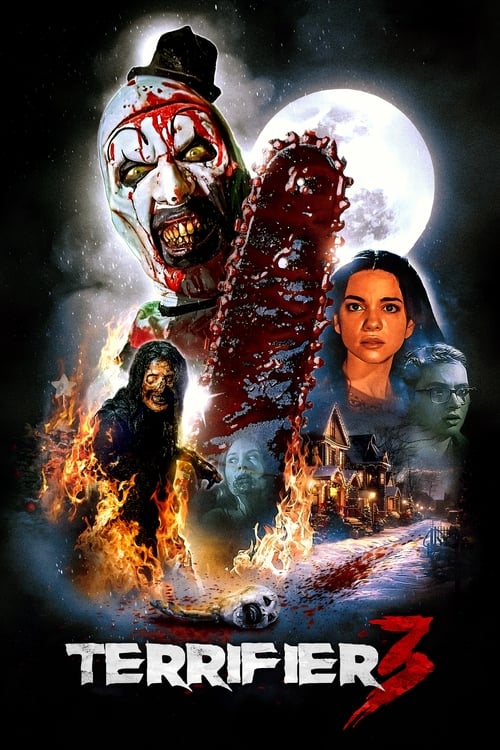
Terrifier 3
2024 · Damien Leone
Strictly for when you want to be pushed — the hardest-hitting gore currently in multiplexes, best with a strong stomach and ideally a game crowd. Absolutely not the pick for a casual or squeamish night.
What it's about
Five years after surviving a Halloween massacre, Sienna and her younger brother are trying to piece their lives back together as Christmas approaches — therapy, family, the fragile hope of a normal holiday. Then Art the Clown returns, dressed for the season, to tear that safety apart.
The experience
Punishing and gleefully transgressive — the gore is extreme, staged with a showman's timing, and the Christmas setting makes every violation land harder. Between the carnage there's a real thread of trauma and recovery, but make no mistake: this is an endurance test played partly for pitch-black laughs.
Performances
David Howard Thornton's Art is a genuine creation — an entirely silent, mime-trained performance that swings from vaudeville clowning to pure menace — and Lauren LaVera gives the series a wounded, determined heroine worth rooting for.
The craft
Damien Leone designs and executes much of the practical gore himself, and the handmade effects work is the film's calling card — elaborate, old-school, and unflinching. Relocating the mayhem to Christmas gives it a whole new visual language of desecrated coziness.
Why it matters
An industrial shock: a microbudget, unrated gore film that opened at number one at the box office ahead of a major studio tentpole — proof that extreme independent horror can win the mainstream on its own terms.
Snapshot
Terrifier 3 is the fourth screen appearance of Art the Clown and the third feature in Damien Leone's franchise, arriving in October 2024 as an unrated wide release from Cineverse and Iconic Events. It relocates the series from Halloween to Christmas, picks up Sienna Shaw (Lauren LaVera) and her brother Jonathan (Elliott Fullam) five years after the massacre of Terrifier 2, and stages Art's return as a desecration of the holiday's promise of safety and family enclosure. The film is significant less for any formal innovation than for what it demonstrated industrially: a microbudget regional gore film, refused a rating and marketed on its refusal, opened at number one at the North American box office ahead of a Warner Bros. tentpole (Joker: Folie à Deux), and was widely reported as the highest-grossing unrated release in the domestic market. It is the point at which the Terrifier project stopped being a cult curiosity and became a functioning franchise with a mainstream distribution footprint — and the point at which Art the Clown joined a very short list of slasher icons minted after 1990.
Industry & production
The series' industrial biography is more interesting than most of its contemporaries'. Art originated in Leone's short The 9th Circle (2008) and a 2011 short titled Terrifier, was folded into the anthology feature All Hallows' Eve (2013), and graduated to his own film with Terrifier (2016) — all made outside any studio system, on budgets that would not cover a single day of a mid-tier horror shoot. Terrifier 2 (2022) was financed with the help of a crowdfunding campaign and released theatrically in a limited unrated engagement that overperformed and then compounded on streaming, where Cineverse's horror ecosystem (the Bloody Disgusting site and the Screambox service, both under the same corporate roof) gave the film a promotional and distribution channel unavailable to comparable indies.
Terrifier 3 is the product of that vertical arrangement scaled up. Leone's longtime producer Phil Falcone and Fuzz on the Lens Productions remained the creative core; Cineverse took the film wide with Iconic Events, an event-cinema specialist, booking it into a screen count in the low thousands — extraordinary for a film with no MPA rating, which conventionally forecloses most national chains and virtually all broadcast advertising. Reported budgets for the film sit in the low single-digit millions; against that, the picture's opening weekend and worldwide gross (in the high teens and mid-tens of millions respectively, per trade reporting) made it one of the highest return-on-cost releases of 2024. Exact figures vary between sources and should be treated as approximate.
Two industrial choices deserve emphasis. First, the unrated release was strategic rather than incidental: refusal of a rating became the product claim, continuous with the viral reporting around Terrifier 2 of walkouts and physical distress in auditoriums. Second, the release date. A Christmas-set film opened in mid-October, keyed to Halloween demand and to Art's identity as a Halloween figure — an inversion that treats holiday iconography as interchangeable branding material, which is arguably the film's own thesis.
Technology
The Terrifier films are technologically conservative by design. Acquisition is digital and unremarkable; specific camera and lens packages for Terrifier 3 are not well documented in accessible technical sources, and it would be invention to assert them. What matters is the deliberate subordination of digital tools to prosthetic craft. Leone came to directing from makeup effects, and the franchise's signature — sustained, unblinking, anatomically detailed mutilation — is achieved with silicone, foam latex, gelatin, blood rigs, articulated dummies and puppeteered appliances. Digital work exists, but as cleanup: rig and wire removal, seam painting, blood augmentation, occasional stitching of practical elements. The camera is held on the effect rather than cutting around it, which is only possible because the effect is physically there.
This is a technological position with an argument inside it. Digital gore is weightless and infinitely revisable; a practical appliance is a real object in real light, on a schedule, with a limited number of takes. The series' extremity depends on the audience's tacit knowledge that something was actually built. The escalation from Terrifier to Terrifier 3 is largely an escalation in the scale and duration of buildable effects, funded by the larger budget: bigger set pieces, more full-body work, more time on screen per gag.
Technique
Cinematography
George Steuber, who shot the previous entries, returns, and the series' visual grammar holds: hard, motivated, often frontal light; frames that stay wide enough to keep the whole body in view; a camera that is usually locked or slowly deliberate rather than handheld. This is the crucial and counterintuitive choice. Most contemporary studio horror obscures — shallow focus, shuttered frame rates, cutting on impact, darkness as a censoring device. Terrifier's images are legible. Atrocity happens in bright, evenly lit, ordinary rooms, held in full view.
Terrifier 3 exploits Christmas as a lighting design. Practical sources — string lights, a tree, mall signage, a Santa's grotto — supply a saturated red-and-green palette that sits against Art's monochrome grease-paint and the black-and-white of his costume. The holiday's own visual language of warmth and abundance becomes the illumination for its violation. The mall sequences in particular use the flat, sourceless brightness of retail space to strip the violence of any gothic alibi.
Editing
Leone cuts his own films, and the editorial signature is temporal distension. Kill sequences are extended past the point of narrative function into duration as ordeal: the shot does not end when the information has been conveyed. The result is a tempo unlike the accelerated slasher — closer to the sustained cruelty of Italian gore cinema, or to the endurance structure of Maniac (1980), than to the punchy rhythms of the 1980s American cycle.
Against that, Leone cuts for comedy. Art is a silent-comedy construction, and much of the film's rhythm depends on reaction beats, sight gags and pantomime timing lifted more or less directly from the Chaplin–Keaton grammar. The tonal whiplash — a mime bit followed immediately by an unbroken shot of dismemberment — is achieved in the cut, and is the film's most distinctive formal effect. Structurally, Terrifier 3 front-loads its most notorious atrocity in a Christmas Eve home-invasion prologue (Santa suit, chainsaw, a tank of liquid nitrogen), then withholds, letting the middle stretch operate on dread and on the family melodrama the series has increasingly cultivated. At roughly two hours, it is shorter than Terrifier 2's sprawl but still long for the form.
Mise-en-scène / staging
The production design works by systematic inversion of holiday ritual: gift-wrapping as body disposal, the mall Santa's throne as a seat of judgment, tinsel and trees as dressing for slaughter, the burlap sack of tools as a grotesque toy bag. Art's costume — the black-and-white clown suit, now variously augmented with Santa red — reads as a single high-contrast graphic element the eye finds instantly in any frame, which is exactly what an icon's design must do. The domestic interiors are staged with deliberate blandness: suburban, cluttered, credible, so that the violence has ordinary furniture to happen on.
Sound
Art does not speak, and the sound design carries the burden that dialogue would otherwise absorb: breath, footfall, the wet foley of the effects work, and long passages of near-silence in which the audience is left with nothing to listen to but the act. Paul Wiley, composer on the previous films, returns, working a hybrid of synthesizer texture and orchestral gesture, and Terrifier 3 adds the obvious and effective device of the carol — sleigh bells, familiar melodic fragments, diegetic seasonal music — soured by context. The score's most useful function is tonal signposting: it tells you when the film is being funny, which the images alone often do not.
Performance
David Howard Thornton's Art is the reason the franchise exists. It is a physical-comedy performance in the strict sense — everything is conveyed through mime, posture, eyeline and gesture, with an expressive vocabulary that runs from coquettish to gleeful to bored. The character's horror derives from the mismatch between vaudeville charm and total moral vacancy; Thornton plays the charm sincerely, which is what makes it obscene.
Lauren LaVera's Sienna is the series' other real achievement, and the sequel's dramatic engine. Where the classical slasher discards its survivor between films, Terrifier commits to consequence: LaVera plays a young woman visibly damaged, medicated, unreliable to her own family, and the performance is pitched at a register of exhausted grief that the surrounding film does not obviously deserve. Elliott Fullam's Jonathan carries a parallel arc of fixation and complicity, and Samantha Scaffidi's Victoria — the disfigured survivor of the first film, now the conduit for the series' supernatural mythology — supplies its most abject and least stable presence.
Narrative & dramatic mode
Terrifier 3 completes the series' migration from abstraction to serial mythology. The 2016 film was almost plotless: a killer, a night, a set of rooms. Terrifier 2 introduced a demonic cosmology — Art as an instrument of something older, an accompanying spectral figure, and Sienna as an angelic warrior with an inherited sword — and Terrifier 3 proceeds on that footing, treating character continuity, prophecy and possession as load-bearing.
The dramatic mode is therefore double. On one axis it is a trauma sequel of the post-2018 kind — the mode of Halloween (2018) and Scream (2022), where the survivor's psychology and the family's damage become the subject and the killer's return is a relapse. On the other it is possession melodrama in the lineage of A Nightmare on Elm Street 3 or Hellraiser, where a mundane world is progressively colonized by an occult scheme. The film's willingness to be earnest about the second while being genuinely attentive to the first is unusual, and produces the tonal instability that critics have most often objected to: the same picture asks to be taken seriously as a study of grief and offers a chainsaw as a punchline.
Genre & cycle
Three cycles converge here. First, the slasher revival of the late 2010s and 2020s — Halloween (2018), the Scream relaunch, Ti West's X trilogy — which restored the form's theatrical viability. Second, the microbudget horror gold rush enabled by streaming demand and by public-domain IP, in which recognizable mascots are cheaper than stars. Third, and most specifically, the extreme-horror tradition: Herschell Gordon Lewis's carnival splatter, Tom Savini's effects work of the late 1970s and early 1980s, Lucio Fulci's anatomical fixations, William Lustig's Maniac (1980), and the shot-on-video and underground extremity that followed. Leone has been open about the Savini/Fulci inheritance, and the Terrifier films are best understood as an argument that this tradition can be made theatrical again rather than exiled to the margins.
The Christmas turn plants the film in a well-tilled subgenre: the Amicus Tales from the Crypt Santa episode (1972), Black Christmas (1974), Christmas Evil (1980), Silent Night, Deadly Night (1984) and its own censorship scandal, Gremlins (1984), Rare Exports (2010). And Art belongs to the evil-clown lineage that runs from the Poltergeist toy through Clownhouse (1989), Killer Klowns from Outer Space (1988), and both screen versions of It — a figure whose cultural charge in America is inseparable from the Gacy case.
Authorship & method
Leone is an unusually complete author: writer, director, editor and effects designer, working with a small repeating team — Steuber on camera, Wiley on score, Falcone producing, Thornton and LaVera as the ensemble's fixed points. That configuration explains the films' consistency and their limitations. Consistency, because the effects are conceived by the person who will shoot and cut them, so the set pieces are designed for the sustained take rather than assembled from coverage. Limitations, because there is no countervailing voice on structure, and the films sprawl.
His method is effects-first in a literal sense: the sequences are the units of conception, and narrative is built to deliver them and to survive between them. What has changed across the trilogy is the seriousness of that connective tissue. In Terrifier it was vestigial; in Terrifier 3 it carries genuine dramatic weight, which is the clearest evidence of Leone developing as a filmmaker rather than only as a technician. Detailed credits below the key creative line — production design, effects crew — are thinly documented in accessible sources.
Movement / national cinema
This is American regional independent horror, made in and around the New York–New Jersey corridor, and it belongs to a specific East Coast tradition: Romero's Pittsburgh operation, Lustig's and Frank Henenlotter's Times Square grindhouse films, Troma's Long Island economics. The defining characteristic of that tradition is not an aesthetic but a financing structure — outside the studios, outside the guild-heavy production centers, with craft labor doubling and effects made in-house. Terrifier 3 is the most commercially successful recent instance of it, and its success is a genuine data point about the collapsed middle of American theatrical distribution: with a mascot, a streaming platform's promotional apparatus and an event-cinema booker, a film made for the price of a studio marketing test can open wide.
Era / period
The film is precisely of its moment: a post-pandemic theatrical economy in which horror and event programming carry disproportionate weight; a cult-formation process that runs through streaming, Reddit, TikTok reaction video and physical-distress anecdote rather than repertory or video rental; and a market where an unrated gore film out-opening a $200-million-class studio sequel is legible as a news story about the studios' condition. The Terrifier films are also, unmistakably, artifacts of a merchandising logic — Art exists on masks, figures, apparel and Halloween racks in a way no new horror character had managed since Chucky.
Themes
The governing theme is desecration: the film takes the rituals that promise safety — the family home, the holiday, the child's expectation of a benign Santa — and demonstrates their non-protection. Christmas is chosen because it is the most heavily defended of those rituals. Beneath that sits a sustained interest in aftermath: the series' insistence, unusual for the form, that surviving is not resolution, that grief is disfiguring, and that a family can be destroyed a second time by what the first destruction left behind.
The occult framework supplies a Manichean scheme — a demonic instrument and a chosen defender — which the films play with surprising sincerity, giving the violence a metaphysical stake rather than a purely sensational one. And there is an unavoidable reflexive theme, whether or not Leone intends it: Art performs for the camera, mugs, awaits appreciation. The clown's audience is us, and the film's central transaction is the pleasure of watching, held long enough to become uncomfortable.
Reception, canon & influence
Critical reception was divided along predictable lines. Reviewers sympathetic to the tradition credited the improved craft, the scale of the practical effects, Thornton's performance and LaVera's commitment; hostile notices treated the film as an endurance test whose nihilism was its only content, and objected to the mismatch between the trauma drama and the set pieces. Aggregate critical scores were middling while audience response was strongly favorable — a gap that is itself characteristic of the extreme-horror niche, where the intended audience and the general critical constituency want incompatible things. Reported figures aside, the commercial story was unambiguous and widely covered: a number-one domestic opening over Joker: Folie à Deux, and status as the top-grossing unrated release in the North American market.
Influences on the film run backward through the channels sketched above: Savini and Fulci for the effects ethic, Maniac for the grubby duration of its cruelty, silent comedy for Art's body, the Christmas-slasher subgenre for the setting, and the 1980s franchise slashers for the icon-plus-mythology architecture. The recent trauma sequels supplied the survivor-centered dramatic template.
Forward influence must be stated carefully, because the film is barely two years old at the time of writing. What can be said: it confirmed a distribution model — streaming-nurtured cult property, unrated theatrical event release through a specialist booker, vertically integrated promotion — that other low-budget horror producers have visible incentive to imitate. It established Art the Clown as a durable commercial property, with a further entry announced and Leone having spoken publicly of a multi-film arc. And it functions as evidence in the ongoing argument about practical effects: a film whose entire commercial proposition rested on gore that audiences believed was physically made. Whether Terrifier 3 will look like a turning point or a well-timed anomaly is not yet answerable, and any confident claim about its long-term canonical position would be premature.
Reception
No reappraisal needed — it arrived a folk hero. After Terrifier 2 turned a crowdfunded gore flick into a phenomenon, part 3 opened as an actual mainstream event, and critics who'd dismissed the series gave it the franchise's best reviews.
How Terrifier 3 was received, from release to now →
How to watch Terrifier 3: what to notice on a first viewing
- Watch the Christmas lights and mall signs light every kill. Steuber shoots in bright, evenly lit, ordinary rooms using practical holiday sources, never hiding the violence in shadow. The brightness strips away any gothic excuse; you see everything, on purpose.
- Notice how long each kill shot runs past the obvious cut point. Leone holds on violence well past the point where the story needs it, stretching duration into an ordeal rather than cutting on impact. The length is the point; it turns watching itself into the test.
- Watch Art's gestures; he never once speaks. Thornton builds the character entirely through mime, posture, and eyeline, in a vaudeville-charm register lifted from silent comedy. The charm is played straight, which is what makes his moral vacancy so unsettling.
- Notice how the props turn holiday objects into tools. Gift wrap, the mall Santa's throne, and the burlap toy sack are staged as instruments, inverting the ritual meaning of each object. The desecration is built into the objects themselves, not just the acts done with them.
- Listen for carols playing under scenes that turn violent. Wiley's score folds sleigh bells and familiar holiday melodies into its synthesizer-and-orchestral base, souring them with context. The music tells you when to laugh, which the images alone will not.
The whole guide to watching Terrifier 3, with the keys for a rewatch →
Influences: the films it descends from and the films it influenced
- He Who Gets Slapped (1924) — Lon Chaney builds dread out of whiteface and pantomime alone, establishing the painted mute clown as an expressive instrument rather than a static mask — the exact register Thornton plays Art in.
- The Circus (1928) — Art's kill scenes are structured as silent-clown gags — the held look to camera, the anticipatory beat before the payoff, business improvised from props at hand — with atrocity substituted for the punchline.
- Black Christmas (1974) — Invented the grammar Leone inherits wholesale: carols and tinsel-lit interiors doing double duty as score and practical light source, with holiday decor supplying the in-frame sources for a stalking.
- Halloween (1978) — The silent, unblinking icon held in deep-focus stillness at the edge of the composition rather than cut around — the staging principle behind Steuber's wide, patient framings of Art.
- Dawn of the Dead (1978) — Savini's appliance work shot under flat, bright commercial light instead of concealed in shadow — the legibility ethic that lets Terrifier's gore read as physically manufactured.
- Maniac (1980) — Savini's in-camera shotgun head-burst plus the film's refusal to shorten a single victim's death establishes duration-as-cruelty: the sustained take rather than assembled coverage.
- The Beyond (1981) — Ocular and facial destruction held in unhurried close-up long past narrative function — the temporal distension Leone applies to his showpiece mutilations.
- The New York Ripper (1982) — Razor mutilation played in near real time with the camera declining to cut away, and a grotesque vocal signature as the killer's audio brand — the confrontational model behind the 'endurance test' charge against T3.
- Silent Night, Deadly Night (1984) — Killer in Santa costume performing the gift-giving ritual as murder, released on a controversy-forward ad campaign — both the staging inversion and the outrage-as-marketing model of T3's unrated theatrical push.
- A Nightmare on Elm Street 3: Dream Warriors (1987) — The franchise architecture Leone copies exactly: occult backstory accreted sequel by sequel around a performing icon, plus the original survivor returned as a damaged adult who must face him again.
- Evil Dead II (1987) — The whiplash cut from splatter to slapstick within a single sequence, licensing Art's mugging beat landing immediately after a mutilation without releasing the horror.
- All Hallows' Eve (2013) — Leone's origin text for Art: an anthology assembled backward from prosthetic set pieces, codifying the effects-first method where narrative exists only to deliver and survive between sequences.
- The Sadness (2021) — Works the same Fulci inheritance in the present tense — arterial practical effects staged in bright unglamorous light, taboo cruelty held on screen rather than implied or cut around.
- Hatchet (2006) — The prior indie attempt to manufacture a practical-effects slasher icon from scratch — masked heavy, in-camera prosthetic kills, franchise-building on a micro budget — the bet Leone actually cashed.
- Thanksgiving (2023) — Parallel holiday-inversion slasher: a masked icon staging kills as perverted enactments of the holiday's own rituals, built on practical prosthetics for a theatrical event release.
- In a Violent Nature (2024) — Pushes the same duration principle further — prosthetic kill set pieces played in long unbroken takes with a mute icon and near-scoreless foley, so the body-work is the event rather than the edit.
Similar films
- Terrifier 2 (2022) — influence & lineage · same viewing thread
- Black Christmas (1974) — influence & lineage
- Five Nights at Freddy's (2023) — same viewing thread
- Scream (2022) — same viewing thread
- Scream VI (2023) — same viewing thread
- Final Destination Bloodlines (2025) — same viewing thread
- X (2022) — same viewing thread
- The Black Phone (2022) — same viewing thread
All the films related to Terrifier 3 →
Watch it with: curated runs of related films
- Fresh Blood: 2020s Studio Horror — A run of the decade's mainstream fright machine — abduction shockers, franchise revivals, and one arthouse throwback — best watched back-to-back to feel how modern horror hunts its prey.