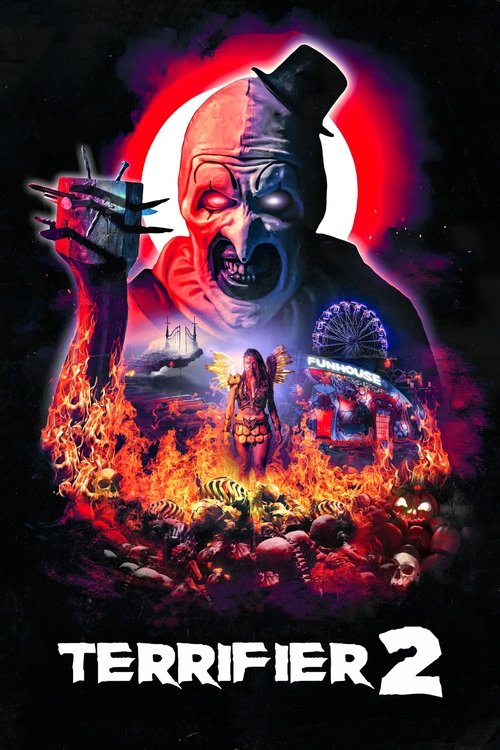
Terrifier 2
2022 · Damien Leone
Strictly for when you want to test your limits — the movie you dare your most hardened horror friends to finish. This is the opposite of a comfort watch; reports of walkouts and fainting were part of its legend, and they weren't entirely hype.
What it's about
A year after a small-town massacre, Art the Clown — a silent, grinning killer in grubby mime makeup — is resurrected by something sinister and comes home on Halloween night. His targets are a teenage girl named Sienna, who's been having strange dreams, and her horror-obsessed little brother; as the bodies pile up, the siblings start to realize Art is more than a man with a bag of knives.
The experience
An endurance test by design: long, unhurried, and staggeringly graphic, with kills that push practical gore further than almost anything in theatrical release. But it's also weirdly playful — Art is a silent-comedy performer with a butcher's tools — and there's a sincere heroic-fantasy streak running through the carnage.
Performances
David Howard Thornton's Art is a masterclass in silent menace — all mugging, mime, and gleeful pantomime, funnier and scarier for never speaking a word. Lauren LaVera gives the film a real emotional center as Sienna, a final girl played with full conviction.
The craft
Director Damien Leone is also the effects artist, and it shows: the film is built around extended, handmade practical-gore set pieces executed with obsessive craft on a crowdfunded budget in the low six figures. At 138 minutes and unrated, it refuses every commercial compromise, and the Halloween-night atmosphere is thick and lurid.
Why it matters
An indie splatter film that behaved like a studio release at the box office, it minted the first durable new horror icon in a generation and proved unrated, practical-effects extremity could be a theatrical event.
Snapshot
Terrifier 2 is the improbable center of gravity in twenty-first-century American splatter: a 138-minute, unrated, crowdfunded slasher that behaved in theaters like a studio release and produced the first genuinely durable new horror icon in a generation. Damien Leone's second feature built around Art the Clown expands a threadbare 2016 stalk-and-kill film into something stranger — a Halloween-night epic that grafts occult mythology, family melodrama, and a heroic-fantasy final girl onto a structure of extended, unhurried practical-effects atrocity. The film's reputation was made less by criticism than by circulation: reports of walkouts, vomiting, and fainting became the marketing, and a picture made for a reported budget in the low hundreds of thousands returned something on the order of fifteen million dollars worldwide. Its significance is threefold. It proved that an unrated, effects-driven horror film could still command theatrical exhibition in the streaming era; it established Art the Clown as a merchandisable, franchise-bearing figure alongside Myers, Voorhees, and Krueger; and it demonstrated that DIY regional horror, financed outside conventional channels, could reach a mass audience without softening a single frame.
Industry & production
The film is a product of the crowdfunding economy that reshaped low-budget genre production in the 2010s. Terrifier (2016) had been made for a famously tiny sum after an Indiegogo campaign; Terrifier 2 returned to the same platform and raised a budget an order of magnitude larger — still, by any industrial measure, microbudget. That money bought time and scale rather than gloss: more locations, a longer schedule, and above all the extended effects sequences that are the film's reason for existing. Production was delayed by the COVID-19 shutdowns and shot in the New York region where Leone has based the entire Art cycle, using a small crew and largely non-star cast, with a cameo by the wrestler Chris Jericho functioning as the film's one piece of recognizable casting.
Distribution is where Terrifier 2 becomes an industry story. Bloody Disgusting — the horror site — and Cinedigm, then owner of the Screambox streaming service, took it directly to theaters in October 2022 without submitting it to the MPA, releasing it unrated on several hundred screens and expanding through the month as demand built. Unrated theatrical horror had been effectively dead as a commercial proposition for decades; the assumption was that no rating meant no chains, no ads, no audience. The Screambox route inverted the logic: the audience was already assembled online, primed by the first film's cult afterlife on streaming, and the absence of a rating was the selling point rather than the obstacle. The viral accounts of physical audience distress — a phenomenon with a long lineage running from William Castle's nurses-in-the-lobby gimmicks through the ambulance stories around The Exorcist (1973) and the Toronto reports on Julia Ducournau's Raw (2016) — cost nothing and did more than any campaign could have. Whether every incident was real is beside the point; the discourse was the distribution.
The consequence was structural. The picture's returns validated a model — genre-native distributor, streaming-service backing, unrated theatrical, October window — that Cineverse (Cinedigm's successor) ran again with Terrifier 3 in 2024, which opened at number one domestically, an outcome without real precedent for an unrated independent slasher.
Technology
Nothing in Terrifier 2 is technologically novel; the interest lies in what cheap digital capture makes possible for a filmmaker whose real medium is latex. Digital acquisition allowed Leone the coverage and, crucially, the take length that a film-based budget of this size could never have afforded — the extended murders depend on being able to roll for a long time on a rigged body without the meter running. The gore itself is resolutely analog: silicone and foam appliances, articulated dummies, blood pumps, prosthetic torsos and heads. Leone came into filmmaking as a makeup effects artist and supervised the effects himself with a small team, and the film's entire aesthetic argument is that a physically present prosthetic being cut, torn, and doused in front of the lens carries a weight that digital augmentation cannot simulate. Where computer imagery appears, it is in service of concealment — rig removal, seams — rather than spectacle.
Two other technologies matter as much as the cameras: the crowdfunding platform, which functioned as this film's studio, and the social video ecosystem of reaction clips and reviews, which functioned as its distributor of attention.
Technique
Cinematography
George Steuber's photography is the least self-conscious element of the film and among its most effective. The visual scheme is high-contrast and gel-saturated — sodium oranges, sick greens, deep blacks that swallow the frame's edges — closer to the color logic of 1980s Italian horror than to the desaturated realism common in contemporary American indies. Camera movement is sparing. Steuber and Leone favor locked or slowly drifting wide and medium-wide setups that hold the whole body in frame during violence, refusing the fragmentary cutting that normally lets a slasher imply more than it shows. The frame becomes a proscenium: Art enters it, performs, and the camera declines to look away. Handheld appears mainly in pursuit, where the shift in texture registers as a change in register rather than a default style. The compositional signature — Art standing at the rear of a wide shot, small, still, grinning, while the victim occupies the foreground unaware — is inherited directly from Carpenter's Halloween and used relentlessly.
Editing
Leone cuts his own films, and the editing is the most contested aspect of Terrifier 2. At 138 minutes it is roughly the length of two conventional slashers, and the picture's rhythm is deliberately anti-economical: set pieces are permitted to run far past the point where the genre's grammar would call for release. The notorious bedroom sequence — the mutilation of Sienna's friend Allie (Casey Hartnett) — is the extreme case, sustained at a duration that converts shock into endurance and comedy into something more difficult. This is a real aesthetic strategy, and it is also the source of the film's structural slackness: the connective material between atrocities is loose, the family scenes are longer than their dramatic content supports, and the mythological exposition arrives in lumps. Critics who admired the film's audacity and critics who found it bloated were, largely, describing the same editorial choice.
Mise-en-scène / staging
The film's staging is theatrical in the literal sense. Art the Clown is designed as a silent-cinema figure — monochrome greasepaint, tiny hat, pierrot silhouette — and Leone stages him accordingly, giving him space and time to work a bit. Murders are constructed as routines with setups, escalations, and punchlines; the clown props (the plastic bag of tools, the toy horn, the trash bag) are the props of a vaudeville act repurposed. Halloween itself supplies the mise-en-scène's alibi: costumes, masks, and decorations make the monstrous ambient, so that Art can move through carnival, arcade, diner, and suburban house without anyone reading him as a threat until it is too late. Against this, Sienna's homemade winged warrior costume — designed by her late father, later revealed as literal armament — is the one visual element in the film that is genuinely, unironically beautiful, and its function is to give the picture a countervailing image to set against the clown's.
Sound
Art never speaks, which throws enormous load onto sound design. His presence is built from percussive specifics — footsteps, the squeak of a prop, the wet mechanics of the effects work — and from the pointed absence of vocalization where a genre audience expects a growl or a breath. Paul Wiley's score works in two modes: an unsettled synth-and-string atmosphere for the stalking material, and broader, almost heroic-fantasy gestures for Sienna's arc, a scoring decision that is inseparable from the film's genre migration. The Clown Café dream sequence flips into bright, ersatz-commercial pastiche, and the tonal whiplash is the point — the film keeps insisting that what you are watching is, in some register, an entertainment act.
Performance
David Howard Thornton's Art is the reason the franchise exists. Working entirely in mime — no dialogue, no vocal sound — Thornton builds the character out of pantomime vocabulary: exaggerated double-takes, coy waves, delighted shoulder-shrugs, a grin held past the point of comfort. The performance is genuinely funny, and its comedy is what makes the violence unbearable rather than merely disgusting; the audience is placed in the position of laughing with a performer and then being implicated in what the performer does. Thornton took over the role from Mike Giannelli, who originated Art in Leone's earlier shorts and the anthology All Hallows' Eve (2013), and the character's shift toward broad, playful malevolence dates from that recasting.
Lauren LaVera's Sienna is the film's other necessary performance and its clearest advance over the 2016 picture, whose survivor was largely a body to be brutalized. LaVera plays grief and exhaustion first and heroism late, and her physical commitment in the final act sells a tonal shift — slasher into dark fantasy — that on the page reads as unearned. Elliott Fullam's Jonathan supplies the film's uneasy internal commentary as a boy fascinated by the massacre; Samantha Scaffidi returns as Victoria Heyes, the first film's disfigured survivor, carrying the series' continuity of consequence.
Narrative & dramatic mode
Structurally the film is episodic — a chain of set pieces strung along Halloween night — but Leone braids two unfamiliar strands into the slasher spine. The first is domestic melodrama: the Shaw family is defined by the recent death of the father, and the mother-daughter friction, the sibling bond, and the inherited sketchbook of drawings are played straight, at length, without genre irony. The second is occult mythology. Art's resurrection by an unexplained entity, the Little Pale Girl who accompanies him as a doubled child-familiar, and the eventual revelation that Sienna's costume and sword are a genuine inheritance of power move the film out of the slasher's secular, motiveless-evil framework and into something closer to a fantasy of good against evil.
This is a significant generic gamble. The classical slasher derives dread precisely from the killer's meaninglessness; explaining Art risks domesticating him. Leone hedges by explaining almost nothing — the entity is never named or theorized — so the mythology functions as atmosphere and franchise architecture rather than as answer. The dramatic mode that results is unstable by design: broad comedy, family drama, gross-out endurance test, and heroic fantasy alternate rather than blend, and the film's most divisive quality is its refusal to settle into any one of them.
Genre & cycle
Terrifier 2 sits inside the 2010s–2020s slasher revival — the Blumhouse Halloween trilogy, the legacy Scream films, Ti West's X — but occupies its most disreputable corner. Where the revival's mainstream wing is knowing, metafictional, and rated for wide release, Leone's film belongs to the splatter tradition proper: Herschell Gordon Lewis's frank exhibitionism, Lucio Fulci's set-piece atrocities, Tom Savini's effects showcases in Friday the 13th (1980) and William Lustig's Maniac (1980), and the video-era direct-to-tape economy in which gore was the product rather than a consequence of the story. It also inherits from the 2000s "torture" cycle of Saw and Hostel, and stands adjacent to New French Extremity's Martyrs and Inside in duration and severity — though Leone's tone is jokey and showmanlike where the French films are austere and punishing, a difference that accounts for much of the critical divide over whether Terrifier 2's violence is transgressive or merely appetitive.
Authorship & method
Leone is a total-authorship figure of a kind that only microbudget production still permits: writer, director, editor, and effects supervisor on the same film. The lineage is Raimi and Peter Jackson in their DIY splatter phase, or Frank Henenlotter in New York — filmmakers whose craft grew out of the practical trickery rather than the other way round. The method has visible costs (the screenwriting and the pacing are the weakest links precisely because no one else is editing Leone's script or Leone's cut) and visible benefits (the effects sequences are conceived, shot, and cut by the person who built them, which is why they hold on screen for so long without collapsing).
The core collaborators are few and consistent across the cycle: cinematographer George Steuber, who has shot the Art features and supplies the color-forward, patient framing; composer Paul Wiley, who gives the second and third films a scale the first lacked; and Thornton, whose performance is co-authorial in the sense that the character's comic vocabulary belongs to him. Beyond interviews and genre-press coverage, the documentary record on this production is thin — there is no substantial archive of production materials, and specific technical credits below the line are less thoroughly reported than they would be for a studio picture. Claims about the film's making should be treated accordingly.
Movement / national cinema
The film belongs to American regional independent horror, and specifically to the Northeastern strain that runs from Romero's Pittsburgh through Craven's and Lustig's New York and Henenlotter's Times Square — filmmaking made outside the industry, in the maker's own geography, with the local landscape (suburban houses, arcades, diners, motel rooms) standing in for anywhere. What distinguishes the current iteration from its 1970s ancestor is finance: where Romero assembled investors and Henenlotter scraped, Leone raised money from the audience directly, which meant the audience's expectations were built into the film before a frame was shot. The crowdfunded feature is arguably a movement of its own, and Terrifier 2 is its most commercially consequential example.
Era / period
The film arrives at a precise moment: the post-pandemic theatrical market, in which horror was the genre most reliably capable of moving audiences back into cinemas, and in which the collapse of the mid-budget release left exhibition polarized between franchise tentpoles and small genre plays. It also arrives after a decade in which streaming services — Shudder, Screambox — cultivated a horror audience that identified itself as a community rather than a market segment. Terrifier 2 converted that community into ticket buyers. Its virality depended on the reaction-video economy of TikTok and YouTube, where the physical response to the film became the content; the extremity was not incidental to its distribution but the mechanism of it.
Themes
Grief and inheritance run under everything: the father's death and the drawings he left behind are the source of Sienna's costume, her weapon, and her eventual survival, making the film's fantasy climax an image of a parent's love armoring a child. Against that, Art embodies evil as pure performance — cruelty without motive, ideology, or explanation, executed with the timing and self-delight of a comedian. The pairing is the film's real subject: two kinds of creativity, one that makes and one that unmakes.
The film is also, uncomfortably and probably knowingly, about spectatorship. Jonathan's fascination with the massacre mirrors the audience's; the Clown Café sequence turns Art into a mascot; the murders are staged as acts for a viewer. Whether Terrifier 2 critiques the appetite it serves or simply serves it is the honest crux of the debate around it, and the film does not resolve it. The related charge — that the violence falls with particular relish on young women — has substance, and the strongest counterargument is not that the film is innocent but that Sienna is granted a degree of agency, interiority, and physical authorship that the first film's survivor was denied entirely.
Reception, canon & influence
Critical reception was mixed-to-favorable and unusually split along an axis of tolerance rather than quality judgment. Consensus praise settled on Thornton, on LaVera, and on the sheer conviction of the practical effects; consensus criticism settled on the runtime, the loose script, and the extremity of the bedroom sequence. Several critics who admired the film said so while noting they could not recommend it, which is itself a marker of how far outside normal circulation it sat. Audience response, measured by returns and by the film's cultural footprint, was far warmer than the reviews.
Looking backward, the film's debts are legible and mostly unhidden: Carpenter's Halloween for the silent stalker and the holiday setting; Craven's Freddy Krueger for the personality-forward killer whose showmanship makes him marketable; Fulci and the giallo tradition for color and for the primacy of the atrocity set piece; Savini and Lustig for the specific pleasures of prosthetic dismemberment; the silent-cinema clown and Grand Guignol for Art's design and pantomime. The Little Pale Girl draws on a deep well of uncanny-child imagery without citing any single source.
Looking forward, the influence is already measurable. Terrifier 2 made Art the Clown a mainstream Halloween figure — costumes, merchandise, convention presence — the first horror character in decades to achieve that saturation from an independent origin. It re-legitimized the unrated theatrical release as a commercial strategy and gave Cineverse a template it executed at greater scale with Terrifier 3 (2024), whose number-one domestic opening is the clearest evidence of what the second film built. It has encouraged a wave of practical-effects-forward independent horror pitched at the same audience, and it has strengthened the argument, made repeatedly since the 1970s and repeatedly forgotten, that the horror audience will travel for something it cannot see anywhere else. Whether the film is good is a question critics will keep arguing. That it changed what a microbudget slasher could plausibly attempt is no longer in dispute.
Reception
Dropped into theaters unrated in October 2022 as a crowdfunded indie and became the sleeper phenomenon of the year, riding viral reports of fainting moviegoers to a multi-million-dollar run on a shoestring budget. Critics stayed lukewarm, but it's since been canonized by horror fans as the film that turned Art the Clown into a bona fide modern slasher icon.
How Terrifier 2 was received, from release to now →
How to watch Terrifier 2: what to notice on a first viewing
- Notice the sodium orange and sick green lighting. Steuber's high-contrast color scheme runs to saturated oranges and greens with deep blacks, closer to 1980s Italian horror than typical American indie naturalism. The color alone tells you this isn't aiming for naturalism; it's building a heightened, theatrical nightmare.
- Notice the camera rarely moves during a kill. Steuber and Leone favor locked or slowly drifting wide shots that hold the whole body in frame, refusing the fragmentary cutting most slashers use. The steadiness is a dare; the film wants you to see the whole thing rather than infer it from pieces.
- Watch Art communicate entirely without speaking. Thornton builds the character from exaggerated double-takes, waves, and held grins, mime vocabulary rather than any dialogue or vocal sound. The performance is genuinely comic, which is what makes what follows so much harder to simply enjoy.
- Notice Art standing small and still at the back of a shot. The compositional signature places him at the rear of a wide frame, grinning, while an unaware victim occupies the foreground. You often see the threat before any character does, turning the frame itself into the source of dread.
- Listen for footsteps and prop squeaks instead of any growl. Art never speaks or vocalizes, so his presence is built entirely from percussive footsteps, prop noises, and the deliberate absence of the sounds this genre usually supplies. The quiet makes him feel less like a man and more like something the film refuses to explain.
The whole guide to watching Terrifier 2, with the keys for a rewatch →
Influences: the films it descends from and the films it influenced
- The Man Who Laughs (1928) — Conrad Veidt's surgically fixed rictus — a horror face that cannot stop grinning, forcing the performance into eyes, hands and spine — is the direct design and pantomime template for Thornton's mute, greasepainted Art.
- Halloween (1978) — Dean Cundey's static anamorphic wides let the killer resolve out of the deep background with no cut and no music sting; Leone and George Steuber reuse that lurking-in-frame composition wholesale, along with the single-Halloween-night episodic spine.
- Suspiria (1977) — Luciano Tovoli's hard primary gels keyed to no diegetic source establish color as authored rather than motivated — the logic behind Steuber's magenta and cyan washes over the carnival and the laundromat.
- The Beyond (1981) — Fulci privileges the atrocity set piece over narrative coherence, running a killing far past its plot function and hanging an occult-gateway cosmology (the Book of Eibon) off it; the bedroom sequence's duration and the film's amulet mythology are both Fulci arithmetic.
- Dawn of the Dead (1978) — Savini's on-camera prosthetic set pieces combined with Romero's refusal to trim for a rating — the unrated theatrical release as commercial strategy rather than compromise, the exact template Terrifier 2 revived.
- Maniac (1980) — Savini's appliance gags (his own shotgun head-burst) shot in unblinking medium-wide with no cutaway, produced under grimy regional New York economics — the specific pleasure of prosthetic dismemberment held long enough to be inspected.
- A Nightmare on Elm Street (1984) — Freddy turns the killer into a performer who plays to the victim and the lens, staging kills as authored bits rather than functional beats; Art is that marketable personality-forward showman with the dialogue subtracted.
- Phantasm (1979) — Coscarelli built a cosmology retroactively across sequels out of a first film that explained nothing — the same sequel-as-mythology-engine that produces the Little Pale Girl and the amulet apparatus here.
- The Evil Dead (1981) — Raimi as writer, director and improvising effects builder on a self-financed regional shoot: total authorship where the practical trick dictates the scene rather than the script dictating the trick — Leone's precise working method.
- Basket Case (1982) — Henenlotter's grindhouse economics — homemade latex, deliberately visible seams, grotesquerie played for laughs — establish the tonal register in which a kill can be funny and appalling in the same shot.
- Killer Klowns from Outer Space (1988) — The Chiodos derive each kill from circus-routine logic — popcorn, balloon animals, shadow puppetry supply the mechanism — which is exactly how Art's garbage-bag, wig and hacksaw bits are constructed: gag first, murder second.
- Braindead (1992) — Jackson's escalation calculus, in which every practical gore gag must exceed the last in sheer volume until excess tips into comedy, governs Terrifier 2's climb from the diner to the bedroom.
- Terrifier 3 (2024) — Same authorship stack scaled up — Steuber's gelled wides, Paul Wiley's synth-orchestral scoring, holiday swapped Halloween-for-Christmas — released wide and unrated on the distribution model the second film proved viable.
- In a Violent Nature (2024) — Nash builds an entire slasher from static and trailing wide shots that keep the killer in frame without score, then halts for one enormously extended practical-effects kill — the Terrifier grammar of duration and unbroken framing pushed to formal extremity.
- Trick 'r Treat (2007) — Interlocking single-Halloween-night episodes anchored by Sam, a silent burlap mascot designed as merchandisable icon before he is designed as a character — the same structure-plus-mascot engineering Leone runs on Art.
- The Sadness (2021) — Contemporary microbudget splatter that makes prosthetic atrocity the entire selling proposition and goes out unrated to a genre audience willing to travel for footage unavailable elsewhere.
- Evil Dead Burn (2026) — Practical body-horror brutality taken so far it becomes the film's identity and divides audiences (walkouts, B-grade splits) — the 'sheer brutality limits its appeal' reservation shared with Burn.
- Saw X (2023) — Carries the practical-effects, in-camera-mutilation banner of torture-horror into the 2020s, sharing Saw X's commitment to tactile prosthetic gore over CGI.
Similar films
- Terrifier 3 (2024) — influence & lineage · same viewing thread
- Trick 'r Treat (2007) — influence & lineage
- Halloween (1978) — influence & lineage
- Scream (2022) — same viewing thread
- The Black Phone (2022) — same viewing thread
- Scream VI (2023) — same viewing thread
- Five Nights at Freddy's (2023) — same viewing thread
- Sinners (2025) — same viewing thread
All the films related to Terrifier 2 →
Watch it with: curated runs of related films
- Fresh Blood: 2020s Studio Horror — A run of the decade's mainstream fright machine — abduction shockers, franchise revivals, and one arthouse throwback — best watched back-to-back to feel how modern horror hunts its prey.