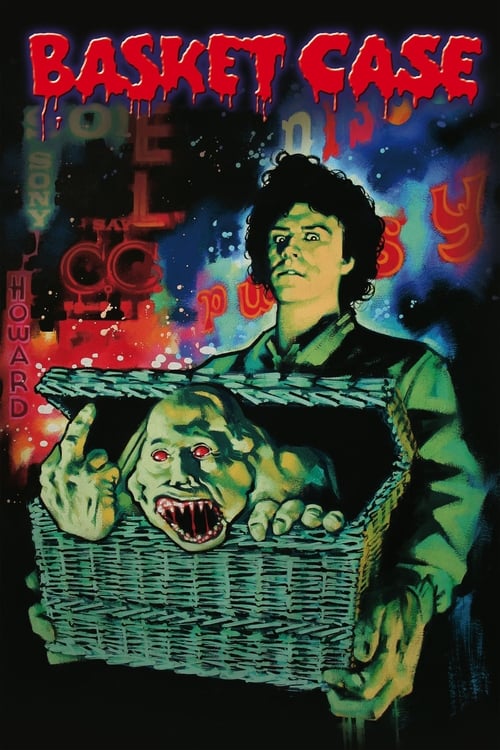
Basket Case
1982 · Frank Henenlotter
For a midnight-movie mood: when you want something outrageous, funny, and handmade with friends and maybe a drink. Trash-cinema comfort food with a surprising emotional kick.
What it's about
Duane, a polite young man from upstate New York, checks into a flophouse off Times Square carrying a large wicker basket. Inside is Belial, his deformed, formerly conjoined twin — a clawed, telepathic lump of rage — and the brothers have come to the city to take revenge on the doctors who separated them. Then Duane meets a girl, and the bond between the twins starts to strain.
The experience
Grimy, gleeful, and weirdly touching — it swings between splattery monster mayhem, deadpan comedy, and a genuinely sad story about brothers who can't let each other go. The cheapness is part of the charm; it feels like a transmission from a vanished, sleazier New York.
The craft
Shot on 16mm in and around the real Times Square grindhouse district, it doubles as a time capsule of that world. Belial is realized through puppetry and stop-motion whose jerky crudeness somehow makes him more unnerving — and more endearing.
Why it matters
A defining 1980s midnight movie that launched Frank Henenlotter's career and became a touchstone of New York's low-budget splatter scene, spawning two sequels.
Snapshot
Basket Case is a micro-budget horror comedy shot on 16mm in and around Times Square, and it became one of the defining midnight movies of the 1980s. Duane Bradley (Kevin Van Hentenryck), a polite young man from upstate New York, checks into the run-down Hotel Broslin carrying a large wicker basket. Inside is Belial, his formerly conjoined twin: a lumpy, fleshy mass with a face, clawed arms and no legs. The two share a telepathic bond, and they have come to the city to find and kill the doctors who separated them against their will. What starts as a revenge story turns into a story about jealousy. Duane's tentative romance with a receptionist, Sharon, threatens the twins' bond, and the film ends with the brothers destroying each other.
The film was Frank Henenlotter's feature debut, and it set out the concerns of his whole career. He treats the body as a source of both comedy and grief. He has a real fondness for the outcasts and hustlers of 42nd Street. And he makes grindhouse sleaze with a sincerity that earns the film its moments of pathos. Its crudeness is part of its identity, and over the decades it has moved from cult curiosity to recognised artefact. In 2017 the Museum of Modern Art restored it, which shows how far its reputation has come.
Industry & production
Basket Case was made entirely outside the industry. Henenlotter was a New York exploitation-film enthusiast with no studio connections. He wrote the film and raised money through producer Edgar Ievins, and the budget is commonly reported at about $35,000, a tiny sum even by the standards of early-1980s independent horror. The shoot was spread out and opportunistic. Much of it was filmed guerrilla-style on Manhattan streets, in cheap interiors standing in for the Broslin, and in borrowed locations. A cast of mostly non-professional or first-time screen actors worked for very little.
The film was handled by Analysis Film Releasing. Accounts of the early release say the distributor at first trimmed some of the gore for wider play, and that the film did better once the full version was reinstated and sold to the midnight circuit, where its reputation grew. The exact details of these cuts are not consistently documented. What is well documented is that its long life came from repertory and midnight screenings, and then from home video, more than from a conventional first run. Its advertising carried a line attributed to critic Rex Reed calling it "the sickest movie ever made," and that tagline became inseparable from the film's identity. Reliable box-office figures are not available.
The film's success led to two sequels directed by Henenlotter, Basket Case 2 (1990) and Basket Case 3: The Progeny (1991–92). Both had larger budgets and moved toward broader comedy.
Technology
The film was shot on 16mm and later blown up for theatrical exhibition. The grain, soft focus and colour drift of that process are central to how it looks. Lighting is basic, and night exteriors often depend on whatever neon and sodium light Times Square offered. These limits give the film an almost documentary record of 42nd Street just before its late-1980s and 1990s redevelopment.
Belial was made with practical effects of the cheapest kind:
- The puppet. For close-ups and attack scenes he is mostly a hand puppet or rubber prop, operated from below or off-frame.
- The arm. A separate "Belial arm" was used for inserts of clawing hands.
- Stop-motion. In one notable sequence Belial rampages around the hotel room in stop-motion animation. Its jerky, hand-made quality stands out from the rest of the film, and admirers and critics often single it out as both the film's most charming and its most self-evidently cheap moment.
- Gore. Makeup effects are blood-heavy and simple: slashed faces, a man cut in half by a saw in a flashback, and a victim pushed face-first into a drawer of scalpels.
The 2017 restoration, overseen with MoMA's involvement and drawing on the original 16mm materials, gave the film a new clarity. It was released on home video with Henenlotter's participation.
Technique
Cinematography
Bruce Torbet's camerawork is mostly functional: handheld or locked-off, with framing driven by budget and by the need to hide the puppet's limits. Its most lasting value is the street footage. Duane walking the blocks around 42nd Street past marquees, peep shows and loiterers is now often cited as some of the more vivid fiction-film documentation of that strip in the early 1980s. Inside the Broslin the camera favours tight, cramped compositions that make the hotel feel like a warren. Belial is often shown in fragments, such as a hand emerging from the basket or eyes glinting in the dark, partly to suggest menace and partly because a full view would show the prop's rigidity.
Editing
The film is cut for comic and shock rhythm more than for suspense. Henenlotter often holds a reaction a beat too long, letting the actors' bewilderment turn grotesque situations funny. The structure relies on an extended flashback, told by Duane to Sharon's niece's friend... more precisely, confided in a drunken late-night conversation, that lays out the twins' childhood: their mother's death, their father's revulsion, the kitchen-table surgery and Belial's first revenge. That central flashback reorganises the film's sympathies. Detailed, authoritative credit information on who handled the editing is not consistently reported across sources, and I will not assert it here.
Mise-en-scène / staging
The Hotel Broslin is the film's key set. Its peeling walls, shared bathrooms and eccentric residents (the hotel manager, a good-hearted prostitute named Casey played by Beverly Bonner, various hard-luck tenants) build a social world of marginal people. In that world a man with a strange basket is barely noticed. Henenlotter stages violence as broad set pieces: shrieking victims, sprays of blood, Belial's growling attacks. The doctors' offices and homes, by contrast, look drab and middle-class, which sets the respectable world against the Broslin. The climax uses the building's exterior: the twins fall from the hotel window and hang briefly from a sign before dropping to the street, an image that has become one of the film's emblems.
Sound
The sound is dense with location ambience, and much of it is post-dubbed in the rough way typical of low-budget 16mm production. Belial has no speech. He communicates through shrieks, grunts and growls, and through Duane's telepathic "hearing," which is conveyed by the actor's reactions and occasional voiceover rather than by elaborate sound design. Gus Russo's score is modest and synth-inflected, swinging between ominous drones and cues that underline the comedy.
Performance
Kevin Van Hentenryck's performance holds the film together. His Duane is wide-eyed, gentle and unsure of himself, an innocent swamped by the city and by his brother's demands. That innocence keeps the audience on his side even as the bodies pile up. Terri Susan Smith's Sharon plays the romance with a breathy, almost parodic sweetness. Beverly Bonner's Casey is warm, brassy and sympathetic, and Bonner returned to the role in the sequels. The doctors are played broadly, as smug or cowardly figures of an indifferent medical establishment. Belial, a puppet, still registers as a character: jealous, lonely and furious. Much of the film's emotional effect depends on the audience coming to see him that way.
Narrative & dramatic mode
The narrative runs in two strands. One is a revenge procedural: Duane and Belial work through a list of the physicians (Drs. Lifflander, Needleman and Kutter) who took part in the separation surgery. The other is a coming-of-age and romantic story in which Duane's attraction to Sharon and his hesitant step toward independence set off Belial's jealousy.
The dramatic mode is a hybrid of gross-out comedy, exploitation shock and a strain of real melancholy. The flashback shows that Belial was cast aside from birth, blamed by the father for the mother's death and "discarded" after the surgery. It frames the twins as victims long before they are killers. In a notorious scene, Belial, sensing Duane's arousal, goes to Sharon's apartment and assaults her, and the film presents this as a horrifying expression of the twins' fused psyche. The tragic ending follows: the two cannot exist together in Duane's new life, and they cannot survive apart.
Genre & cycle
Basket Case belongs to the low-budget horror boom of the late 1970s and early 1980s, which followed Night of the Living Dead (1968), The Texas Chain Saw Massacre (1974) and the success of Halloween (1978). It does not fit neatly into the dominant slasher cycle. Its killer is a sympathetic monster and its tone is openly comic, which puts it closer to the "splatter comedy" developing at the same moment. The Evil Dead (1981) belongs to the same moment, and Peter Jackson's and Stuart Gordon's later work extends it.
It is also a "body horror" film in the broad sense. Like David Cronenberg's films of the period, it is concerned with deformity, surgery and the fusion of bodies, but its register is far more populist and cartoonish. It fits a long tradition of twin-horror films, among them Sisters (1972) and Dead Ringers (1988), and it stands as a key title in the midnight-movie canon and the 1980s home-video horror market.
Authorship & method
Frank Henenlotter wrote, directed and (per most accounts) edited the film. He was a 42nd Street habitué and collector of exploitation films, and his authorship is unusually consistent. Brain Damage (1988) deals with addiction through a parasitic creature. Frankenhooker (1990) mixes Frankenstein with the Times Square sex trade. Bad Biology (2008) returns to sexual body horror. Across all of them run grotesque bodies, wry humour, sympathy for the marginal and a love of New York's sleazier corners. His method is to make the most of very little: practical effects, real locations and a tone that lets amateur production values read as stylistic choices.
Henenlotter has also been closely tied to film preservation, especially through his long work with Something Weird Video on recovering and releasing obscure exploitation films. He co-directed documentaries on the field, including Herschell Gordon Lewis: The Godfather of Gore (2010) and That's Sexploitation! (2013). That archival work is part of his authorial identity: he is a curator of the tradition he works in.
Key collaborators:
- Edgar Ievins, producer, who made the production possible and continued to work with Henenlotter.
- Bruce Torbet, cinematographer, responsible for the film's raw 16mm look and street photography.
- Gus Russo, composer.
- Kevin Van Hentenryck, whose performance is central to the film and who played Duane again in both sequels.
The makeup and creature effects were the work of a small crew. Credit attributions vary between sources, and I won't name individuals here with confidence.
Movement / national cinema
The film belongs to American independent and exploitation cinema, and specifically to New York's underground and grindhouse culture of the 1970s and early 1980s. It shares the city's do-it-yourself ethos with other New York low-budget filmmakers of the period: Larry Cohen's guerrilla-shot genre films, the "No Wave" underground, and the scrappy horror produced for the 42nd Street circuit. In 1985, Troma's The Toxic Avenger would bring a similar spirit of grotesque comedy to the region. Basket Case is often read as a film made by and about the Times Square subculture that consumed such films.
Era / period
The film is a record of New York at its post-fiscal-crisis low point: the decaying, dangerous and lively Times Square of grindhouse theatres, sex shops and cheap hotels, before the cleanup of the 1990s. Its early-1980s horror context included the home-video boom, the cultural visibility of splatter, and in Britain the "video nasties" moral panic, though the film's own censorship history there should not be overstated without a source. The period's anxieties about the body, medical authority and urban decay all find an outlet in the film, though in a register of black comedy rather than earnest allegory.
Themes
- Separation and identity. The surgery that separated the twins physically could not separate them psychically. The film asks whether Duane can become his own person, and answers that he cannot without destroying both himself and his brother.
- The body and deformity. Belial is monstrous, but the film locates the true cruelty in those who reject him: the father, the doctors, the respectable world. In this it follows Tod Browning's Freaks (1932), which views the "normal" with suspicion and the "freak" with sympathy.
- Medical authority. The doctors are self-interested, careless and complicit in an act of violence presented as treatment. The revenge plot partly works as a grotesque fable about bodily autonomy and consent.
- Sexuality and jealousy. The twins' telepathic bond makes Duane's desire into Belial's experience, with disturbing results. The film makes the fear of intimacy and of losing a companion literal.
- The city as refuge and trap. Times Square shelters the outcasts and finally kills them. The Broslin's lodgers form a makeshift community of the marginal, and the twins briefly find a place among them.
- Comedy and grief. The film's mix of slapstick gore and real sorrow is itself thematic: the absurd and the tragic are hard to tell apart.
Reception, canon & influence
Critical reception. On release the film got little serious critical attention outside genre circles, and many mainstream reviewers dismissed it as crude exploitation. The Rex Reed line used in its advertising ("the sickest movie ever made") is the best-known contemporary response, and it became a badge of honour on the midnight circuit. Over time critical opinion has risen considerably. The film is now regularly praised for its sincerity, its humour, Van Hentenryck's performance and its value as a document of old Times Square. The 2017 MoMA restoration marked its full canonisation as a cult and archival object.
Influences on the film (backward). These include:
- Tod Browning's Freaks (1932), for its sympathy toward the deformed.
- Herschell Gordon Lewis's splatter films, for unashamed gore on a tiny budget.
- Night of the Living Dead and the 1970s independent horror boom, for the regional, self-financed model.
- Larry Cohen's It's Alive (1974), for the monstrous offspring as an object of sympathy.
- Brian De Palma's Sisters (1972), for separated conjoined twins.
- The wider 42nd Street exploitation repertoire Henenlotter grew up watching.
Legacy (forward). Basket Case helped establish the template for 1980s horror-comedy splatter: sympathetic monsters, practical-effects grotesquerie and knowing humour. It anticipates films like Re-Animator (1985), The Toxic Avenger (1984), Peter Jackson's Bad Taste (1987) and Braindead (1992), and the wider Troma-style aesthetic, though direct influence on specific filmmakers is better described as a shared climate than a documented lineage. It launched Henenlotter's career and its two sequels, and it remains a reference point for micro-budget filmmakers who want to show that ingenuity and sincerity can outweigh resources. For a film archive or atlas, it is a node connecting classical "freak" cinema, grindhouse splatter, New York underground culture and the later cult-video canon.
Influences: the films it descends from and the films it influenced
- Freaks (1932) — Gives the deformed body the film's moral centre and turns its 'monster' into the agent of revenge against 'normal' tormentors, the same reversal Belial carries out against the doctors who separated him.
- King Kong (1933) — Its stop-motion rampage, a frame-by-frame armature creature breaking out of captivity, is the model for Belial's stop-motion tantrum in the hotel room, where the poor match with the live-action footage becomes part of the creature's strangeness.
- Blood Feast (1963) — Set the splatter template of lingering close-ups of crude prosthetic gore as the selling point of a near-zero-budget film; Henenlotter later co-directed a documentary about Lewis.
- The Brain That Wouldn't Die (1962) — A misused surgical body kept hidden (a head in a pan, a mutant in a closet) and shown only through glimpses and sounds from behind a door, the fragmentary-offscreen method of the basket's lid.
- Sisters (1972) — Builds its plot around the surgical separation of conjoined twins, with a murderous 'other' twin and a flashback that reveals the operation, the same structure as Basket Case's extended separation flashback.
- It's Alive (1974) — Keeps Rick Baker's monster-infant puppet almost entirely offscreen, shown in quick inserts and claw shots, and asks for sympathy for monstrous kin, the fragmentary-puppet grammar Henenlotter used for Belial.
- Eraserhead (1977) — A self-built animatronic deformed 'child' kept in a squalid single room, its fussing and feeding staged as domestic burden, a direct model for the Duane–Belial dynamic in the Hotel Broslin.
- The Toxic Avenger (1984) — Makes the Basket Case formula (sympathetic deformed avenger, latex gore played for laughs, regional micro-budget production) into the Troma house style.
- Re-Animator (1985) — Splatter comedy built on deadpan held reactions to practical-effects atrocities and on reckless medical authority. A headless body and severed head echo the bodily-separation grotesque.
- Street Trash (1987) — New York flophouse-and-Bowery splatter comedy with colour-coded melting-body practical effects, carrying Henenlotter's mix of skid-row location realism and gross-out humour into the late eighties.
- Bad Taste (1987) — Self-financed and shot on 16mm over years of weekends, with homemade latex effects. It proves the Basket Case idea that resourcefulness can stand in for budget in splatter comedy.
- Brain Damage (1988) — Henenlotter turns the hidden companion creature into Aylmer, a talking puppet parasite, and keeps Basket Case's co-dependent bond between a young man and a grotesque body he carries.
- Society (1989) — Screaming Mad George's 'shunting' climax pushes practical body-fusion effects into satirical body horror, extending the conjoined-flesh grotesque into a set-piece.
- Basket Case 2 (1990) — Brings back Van Hentenryck's Duane and upgrades Belial with Gabe Bartalos's animatronics, plus a whole household of 'freaks' that makes the Browning debt explicit.
- Braindead (1992) — A sympathetic young man hides a monstrous family member at home, with a rod-puppet zombie baby (Selwyn) and escalating splatter comedy carried by held reaction timing.
- Malignant (2021) — A surgically removed parasitic twin, still fused to its sibling, comes back to take revenge on the doctors who separated them. A flashback reveals the operation, a direct update of Belial's plot and framing.
- Terrifier 2 (2022) — Henenlotter's grindhouse economics — homemade latex, deliberately visible seams, grotesquerie played for laughs — establish the tonal register in which a kill can be funny and appalling in the same shot.
- Castle Freak (1996) — A disfigured sibling kept hidden by family shame who erupts into sexual violence sets the low-budget video-horror precedent for Giorgio as the family's buried secret.
- Maniac (1980) — Shot guerrilla-style on pre-cleanup Times Square streets with Tom Savini's practical splatter effects, the same New York grindhouse production mode and documentary location texture.
- The Driller Killer (1979) — A self-financed New York underground horror film on cheap stock, shot in real tenements and street locations, with a madman-in-the-city plot built around a power tool. It shows the same do-it-yourself model as Basket Case.
- Q: The Winged Serpent (1982) — Released the same year, it combines run-and-gun Manhattan location shooting (often unpermitted) with a stop-motion creature, the same pairing of handmade animation and real New York streets.
Similar films
- Maniac (1980) — influence & lineage
- Malignant (2021) — influence & lineage
- Beetlejuice (1988) — shared sensibility
- The Evil Dead (1982) — shared sensibility
- Frankenstein (1931) — shared sensibility
- It (2017) — shared sensibility
- Delicatessen (1991) — shared sensibility
- Phantasm (1979) — shared sensibility