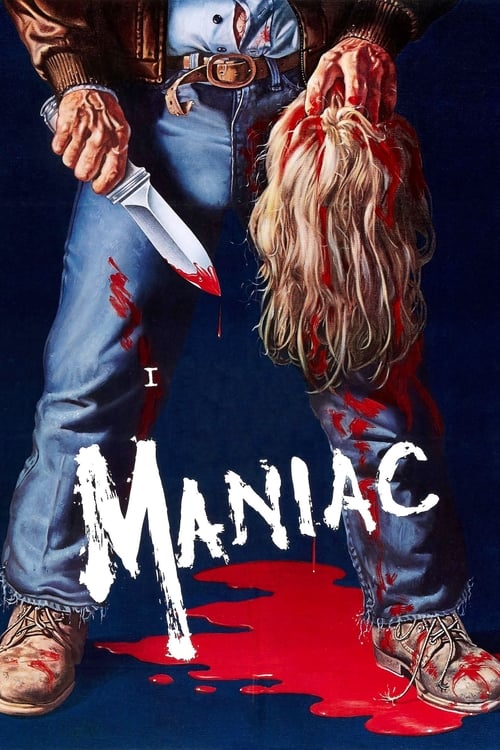
Maniac
1980 · William Lustig
Only for when you want horror at its most confrontational — a film to test your limits, not to have fun with. This is the opposite of a comfort watch; approach knowing it earns its notoriety.
What it's about
Frank Zito lives alone in a cramped New York apartment crowded with mannequins, each one wearing a trophy from the women he stalks and kills across the city. Shaped by a childhood of abuse, he moves between murder and a fragile, unlikely courtship with a fashion photographer who offers him a glimpse of an ordinary life he can't hold onto.
The experience
Suffocating and genuinely upsetting — the film locks you inside Frank's head and keeps you there, with no detective or hero to cut away to. It's a grimy, sweaty endurance test, closer to a character study of illness than a thrill ride.
Performances
Joe Spinell, who also co-wrote the film, is remarkable — pathetic, terrifying, and weirdly mournful, often all in the same scene. It's a character-actor passion project of a kind that barely exists.
The craft
Shot guerrilla-style on real New York streets without permits, it has a verité filth no studio film could replicate, and Tom Savini's effects work is infamous for a reason. The droning score and Frank's whispered monologues create an atmosphere of total moral airlessness.
Why it matters
Released unrated and attacked as the nadir of the slasher boom, it became the defining case in debates over screen violence against women — and a cult landmark of New York grindhouse filmmaking.
Snapshot
Maniac is a low-budget New York horror film about Frank Zito (Joe Spinell), a middle-aged man who lives alone in a cramped apartment full of mannequins. He stalks and kills women across the city and nails their scalps to the mannequins. Frank was abused as a child by his mother, now dead, and the film presents his violence as a compulsive re-enactment of that relationship. Running alongside the killings is an unlikely courtship with Anna D'Antoni (Caroline Munro), a fashion photographer who briefly offers Frank a picture of normal life before the pattern takes over again.
Made outside the studio system, shot largely on the streets without much official sanction, and released in the United States without an MPAA rating, Maniac became one of the most argued-over films of the early-1980s slasher boom. Its main innovation is where it puts the audience. The film follows the killer, not his victims, and stays with him in his home life, his breakdowns and his self-pity. This makes it less a whodunit or a survival story than a character study of a killer, delivered through exploitation-cinema gore. Tom Savini's makeup effects, especially a shotgun blast to the head, became notorious. The film's reputation has moved from critical disgust to cult reverence, and that shift is itself a useful case study in how exploitation cinema gets reassessed.
Industry & production
Maniac belongs to the independent exploitation economy of late-1970s New York. That world was shaped by the 42nd Street grindhouses, by producers who could raise small sums privately, and by crews who often moved between low-budget features, commercials and adult films. William Lustig had worked in that last sector before Maniac, directing adult features under a pseudonym. The experience gave him practical skills: shooting fast, cheaply and on location with small crews.
The project grew out of Lustig's partnership with Joe Spinell, a character actor known for supporting roles in The Godfather (1972), Rocky (1976) and Taxi Driver (1976). Spinell co-wrote the screenplay with C. A. Rosenberg and treated the film as a showcase for himself as a leading man. Andrew W. Garroni produced alongside Lustig. Judd Hamilton, Caroline Munro's husband at the time, is credited among the executive producers, which helps explain how a British actress known for Hammer and Harryhausen-era fantasy films ended up in a grimy New York slasher.
The budget was very small by any industry standard; figures in the hundreds of thousands of dollars are commonly cited. Much of the film was shot guerrilla-style on New York locations, including streets, a subway station, parked cars and apartment interiors, with little or no formal permitting. Production accounts, many from Lustig's own commentaries and interviews, describe shoots squeezed into the gaps of the city's routine. After the MPAA indicated the film would not get an R without major cuts, the distributor released it unrated. That was a common move for independent horror at the time: it gave up access to some mainstream venues and advertising outlets in exchange for keeping the gore that was the film's selling point.
Technology
Maniac was shot on 16mm and blown up to 35mm for theatrical release, the standard workaround for independent producers who couldn't afford 35mm negative and camera rental. Blow-up enlarges grain and softens fine detail, and in Maniac that texture fits the subject: the night exteriors look murky, sodium-lit and dirty. Later restorations from the original materials, chiefly by Lustig's own label, Blue Underground, have made more detail visible, but the film's look is still tied to that format.
The film's most consequential technical work is Tom Savini's prosthetic makeup. Savini had made his name with George A. Romero's Dawn of the Dead (1978) and Sean S. Cunningham's Friday the 13th (1980). On Maniac he built several practical gore set-pieces: scalpings, a stabbing and, most famously, an exploding head. He made a life-cast of his own head, filled it with fake blood and tissue, and blew it apart with a real shotgun, shot in close-up. Savini also plays the victim in that scene. These were in-camera practical effects with no optical trickery, and their physical immediacy is a large part of why the film was seen as transgressive.
Technique
Cinematography
The cinematography, credited to Robert Lindsay, rests on two modes. The first is the subjective or semi-subjective stalking shot. The camera tracks potential victims from Frank's approximate position, a device already established by the opening of John Carpenter's Halloween (1978) and, further back, by Michael Powell's Peeping Tom (1960) and the Italian giallo. The second, and more distinctive, is the intimate, often static framing of Frank alone in his apartment. These scenes are lit with low, warm practicals and crowded by the mannequins, and they turn his living space into an image of his mind.
Exteriors rely on whatever light New York supplied at night: streetlamps, neon, headlights and subway fluorescents. The grain of the 16mm blow-up and the unglamorous locations give the film a semi-documentary roughness that has often been compared to the New York street films of the 1970s.
Editing
Lorenzo Marinelli is credited as editor. The cutting structure is episodic: a string of stalk-and-kill set-pieces linked by scenes in Frank's apartment and, in the second half, by the Anna subplot. The stalking sequences, above all the long pursuit of a nurse through a subway station and its toilets, use extended suspense cutting in which delay matters more than shock. By contrast, the effects scenes are often cut to hold on the gore longer than mainstream horror of the period would, so the editing serves the makeup.
The film's rhythm has a deliberate monotony, in which each killing is followed by Frank's remorseful collapse. Some critics read this as a weakness and others as a structural portrait of compulsion.
Mise-en-scène / staging
The apartment is the film's central design achievement. It is a cluttered single room full of religious kitsch, old photographs, toys and mannequins, with the mannequins wearing the scalps and clothing of Frank's victims. The mannequins do several jobs at once. They are trophies, substitute companions and stand-ins for the women he cannot relate to, and in the climax they become a hallucinated avenging chorus. The film contrasts this squalor with Anna's world of fashion photography, studios and models, setting a world that manufactures images of women beside a man who manufactures grotesque replicas of them.
The exterior staging uses specific, recognisable New York locations. The most celebrated is a parked car with a city bridge in the background, the setting for the shotgun killing. The geography is real rather than invented, and that adds to the film's sense of menace on the street.
Sound
Jay Chattaway's score mixes synthesizer textures with piano and a recurring melancholy theme. Its instrumentation fits the turn-of-the-decade moment when synth scoring was becoming the default for low-budget horror after Carpenter's Halloween. The music tends towards mournfulness rather than pure shock cues, supporting the film's view of Frank as pitiable as well as monstrous.
The sound design is equally important. Frank's heavy, ragged breathing and his muttered monologues, in which he talks to his mother, his victims and himself, are pushed forward in the mix. The result is an acoustic interiority: the soundtrack keeps placing the audience inside Frank's head.
Performance
Spinell's performance is the film's centre and its most frequently defended element. Sweaty, heavy-set and pock-marked, he plays Frank with a self-pity that switches between childlike whimpering and sudden rage. He never makes him charismatic in the way later slasher villains became. Spinell's background as a New York character actor gives the performance a lived-in specificity that most slasher killers of the period, masked and mute, lack.
Caroline Munro plays Anna with a warm, slightly unreal poise. Critics have often found the courtship plot implausible, and her casting makes the gap between Frank and the world he wants to join almost dreamlike. Gail Lawrence (also known as Abigail Clayton) appears as one of the models. Savini's cameo as the "disco boy" is now part of the film's legend.
Narrative & dramatic mode
The narrative mode is the killer's-eye character study. There is no investigating detective at the centre, and no final girl in the Halloween sense. The police are glimpsed only in passing, through news reports and the aftermath of crimes. Instead the film is organised around Frank's subjectivity: a cycle of compulsion, killing, guilt and regression. A visit to his mother's grave reveals the trauma in explicit, Freudian, Psycho-derived terms.
The Anna plot briefly promises redemption or exposure and is shaped as the film's main source of suspense: will Frank attack her, and will she find out? The climax at the cemetery returns the film to its compulsion. The coda then moves into overt fantasy, as the mannequins come to life and tear Frank apart. The final shot, of his body with eyes that suddenly open, adds an ambiguous shock ending in keeping with the genre conventions of the day. The dramatic register is closer to grim tragedy and psychological horror than to the playful body-count mode of Friday the 13th.
Genre & cycle
Maniac sits inside the slasher boom that followed Halloween and peaked in 1980–81, but it belongs most specifically to a subset of the cycle: urban psycho-killer films that focus on the killer's pathology and are set in recognisable cities rather than summer camps or small towns. Related titles include Don't Go in the House (1979/80), Dressed to Kill (1980), Eyes of a Stranger (1981) and Nightmare (1981, also known as Nightmares in a Damaged Brain). The 1980–81 controversy over what critics called "women in jeopardy" or "violence against women" films often grouped Maniac with these, and it was among the most frequently cited examples.
The film also draws on 42nd Street exploitation conventions: gore as the selling point, ad campaigns built around the poster image of Spinell holding a scalp, and unrated release. Its New York setting connects it to the vigilante and urban-decay cycle of the 1970s, including Death Wish (1974) and Taxi Driver. In Britain it became caught up in the early-1980s "video nasties" panic, and its availability there was long restricted and censored.
Authorship & method
William Lustig (director, co-producer) directs with the pragmatism of an exploitation craftsman rather than the self-consciousness of an auteur. His later career kept the same independent, genre-focused course: Vigilante (1983), Maniac Cop (1988) and its sequels, and Uncle Sam (1996). He then moved into home-video restoration and distribution, first in senior roles connected with Anchor Bay's cult catalogue and then as founder of Blue Underground. That second career has shaped how Maniac and many similar films are preserved and canonised. Lustig has been the main narrator of the film's production history in commentaries and interviews, so that history is partly a self-told one and should be read with that in mind.
Joe Spinell (star, co-writer) has an unusually strong claim to co-authorship. The film's emphasis on Frank's inner life, loneliness and maternal trauma is widely credited to his conception of the character, and its continuing reputation rests largely on his performance. Spinell and Munro were reunited in The Last Horror Film (1982). Spinell spent the rest of the decade trying to set up a sequel. A short promotional piece, Maniac 2: Mr. Robbie, was shot with Buddy Giovinazzo directing, but the feature was never made, and Spinell died in 1989.
C. A. Rosenberg shares the screenplay credit. Beyond the credit, the record of how the writing was divided is thin.
Tom Savini (special makeup effects) is arguably the film's other auteur in the eyes of its fan audience. Maniac sits between Dawn of the Dead and Friday the 13th on one side and The Burning (1981) and Day of the Dead (1985) on the other, at the height of his reputation as the leading practical-gore artist of his generation.
Jay Chattaway (composer) went on to score further genre films, including Lustig's Vigilante and Maniac Cop. He later had a long career in television music, most prominently for the Star Trek franchise.
Robert Lindsay (cinematography) and Lorenzo Marinelli (editing) worked within the constraints of the 16mm, location-based method. Little detailed critical writing exists on their individual contributions.
Movement / national cinema
Maniac is American independent exploitation cinema, and in particular a product of New York's low-budget production scene. That scene was distinct from the Hollywood studios and from the more art-house New York independents of the same years. It shares a city, and sometimes personnel and sensibility, with the 42nd Street grindhouse circuit it was made to play in.
It also belongs to a loose New York cinema of urban decay, alongside films made at very different budget levels, from Taxi Driver to Abel Ferrara's The Driller Killer (1979) and Ms .45 (1981). These films portray the late-1970s city, near bankruptcy, high in crime and with a seedy Times Square, as a landscape that produces violence. Ferrara's films are the closest stylistic relatives: grimy, location-shot portraits of disturbed people adrift in Manhattan.
Its international links run mainly through the Italian giallo and the Italian gore cycle. Munro had a European genre career, and the film was distributed and discussed in a European horror culture that welcomed American gore. Lucio Fulci's The New York Ripper (1982) is often mentioned as a near-contemporary companion.
Era / period
The film is closely tied to New York at the turn of the 1980s. The city was emerging from its 1975 fiscal crisis, a large part of public life was shaped by fear of crime, and the "Son of Sam" killings of 1976–77 were still fresh. Critics have often read Maniac against that backdrop, though the film does not refer to specific cases.
In industry terms it arrived at the peak of the post-Halloween slasher market and of independent horror's unrated-release strategy, just before the home-video boom turned such titles into rental-store staples. It also arrived as feminist criticism of on-screen violence against women was gaining public force. Maniac and Dressed to Kill were frequent targets, and the film's reception cannot be separated from that debate.
Themes
- Maternal trauma and the pathological family. Following Psycho (1960), the film explains Frank through an abusive, sexually charged relationship with his dead mother. It is a crude Freudianism, but the film commits to it. The cemetery scenes make the theme literal.
- Women as images and objects. The mannequins, Anna's fashion photography and the models Frank targets create a tight network of images. The film sets a man who turns women into dolls beside an industry that turns women into pictures. Critics disagree about whether this works as critique or merely as alibi, and that disagreement is central to the film's reputation.
- Loneliness and the city. Frank is isolated amid crowds, and New York is shown as a place of anonymous proximity: subways, parked cars, apartment corridors. Some critics argue the city is as much the subject as Frank.
- Compulsion and guilt. The repeated cycle of killing and remorse turns Frank's violence into addiction rather than pleasure. The film withholds the cathartic heroism of slasher survival and offers only the killer's self-destruction.
- The audience's complicity. By putting viewers in Frank's perspective, the film raises, whether by design or not, the question that dominated its reception: what it means to watch violence from the side of the man inflicting it.
Reception, canon & influence
Critical reception. On release, Maniac was widely condemned by mainstream critics as an especially brutal example of the slasher cycle's misogyny. It was frequently cited in the period's debates over violence against women in horror films, and its gore and unrated release were central to that hostility. Some reviewers acknowledged Spinell's performance or the film's grim conviction, but the dominant critical response was revulsion. In Britain, censorship and the video-nasty climate limited both its availability and serious discussion of it for years.
Reassessment came mainly through genre criticism, fan culture and home video. Writers on horror have increasingly treated Maniac as a serious, if crude, psychological portrait, singling out Spinell's performance, its sense of place and its refusal of the slasher's comforting formulas. Blue Underground's restored releases helped establish it as a cult classic. It now appears regularly in histories of the slasher film and of New York exploitation cinema, though its gender politics remain contested rather than settled.
Influences on the film (backward).
- Alfred Hitchcock's Psycho (1960): the mother-fixated killer and the psychoanalytic explanation.
- Michael Powell's Peeping Tom (1960): the killer's point of view and the link between image-making and murder.
- The Italian giallo: stylised stalking and fetishised killings.
- Carpenter's Halloween (1978): the subjective stalking camera and the commercial template.
- Taxi Driver (1976): the lonely, deranged New Yorker, and the city as a moral sewer. Spinell appeared in it.
- Savini's earlier work with Romero, which set the standard for practical gore.
Legacy (forward).
- Maniac helped define the killer-centred strand of 1980s horror. Later films that explore a murderer's psychology from the inside, most prominently John McNaughton's Henry: Portrait of a Serial Killer (made 1986, released 1990), are often discussed in relation to it, though direct influence is hard to document.
- It cemented Savini's reputation, and its exploding-head effect became one of the best-known practical gore effects of the era.
- It launched Lustig's genre career and, indirectly, his work as a restorer and distributor of exploitation cinema, which in turn shaped how the whole tradition is preserved.
- It produced an unrealised sequel and, in 2012, a French–American remake directed by Franck Khalfoun, produced by Alexandre Aja and starring Elijah Wood. The remake shot almost entirely from the killer's point of view, taking the original's perspective to its formal extreme. That choice confirms that later filmmakers saw subjectivity as the original's defining contribution.
Maniac now holds an uneasy but secure place in the horror canon. It is a key document of the slasher era and of New York exploitation filmmaking, and it shows plainly the questions of perspective, misogyny and identification that the genre has never fully resolved.
Influences: the films it descends from and the films it influenced
- Psycho (1960) — It established the killer whose compulsion is driven by a dead mother. Frank's conversations with his mother's voice and his shrine to her follow Norman Bates's split interior directly.
- Peeping Tom (1960) — Powell lines the camera up with the murderer's eye and asks the audience to pity a lonely killer. Lustig builds both his stalking shots and Spinell's sympathetic performance on these two devices.
- Blood and Black Lace (1964) — Bava stages murders among store mannequins and treats the female body as a styled fetish object. This is the giallo source for Frank's apartment of mannequins dressed in his victims' scalps and clothes.
- Deep Red (1975) — Argento uses long, prowling build-ups before each kill, with a childhood trauma revealed through dolls and objects. Maniac's slow subway and parking-garage suspense delays borrow this giallo timing.
- Black Christmas (1974) — Clark's handheld point-of-view shots from an unseen killer, paired with the killer's broken, regressive voice, are the template for Maniac's subjective camera combined with Frank's muttered inner monologue.
- Taxi Driver (1976) — Scorsese shapes the film around a lonely, unravelling New Yorker's voiceover, set against night streets shot on location as a moral sewer. Spinell, who appeared in it, brought this mode of character study into the slasher.
- Dawn of the Dead (1978) — Savini refined his practical prosthetic gore and blood-pump effects here. He carried that method straight into Maniac's shotgun head explosion and scalpings.
- Halloween (1978) — Carpenter's opening Steadicam point-of-view stalk and his minimalist synth score made the commercial slasher template. Maniac re-shoots that template in grimy 16mm on real Manhattan streets.
- Nightmare (1981) — An unrated, video-nasty-era New York psycho film that repeats Maniac's recipe: a killer-centred narrative, a childhood sexual trauma that resurfaces as compulsion, and graphic practical gore.
- Angst (1983) — It locks the audience inside the murderer through continuous voiceover and a camera bound to his body. This pushes Maniac's acoustic interiority and point of view into a full first-person study.
- Vigilante (1983) — Lustig repeats his guerrilla night location shooting across New York's derelict boroughs, with Jay Chattaway again providing the brooding synth score.
- Maniac Cop (1988) — Lustig and Chattaway carry Maniac's stolen-location street shooting and synth pulse into a franchise slasher about a killer haunting New York at night.
- Henry: Portrait of a Serial Killer (1986) — It drops the slasher's investigation and survivor structure for an affectless, observational portrait of the killer's daily life, extending Maniac's killer-centred character study.
- Maniac (2012) — The remake is shot almost entirely from the killer's point of view, with Elijah Wood seen only in reflections. It takes the original's subjective stalking shot and mannequin fixation to their formal extreme.
- Terrifier 2 (2022) — Savini's appliance gags (his own shotgun head-burst) shot in unblinking medium-wide with no cutaway, produced under grimy regional New York economics — the specific pleasure of prosthetic dismemberment held long enough to be inspected.
- Terrifier 3 (2024) — Savini's in-camera shotgun head-burst plus the film's refusal to shorten a single victim's death establishes duration-as-cruelty: the sustained take rather than assembled coverage.
- The Driller Killer (1979) — Ferrara shot a disintegrating artist-killer guerrilla-style on cheap gauge in derelict Union Square lofts. It is the same low-budget New York decay aesthetic Lustig used to turn the city into the killer's mental landscape.
- Don't Go in the House (1980) — Released the same year, it centres on a man abused by his mother who keeps dressed corpses in his home and talks to her voice. It runs a near-identical structure of maternal-trauma compulsion and domestic tableau.
- Friday the 13th (1980) — Made in the same months as Maniac, Savini's prosthetic set-pieces here made the lingering, showcased practical kill the selling point of the 1980 slasher.
- Christmas Evil (1980) — It is a slow character study of a lonely, childhood-damaged man in suburban New York. Like Maniac, it puts the killer's pitiable routine ahead of the victims' perspective.
- Basket Case (1982) — Shot guerrilla-style on pre-cleanup Times Square streets with Tom Savini's practical splatter effects, the same New York grindhouse production mode and documentary location texture.
Similar films
- Henry: Portrait of a Serial Killer (1986) — influence & lineage
- Peeping Tom (1960) — influence & lineage
- Blood and Black Lace (1964) — influence & lineage
- Taxi Driver (1976) — influence & lineage
- Ichi the Killer (2001) — shared sensibility
- Dressed to Kill (1980) — shared sensibility
- Manhunter (1986) — shared sensibility
- Cruising (1980) — shared sensibility