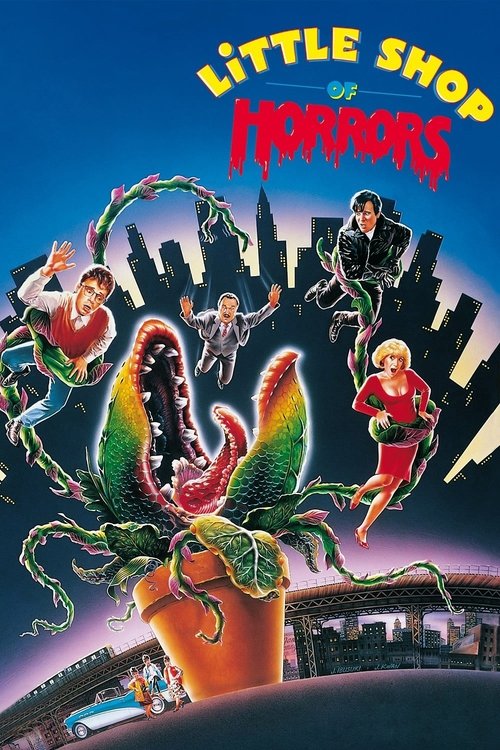
Little Shop of Horrors
1986 · Frank Oz
For a fun night in when you want to sing along with something slightly twisted — comfort viewing with teeth. Great with a crowd, great as a pick-me-up, zero homework required.
What it's about
Seymour, a meek clerk in a failing Skid Row flower shop, nurses a hopeless crush on his coworker Audrey and a strange little plant he's named after her. When the plant turns out to have an appetite for blood — and a singing voice — it starts bringing the shop fame, and Seymour everything he's ever wanted, for a price that keeps going up. A doo-wop girl group narrates the whole Faustian bargain from the sidewalk.
The experience
A giddy, big-hearted horror musical that swings between showstopper joy and cheerful menace — catchy enough that the songs live in your head for weeks. It's funny, romantic, and just macabre enough to keep its edge.
Performances
Rick Moranis is a perfect Seymour and Ellen Greene, reprising her stage role, is definitive as Audrey — that tiny voice blooming into a torch singer's belt. Steve Martin's sadistic biker-dentist is one of the great comic cameos of the decade, and Levi Stubbs' growling vocal performance gives the plant real star power.
The craft
Frank Oz brought Muppet-shop mastery to Audrey II, a massive animatronic puppet that remains one of the most ambitious practical creatures ever filmed — lip-syncing, lunging, entirely real on set. The Alan Menken–Howard Ashman songs are wall-to-wall winners, staged on a fully built studio Skid Row; it rewards a big screen and good speakers.
Why it matters
A one-of-a-kind revival of the studio musical at a moment when the form was considered dead, and the proving ground for the Menken–Ashman songwriting team before they reshaped animated musicals. Also a legendary case study in test screenings changing a film's ending.
Snapshot
A musical horror comedy about a Skid Row flower-shop clerk who feeds a talking plant, adapted from an off-Broadway hit that was itself adapted from a two-day Roger Corman quickie. It is one of the strangest artifacts of mid-1980s Hollywood: a full-scale studio musical made at a moment when the studio musical had effectively ceased to exist, staged inside a hermetically built city block at Pinewood, and carried by an animatronic creature that ranks among the most ambitious practical puppets ever put on film. It is also the canonical case study in preview-screening intervention — a picture whose original ending, faithful to its source, was destroyed by test audiences and replaced with its moral opposite. Frank Oz, in his second solo feature, brought Muppet-shop craft to a Faustian fable, and in doing so provided the proving ground for Howard Ashman and Alan Menken, who would take the same songwriting grammar into Disney animation three years later and reanimate the American musical from a direction nobody was watching.
Industry & production
The lineage runs backward through three distinct production cultures. Roger Corman's The Little Shop of Horrors (1960), scripted by Charles B. Griffith, was shot in a famously compressed schedule — the two-day figure is part of exploitation folklore and the exact accounting varies by teller — on standing sets left over from A Bucket of Blood. It became a late-night television perennial, aided by its unprotected copyright status, and supplied a young Jack Nicholson with a masochistic dental patient.
Howard Ashman (book and lyrics, and director of the stage production) and Alan Menken (music) turned that disposable object into a 1982 off-Broadway musical at the Orpheum Theatre that ran for years and took the season's major off-Broadway honors. Crucially, the show's producer was David Geffen, who then produced the film through The Geffen Company for release by Warner Bros. — meaning the property moved to screen with its originating impresario intact, and with Ashman himself writing the screenplay.
The production decamped to Pinewood Studios in England, where a complete Skid Row was built on the 007 Stage under production designer Roy Walker (Barry Lyndon, The Shining). This was a deliberate choice, not a cost dodge: the material demanded a sealed, obviously theatrical world, and a stage build allowed the enormous puppet rigs to be operated from below through purpose-cut trapping. The crew was overwhelmingly British — cinematographer Robert Paynter, editor John Jympson, creature designer Lyle Conway — placing the film squarely in the tradition of American genre pictures assembled by British technicians at Pinewood and Elstree.
The famous rupture came at preview. The film as first completed followed the show: Audrey II eats Audrey, then Seymour, and the plants inherit the earth in an extended effects finale involving large-scale miniatures under Bran Ferren. Test audiences rejected it decisively. Geffen and Warner Bros. ordered a new ending, and Oz shot one in which Seymour electrocutes the plant and escapes to the suburbs with Audrey alive. Oz has said in later interviews that the logic was structural rather than cowardly: on stage the audience watches the dead performers return for a curtain call, so the annihilation reads as a joke; on film, death is permanent, and the audience had spent ninety minutes learning to love these two people. The excised sequence survived in black-and-white workprint and circulated among collectors for two decades. A restored director's cut was prepared for Blu-ray in 2012, briefly recalled before wide distribution, and subsequently issued — a sequence of events widely reported at the time and central to the film's later reputation.
Technology
The picture is a landmark of pre-digital creature performance. Lyle Conway, who had worked with Oz on The Dark Crystal, designed and built Audrey II across a series of escalating scales, from a pod that fits in a hand to a hero puppet large enough to swallow a standing adult. The largest versions were cable-, rod-, and hydraulically actuated, requiring dozens of operators working in coordination beneath and behind the set — the exact head counts cited in production accounts vary, but the order of magnitude is unambiguous.
The film's signature technical solution addressed a fundamental problem: a puppet that massive cannot be moved quickly, and slow movement reads as dead weight. The plant sequences were therefore undercranked — shot at a reduced frame rate so that operators could work at a deliberate, controllable pace while projection at standard speed restored a fluid, muscular liveliness. This inverted the entire production apparatus around it. Music playback had to be slowed proportionally so that the plant's lip-sync would land correctly once the footage ran at normal speed, which meant the human performers in those scenes had to act and sing to dragging playback, moving with an unnatural slowness that would look normal only later. Sound in those passages was substantially rebuilt in post as a consequence.
The abandoned finale added a second technological register: miniature cityscapes, forced-perspective plant growth, and optical work supervised by Ferren, closer in kind to a 1950s monster picture than to anything else in the film. That both these strands — Conway's animatronics and Ferren's miniatures — earned the picture its Academy Award nomination for Visual Effects (losing to Aliens) is a nice irony, since half the nominated work had been cut. A second nomination went to Ashman and Menken for Best Original Song, for "Mean Green Mother from Outer Space," written expressly for the film and generally noted as the first Oscar-nominated song to carry profanity.
Technique
Cinematography
Robert Paynter, whose credits included An American Werewolf in London and Superman II and III, lights Skid Row as a permanent stylized dusk: sodium-toned streets, standing steam, wet asphalt, and a horizon that is visibly a painted backing. Nothing pretends to be documentary. The flower shop interior is warmer and more saturated, a pocket of amber inside the gray, and the visual argument of the film is largely carried by that contrast — the shop as fragile refuge, the street as the condition to be escaped.
The exception is "Somewhere That's Green," which shifts into a flat, frontal, hyper-lit register borrowed from 1950s advertising and situation comedy: even key, pastel palette, no shadow, an entire visual grammar quoted rather than invented. It is the film's most stylistically discrete passage and its most acid one, since the paradise it renders is deliberately cheap.
Editing
John Jympson, who cut A Hard Day's Night for Richard Lester and would later cut A Fish Called Wanda, works against the MTV convention that dominated 1986 musical sequences. The big ensemble numbers — "Skid Row (Downtown)" above all — are built around sustained camera movement and long-ish takes that preserve the geography of the block and the legibility of choreography. Fragmentation is reserved for comedy: "Dentist!" cuts hard and fast because its joke is escalation. The plant sequences impose their own rhythm, since undercranked footage cannot be freely intercut with normal-speed coverage without exposing the seam.
Mise-en-scène / staging
The film is essentially a chamber piece with a monster in it. Oz stages almost everything within a handful of spaces — shop, street, dental surgery, Audrey's apartment — and treats the total artificiality of the build as a feature. The doo-wop trio (Tichina Arnold, Michelle Weeks, Tisha Campbell) function as a mobile Greek chorus, appearing on stoops, fire escapes, and street corners to comment on action they are not part of, a device inherited intact from Ashman's stage direction and one of the show's most durable formal inventions. Blocking in the shop tightens as the plant grows: Seymour's available floor space contracts scene by scene, so the loss of his autonomy is rendered spatially before it is stated.
Sound
Menken's score is a precise pastiche of early-1960s Black American pop — girl-group, Motown, Spector-adjacent production — deployed so that the musical idiom of the era being parodied does the period work that the sets only half-do. Levi Stubbs of the Four Tops voices Audrey II, and the casting is the film's single best sonic decision: a genuine soul instrument, unironic and enormous, coming out of a vegetable. Rick Moranis and Ellen Greene sing their own material, Greene reprising the role she originated on stage. Greene's vocal design is itself a structural device — a small, breathy, Holliday-esque speaking voice that opens without warning into a full belt in "Suddenly Seymour," so that the character's interior life arrives as an audible event.
Performance
Moranis plays Seymour with genuine, unhedged sweetness rather than nerd caricature, which is what allows the murders to register as tragedy rather than farce. Greene's Audrey is the film's emotional anchor and the performance most obviously carried over from the theater — pitched slightly larger than the film around it, and better for it. Vincent Gardenia's Mushnik supplies the Yiddish-inflected commercial appetite the plot needs. Steve Martin's Orin Scrivello, DDS is a sustained piece of physical comedy built on sadism as showmanship, and Bill Murray's masochistic patient — reworking Nicholson's 1960 cameo — plays as a two-hander that briefly stops the film dead in the best way. John Candy, Christopher Guest and Jim Belushi appear in smaller turns.
Narrative & dramatic mode
The structure is Faust with a retail setting. Seymour receives an object of power, discovers its price, pays it incrementally, and is destroyed — or, in the released version, is redeemed. Ashman's screenplay preserves the show's tight causal chain: each concession to the plant produces a material improvement in Seymour's life, so ambition and murder become the same gesture. The mode is ironic throughout — the songs are sincere, the situations are not, and the comedy lives in that gap. The chorus provides exposition and moral framing without moralizing.
The ending change alters the genre of the whole. As written, the film is a cautionary fable in which appetite consumes its host; as released, it is a romantic comedy in which the hero kills the devil and gets the girl. The dramatic scaffolding of the first eighty minutes is built for the former, and the tension between structure and resolution is audible in the released cut — a reason the restored version is not merely a curiosity but a materially different work.
Genre & cycle
Three cycles intersect here. The horror-comedy boom — Gremlins and Ghostbusters (1984), Return of the Living Dead (1985), Evil Dead II (1987), Beetlejuice (1988) — supplied the tonal permission. The animatronic creature feature — The Dark Crystal, Gremlins, Labyrinth (1986) — supplied the technology and much of the crew. And the film stands nearly alone in the third: the live-action studio musical, a form in near-total commercial collapse between the 1970s and the 1990s. That isolation is the key to its historical position. It is a late, expensive, expert example of a mode Hollywood had abandoned, made at the exact moment the mode was about to be rescued elsewhere.
Authorship & method
Frank Oz came to the film as a Muppet performer and Henson collaborator — Miss Piggy, Fozzie, Grover, and Yoda — with The Dark Crystal (co-directed with Jim Henson) and The Muppets Take Manhattan behind him. His method here is recognizably that background applied to human actors: performance-first, puppet-literate, willing to build a whole world rather than borrow one. He would move afterward toward comedies of performance and deception — Dirty Rotten Scoundrels, What About Bob?, Bowfinger — and Little Shop remains his most technically extreme picture.
The authorship is genuinely divided. Howard Ashman wrote the screenplay and had directed the stage original, and the film's dramaturgy is his. Alan Menken's score is the film's spine. Robert Paynter established its two-register palette; John Jympson protected its numbers from fashionable over-cutting; Roy Walker built the enclosed world; Lyle Conway created the character that carries the title. Levi Stubbs should be counted among the authors of the performance rather than the cast list.
Movement / national cinema
An American film in every cultural coordinate — Skid Row, Motown, the suburban dream — manufactured almost entirely by British labor on English stages. It belongs to the runaway-production tradition that gave Britain a durable technical infrastructure in creature effects and large-stage construction through the 1980s. It also belongs to the New York theater-to-Hollywood pipeline, arriving with its writer, its star, its producer, and its formal devices largely intact, which is unusual: most stage-to-screen musicals lose the original creative team at the door.
Era / period
1986 Hollywood ran on high concept, ancillary revenue, and effects spectacle. Little Shop fits the effects criterion and violates nearly every other one — a musical, an off-Broadway adaptation, a downbeat allegory. It performed modestly rather than as a hit. More consequentially, it is a defining artifact of preview-screening culture, the same mid-1980s apparatus that reshaped Brazil, Blade Runner, and Fatal Attraction: the moment when audience research acquired the standing to overrule a completed film's third act. The period's other relevant fact is retrospective and grim — Ashman died of complications from AIDS in 1991, and the film's fable of a hidden thing that grows and consumes has been read, unavoidably if not authorially, in that light.
Themes
Appetite as economics. Audrey II is a business proposition before it is a monster: it draws customers, generates press, and lifts Seymour and Mushnik out of poverty, and every increment of prosperity is purchased with a body. The Reagan-era reading is not imposed from outside — the film's own logic is that upward mobility from Skid Row requires something unspeakable.
Escape as consumer catalog. "Somewhere That's Green" defines paradise entirely through purchasable goods, and the film neither mocks Audrey for wanting them nor pretends they would suffice. It is the sharpest and most sympathetic thing in the picture.
Abuse and rescue. Audrey's relationship with Orin is played for laughs in a register that has aged uncomfortably, though the film is clear-eyed about her injuries and about Seymour's rescue fantasy — including the fact that the rescue is accomplished by murder.
Race and voice. Later criticism has examined the score's mapping of idiom onto function: a Black-voiced tempter, a Black chorus narrating the fate of white protagonists, in a musical language borrowed wholesale from Black American pop. The observation is a legitimate strand of the film's critical literature rather than a settled verdict.
Reception, canon & influence
Contemporary notices were broadly positive, with particular praise for Conway's creature work, Steve Martin's number, and Greene's performance; reservations tended to concern the tonal management of horror against comedy and, from those who knew the show, the substituted ending. The two Academy Award nominations — Visual Effects and Original Song — mark its institutional standing. Commercially it was a modest performer rather than a failure or a hit, and its real audience arrived on home video.
Backward, its debts are explicit: Corman and Griffith's 1960 original for the premise and several gags; the Faust tradition for the shape; Spector, the Supremes and the Shirelles for the score; the 1950s alien-invasion cycle for the pods and the paranoia; and the Broadway convention of the commenting chorus, relocated to a stoop.
Forward, the influence is larger than the film's commercial profile suggests. Ashman and Menken went from Little Shop directly to The Little Mermaid (1989), Beauty and the Beast (1991), and Aladdin (1992), carrying with them the exact devices developed here: the character-defining "I Want" song — "Somewhere That's Green" is the recognizable ancestor of "Part of Your World" — the comic villain patter number, and the ensemble as narrator. The Disney Renaissance, and with it the survival of the American musical through animation, runs through this picture.
Its second legacy is technical: Audrey II remains a reference point for character-driven animatronic performance, a demonstration that a puppet could carry a leading role through acting rather than through shock cutting. Its third is generic — the horror-musical as a viable form, visible in everything from Repo! The Genetic Opera to Anna and the Apocalypse and in the broader license to sing inside a genre picture.
The stage show, meanwhile, became one of the most-performed musicals in American schools and regional theaters, with a 2003 Broadway production and a long-running 2019 off-Broadway revival, so the property's cultural presence now substantially exceeds the film's. And the film itself acquired a fourth life as a preservation cause: the decades-long circulation of the workprint finale and its eventual restoration made Little Shop of Horrors an emblem of fan-driven archival recovery, and one of the few cases where the version the audience rejected in 1986 is now widely regarded as the better film.
Reception
A modest box-office performer in 1986 that got warm reviews but no blockbuster glory, it's since grown into a beloved cult classic — theater-kid gateway drug, Halloween-season staple, and a fixture of 'best movie musicals' lists.
How Little Shop of Horrors was received, from release to now →
How to watch Little Shop of Horrors: what to notice on a first viewing
- Watch the color shift between the gray street and the flower shop. Robert Paynter lights Skid Row in permanent sodium-toned dusk, then warms and saturates the shop interior into a pocket of amber. The color tells you which space is a refuge and which one is the danger to escape.
- Notice the three women who comment from stoops and fire escapes. The doo-wop trio keeps appearing on the edges of scenes they are not part of, narrating and reacting without ever entering the plot. They give the film a running moral commentary that never has to be spoken by anyone in the story.
- Track how much floor space is left in the shop each visit. As the plant grows, Seymour's available room in the shop keeps shrinking scene by scene, until he is working around it more than in it. His shrinking space tells you he is losing control before the story says so out loud.
- Listen to the plant's singing voice, full soul power from a vegetable. Levi Stubbs of the Four Tops voices Audrey II completely straight, no camp in the delivery, a real instrument coming out of a puppet. The sincerity of the voice is what makes a talking plant genuinely persuasive instead of silly.
- Listen for Audrey's voice suddenly opening into a full belt. Ellen Greene speaks in a small, breathy register, then without warning lets the singing voice open all the way up in 'Suddenly Seymour.' The size of her voice arrives as news about who she actually is underneath.
The whole guide to watching Little Shop of Horrors, with the keys for a rewatch →
Influences: the films it descends from and the films it influenced
- The Little Shop of Horrors (1960) — Corman's two-day shoot on borrowed standing sets bequeathed the single-block skid-row geography and one-interior containment, and Oz restages the masochist-in-the-dentist's-chair set piece almost beat for beat, promoting a throwaway Nicholson gag into a full production number.
- Invasion of the Body Snatchers (1956) — Established the alien pod as a practical, hand-buildable prop that germinates in ordinary domestic rooms, with dread generated by containment inside one small community rather than by spectacle of scale — the exact economy Audrey II's shop-window incubation depends on.
- The Day of the Triffids (1962) — The ambulatory plant built at full scale as an articulated shell with operators concealed inside and below the frame line — the practical-creature precedent for staging a vegetable as a physical scene partner rather than an optical effect.
- The Wizard of Oz (1939) — Two-register palette used as dramaturgy — desaturated reality against saturated wish — and the yearning ballad sung from the poorest corner of the set, the structural template Ashman rebuilt as 'Somewhere That's Green'.
- West Side Story (1961) — A wholly studio-built tenement block whose stoops, grates and fire escapes are treated as a performing surface, with a street ensemble that comments on the action in song — the geometry Roy Walker's set and the Crystal/Ronette/Chiffon chorus both inherit.
- The Dark Crystal (1982) — The Creature Shop method Lyle Conway carried directly to Audrey II: multi-operator creatures with cable- and radio-controlled facial mechanics, performed to prerecorded vocal playback at reduced speed and covered in sustained takes.
- The Empire Strikes Back (1980) — Oz's own Yoda proved a hand-and-rod puppet could sustain long dramatic two-handers opposite a star without being cut around; Audrey II is that proof scaled up to a co-lead with a singing voice.
- Phantom of the Paradise (1974) — Faust rewritten as a pop musical in which Paul Williams's period pastiches — Spector wall-of-sound, doo-wop, surf — do the characterization and the satire, the precise function Menken's Motown and girl-group pastiche performs here.
- The Rocky Horror Picture Show (1975) — Transferred a stage horror-musical by preserving its proscenium frontality and its 1950s B-picture citations instead of opening it out, and modeled the afterlife in which a commercially modest genre musical finds its real audience outside the theatrical run.
- The Great Muppet Caper (1981) — A musical built on ambitious practical puppetry (the Audrey II rig) fused with Berkeley-scale numbers — the direct extension of Caper's puppet-in-a-musical craft by a fellow Henson performer-director.
- The Little Mermaid (1989) — Ashman and Menken carried the devices over intact — 'Part of Your World' is 'Somewhere That's Green' rebuilt as the character-defining I Want song, alongside the comic villain patter number and the ensemble deployed as narrator.
- Beauty and the Beast (1991) — Ashman's Broadway dramaturgy imported wholesale into animation: a prologue number that states the entire premise before the story starts, and Gaston's comic-villain patter descending straight from the comedy of menace written for Orin and Audrey II.
- Aladdin (1992) — Extends Ashman's Calloway/Motown pastiche writing to 'Friend Like Me' and the fast-patter villain mode, and casts for voice-as-performance — Robin Williams occupying the authorial position Levi Stubbs holds over Audrey II.
- The Nightmare Before Christmas (1993) — A horror-musical built entirely out of puppet performance, with replacement-animation faces required to carry sung lead vocals and the numbers held as continuous staged sequences rather than cut to a pop rhythm.
- Repo! The Genetic Opera (2008) — Takes up the horror-musical license directly — a stage-derived through-sung score, an enclosed studio-built city with no exterior beyond it, and a narrating chorus figure who addresses the audience between grotesqueries.
- Anna and the Apocalypse (2017) — Original-song horror-musical whose numbers are staged as long choreographed takes moving through a contained small-town geography, opening on an I Want ballad that anchors the heroine's escape-fantasy exactly as 'Somewhere That's Green' does.
- Buddy (2026) — The singing monster as engineering problem: the puppet shot undercranked so playback at speed syncs the lip plate to the vocal, making charm and appetite the same performance — the direct precedent for Buddy's earworm number.
- Streets of Fire (1984) — An entire picture shot on a studio-built, perpetual-dusk city block in a two-register neon-against-shadow palette, with its songs staged as complete performances held in wide rather than dissected into music-video montage.
- Gremlins (1984) — Chris Walas's cable-and-rod creature ensemble is asked to carry comic timing and menace as acting beats on a studio backlot street, solving the same horror-comedy tonal problem by keeping the puppets on screen long enough to perform.
- Labyrinth (1986) — Same shop, same year: Henson-built animatronic performers integrated with live actors inside numbers staged as continuous musical sequences, the puppets given eye lines and reaction beats instead of being protected by shock cutting.
- Hairspray (1988) — Deploys an early-sixties Black girl-group trio as a diegetic doo-wop Greek chorus, choreographed frontally to the camera in a stylized period streetscape — the same conversion of R&B performance convention into narrative machinery.
- Godzilla vs. Biollante (1989) — The contemporaneous solution to the same engineering problem — a giant plant puppet worked by a large under-stage crew and shot at reduced camera speed so its movement reads as full-scale mass — which is functionally how Biollante's final form is performed.
Similar films
- The Little Shop of Horrors (1960) — influence & lineage
- The Rocky Horror Picture Show (1975) — influence & lineage
- Labyrinth (1986) — influence & lineage
- The Nightmare Before Christmas (1993) — influence & lineage
- Gremlins (1984) — influence & lineage
- The Wizard of Oz (1939) — influence & lineage
- Beetlejuice (1988) — shared sensibility
- Bride of Frankenstein (1935) — shared sensibility