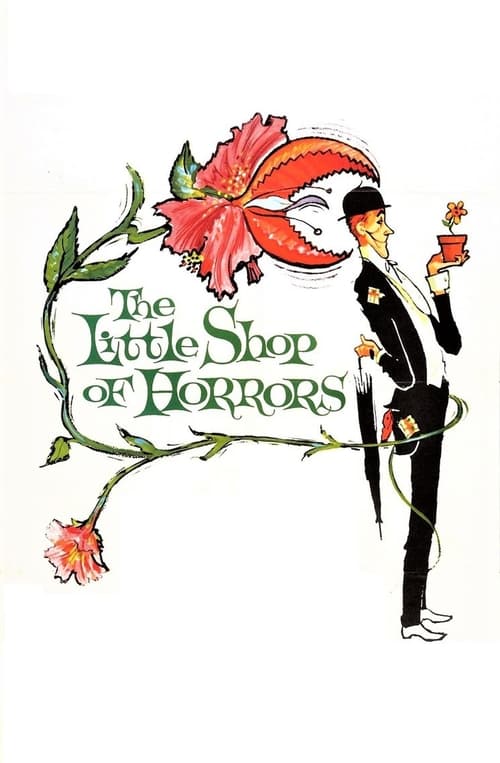
The Little Shop of Horrors
1960 · Roger Corman
When you want something short, absurd, and low-stakes — a late-night giggle at a movie that knows exactly how cheap it is and turns that into charm. Pure comfort for fans of scrappy B-movies.
What it's about
Seymour, a hapless clerk in a skid-row flower shop, pines for his sweet co-worker Audrey and cultivates a strange new plant he names after her. The plant talks — and it feeds on human blood, and its appetite grows with its fame. Seymour slides from lucky nobody to nervous errand boy for a vegetable that keeps demanding dinner.
The experience
Fast, silly, and gleefully morbid — a cartoonish farce where the gags come cheap and rapid-fire and the horror is played entirely for laughs. It has the loose, anything-goes energy of a joke told at top speed.
Performances
A young Jack Nicholson turns up in an unforgettable early cameo as a masochistic dental patient who's thrilled to be in the chair — a few minutes of screen time people still talk about.
The craft
Roger Corman famously shot it in about two days on leftover sets, and the film wears that speed as style: quick, gag-stuffed scenes, a wisecracking script, and a talking man-eating plant sold on pennies. It's a case study in how invention and pace can outrun budget entirely.
Why it matters
The bargain-basement quickie improbably seeded a beloved stage-and-screen musical franchise decades later, and it stands as the definitive example of Corman's fast-cheap-and-alive production legend.
Snapshot
The Little Shop of Horrors is a black-comic horror quickie that has long outlived the conditions of its making. Produced by Roger Corman for the bottom half of a drive-in double bill, it concerns Seymour Krelboin, a hapless clerk at a skid-row florist shop, who cultivates a talking, blood-craving plant he names Audrey Junior after the co-worker he loves. As the plant grows, so does its appetite, and Seymour drifts from accidental killer to anxious caterer for a vegetable that demands fresh corpses. The film is remembered for three things above all: the legend of its two-day shoot; the early, indelible cameo by Jack Nicholson as a pain-loving dental patient; and its improbable second life as the seed of one of the most successful stage-to-screen musical franchises of the late twentieth century. As a film in its own right it is fast, cheap, deadpan, and far wittier than its means suggest — a beatnik-era farce in horror's clothing.
Industry & production
The picture belongs squarely to the world of American International Pictures and the exploitation economics Corman mastered in the late 1950s. The film is one of the most famous instances of Corman's "use what's standing" method: he shot the interiors on sets left over from his own A Bucket of Blood (1959), reusing labor, locations, and a writer he trusted. The production is inseparable from its origin legend — Corman's oft-repeated claim that he wagered he could shoot a feature in two days and a night, having already made Bucket of Blood in roughly five. Whatever the precise schedule (exteriors and pickups extended the total time), the two-day interior shoot is well documented as Corman's own account and is corroborated across his interviews and memoir, How I Made a Hundred Movies in Hollywood and Never Lost a Dime.
Budget figures for the film should be treated with caution: numbers in the very low tens of thousands of dollars circulate widely, but the record is anecdotal and Corman's own figures shifted over the years; no audited accounting survives in public form, so any single dollar amount is best regarded as approximate. What is certain is that the film cost almost nothing by industry standards and was conceived to fill out a program rather than headline one. A consequential production detail — possibly an oversight, possibly indifference — was the handling of copyright: the film lapsed into the public domain, which meant it could be duplicated and broadcast freely. That accident of rights, more than any distribution strategy, drove its decades of television and home-video ubiquity.
Technology
This is standard-issue late-1950s low-budget filmmaking: black-and-white 35mm photography, post-synchronized and location-recorded sound mixed for a modest theatrical release, and conventional studio lighting deployed at speed. There is no technological novelty here, and that is the point — Corman's innovation was procedural rather than mechanical. The "technology" that matters is the economy of the standing set, the pre-lit space, and the willingness to print early takes. The plant itself, Audrey Junior, is a practical prop — a succession of progressively larger papier-mâché and fabric puppets operated off-camera — rather than any kind of effects showcase. Its menace is generated by performance, framing, and voice rather than by mechanical sophistication.
Technique
Cinematography
The photography (credited to Archie R. Dalzell) is functional, clean, and fast — flat frontal lighting, few setups, and a reliance on the wide and medium shots that let dialogue scenes play in long takes without coverage. There is little of the expressionist shadow-play one associates with horror; the visual register is closer to a television sitcom than to Gothic menace, which is exactly what the comedy needs. The skid-row exteriors carry a documentary grubbiness that grounds the absurdity, while the shop interiors are staged for traffic and timing rather than atmosphere.
Editing
Cut by Marshall Neilan Jr., the film moves at a clip dictated by its dialogue. The comic engine is verbal velocity — overlapping patter, non-sequiturs, and rapid scene turnover — and the editing serves that rhythm, favoring brisk exits over lingering. Given the compressed shoot, coverage was minimal, so the cutting works within the long takes it was handed rather than building scenes from many angles. The result is a film that feels improvised and propulsive, occasionally ragged, but rarely slack.
Mise-en-scène / staging
The staging is essentially theatrical: a single dominant location (Mushnick's shop), a handful of recurring side spaces, and a parade of eccentric walk-ons who enter, deliver a turn, and leave. Corman blocks for the joke, arranging bodies so that gags land in the frame without a cut. The escalating size of Audrey Junior is the production design's one ambitious gesture, and it is used structurally — the plant's growth marks the passage of acts and the rising stakes of Seymour's predicament.
Sound
The film's most reused asset is its music. The score is credited to Fred Katz, the jazz cellist, who supplied Corman with a body of music recycled across several productions, A Bucket of Blood among them — a thrift entirely characteristic of the operation. The voice of Audrey Junior was provided by the screenwriter, Charles B. Griffith, whose flat, demanding "Feed me!" gives the plant its personality. (The more famous refrain "Feed me, Seymour!" belongs to the later musical, not to this film.) Dialogue, much of it delivered at speed and in dialect, is the dominant sonic texture.
Performance
Performance is where the film earns its reputation. Jonathan Haze plays Seymour as a quivering nebbish, all apology and panic; Jackie Joseph's Audrey is sweetly oblivious; and Mel Welles, as the proprietor Gravis Mushnick, anchors the comedy in a broad, Yiddish-inflected exasperation that gives the film its vaudevillian spine. Dick Miller, a Corman regular, turns up as a customer who eats flowers. The performance everyone remembers, however, is Jack Nicholson's brief appearance as Wilbur Force, a masochist who visits the sadistic dentist for the pleasure of the drill — a few minutes of gleeful perversity that became a touchstone once Nicholson was a star. The ensemble plays in a register of committed deadpan, treating the ludicrous as ordinary, which is the film's chief comic strategy.
Narrative & dramatic mode
The dramatic mode is farce grafted onto a horror premise — a Faustian bargain played for laughs. Seymour's arc is the classic comic descent: a small lie or accident (the first body) compounds into a spiral he cannot escape, and each attempt to satisfy the plant deepens his guilt and his entrapment. The structure is episodic, hung on a string of comic set-pieces — the dentist, the flower-eating customer, the bargain-hunting detectives — rather than a tightly geared plot. Running beneath the gags is a recognizably fairy-tale shape: the meek nobody who gains brief status and the love of the girl through a monstrous secret, only to be destroyed by it. The tone holds horror at arm's length through irony; the violence is implied or absurd rather than visceral.
Genre & cycle
The film sits at the intersection of horror, comedy, and the beatnik satire briefly fashionable around 1959–1960. It is best understood as a companion piece to A Bucket of Blood, with which it shares a writer, a director, sets, music, and a premise: an inadequate man who achieves recognition through serial killing dressed up as art or horticulture. Both belong to a small cycle of Corman/Griffith horror-comedies that mocked the very genre they exploited. The detective subplot, with its hard-boiled monotone parody, openly lampoons the Dragnet-style police procedural then saturating television, situating the film within a broader culture of genre send-up.
Authorship & method
The dossier's two essential authors are Corman and his screenwriter, Charles B. Griffith. Corman's authorship is one of method: speed, frugality, set-reuse, and a tolerance for the rough edge in exchange for energy and economy. Griffith is the film's comic voice — the gags, the dialect humor, the absurd customers, and the plant's dialogue are his, and he doubled as the voice of Audrey Junior. The collaboration extends to a stock company of performers and craftsmen who moved between Corman pictures: Dick Miller and Jonathan Haze in front of the camera; Fred Katz's portable score behind it; cinematographer Archie R. Dalzell and editor Marshall Neilan Jr. executing at the required pace. This is authorship as repertory — a small, trusted troupe producing a recognizable house style under extreme constraint. The "Corman method" here is not a metaphor but a literal mode of production, and the film is one of its purest demonstrations.
Movement / national cinema
Little Shop is a wholly American artifact of the independent exploitation sector — the AIP/drive-in ecosystem that operated alongside, and in implicit opposition to, the declining studio system. It is not part of any self-conscious aesthetic movement, but it draws on distinctly American comic traditions: Borscht Belt and Yiddish-theater patter, the wisecracking idiom of urban vaudeville, and the EC Comics strain of gruesome humor. Its skid-row setting and beatnik flavor place it in a specific late-1950s American cultural moment, when bohemian affectation had become broadly available as a target for parody.
Era / period
The film is a creature of the turn from the 1950s to the 1960s, when the major studios' grip was loosening and low-budget independents fed the drive-in and double-bill market. Its sensibility — fast, cheap, irreverent, allergic to the solemnity of A-picture horror — anticipates the looser, more self-aware genre filmmaking of the decade to come. Made on the cusp, it carries the thrift and speed of 1950s exploitation while pointing toward the cult and camp sensibilities that would flourish in the 1960s and after.
Themes
Beneath the farce run several durable themes. The first is consumption: Audrey Junior is appetite made literal, a hungry thing whose demands escalate without limit and reduce a man to its supplier — a fable readily read as a satire of acquisitiveness or of feeding any insatiable system. The second is the meek man's bargain: Seymour gains love, attention, and a fleeting importance only by becoming complicit in murder, dramatizing the price of recognition for the powerless. The third is the comedy of the immigrant small business — Mushnick's shop as a precarious enterprise where dignity and ruin are equally close at hand. Threading through all of it is a knowing irony about horror itself, the film treating monstrosity as a domestic nuisance to be managed rather than a cosmic threat.
Reception, canon & influence
On release the film was what it was built to be — disposable bottom-of-the-bill product that attracted little serious critical notice. Its canonization came later and by an unusual route. Because the film entered the public domain, it circulated endlessly on television and, eventually, cheap home video, accumulating a cult audience over the 1960s and 1970s and acquiring the retrospective glamour of Nicholson's cameo. It became a fixture of "so-bad-it's-good" and midnight-movie programming, and its reputation steadily rose from throwaway to beloved curio.
The influences on the film are clear and largely traceable to its own makers: A Bucket of Blood directly precedes it in premise and personnel; the EC horror-comic tradition and Grand Guignol supply its cheerful morbidity; Yiddish theater and vaudeville supply its comic rhythm; and Dragnet and its imitators supply the detective parody.
Its forward influence vastly exceeds anything its budget would predict. In 1982 Howard Ashman and Alan Menken adapted it into the Off-Broadway musical Little Shop of Horrors, transforming the cheap farce into a doo-wop-scored sleeper hit; that show in turn became Frank Oz's lavish 1986 film, which fixed the property — and the plant, now Audrey II, crying "Feed me, Seymour!" — in popular memory far more firmly than the original ever did. The 1960 film is thus that rare thing: a near-throwaway whose afterlife dwarfs its first life, surviving both as a cult object in its own right and as the unlikely root of a major modern musical. As a case study it remains the definitive illustration of the Corman proposition — that wit, speed, and a willing repertory company could conjure something lasting out of almost nothing.
A Deleuzian reading
It's the middle of the night in a florist's shop on skid row, and a plant is hungry.
The full Deleuzian reading of The Little Shop of Horrors →
Reception
In 1960 it was disposable drive-in filler, shot for peanuts and dumped onto double bills; decades of TV reruns and public-domain circulation — plus the hit musical it spawned — turned it into one of the most beloved artifacts of the entire Roger Corman legend.
How The Little Shop of Horrors was received, from release to now →
Influences: the films it descends from and the films it influenced
- Little Shop of Horrors (1986) — The direct lineal remake — Audrey II is the engineered heir of the crude Audrey Junior practical puppet, and Oz's puppeteering monetizes the original's 'Feed me' gag into the property's defining image.
- A Bucket of Blood (1959) — The immediate dry run — same Corman/Griffith team built the identical beatnik-coffeehouse milieu, repertory cast, and the artist-kills-to-create premise on a five-day schedule that Little Shop simply accelerated to two days.
- His Girl Friday (1940) — The overlapping machine-gun dialogue tempo is the direct ancestor of Griffith's 'verbal velocity' comic patter, where lines are stacked and rattled off faster than the audience can fully parse them.
- Arsenic and Old Lace (1944) — Stage-bound black-comedy-horror played at frantic farce tempo with the cast committing deadpan to murder-as-domestic-routine — the tonal template for treating homicide as breezy comic business.
- Dragnet (1954) — The clipped, flat police-procedural cadence and just-the-facts deadpan that the film's detective interludes parody almost verbatim.
- Hellzapoppin' (1941) — The anarchic vaudeville-to-screen structure of episodic comic set-pieces and Yiddish/burlesque rhythm that shapes Little Shop's string of absurd-customer vignettes.
- The Terror (1963) — The purest extension of the standing-set-reuse method — improvised over a weekend specifically to consume the leftover castle sets from The Raven before they were struck, with Nicholson again on hand.
- The Raven (1963) — Sibling horror-comedy hybrid that, like Little Shop, mines laughs from horror icons playing grotesque material in committed deadpan within a fast Corman repertory shoot.
- Spider Baby (1967) — Corman-school alum Jack Hill carries forward the microbudget farce-horror hybrid and the actors' straight-faced commitment to macabre grotesquerie.
- Eating Raoul (1982) — Bartel, trained in the Corman shop, sustains the deadpan murder-as-commerce farce on a microbudget with a tight repertory company — the same wit-over-money proposition.
- The Rocky Horror Picture Show (1975) — Inherits the exact public-domain-style cult afterlife mechanism — a cheap horror-comedy that became a beloved participatory midnight-movie ritual rather than a first-run hit.
- Piranha (1978) — Corman-produced creature feature where Dante plays a practical-effects monster with the same knowing comic wink, energy-over-polish craft inherited directly from the AIP economy.
- Gremlins (1984) — The practical-puppet creature as comic-horror engine, executed by Corman alum Dante with stock-company face Dick Miller — the Audrey Junior puppet idea scaled up to a studio budget.
Similar films
- Little Shop of Horrors (1986) — influence & lineage
- The Rocky Horror Picture Show (1975) — influence & lineage
- Re-Animator (1985) — influence & lineage
- Alice (1988) — often watched together
- Beetlejuice Beetlejuice (2024) — often watched together
- Beetlejuice (1988) — shared sensibility
- Buddy (2026) — shared sensibility
- Braindead (1992) — shared sensibility