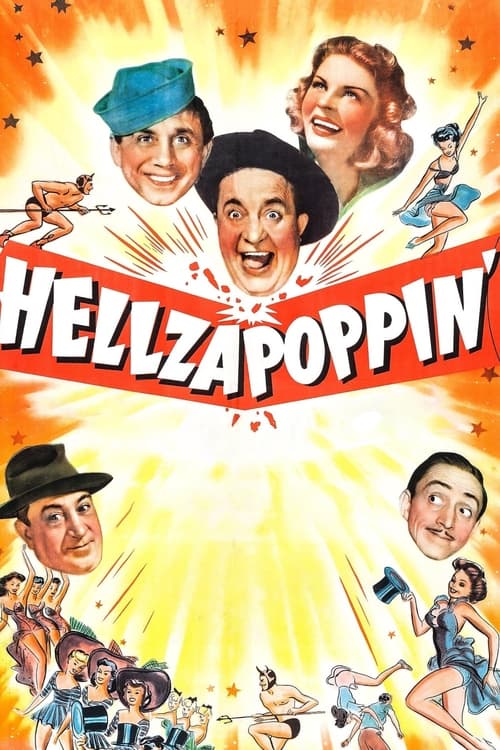
Hellzapoppin'
1941 · H. C. Potter
For when you want to laugh at comedy with zero respect for the rules — a party movie, a curiosity, and a genuine jaw-dropper in one. Great with friends who think old Hollywood was stuffy.
What it's about
Stage comedians Olsen and Johnson try to turn their plotless Broadway revue into a Hollywood movie, and the movie itself keeps falling apart around them. They halfheartedly matchmake a young couple while arguing with the projectionist, heckling the audience via title cards, and letting the film literally slip out of its sprockets.
The experience
Pure anarchic momentum — a gag-a-second barrage where the fourth wall isn't broken so much as demolished and sold for parts. Some jokes are corny, some are decades ahead of their time, and the sheer velocity keeps you laughing at how far it's willing to go.
Performances
Olsen and Johnson barrel through their own movie like invaders, and the film's famous Lindy Hop number is a burst of athletic dance brilliance that stops the show cold.
The craft
The film turns the impossibility of adapting a plotless stage revue into its own subject, deploying tricks — characters talking to the projectionist, frames freezing and slipping, self-aware title cards — that still feel radical. It's a catalog of formal mischief made inside the studio system, decades before such gags became common.
Why it matters
One of the most aggressively self-referential comedies of the studio era, it anticipated generations of fourth-wall-breaking humor and became a cult object for comedy nerds.
Snapshot
Hellzapoppin' is the Universal Pictures screen adaptation of Ole Olsen and Chic Johnson's anarchic Broadway revue of the same name, and it survives today as one of the most aggressively self-reflexive comedies of the Hollywood studio era. Where the stage show had no plot to speak of — it was a two-hour barrage of vaudeville gags, blackout sketches, live pyrotechnics, plants in the audience, and controlled chaos — the film confronts the problem of adapting the unadaptable by making that very problem its subject. The picture is about two comedians trying to turn their formless stage hit into a movie, and it breaks the fourth wall relentlessly: characters argue with the projectionist, the film slips out of its sprockets, title cards heckle the audience, and running gags detonate across the entire runtime with no regard for the romantic plot nominally holding things together. That romantic plot — a young couple, a country-house musical, a comic misunderstanding — is deliberately flimsy, a scaffold on which to hang the demolition. The film is also the vehicle for what many dance historians consider the single greatest Lindy Hop sequence ever committed to film, performed by Whitey's Lindy Hoppers. It is a minor studio comedy that has become, retrospectively, a touchstone for postmodern film comedy and for the global swing-dance revival.
Industry & production
The film originates in one of the genuine phenomena of late-1930s Broadway. Hellzapoppin' opened in September 1938 and became one of the longest-running Broadway musical productions of its era, sustained by Olsen and Johnson's brand of participatory bedlam. Universal acquired the property, and the studio's central creative dilemma was structural: the revue's appeal depended on liveness, unpredictability, and the destruction of the barrier between stage and house — qualities that a fixed strip of celluloid inherently cannot reproduce. The screenplay's solution, credited to Nat Perrin and Warren Wilson, was to graft a conventional boy-meets-girl musical onto a metafictional frame in which Olsen and Johnson (playing versions of themselves) supervise and constantly interrupt the making of the film we are watching.
The production is a characteristic mid-budget Universal effort of the period rather than a prestige release, and the surviving documentary record on its exact budget and box-office performance is thin; I will not assign figures the sources do not reliably support. What is well attested is the casting logic, which loaded the film with second-tier comic specialists: Martha Raye as a brassy man-chaser, Mischa Auer as a bogus Russian aristocrat, Hugh Herbert in his flustered-eccentric register, and the romantic leads Robert Paige and Jane Frazee to carry the "straight" musical. Shemp Howard appears as the beleaguered projectionist Louie, and Elisha Cook Jr. is among the supporting players. The center of gravity, however, remained Olsen and Johnson and their gag-writing apparatus; the generally accepted account is that the comedians and their material dominated the production, with the director functioning more as an organizer of chaos than as a controlling author.
Technology
Hellzapoppin' is a black-and-white, monaural sound film made with standard Universal production technology of 1941, and it is not a picture that advanced the state of the art in optics or recording. Its interest on the technology axis is instead conceptual: the film treats the cinematic apparatus itself — the projector, the film strip, the frame line, the soundtrack — as diegetic material to be manipulated. Gags depend on the audience's literacy in how movies are physically shown: the image appears to slip out of frame and must be "adjusted," the picture seems to catch and burn, a superimposed sled gag lampoons a rival release, and the projectionist becomes a character who can be addressed from inside the story. Achieving these effects drew on the ordinary optical-printing, matte, and superimposition toolkit of the studio special-effects department, but bent toward a joke about the medium rather than toward invisible illusion. In that sense the film's "technology" is metacinematic: it is one of the clearest early demonstrations that Hollywood's technical machinery could be turned inside out and made the punchline.
Technique
Cinematography
The camera is credited to Elwood "Woody" Bredell, a cinematographer who would shortly become one of the more distinctive stylists of 1940s Universal, shooting atmospheric thrillers and helping define the studio's noir look later in the decade (his work on films such as Phantom Lady and The Killers is his lasting reputation). In Hellzapoppin' the visual style is subordinated to the comedy's demands: bright, high-key musical-number lighting for the romantic and dance material, and a flexible, gag-serving coverage elsewhere that must accommodate objects and figures barging into frame, characters looking down the lens, and the constant threat of the image itself misbehaving. The photography's achievement is disciplined utility — clean, legible framing that keeps the visual anarchy readable rather than muddy.
Editing
Editing is arguably the film's most important technical dimension, because Hellzapoppin' is fundamentally a montage of interruptions. The comedy lives in the cut: a gag is set up, abandoned, and returned to reels later; the "film" appears to be assembled wrongly, run out of order, or spliced against itself; sight gags depend on precise timing between an off-screen setup and an on-screen payoff. Several of the film's celebrated running jokes are editorial constructions — a recurring plea for a boy named "Stinky" to go home, a man wandering the entire picture in search of a "Mrs. Jones" while the potted plant he carries grows across scenes into a full tree — that only cohere because the cutting threads them through otherwise unrelated sequences. The film effectively weaponizes continuity editing by advertising its own discontinuity.
Mise-en-scène / staging
The staging inherits the revue's logic of the crowded, overloaded frame: gags are stacked in the foreground and background simultaneously, and the set is treated as a space that can be violated at any moment by an intruding object, sign, or performer. The romantic musical sequences are staged in the polished country-house-party idiom of the era, deliberately generic so that the surrounding mayhem reads as contrast. The most extraordinary staging is the Lindy Hop number, discussed below, which converts an ordinary domestic-service setting into an explosive dance arena.
Sound
Sound is a full partner in the comedy rather than mere accompaniment. The film uses the soundtrack self-consciously — disembodied voices address characters, sound effects arrive divorced from plausible sources, and the audio is treated as another layer of the apparatus that can malfunction or be interrupted. The musical score carries a set of original songs written for the film by Don Raye and Gene de Paul, the songwriting team associated with several Universal musicals of the period, providing the conventional romantic numbers against which the disruptions register.
Performance
Performance style is broad, presentational, and revue-derived. Olsen and Johnson play at, rather than to, the audience, acknowledging the camera and the fictional status of everything around them. Martha Raye and Mischa Auer work in a heightened farce register, and Hugh Herbert deploys his signature dithering shtick. The romantic leads perform in a straighter, more sincere musical-comedy mode whose very earnestness the surrounding performances exist to puncture. The overall effect is an intentional clash of acting registers — sincerity used as a straight line for anarchy.
Narrative & dramatic mode
The film's dramatic mode is its defining feature: it is a comedy of radical self-reference, structured as a story that knows it is a movie. The frame narrative — Olsen and Johnson bringing their show to Hollywood and intervening in its adaptation — licenses a continuous assault on the conventions of narrative cinema. Causality, temporal order, and the separation of story-world from screening-room are all treated as breakable. This is not surrealism in the European art-cinema sense; it is vaudeville logic scaled up to feature length, in which the only real through-line is the accumulation and eventual payoff of running gags. The nominal romance functions as a deliberately thin armature, present so that it can be repeatedly derailed. The result is a picture that anticipates, decades early, the fully self-aware comic narration later associated with the term "postmodern."
Genre & cycle
Hellzapoppin' sits at the intersection of the Hollywood musical, the screwball/anarchic comedy, and the show-business backstager, while belonging most truly to the specific 1930s–40s cycle of comedian-driven vehicles built around established stage or radio acts. It shares DNA with the Marx Brothers' anarchic comedies — the impulse to treat plot as an obstacle to be sabotaged — and with the broader studio practice of importing revue and vaudeville stars into loosely plotted musical frameworks. Its incorporation of a spectacular specialty dance number also links it to the era's convention of the interpolated, plot-detachable set piece. Within that cycle it is an outlier for the totality of its self-reference: most comedian vehicles broke the fourth wall occasionally, whereas Hellzapoppin' makes fourth-wall demolition its organizing principle.
Authorship & method
Authorship here is genuinely diffuse, and this is central to understanding the film. The director of record is H. C. Potter, a competent studio craftsman whose more characteristic and better-remembered work is in polished mainstream comedy and drama (The Farmer's Daughter, Mr. Blandings Builds His Dream House). The prevailing account is that Potter exercised limited authorial control over Hellzapoppin', with creative dominance resting instead with the star comedians Ole Olsen and Chic Johnson and their gag apparatus; the film is best understood as their sensibility captured on celluloid rather than a director's personal statement. The screenplay is credited to Nat Perrin and Warren Wilson, whose key contribution was the metafictional frame that made the material filmable. The cinematography is by Elwood "Woody" Bredell, whose later noir work marks him as a significant studio stylist. The songs are by Don Raye and Gene de Paul. One further creative authorship deserves emphasis: the choreography and performance of the Lindy Hop sequence, driven by the Black social dancers of Whitey's Lindy Hoppers — a lineage associated above all with Frankie Manning, whose innovations in aerial Lindy Hop are widely credited within dance history. That sequence is arguably the film's most durable act of authorship, and it originates outside the official Hollywood credits.
Movement / national cinema
This is a product of the American studio system at its classical peak, specifically Universal's populist, comedy-and-musical wing rather than any avant-garde or art-cinema movement. It is not affiliated with the European modernist currents — Dada, Surrealism — that its formal games superficially resemble; its self-reflexivity grows out of the indigenous American traditions of vaudeville, burlesque, and the Broadway revue. The dance material connects it to a distinctly African American cultural movement — the Harlem swing and Lindy Hop scene centered on the Savoy Ballroom — whose artistry the film both showcases and, in keeping with the era's practices, frames within a subordinate service-worker setting.
Era / period
Released in 1941, the film belongs to the last moment before America's full entry into the Second World War reoriented Hollywood's output. It is a product of the studio system's confident, high-volume classical period, when comedian vehicles and B-plus musicals were a staple. Its topical jokes are of their moment — most famously a "Rosebud" sled gag that parodies Citizen Kane, released the same year, an unusually direct instance of one 1941 release ribbing another. The film's sensibility — escapist, frantic, resolutely apolitical — reflects the pre-Pearl Harbor entertainment economy.
Themes
For a film so devoted to nonsense, its through-line is genuinely thematic: it is a comedy about the impossibility of translating live performance into film, and about the conventions of narrative cinema themselves. Its recurring preoccupation is the fragility of the illusion — the seams of the medium (the projector, the frame, the soundtrack, the script) are its true subject. Secondary and more conventional is the romantic theme of the young couple reconciled, played sincerely precisely so the film can mock its own sentimentality. Beneath the anarchy is a democratic, audience-flattering premise: the spectator is treated as a knowing collaborator who understands how movies work and enjoys watching them come apart.
Reception, canon & influence
On release the film was received as what it was — a lively, disreputable comedy vehicle for a popular stage act — rather than as an artwork, and it did not enter the critical canon by the front door. Its reputation has risen substantially over the succeeding decades, and its standing today rests on two pillars. First, film and comedy historians now routinely cite it as a landmark of self-reflexive, metafictional screen comedy: its fourth-wall demolition, its jokes about the apparatus, and its plot-as-obstacle structure are read as a direct ancestor of the anarchic parody tradition that runs through the Marx Brothers' orbit, Monty Python, and the ZAZ team's spoof comedies (Airplane! and its successors). Second, the Lindy Hop sequence performed by Whitey's Lindy Hoppers is widely regarded as the finest surviving filmed record of aerial Lindy Hop, and it became foundational study material for the international swing-dance revival that gathered force from the 1980s onward — dancers have learned the choreography frame by frame, and Frankie Manning's later career as a teacher and living link to that tradition amplified the sequence's influence.
The lines of influence run in both directions. Looking backward, Hellzapoppin' inherits the American revue and vaudeville tradition, the anarchic-comedian film cycle, and the Harlem swing dance culture of the Savoy Ballroom. Looking forward, it prefigures the postmodern comic mode and preserved, almost accidentally, a peak of African American vernacular dance that would otherwise be far more thinly documented. It is worth stating plainly where the record is uneven: the film's own production history is comparatively under-documented, and much of its modern prestige derives from a single dance number and a formal precocity that its makers likely regarded as mere joke-craft. That gap between the film's modest original standing and its outsized retrospective importance is itself the most telling fact about it.
Reception
A hit Broadway anarchy-fest that critics found merely chaotic on screen in 1941, it spent decades nearly impossible to see in the US due to rights limbo — and re-emerged as a cult treasure hailed as decades ahead of its time, a proto-Python, proto-ZAZ meta-comedy.
How Hellzapoppin' was received, from release to now →
Influences: the films it descends from and the films it influenced
- The Playhouse (1921) — Multiple-exposure trick photography turns one presentational vaudeville-revue stage into an overloaded frame of identical performers — the same 'more bodies than the frame can hold' gag-logic and direct-to-house address Hellzapoppin' inherits.
- Sherlock Jr. (1924) — The projectionist who walks into the movie screen establishes the metacinema gag of a character physically wrestling the film apparatus — the founding move behind Hellzapoppin's characters arguing with the projectionist and slipping between reels.
- Man with a Movie Camera (1929) — Montage that repeatedly exposes its own editing, projection and spectatorship — the self-conscious 'here is the apparatus' cutting that Hellzapoppin' weaponizes for laughs rather than theory.
- Million Dollar Legs (1932) — Nonsense-country anarchic comedy where narrative is a flimsy clothesline for non-sequitur gags — the structural template of plot-as-mere-pretext.
- Duck Soup (1933) — The anarchic comedian vehicle in which clashing verbal and physical registers demolish any coherent story; Hellzapoppin' adopts this 'gags over plot' comedian-vehicle grammar wholesale.
- A Night at the Opera (1935) — Comedians sabotage a staged spectacle from inside its own machinery (the opera, the sets, the scenery) — the running-gag assault on the show's apparatus that Hellzapoppin' turns on the movie itself.
- A Day at the Races (1937) — The earlier MGM filmed record of Whitey's Lindy Hoppers with Frankie Manning's aerial choreography ('All God's Chillun Got Rhythm') — the direct choreographic and personnel ancestor of Hellzapoppin's Lindy Hop number.
- Duck Amuck (1953) — Daffy Duck is tormented by a visible off-screen animator who erases backgrounds and mangles the soundtrack — pure metacinema descendant of the character-versus-apparatus gag.
- Blazing Saddles (1974) — The finale crashes the brawl through the studio backlot into adjacent productions and out to the real audience — the fourth-wall demolition and film-eats-its-own-frame ending Hellzapoppin' pioneered.
- Monty Python and the Holy Grail (1975) — The film's own apparatus keeps failing — the animator dies mid-sequence, the narrative is finally arrested by police — extending Hellzapoppin's anarchic plot-as-obstacle self-sabotage.
- The Muppet Movie (1979) — Characters read and quote their own screenplay and comment on the movie they are inside — the self-reading, apparatus-aware comedy Hellzapoppin' modeled.
- Airplane! (1980) — The ZAZ spoof mode the dossier names directly — relentless background gags, literalized idioms and fourth-wall winks packed into every frame, descended from Hellzapoppin's overloaded joke density.
- Malcolm X (1992) — Restages the Savoy Ballroom aerial Lindy Hop as a bravura set piece, reviving the exact vernacular dance craft that Hellzapoppin' preserved on film for the swing-revival dancers who studied it.
- Deadpool (2016) — Sustained direct-to-camera address and apparatus-aware gags (jokes about the budget, the studio, the movie's own construction) inside a studio genre vehicle — the presentational fourth-wall comedy Hellzapoppin' prototyped.
- Annie Hall (1977) — Anarchic, self-aware comedy in which characters address the audience and comment on the movie's own machinery anticipates Alvy's fourth-wall asides and meta-jokes about the film itself.
- The Purple Rose of Cairo (1985) — Pioneers the reflexive-comedy grammar of characters arguing with the projectionist and the film literally breaking down, the fourth-wall-demolition idiom Allen refines into a controlled dramatic device.
- Gremlins 2: The New Batch (1990) — The precedent for characters shouting up at the booth when the film jams and slips its sprockets; its vaudeville logic of a movie that keeps breaking its own projection is exactly the gag Dante rebuilds with Hulk Hogan berating the gremlins who've hijacked the reel.
- Never Give a Sucker an Even Break (1941) — W.C. Fields pitches an impossible screenplay that the film then literally enacts, treating its own plot as an absurd obstacle — the same 1941 plot-as-obstacle metafiction Olsen and Johnson run.
- Citizen Kane (1941) — The contemporaneous target of Hellzapoppin's most pointed parody — the burning 'Rosebud' sled recurs as a running gag, a direct citation of a same-year release.
- Road to Morocco (1942) — Hope and Crosby's asides to the camera acknowledging they're in a Paramount picture — studio-era fourth-wall address running parallel to Hellzapoppin's apparatus jokes.
- The Little Shop of Horrors (1960) — The anarchic vaudeville-to-screen structure of episodic comic set-pieces and Yiddish/burlesque rhythm that shapes Little Shop's string of absurd-customer vignettes.
Similar films
- Duck Soup (1933) — influence & lineage
- Blazing Saddles (1974) — influence & lineage
- A Night at the Opera (1935) — influence & lineage
- The Great Dictator (1940) — shared sensibility
- Beyond the Valley of the Dolls (1970) — shared sensibility
- To Be or Not to Be (1942) — shared sensibility
- Swing Time (1936) — shared sensibility
- Ball of Fire (1941) — shared sensibility