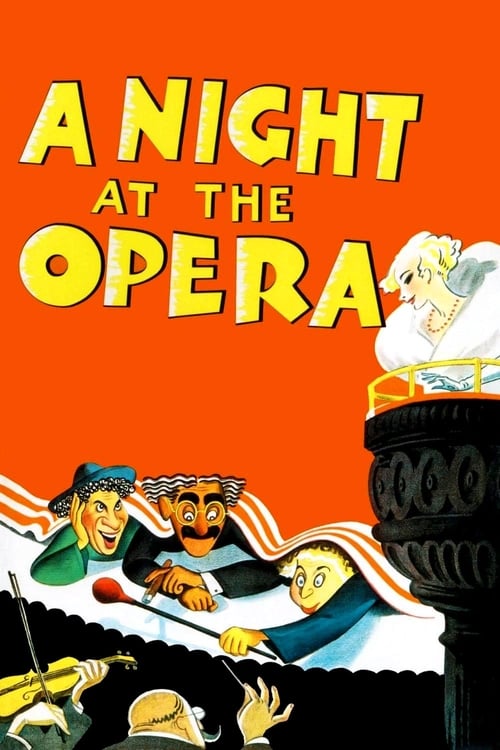
A Night at the Opera
1935 · Sam Wood
When you need a guaranteed laugh and want anarchy with zero stakes — an ideal group watch or a pick-me-up when modern comedy feels too mean.
What it's about
A shameless business manager who's been sponging off a rich widow hitches the fortunes of two young opera singers in love to a transatlantic voyage, aiming to make the tenor a star and humiliate every stuffed shirt in the opera world along the way. Groucho, Chico, and Harpo run their con from steamship stateroom to the stage of the opera house itself, dismantling high society from the inside.
The experience
Pure escalating chaos with a grin — verbal contract-shredding wordplay, sight gags stacked until a room literally can't hold them, and musical interludes that let you catch your breath before the next demolition. Ninety minutes that still get out-loud laughs ninety years on.
Performances
Groucho Marx fires off insults at a rate no one has matched since, with Margaret Dumont as his magnificently unruffled target; Chico and Harpo each get showcase moments — a piano bit, a harp solo — that reveal real musicianship under the clowning.
The craft
This is the Marx Brothers rebuilt at MGM with a plot, romance, and production polish framing the mayhem, and the discipline sharpens the gags — the stateroom scene, where an entire ship's staff crams into a closet-sized cabin, is one of the most perfectly constructed jokes ever filmed. The comic set pieces were road-tested live before cameras rolled, and the timing shows it.
Why it matters
The brothers' biggest hit and most canonized film, it defined how anarchic comedy could survive inside the studio system — and its routines have been quoted, borrowed, and taught ever since.
Snapshot
A Night at the Opera is the film in which the Marx Brothers were rebuilt. Made at MGM under Irving Thalberg after Paramount let the team go, it takes the anarchic vaudeville engine of Duck Soup (1933) and mounts it inside a glossy studio musical — complete with young lovers, two tenor ballads, a harp solo, a piano solo, and a climactic performance of Verdi's Il Trovatore. The result is the most commercially successful and most widely canonized Marx Brothers picture, and also the most contested: it is either the moment the brothers learned to build comedy that lasts, or the moment the studio put a leash on them, depending on which critic you ask.
The premise is a machine for collision. Otis B. Driftwood (Groucho) is fleecing the wealthy Mrs. Claypool (Margaret Dumont) while pretending to advance her social ambitions in the opera world. Fiorello (Chico) manages the unknown tenor Riccardo Baroni (Allan Jones), who loves the soprano Rosa Castaldi (Kitty Carlisle); Tomasso (Harpo) is dresser and punching bag to the preening star Rodolfo Lassparri (Walter Woolf King). Contracts are signed and torn up, stowaways cross the Atlantic, an opera house is demolished from the inside, and the lovers are united. Ninety-six minutes, black and white, Academy ratio.
It contains at least three sequences that have outlived their film: the contract negotiation ("the party of the first part," terminating in Chico's "there ain't no Sanity Clause"), the stateroom scene, and the sabotaged Trovatore finale. Whatever one concludes about MGM's civilizing project, these are among the most durable comic constructions in American cinema.
Industry & production
The context is a career emergency. Paramount and the Marx Brothers had parted after Duck Soup, a film that performed below the studio's hopes and left the team without a contract; Zeppo had quit the act to become an agent, reducing the brothers to three. The much-repeated account of the rescue — that Chico's bridge and card-table friendship with Irving Thalberg opened the door at MGM — is Marx Brothers lore of long standing and should be treated as such, but the outcome is documented: Thalberg signed the team to his own production unit at MGM.
Thalberg's diagnosis was blunt and strategic. The Paramount films, he reasoned, were funny to the point of exhaustion but gave audiences — particularly women, and particularly outside the big cities — no one to care about and nothing to hope for. His prescription was structural: cut the number of gags roughly in half, but make each one work twice as hard; give the brothers a sympathetic object (a pair of lovers) so their destruction serves a cause; supply romance, songs, and production value; and, crucially, aim the comedy at the powerful rather than let it spray indiscriminately. In the Paramount pictures the brothers were a weather system. Here they are, however chaotically, on somebody's side.
The most distinctive production decision was to road-test the comedy in front of paying audiences. Before shooting, the brothers took the film's key sequences out as a live stage act through West Coast theaters, performing several shows a day while writers sat in the house timing laughs, cutting lines that died, and reordering material. This was an attempt to solve a specifically cinematic problem: a stage comic adjusts to the room, but a film print cannot, so laugh-space and rhythm have to be engineered in advance. The practice — essentially previewing the script as vaudeville — is unusual in studio-era Hollywood and is the single most important reason the film's set pieces feel built rather than improvised.
Thalberg assigned Sam Wood to direct, a reliable MGM contract craftsman. Production drew on the full apparatus of the studio at its most confident: Cedric Gibbons's art department, Herbert Stothart's music department, Douglas Shearer's sound department. The film was a substantial hit — decisively so, restoring the brothers as a commercial proposition and prompting the near-identical follow-up, A Day at the Races (1937). Precise ledger figures circulate in the literature via MGM's internal records; rather than cite numbers I cannot verify here, it is enough to say the picture's success was large and unambiguous, and that it defined the team's remaining career. Thalberg's death in 1936 removed the producer who had made the formula work; the later MGM Marx films are widely and correctly regarded as a decline.
Technology
Nothing in A Night at the Opera is technically experimental. It is a demonstration of a mature system. By 1935 the sound film had absorbed its early constraints: blimped Mitchell cameras had restored camera mobility, incandescent lighting had replaced the noisy arcs of the earliest talkies, Western Electric's noise-reduction recording had lowered the optical soundtrack's hiss floor, and re-recording (dubbing) allowed dialogue, music, and effects to be mixed after the fact rather than captured live in one pass.
That maturity is exactly what the film needs, because it is unusually demanding acoustically. It has to carry rapid overlapping dialogue in a crowded closet, an unaccompanied ocean-liner sing-along, solo harp and solo piano, and full orchestral opera. Musical numbers were pre-recorded and performed to playback — standard practice by 1935 — which is what permits the camera to move freely around Allan Jones and Kitty Carlisle without the singers being pinned to a microphone. Douglas Shearer's department was among the industry's most accomplished, and the film's ability to keep Groucho's dry, forward-placed delivery legible against Verdi is a real if invisible achievement.
The other technology at work is the studio itself: standing sets, a full-scale opera house interior, flyable backdrops that can be swapped mid-performance for a fruit cart and a battleship, and rigging solid enough for Harpo to swing across the proscenium on ropes. The finale's comedy depends entirely on the physical plant of a major studio — it is a joke that only a company with a scene dock could tell.
Technique
Cinematography
Merritt B. Gerstad shoots in the MGM house manner: high-key, evenly modeled, glossy, with the soft glamour lighting reserved for Carlisle and the flatter, more utilitarian coverage given to the comedians. The camera's guiding principle in the comic sequences is restraint. Where a later comedy would cut in for reactions, Gerstad and Wood tend to hold wider frames that keep two or three brothers, and often their victims, in the same shot. The gags are frequently spatial — bodies in the wrong place, too many of them — and that requires the frame to show the space honestly.
The stateroom sequence is the purest case. Its comedy is a function of measurable volume: a cabin barely larger than the trunk that arrives in it, filling with stewards, manicurists, engineers, and a woman looking for her aunt. Cutting into close-ups would destroy the arithmetic. The camera instead observes from the corridor side, letting the doorway become a proscenium and the accumulating bodies become a visible graph of pressure. When Dumont finally opens the door, the payoff is purely photographic — the shot has been holding the joke all along.
Editing
William LeVanway's cutting is deliberately unshowy. Its intelligence lies in duration rather than juxtaposition: the film knows how long to sit on a line, when to let a pause land, and — because of the road tour — roughly how much air a laugh will need. The contract scene is essentially a two-shot dialogue duel, cut sparingly, letting Groucho and Chico's rhythm carry it; the tempo of the material was verified on stage before a foot of film was exposed.
The finale is the exception and reverses the method. There the editing becomes genuinely contrapuntal, shuttling between the stage, the pit, the wings, the flies, and the boxes, so that Verdi's score and the brothers' sabotage advance simultaneously in different spaces. The switch of the orchestra's sheet music to "Take Me Out to the Ball Game" is a montage joke — its comedy exists only in the cut between conductor, players, and appalled management.
Mise-en-scène / staging
Cedric Gibbons's art direction supplies the film's central comic argument: every environment is a symbol of hierarchy, and every one gets breached. The liner is stratified into first class, steerage, and the space between; the hotel suite is a maze of beds that migrate from room to room; the opera house is a temple with a backstage that can be turned inside out. The brothers do not attack these institutions rhetorically. They attack them architecturally — by being in the wrong room, on the wrong deck, in the wrong costume, on the wrong side of a curtain.
The steerage sequence is the film's warmest passage and the clearest statement of its politics: immigrants dancing on a lower deck, Allan Jones singing "Cosi Cosa," Chico at the piano, Harpo at the harp. It also earns its comic capital — the class it belongs to is the one the finale will vindicate.
Sound
Beyond the technical competence, sound is a structural resource. The film organizes itself around registers of voice: Groucho's flat, rapid American patter; Chico's dialect wordplay, which turns English into a series of productive misunderstandings; Harpo's total muteness, which throws him back onto horns, whistles, and instruments; and, above all this, the trained operatic tenor and soprano representing "legitimate" voice. Lassparri's Pagliacci opening establishes the register the film will spend ninety minutes deflating; the Trovatore finale restores it, but only after the sound design has been thoroughly vandalized.
The harp and piano solos, often dismissed as pace-killing concessions, are formally consistent with this scheme: they are the two silent-adjacent brothers speaking in the only registers available to them.
Performance
Zeppo's departure sharpens the geometry into a clean trio: aggressor, negotiator, and anarchic id. Groucho's Driftwood is a con man whose weapon is fluency; Chico's Fiorello is a negotiator whose weapon is deliberate incomprehension; Harpo's Tomasso is pure appetite and pure sabotage.
Margaret Dumont's contribution is routinely undervalued. Her performance is not obliviousness but a kind of immovable propriety — she plays every scene entirely straight, at full dignity, which is precisely what gives Groucho a surface to hit. Sig Ruman's Gottlieb, blustering and pompous, established a foil type he would repeat for the team. Allan Jones and Kitty Carlisle, both genuine singers performing their own vocals, are asked to be sincere in the middle of a demolition — a thankless assignment they carry with more charm than the film's detractors usually allow. Walter Woolf King's Lassparri is the necessary condition of the whole design: a star so unpleasant that his humiliation reads as justice.
Narrative & dramatic mode
The Paramount films were revues with plots attached. A Night at the Opera is a farce with a plot that actually functions. Its dramatic mode is classical: two lovers separated by an institution and a villain, assisted by tricksters, resolved by a public performance in which merit is finally recognized.
What makes it more than a formula is that the comic set pieces are integrated into the causal chain rather than suspended above it. The contract scene establishes the legal instrument that will be torn up at the end. The stateroom is a consequence of the stowaway plot. The three-aviators impersonation and the migrating beds are pursuit and evasion. The finale's chaos is not an interruption of the story but the mechanism of its resolution: the brothers wreck the opera to force the management to hire Riccardo. Destruction becomes plot.
The structural cost is real. The film accepts a rhythm of alternation — comedy, romance, song, comedy — that a purist finds compromising, and the romantic scenes are the least alive footage in the picture. The structural gain is that the ending means something. Duck Soup ends by throwing fruit at Dumont. Opera ends with a promise kept.
Genre & cycle
The film sits at the junction of three cycles: the comedian comedy, in which a pre-existing performing persona is imported wholesale from vaudeville or radio into narrative film; the studio musical, in which songs and spectacle carry a share of the entertainment load; and the backstage picture, which was one of the most durable Depression-era forms.
Its distinctive move is to fuse them. Earlier comedian comedies tended to treat plot as scaffolding; the classic backstage musical tended to treat comedy as relief. A Night at the Opera makes the comedians the engine of the backstage plot. This hybrid — anarchic clowns deployed against a snobbish cultural institution, with a romance to justify them — became a template MGM ran again immediately with A Day at the Races, and one visible in later comedian vehicles that place disruptive performers inside a respectable narrative frame.
It also belongs to the long comic tradition of high-culture deflation, the send-up of opera as the emblem of borrowed prestige — a line that runs forward through decades of cartoons and comedies in which a chandelier, a soprano, and a man in tails are shorthand for pretension asking to be punctured.
Authorship & method
Sam Wood is the credited director and, by the standard measures of authorship, not the film's author. A skilled MGM contract director who would later make Goodbye, Mr. Chips, Kings Row, The Pride of the Yankees, and For Whom the Bell Tolls, Wood was reportedly disliked by the brothers, who resented his fondness for repeated takes on material they had already perfected on stage; the caustic remarks attributed to Groucho about him are part of the anecdotal record rather than the documentary one. Wood's actual contribution is real but modest: clean, unobtrusive staging that stays out of the comedy's way — which, for this material, is closer to a virtue than a failing. (Wood's later prominence as a founder and first president of the Motion Picture Alliance for the Preservation of American Ideals belongs to a different chapter of his career, but it marks him as a figure of the studio establishment rather than a subversive.)
The authorship is genuinely distributed. Irving Thalberg is the closest thing to an auteur here: the film's strategy, structure, and tone are his diagnosis executed. The screenplay is by George S. Kaufman and Morrie Ryskind, who had written the brothers' Broadway hits The Cocoanuts and Animal Crackers — a return of the team's original literary architects, and the source of the film's unusually well-machined dialogue. The story credit is James Kevin McGuinness's. Al Boasberg, uncredited, is widely credited within the literature with the stateroom sequence; the colorful story of how he delivered the pages is one of Hollywood's better-worn anecdotes and should be enjoyed as such. Kaufman's remark, on hearing Groucho work, that he thought he had just caught one of the original lines is likewise anecdote — but it captures something true about the method, which was to write tightly, then let the performers erode the writing in front of audiences until only the durable parts remained.
Merritt B. Gerstad photographed; William LeVanway cut; Cedric Gibbons supervised the art direction with Ben Carré; Dolly Tree designed the gowns; Douglas Shearer supervised sound; Herbert Stothart directed the music and handled the Verdi arrangements. The songs are "Alone," by Nacio Herb Brown and Arthur Freed, which became a genuine popular hit, and "Cosi Cosa," by Bronisław Kaper, Walter Jurmann, and Ned Washington. That Freed — soon to run MGM's most important musical unit — supplied the ballad is a small index of how thoroughly the film was folded into the studio's musical apparatus.
Movement / national cinema
This is classical Hollywood at its most systematic: the studio at peak vertical integration, a producer-unit system, a house visual style, and a stable of contract talent. There is no avant-garde ambition anywhere in the film, and its interest for film history is partly that of a perfectly representative artifact.
Its deeper cultural location is American-Jewish immigrant vaudeville. The brothers came out of New York's ethnic-comedy circuit, where dialect masquerade was standard equipment — Chico's Italian is a performance of an accent, not an accent, and the film knows it. What A Night at the Opera stages, at a level below its plot, is a confrontation between European high culture and the American immigrant vernacular that had learned to imitate, mock, and eventually inherit it. The brothers cross the Atlantic as stowaways, arrive with no credentials, and end by dictating terms to the opera. In 1935, with European emigration a live and darkening subject, the ocean-liner setting and the stowaway plot carry a charge the film never states — a resonance worth naming as reading rather than as documented intent.
Era / period
Two dates frame the picture. The first is 1934, when the Production Code Administration under Joseph Breen began enforcing the Code in earnest. A Night at the Opera is the first Marx Brothers feature made entirely inside that regime, and the difference from the pre-Code Paramount films is audible: Groucho's innuendo is redirected from sex toward money, appetite, and social climbing. The wolfishness survives; the specifics are sanded. Something is lost, and something is displaced into the film's economic satire, which is unusually sharp precisely because it is the available channel.
The second is the Depression, six years deep and beginning to lift for the industry. The film's sympathies are legible in its geography: steerage is where the music and warmth are, first class is where the fraud is, and the opera company's board is a collection of pompous men protecting a monopoly. A Depression audience watching a stowaway tenor unseat a bullying star was not watching a neutral fable.
1935 was also a peak year for MGM and for Thalberg personally — Mutiny on the Bounty, also his, took the year's Best Picture Oscar. A Night at the Opera is a product of a producer at the height of his powers and near the end of his life.
Themes
Contracts and the fiction of language. The film opens and closes on documents. The contract scene reduces legal language to noise by simply reading it aloud — "the party of the first part of the party of the first part" — until nothing is left but the clause Chico rejects because he does not believe in Santa Claus. Written authority, the film argues, is a bluff maintained by nobody reading it.
Prestige as a racket. Opera in this film is not art; it is a market in reputation, run by men who cannot sing, sold to patrons who cannot listen, protected by the threat of embarrassment. The brothers' method of attack is to withdraw the embarrassment — they simply refuse to be impressed, and the whole structure loses its grip.
Class and solidarity. The steerage sequence is the film's ethical center. Its position — the underclass has the music, the top deck has the money — organizes everything that follows, and the finale's victory is a victory for the lower deck.
Chaos in the service of order. This is the Thalberg revision made thematic. The brothers destroy an institution, but they destroy it to make it work correctly. It is the difference between nihilism and reform, and it is exactly what the film's critics object to and what its admirers value.
Bodies against systems. Nearly every major gag is physical crowding: too many people in a cabin, too many beds in a suite, too many backdrops on one stage. The films' recurring proposition is that no system survives contact with enough bodies.
Reception, canon & influence
Contemporary reception. The film was received warmly and performed strongly, reestablishing the Marx Brothers commercially after the Paramount collapse. Reviewers of the day generally welcomed the return and the added production polish; the songs, particularly "Alone," found an independent life as popular music.
Influences on the film (backward). The most direct inheritance is the brothers' own stage career: the Broadway shows The Cocoanuts and Animal Crackers, and behind them the vaudeville circuits where the personae were forged over roughly two decades. Kaufman and Ryskind's return imports the Broadway wisecrack tradition — the American theatrical school of insult comedy and verbal precision — directly into the script. The five Paramount features (The Cocoanuts, Animal Crackers, Monkey Business, Horse Feathers, Duck Soup) supply the grammar, with Leo McCarey's work on Duck Soup having sharpened the team's physical comedy. The musical scaffolding derives from the operetta and backstage-musical traditions MGM had been refining since the coming of sound; the target — grand opera as social ritual — comes from a century of stage burlesque that long predates cinema.
Critical afterlife. The film became the standard entry point to the Marx Brothers and a fixture of revival houses, television, and college film societies during the 1960s and '70s rediscovery, when the brothers were adopted as patron saints of a countercultural moment that read their anarchy politically. That adoption produced the durable critical split. One camp — the position associated with critics and historians who prize the Paramount films, and articulated at length in the scholarly Marx literature such as Joe Adamson's Groucho, Harpo, Chico and Sometimes Zeppo — holds that MGM domesticated a genuinely subversive act, replacing pure nonsense with narrative alibis, and that Duck Soup is the greater film. The other holds that Thalberg gave the brothers architecture, and that the set pieces here are better built and better sustained than anything at Paramount precisely because they were engineered. Both positions are defensible; the honest summary is that A Night at the Opera is the team's best-made film and Duck Soup their most radical one.
Institutionally, the film has been thoroughly canonized: it was selected for the Library of Congress's National Film Registry in 1993, and it placed high — twelfth — on the American Film Institute's 100 Years…100 Laughs list, with Duck Soup the only Marx film ranked above it.
Legacy (forward). Its most immediate legacy was internal: A Day at the Races replicated the formula almost beat for beat, and the Thalberg template governed the remainder of the brothers' MGM output. More broadly, the film validated a studio-wide proposition — that comedians could anchor prestige productions if the surrounding narrative gave audiences someone to root for — which shaped the packaging of comedian vehicles for decades.
The stateroom scene became a portable comic idea: the escalating-crowd gag, in which a confined space is filled past absurdity, recurs across sitcoms, sketch comedy, and animation to the point where later generations encounter the joke long before they encounter its source. The sabotaged-performance finale likewise established a template for comic climaxes staged inside a formal cultural ritual.
The film's cultural footprint extends past cinema. Queen named consecutive albums A Night at the Opera (1975) and A Day at the Races (1976) after the two Thalberg productions, an homage that carried the titles to audiences who had never seen a frame of either. Groucho's verbal style — the rapid deflation of authority through pedantic literalism — passed into the standard equipment of American comic writing, and comedians and filmmakers of the postwar generations, Mel Brooks and Woody Allen among the most explicit, have repeatedly acknowledged the brothers as foundational.
Ninety years on, what survives most cleanly is not the plot MGM insisted on but the proof of concept the plot enabled: that comedy engineered in front of live audiences, then photographed with enough patience to let it breathe, holds its shape indefinitely.
A Deleuzian reading
A door opens and fifteen people fall into a corridor.
The full Deleuzian reading of A Night at the Opera →
Reception
A smash on release — it rescued the Marx Brothers' career after Duck Soup underperformed and Paramount let them go — and it's stayed canonical ever since, though modern viewers are more ambivalent about the MGM polish that made it a hit.
How A Night at the Opera was received, from release to now →
How to watch A Night at the Opera: what to notice on a first viewing
- Watch how the camera stays back during the crowded stateroom scene. Gerstad and Wood hold a wide shot from the corridor instead of cutting to close-ups as more and more people pack into the cabin. You can only find the joke funny if you can actually count the bodies.
- Notice how many bodies end up crowded into small spaces. Nearly every major gag is physical crowding, too many people in a cabin, too many beds in a suite, engineered so the space itself becomes the joke. The film argues that no system survives contact with enough bodies in the wrong room.
- Listen for how differently each brother uses his voice. Groucho's rapid patter, Chico's deliberate misunderstandings, and Harpo's total silence are kept distinct throughout, set against the trained opera voices around them. Each brother's whole comic weapon is audible before he does anything.
- Notice the contract's language collapse the longer it's read. Groucho and Chico read the legal document aloud until 'the party of the first part' turns into noise, and Chico rejects a clause because he doesn't believe in Santa Claus. Written authority is a bluff nobody actually reads.
- Notice the steerage deck scene, with dancing, piano, and harp. The film gives its warmest, most unhurried passage to the immigrants on the lower deck rather than the wealthy passengers above. The music belongs to the class with the least money, not the most.
The whole guide to watching A Night at the Opera, with the keys for a rewatch →
Influences: the films it descends from and the films it influenced
- The Cocoanuts (1929) — Transferred the brothers' Broadway blocking to film wholesale, parking the camera at proscenium distance while the Chico/Groucho "why-a-duck" routine runs its full stage length — the held-wide-shot, duration-over-juxtaposition grammar Wood later refines rather than replaces.
- Animal Crackers (1930) — Kaufman and Ryskind's drawing-room construction fixed Margaret Dumont as the immovable straight foil whose unbroken social dignity gives Groucho's insults a surface to strike; Mrs. Claypool is that same instrument retuned for MGM.
- Monkey Business (1931) — The shipboard-stowaway structure — four men hidden in a liner's cargo, the forged-passport routine, the ocean crossing as a confined comic geography — is the direct prototype for the steerage voyage and trunk smuggling here.
- Horse Feathers (1932) — Established the institution-infiltration architecture (comedians turned loose inside a body with rituals to desecrate) and the sustained two-man verbal duel — Chico's password routine — sustained in a single wide setup with no cutaway to relieve it.
- Duck Soup (1933) — McCarey's silent-comedy training drilled the team in metronomic pantomime timing — the mirror sequence's mirrored beats — and that physical precision carries directly into Harpo and Chico's contract-tearing and the stateroom's choreographed body arithmetic.
- Berth Marks (1929) — Laurel and Hardy's fight for a single train berth builds its comedy by accumulation and duration inside an impossibly small volume rather than by cutting — the confined-space escalation logic the stateroom scene scales up from two bodies to fifteen.
- The Phantom of the Opera (1925) — Rendered the opera house as vertical geography — flies, catwalks, boxes, backstage machinery — a building to be transgressed from above during a live performance, the exact spatial vocabulary the sabotaged Il Trovatore finale exploits when Harpo takes to the rigging.
- Grand Hotel (1932) — Thalberg's prestige unit-set model: contrapuntal crosscutting between parallel actions distributed through one Cedric Gibbons building, proving a single architectural space could carry a whole film's editing scheme.
- The Merry Widow (1934) — Supplied the MGM operetta register under Gibbons — high-key gloss on marble, mirrors and grand staircases, doorways framed as proscenia — the polished surface that the Marxes' vandalism needs in order to register as vandalism.
- The Broadway Melody (1929) — Pioneered Douglas Shearer's prerecorded-playback method at MGM, freeing musical numbers from live-take immobility; "Alone" and the opera passages are staged to tracks laid down first, which is what lets the camera and the gags move during the music.
- A Day at the Races (1937) — Replicates the Thalberg engineering beat for beat — vaudeville road-testing of routines before shooting, Dumont foil, romantic subplot as narrative alibi, and a climax that sabotages a formal ritual (the race) from inside its machinery.
- Hellzapoppin' (1941) — Runs the sabotaged-performance template at maximum voltage: comedians who control the backstage machinery dismantle a formal show while it plays, with the projection apparatus itself treated as available scenery.
- Some Like It Hot (1959) — The Pullman-berth party transposes the stateroom's crowd arithmetic exactly — bodies admitted one at a time into a space that visibly cannot hold them, the count itself becoming the joke, held rather than cut around.
- A Hard Day's Night (1964) — Builds the Beatles' screen personae on the Marx ensemble scheme — one fixed comic type per member, a deadpan authority figure as foil, confined-compartment gags on a train — with songs integrated as set pieces inside the plot rather than as stops in it.
- The Producers (1967) — Stages its climax as catastrophe inside a formal cultural ritual before a paying audience — the sabotaged-performance finale codified here — with the theater's own conventions of decorum doing the comic work.
- What's Up, Doc? (1972) — Revives the engineered set piece as narrative spine: the four-identical-cases convergence funnels escalating numbers of bodies into one hotel corridor and room, an explicit stateroom descendant built with the same additive escalation.
- Airplane! (1980) — Industrializes the Dumont function — Leslie Nielsen's unbroken institutional dignity is the straight foil's flat surface, played by professionals of gravity so absurdity has something rigid to break against.
- The Party (1968) — Codifies the anarchic outsider demolishing a formal high-society occasion, the social-disruption premise Hrundi V. Bakshi enacts at the producer's party.
- You’re Missing the Point (1940) — The 'sanity clause' contract scene reduces a legal document to escalating double-talk, prefiguring the courtroom climax where Cantinflas defeats the legal apparatus by talking meaningful-sounding gibberish at it.
- Playtime (1967) — Pushes duration-over-juxtaposition to its limit: gags distributed in depth across a held wide shot and resolved by staging, architecture and sound rather than by editing — the Marx wide-shot principle rebuilt as an entire visual system.
Similar films
- Duck Soup (1933) — influence & lineage
- Some Like It Hot (1959) — influence & lineage
- Hellzapoppin' (1941) — influence & lineage
- The Producers (1968) — shared sensibility
- The Rules of the Game (1939) — shared sensibility
- It Happened One Night (1934) — shared sensibility
- Cabaret (1972) — shared sensibility
- Fantasia (1940) — shared sensibility