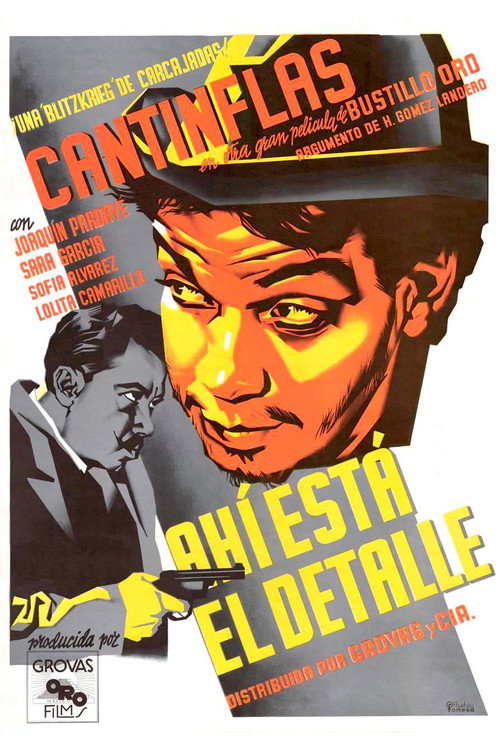
You’re Missing the Point
1940 · Juan Bustillo Oro
For when you want to laugh at glorious nonsense — a breezy, low-stakes classic comedy for a relaxed night, and a treat if wordplay is your kind of humor.
What it's about
A fast-talking tramp sneaks into a wealthy household to deal with a mad dog, and through a servant's quick lie gets mistaken for the family's long-lost brother-in-law — whose return happens to be the condition for unlocking an inheritance. So the freeloader is welcomed like a king, the lies pile up, and the whole tangle of mistaken identity, jealous spouses, and an unexplained murder eventually lands in a courtroom.
The experience
Pure verbal fireworks — Cantinflas talks in dizzying circles, saying everything and committing to nothing, and the farce escalates until the courtroom itself surrenders to the confusion. It's light, silly, and genuinely funny in a way that has aged into charm.
Performances
Cantinflas, in the role that made him a star: his torrential, evasive patter — circling a point without ever landing on it — is a comic instrument nobody has really replicated, and this film is its purest showcase.
The craft
Juan Bustillo Oro builds a classic farce architecture sturdy enough to let his star improvise chaos inside it, with the mistaken-identity plot ratcheting neatly toward a trial where language itself breaks down. The comedy is in the timing and the talk more than the camera.
Why it matters
A foundational comedy of Mexican cinema's Golden Age — the film that turned Cantinflas from a revue-stage sensation into a pan-Hispanic screen icon, with a catchphrase title that entered everyday speech.
Snapshot
Released in Mexico as Ahí está el detalle, this film is one of the foundational comedies of the Golden Age of Mexican cinema (la Época de Oro) and the picture most often credited with elevating Mario Moreno "Cantinflas" from a revue-stage and short-film sensation into a national and pan-Hispanic screen star. Directed by Juan Bustillo Oro, it takes a farce of mistaken identity — a shabby street tramp is passed off as the long-lost brother-in-law of a wealthy household in order to satisfy the terms of an inheritance — and uses it as a scaffold for Cantinflas's signature performance mode: torrential, circular, evasive verbiage that says everything and commits to nothing. The title itself preserves the star's catchphrase, "ahí está el detalle" ("there's the detail," i.e., "that's the whole point"), and the English release title You're Missing the Point renders the same idea. The film is widely regarded as one of the essential documents of Mexican popular comedy, and its courtroom climax is among the most cited sequences in the country's film history. Beyond that broad consensus, much of the granular production record is thinly documented in English-language scholarship, and where that is the case this dossier says so rather than filling gaps.
Industry & production
The film belongs to the rapid expansion of Mexican sound cinema at the end of the 1930s, a period in which Mexico City studios were consolidating an industrial base — soundstages, contracted stars, distribution networks reaching across Latin America and into Spanish-speaking audiences in the United States. Cantinflas had emerged from the carpa (tent-show) tradition and the popular teatro de revista, and had already appeared in shorts and a handful of features; Ahí está el detalle is conventionally identified as his decisive feature breakthrough, the vehicle that fixed his screen persona and demonstrated that his stage act could carry a full-length narrative. The production is associated with Cantinflas's own producing interests (Posa Films, the company built around his star image) working within the broader studio economy of the era, though the precise financing and distribution arrangements are not something I can state with confidence from the documented record; readers should treat any single attribution of producer or studio with caution absent a primary source. What is clear is the commercial logic: build a feature around a proven comic personality, surround him with seasoned character players, and let the star's verbal act — already famous — do the marketing.
Technology
Technically the film is a product of standard late-1930s Mexican studio practice: 35mm black-and-white photography, optical sound recorded on the negative, and studio-bound shooting on constructed interiors supplemented by limited location work. This was well after the transition to sound (Mexican sound cinema dates from the early 1930s), so synchronized dialogue was mature technology — a crucial point for a film whose entire comic engine is speech. The picture required a sound system capable of capturing Cantinflas's rapid, tonally shifting delivery cleanly, and the recording is serviceable to that end. There is no indication of technological novelty; the film's innovations are performative and linguistic rather than mechanical. Color, widescreen, and other later advances are of course absent, and the aesthetic is the flat, evenly lit studio look typical of commercial Mexican comedy of the moment.
Technique
Cinematography
The visual strategy is functional and performer-centered: the camera exists to frame Cantinflas and his interlocutors legibly, favoring medium and medium-long shots that keep the comedian's whole body — his slouch, his hitched trousers, his shrugs and sidelong glances — inside the frame, because his physical comedy is inseparable from his verbal comedy. The photography is even and unshowy, prioritizing clarity of the ensemble over expressive lighting effects. The specific cinematographer credit I would rather not assert without confirmation; Mexican comedies of this period were typically shot by the established studio operators of the day, and the work here is consistent with that competent, unobtrusive house style. The restraint is a virtue: nothing in the camerawork competes with the dialogue.
Editing
The cutting serves comic timing and expository clarity in a farce that depends on the audience always knowing more than the characters do about who is mistaken for whom. Editing generally holds shots long enough to let Cantinflas's monologues build and spiral — the humor lives in duration, in the accumulating absurdity of a sentence that never lands — while cutting to reaction shots of baffled listeners to register the effect of that verbal fog on other people. The film's construction is essentially theatrical, organized in extended dialogue scenes rather than montage-driven sequences, and the editing respects that rhythm.
Mise-en-scène / staging
The staging reflects the film's roots in popular theater. Sets are the familiar oppositional spaces of class farce — the well-appointed bourgeois household versus the world of servants and the street — and the blocking arranges characters so that misunderstanding is spatially legible. Cantinflas is repeatedly placed as an intruder in a milieu where he does not belong, and much of the comedy is generated by his body language reading "wrong" against elegant domestic backgrounds. The mise-en-scène is not pictorially ambitious; it is a frame for performance and for the social contrasts the plot turns on.
Sound
Sound is the film's true medium. Ahí está el detalle is, above all, a movie to be listened to. Cantinflas's art — later enshrined in Spanish as the verb cantinflear, "to talk a great deal without saying anything" — is a torrent of syntactically plausible, semantically empty speech that mimics the cadences of authority, courtesy, and legal argument while evading meaning entirely. The soundtrack therefore foregrounds dialogue above all else. Musical scoring is present in the conventional supporting role of the period, but I cannot reliably name the composer, and I will not guess; the memorable "music" of the film is the rhythm of its language.
Performance
Performance is where the film earns its stature. Cantinflas constructs a fully realized comic persona — the underclass pelado, ragged and marginal, who disarms his social superiors by drowning them in words. It is a performance of enormous verbal dexterity married to precise physical business, and it works because it is also a social gesture: the powerless man who cannot win by force or status wins by making language itself useless to those who wield it. Crucially, he does not carry the film alone. He is supported by a formidable ensemble of Golden Age character actors — the record commonly associates the cast with figures such as Joaquín Pardavé, Sara García, Sofía Álvarez, and Dolores Camarillo, players who anchor the farce in recognizable domestic and bourgeois types. Their grounded seriousness is the straight-faced foundation against which Cantinflas's chaos registers as comedy.
Narrative & dramatic mode
The dramatic mode is classic farce built on mistaken identity, imposture, and the collision of social classes. The mechanics are engineered for maximum confusion: a tramp is enlisted, then reframed as the household's long-missing relative because a will can only be settled when all the brothers are reunited, which turns a nuisance into a treasured guest. Layered on top is a second mistaken identity — the vagabond becomes entangled with the identity of a wanted criminal — that drives the plot toward its judicial climax. The narrative logic is the logic of farce: every lie requires another lie, every solution deepens the tangle, and the audience is kept in privileged possession of the truth while the characters flail. The film's most celebrated set piece is its courtroom sequence, in which Cantinflas, on trial and cross-examined, defeats the entire apparatus of legal reason through sheer incomprehensibility — a scene that crystallizes the whole film's thesis that his verbal fog is a kind of power.
Genre & cycle
The film sits within the comedia ranchera-adjacent but distinct current of urban Mexican popular comedy, specifically the star-vehicle comedy built around a single revue-born comedian. It belongs to the cycle of Cantinflas features that would dominate Mexican comedy for two decades, and it is generally treated as the cornerstone of that cycle — the film that established the template subsequent Cantinflas vehicles would follow: a loose situational premise engineered to deposit the pelado among people of higher status, a series of set pieces built around his monologues, and a sentimental-comic resolution. More broadly it belongs to the international tradition of the tramp-comedian and the trickster of low status who exposes the pretensions of his betters.
Authorship & method
Juan Bustillo Oro is the credited director, and his authorship here is that of a versatile studio professional who worked across genres — he is remembered in Mexican film history as much for atmospheric and melodramatic work (his early Dos monjes is a touchstone of Mexican expressionist-inflected cinema) and for nostalgic period films as for comedy. His method on Ahí está el detalle is best understood as the intelligent subordination of directorial personality to a performer: the film's shape, pacing, and staging are organized to release Cantinflas rather than to impose a directorial signature. That is itself an authorial decision — recognizing that the star's improvisatory verbal genius needed room, and building a sturdy farce architecture strong enough to contain it. Regarding the key technical collaborators — cinematographer, composer, editor, and the writing credits — I want to be candid that I cannot confirm the specific names from memory with the certainty this dossier requires, and I decline to attach names that I cannot vouch for. What can be said is that the film is the product of a mature studio craft ensemble working in service of a singular comic talent, and that the screenplay's contribution is inseparable from Cantinflas's own capacity to expand and transform written dialogue in performance.
Movement / national cinema
The film is a central artifact of the Golden Age of Mexican cinema, the roughly two-decade span from the mid-1930s into the 1950s during which the Mexican film industry became the dominant Spanish-language cinema in the Americas. Within that movement, Ahí está el detalle represents the comedic and popular-cultural wing — the cinema that drew directly on carpa, revista, and the vernacular life of Mexico City's working class, as opposed to the prestige melodramas and comedias rancheras that also defined the era. Cantinflas became one of the age's defining faces, and this film is a primary reason. It also exemplifies how the national cinema built its identity partly through a distinctively Mexican relationship to language and class — the pelado as a figure of national self-recognition.
Era / period
Made in 1940, the film stands at the threshold of the Golden Age's most productive decade. The Mexican industry was about to benefit enormously from the disruption of European film production during the Second World War, which cleared competitive space and expanded Mexican cinema's reach across Latin America. Ahí está el detalle thus arrives just as the conditions for a boom were falling into place, and its success helped demonstrate the commercial viability of the star-comedian model that the industry would exploit throughout the 1940s. The film's sensibility — its affectionate attention to the urban poor, its distrust of bourgeois and legal pretension — is very much of its moment in a modernizing, self-examining Mexico.
Themes
The film's governing theme is class and the power of language across class lines. Cantinflas's pelado has no money, no status, and no legitimate claim to the space he occupies, yet he neutralizes the authority of the wealthy, the respectable, and finally the court through language alone. His verbal evasiveness reads simultaneously as comedy and as social commentary: the institutions of property, family legitimacy, and law are shown to depend on clear meaning, and the poor man's weapon is to make meaning unavailable. Secondary themes include imposture and identity — the ease with which a person can be assigned a false self when it serves others' interests — and the satire of inheritance, respectability, and legal formality. Beneath the farce runs a durable populist sympathy: the marginal man is the one with wit and vitality, and the comfortable are the ones exposed as absurd.
Reception, canon & influence
The film is securely canonical within Mexican cinema. It is routinely named among the essential comedies of the Golden Age and as the decisive film in Cantinflas's rise to become the most celebrated comedian of Spanish-language cinema; retrospective assessments frequently place it on lists of the greatest Mexican films. Its cultural afterlife is unusually concrete: the film's association with Cantinflas's verbal style contributed to the entry of cantinflear and its cognates into the Spanish language as recognized words for meaningful-sounding nonsense — a rare instance of a screen performance leaving a permanent mark on a language itself. I would flag, honestly, that detailed contemporaneous critical reviews and hard commercial figures are not something I can quote reliably, and I will not manufacture them; the strongest documentation is the film's retrospective canonization and its linguistic legacy.
Looking backward, the influences on the film are clearest in the carpa and teatro de revista traditions from which Cantinflas came, and in the broader lineage of the tramp-comedian and the trickster of low estate — the international type of the ragged outsider who deflates authority, of which Chaplin is the most famous cinematic ancestor, though Cantinflas's verbal (rather than primarily physical) genius makes him a distinct variant. Looking forward, the film established the durable template for the Cantinflas vehicle and, through it, shaped Mexican comedy for a generation; Cantinflas would go on to international fame, and this film is the origin point of that trajectory. Its deepest influence, though, is cultural rather than strictly cinematic: it helped make a working-class comic archetype into an emblem of national identity, and it left a word in the dictionary.
A Deleuzian reading
A man stands in a rich family's parlor in clothes that hang wrong on him: trousers hitched up, shoulders slouched, eyes sliding sideways.
The full Deleuzian reading of You’re Missing the Point →
Reception
A smash on release in 1940, it turned Cantinflas from a carpa (tent-show) comic into Mexico's biggest movie star — and it's never really fallen: it's still routinely cited as the best Mexican comedy of the Golden Age, and often as Cantinflas's one indispensable film.
How You’re Missing the Point was received, from release to now →
How to watch You’re Missing the Point: what to notice on a first viewing
- Watch how the camera keeps Cantinflas's whole body in frame. Medium and medium-long shots hold his slouch, his hitched trousers, and his shrugs alongside his face, so his physical comedy reads as clearly as his talk. The framing never cuts away from his body, because his gestures are half the joke.
- Listen for how long a sentence runs before it says anything. Cantinflas spins syntactically correct, fully confident speech that never lands on a plain meaning, mimicking the cadence of courtesy and authority while committing to nothing. His talk sounds like it means something the whole time, and that sound is the entire trick.
- Watch the listeners' faces while Cantinflas keeps talking. The film holds his monologues long enough to build and spiral, then cuts to the baffled faces of Joaquín Pardavé and the other actors listening to him. Their confusion measures exactly how much sense his fast talk is not making.
- Notice how out of place Cantinflas looks in the wealthy household. He is repeatedly staged as an intruder among polished furniture and well-dressed relatives, his posture and clothes reading wrong against the elegant domestic setting around him. The mismatch between his body and the room tells the class joke before any line of dialogue does.
The whole guide to watching You’re Missing the Point, with the keys for a rewatch →
Influences: the films it descends from and the films it influenced
- The Kid (1921) — Establishes the ragged-outsider-deflates-authority persona and the practice of framing and cutting the whole film around a single comic body, the physical template the pelado inherits and transposes into a verbal register.
- Modern Times (1936) — Builds a sturdy narrative armature whose only job is to feed the comedian set-pieces against faceless institutions — the same 'strong farce scaffold subordinated to the star' architecture Bustillo Oro uses to release Cantinflas.
- Duck Soup (1933) — Groucho's rapid officialese-that-means-nothing, weaponized against courts and government, is the direct verbal-comedy ancestor of cantinflear — authoritative-sounding nonsense as the engine of the gag.
- A Night at the Opera (1935) — The 'sanity clause' contract scene reduces a legal document to escalating double-talk, prefiguring the courtroom climax where Cantinflas defeats the legal apparatus by talking meaningful-sounding gibberish at it.
- Allá en el Rancho Grande (1936) — Codifies the commercial Golden Age formula of a mature studio-craft ensemble organized entirely to sell one star persona, the industrial template Ahí está el detalle plugs Cantinflas into.
- Dos monjes (1934) — Same director's expressionist-inflected atmospheric staging shows the personal signature he here deliberately withholds — the authorial decision to subordinate his own visual craft to the performer is legible only against this earlier flamboyance.
- Así es mi tierra (1937) — Cantinflas's early screen appearance ports the carpa/teatro-de-revista pelado routine onto film for the first time, the raw persona Ahí está el detalle would finally give a workable feature architecture.
- El signo de la muerte (1939) — The immediately preceding Cantinflas vehicle, still hunting for how to frame and pace long improvisatory verbal riffs on camera — the unsolved problem Bustillo Oro's long-takes-for-timing solves a year later.
- El gendarme desconocido (1941) — Launches the near-exclusive Delgado–Cantinflas partnership and locks in the mature vehicle formula — plot as pretext, staging tuned to give the verbal improviser room — first proven in Ahí está el detalle.
- Ni sangre ni arena (1941) — Extends the star-vehicle template by dropping the pelado into a genre-parody frame (bullfighting), keeping the same class-farce spaces and mistaken-identity mechanics as scaffolding for the verbal turns.
- El Bolero de Raquel (1957) — A mature entry that runs the identical craft recipe — episodic farce spaces built to trigger cantinflear set-pieces — showing how durably the 1940 architecture reproduced across two decades.
- Around the World in 80 Days (1956) — Exports the pelado wholesale as Passepartout: a performer-centered comic supporting turn that carries the persona's physical-verbal deflation of pomp into an international production.
- Ni de aquí ni de allá (1988) — La India María's language-and-class comedy directly extends the pelado template — a lower-class outsider whose speech register both marks and outwits social power — into a later star-vehicle built around one comic persona.
- A Dog's Will (2000) — Turns Cantinflas's verbal quick-wittedness into a courtroom farce where the picaro talks his way out of a tribunal, the trickster-in-the-dock craft João Grilo's celestial trial reprises.
- The Great Dictator (1940) — Chaplin's own 1940 pivot from physical to vocal comedy — the mock-German gibberish oratory that sounds like authority while meaning nothing — is a parallel invention of the same authoritative-nonsense device as cantinflear.
- His Girl Friday (1940) — A contemporaneous experiment in making sheer dialogue density and speed the comic mechanism, foregrounding talk over gesture in the same way Bustillo Oro's mixing and framing put Cantinflas's word-torrent at the center.
- El rey del barrio (1949) — Tin Tan's caló/pachuco patter is a parallel carpa-derived invention — a distinct urban verbal-comedian persona built on the same class-farce-space, star-vehicle chassis rather than descended from cantinflear itself.
Similar films
- The Great Dictator (1940) — influence & lineage
- The Discreet Charm of the Bourgeoisie (1972) — shared sensibility
- A Dog's Will (2000) — shared sensibility
- Nazarín (1959) — shared sensibility
- Martin (Hache) (1997) — shared sensibility
- Welcome Mr. Marshall! (1953) — shared sensibility
- Trouble in Paradise (1932) — shared sensibility
- The Exterminating Angel (1962) — shared sensibility