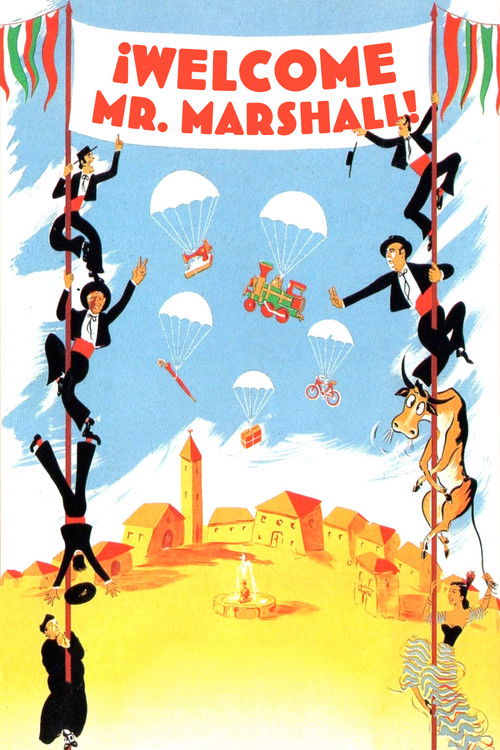
Welcome Mr. Marshall!
1953 · Luis García Berlanga
For when you want a comedy with teeth — something funny and humane that's also quietly saying something sharp about national self-delusion. Easy to watch, but it leaves a bruise worth thinking about.
What it's about
Word reaches the poor Castilian village of Villar del Río that American Marshall Plan officials may pass through — and suddenly there's money on the horizon. The mayor and town notables scramble to dress their dusty pueblo up as a picture-postcard Andalusia, complete with flamenco costumes and rehearsed folklore nobody there actually knows, each villager privately dreaming of what the Americans might bring them.
The experience
A warm, busy village comedy with a razor hidden in it — you laugh at the fussing and the costumes, then notice the satire has been aimed at everyone the whole time, including the audience. It stays light on its feet even as a melancholy undertow gathers toward the end.
The craft
Berlanga and co-writer Juan Antonio Bardem smuggle real political observation past the censors inside folkloric knockabout — the script's double game is the whole show, and it's masterfully sustained. The ensemble choreography of a whole town performing a fantasy version of itself gives the film its best images: rehearsals of borrowed traditions, a village lined up along a road, waiting.
Why it matters
The founding text of modern Spanish film comedy, and a film whose images became national shorthand in Spain for foreign fantasy and thwarted hope; it launched Berlanga as the country's great satirist.
Snapshot
¡Bienvenido, Mister Marshall! is a satirical comedy about a poor Castilian village, Villar del Río, that scrambles to costume itself as a picture-postcard Andalusia when word arrives that American officials of the Marshall Plan may pass through. Directed by Luis García Berlanga from a screenplay he wrote with Juan Antonio Bardem and the veteran comic playwright Miguel Mihura, and produced by the left-leaning cooperative UNINCI, it is the founding text of modern Spanish film comedy: a work that smuggled sharp social and political observation past Francoist censorship under the cover of folkloric knockabout. Its images — villagers rehearsing flamenco they do not know, a whole town waiting at the roadside for cars that never stop — became national shorthand for Spanish self-image, foreign fantasy, and thwarted hope. The film was recognized at the 1953 Cannes Film Festival and remains a fixture near the top of virtually every canon of Spanish cinema.
Industry & production
The film was made under the conditions of Francoist autarky in the early 1950s, when the Spanish industry ran on state protection, import quotas, and a censorship-and-classification regime that determined a film's commercial fate through subsidy categories and dubbing licenses. It was produced by UNINCI (Unión Industrial Cinematográfica), a production company that in this period became a gathering point for filmmakers of oppositional and Communist sympathies; its involvement is central to why the project could be as pointed as it is, and to the later scrutiny UNINCI attracted. The immediate industrial context was the founding moment of a self-consciously serious Spanish cinema: the 1955 "Conversaciones de Salamanca," at which Bardem would famously indict Spanish film, lay just ahead, and Bienvenido is often read retrospectively as an early salvo of that renovating impulse.
Berlanga came to the film through the state film school, the IIEC (Instituto de Investigaciones y Experiencias Cinematográficas), where he and Bardem had trained together; the pair had already co-directed Esa pareja feliz (That Happy Couple, shot 1951, released 1953). Bienvenido was Berlanga's first solo direction and his breakthrough. The financial specifics — budget, returns — are not something I can state with confidence; readers should treat any precise figures with caution, as the reliable record here is thin. What is well established is the film's outsized cultural return relative to its modest means, and its function as a launch pad for the careers of nearly everyone involved.
Technology
Bienvenido is a black-and-white 35mm film in the standard Academy aspect ratio, with monophonic optical sound — entirely conventional technology for a Spanish production of 1953, before widescreen and color became routine in the domestic industry. Like most Spanish features of the era it was post-synchronized: dialogue and the abundant musical numbers were recorded and mixed in the studio rather than captured live, a norm dictated both by equipment and by the dubbing culture of the period. The production combined studio interiors with location work; the exteriors of "Villar del Río" were shot in a real village north of Madrid (Guadalix de la Sierra is the location most consistently cited), and the film's texture depends on that plain, dusty, real-world Castilian setting playing against the artificial Andalusian façade the villagers erect over it.
Technique
Cinematography
Photography is credited to Manuel Berenguer, one of the more accomplished Spanish cinematographers of the period. The visual approach is legible and functional in the register of Italian neorealism as filtered through commercial comedy: available-feeling daylight exteriors, deep and busy compositions that keep the whole community in frame, and a documentary flatness for the "real" village that sets off the theatrical staging of the fake Andalusia. Berlanga's celebrated taste for the long take and the crowded, choreographed group shot — the roving camera that threads through a mass of characters — is already visible here in embryo, though it would become far more radical in his later work. Set against this baseline realism, the film's dream sequences shift register entirely into stylized, genre-parodic imagery.
Editing
The film alternates a brisk expository rhythm — driven hard by voice-over narration — with set-piece sequences that are allowed to breathe: the town meeting, the mass rehearsal of the welcome, the four dream interludes, and the anticlimactic passage of the motorcade. Editing on Spanish films of this vintage is not always cleanly documented; the cutting is commonly credited to Pepita Orduña, though I would flag attribution of the editing as one of the less securely recorded credits. The most conspicuous editorial gesture is structural rather than granular: the sudden tonal cuts into each character's dream and back out again, which let the film ironize its figures' private fantasies before returning them to disappointment.
Mise-en-scène / staging
Mise-en-scène is where the film does its heaviest lifting, because its whole subject is the staging of an identity. The narrative literalizes theatricality: the villagers dress a set, don Andalusian costumes, hang decorations, and rehearse a performance of "Spanishness" for an audience of foreigners. Berlanga stages the community as an ensemble, filling the frame with faces and keeping the town itself — square, church, town hall, road — as a recurring stage. The gap between the shabby Castilian reality underneath and the flamenco-poster fantasy pasted over it is a mise-en-scène joke sustained across the entire film, and it culminates in the deflation of the empty road.
Sound
Music is not decoration here but engine and theme. The score and songs are credited to Jesús García Leoz, and the film's Andalusian musical numbers — above all the welcome anthem sung by Lolita Sevilla — are diegetically motivated as the town's rehearsed offering to the Americans. The lyrics of the songs are frequently attributed to the screenwriters (Berlanga and Bardem), and the numbers function ironically: the "authentic" Spanish folklore on the soundtrack is precisely the borrowed, touristic Andalusian idiom the Castilian villagers have adopted as a disguise. Equally important is the omniscient narrator, whose dry, knowing voice-over frames the action, introduces the townspeople, and supplies much of the film's irony — one of the most distinctive uses of comic narration in Spanish cinema.
Performance
The ensemble is anchored by two towering character actors. José Isbert plays the deaf, doddering, well-meaning mayor Don Pablo, and his hesitations and mangled attempts at an official speech are among the film's comic high points; Manolo Morán plays Manolo, the sharp-talking impresario of the visiting flamenco act who effectively stage-manages the town's transformation. Lolita Sevilla, a real copla and flamenco performer, provides the musical star turn as the singer Carmen Vargas; Elvira Quintillá plays the schoolteacher and Alberto Romea the impoverished hidalgo. The performances balance broad comic types drawn from the Spanish sainete tradition with enough human specificity — small vanities, small dignities — that the eventual disappointment lands emotionally rather than merely as farce.
Narrative & dramatic mode
The dramatic mode is choral, ironic comedy built on a single sustained anticipation: the whole film is a build-up to an arrival that is denied. Structurally it is a "waiting" narrative — the community organizes itself entirely around an event that never properly happens, and the comedy derives from the mismatch between colossal collective effort and null result. Within this armature Berlanga braids together the individual desires of the townspeople, given interior form through the four dream sequences (the mayor's, the priest's, the hidalgo's, the farmer's), each parodying a different genre — the American Western, religious/Inquisitorial spectacle, and so on — to expose how thoroughly imported fantasies colonize even private imagination. The narrator's voice-over holds the pieces together and maintains the film's characteristic double vision: affectionate toward the villagers, mordant about the illusions they and their country live by. The ending, in which the cars sweep through without stopping and the town is left with debt and deflation, is a deliberate anticlimax that converts comedy into quiet social critique.
Genre & cycle
The film sits at the crossing of several Spanish traditions. It draws on the españolada — the folkloric, Andalusian-flavored popular film and musical — but turns it inside out, using the genre's own clichés as the object of satire rather than the source of pleasure. It belongs equally to the theatrical lineage of the sainete and to the grotesque-satirical vein of the esperpento associated with Valle-Inclán, which would run through Berlanga's whole career. Historically it inaugurates the cycle of socially critical Spanish comedy that Berlanga, and later his collaboration with Rafael Azcona, would define — a mode in which choral farce carries serious commentary on Spanish society under Franco.
Authorship & method
Berlanga is the auteur of record, but Bienvenido is emphatically a collaborative object. The screenplay is credited to Berlanga and Bardem together with Miguel Mihura, and the pairing matters: Bardem brought the politically engaged, neorealist-influenced sensibility that he would soon articulate at Salamanca and pursue in his own films (Muerte de un ciclista, Calle Mayor), while Mihura brought a pedigree in absurdist and verbal comedy (he was the founder of the humor magazine La Codorniz and author of Tres sombreros de copa). The result fuses social critique with a genuinely funny, linguistically inventive surface — arguably the combination that let the film pass censorship. Berlanga's directorial method, even at this early stage, favors ensemble orchestration, the moving camera, dense sound, and a tone that is simultaneously warm and corrosive. His signal later collaborator, screenwriter Rafael Azcona, is not part of this film — that partnership began at the start of the 1960s (Plácido, El verdugo) — a distinction worth preserving against the tendency to read Berlanga's whole œuvre through Azcona. The key craft collaborators here are cinematographer Manuel Berenguer and composer Jesús García Leoz; the editor is generally given as Pepita Orduña, with the caveat noted above.
Movement / national cinema
Bienvenido is a landmark of Spanish national cinema and one of the earliest Spanish films to absorb the lessons of Italian neorealism — location shooting, ordinary communities, a documentary interest in the poor and provincial — while bending them toward satire rather than pathos. It stands at the head of a renovating current within an industry otherwise dominated by folklore, historical spectacle, and religious drama, and it is inseparable from the oppositional milieu of UNINCI and from the Salamanca generation's ambition to make a Spanish cinema that was, in Bardem's later formulation, socially useful and truthful. In the longer view it is a cornerstone of the specifically Spanish tradition of grotesque social comedy.
Era / period
The film is a document of Spain in 1953 with unusual precision. Spain under Franco had been excluded from the actual Marshall Plan and from the postwar Western reconstruction, isolated diplomatically and economically through the 1940s. In the very year of the film's release, that isolation began to end with the Pact of Madrid (the 1953 defense and economic agreements between Franco's Spain and the United States, which brought American bases to Spanish soil). Bienvenido captures the resulting national mood exactly: the hunger for American aid and recognition, the humiliation of performing for a foreign benefactor, and the suspicion that the whole transaction would leave ordinary Spaniards with the bill and none of the benefit. That it did so as popular comedy, in a censored state, is the source of both its daring and its durability.
Themes
The film's central theme is national self-image and the foreign gaze: a Castilian town that has no idea how to be "Spanish" for outsiders reaches instinctively for the touristic Andalusian stereotype, revealing how a nation's identity can be a costume assembled to satisfy others' expectations. Around this cluster further themes: the disillusionment of dependency and the false promise of foreign salvation; the tension between authentic provincial poverty and folkloric fantasy; collective effort betrayed by outcome; and, in the dream sequences, the colonization of the imagination by imported (especially American) myths. Under the comedy runs a melancholy about Spain's marginal place in the postwar world and about the gap between what people hope for and what they receive.
Reception, canon & influence
Critically, ¡Bienvenido, Mister Marshall! has been recognized almost from the first as a foundational Spanish film and as Berlanga's breakthrough; it is routinely ranked among the greatest Spanish films ever made in critics' and industry polls. Its most cited early laurel is at the 1953 Cannes Film Festival, where it received international recognition — commonly reported as a prize for its screenplay or a special mention as a comedy; I would flag the precise award category as something to verify, since sources describe it variously. A widely repeated anecdote holds that the American actor Edward G. Robinson, serving on the Cannes jury that year, objected to the film's satirical treatment of the United States (particularly the parodic dream material); this story circulates as film-historical lore and should be treated as such rather than as settled fact.
Influences on the film run backward to Italian neorealism, to the Spanish theatrical traditions of the sainete and the esperpento, and to the folkloric musical it parodies; the writing partnership grafts Bardem's political neorealism onto Mihura's absurdist comic craft. Its legacy runs forward across Spanish cinema: it established Berlanga as a major auteur and launched the tradition of choral, socially critical Spanish comedy that he would perfect with Azcona in Plácido (1961) and El verdugo (1963). Its title and images entered the language — "Bienvenido, Mister Marshall" became a proverbial phrase for false or disappointed expectation — and its ironic anatomy of Spanish identity, folklore-as-mask, and the country's uneasy relationship with American power has shaped how later Spanish filmmakers and audiences understand both the Franco era and the national self-portrait. It endures as the film in which modern Spanish comedy learned to be funny and serious at once.
Reception
A hit in Spain and a prize-winner at Cannes 1953 — where it managed to ruffle American feathers on the jury — it has only grown in stature since, now routinely cited as the founding classic of Spanish film satire and a fixture at or near the top of best-Spanish-film-ever polls.
How Welcome Mr. Marshall! was received, from release to now →
Influences: the films it descends from and the films it influenced
- Bicycle Thieves (1948) — Supplies the neorealist grammar Berlanga builds on — location shooting in a real village, an economically desperate populace treated with documentary plainness — which becomes the sober 'ground floor' from which his fantasy and irony depart.
- Miracle in Milan (1951) — Models the exact hybrid Berlanga adopts: grafting frankly fabulist dream/wish-fulfillment interludes onto a neorealist poor-community base, so the villagers' fantasies of Marshall-Plan riches erupt out of hard realism the way De Sica–Zavattini's do.
- Land Without Bread (Las Hurdes) (1933) — Originates the deadpan, mock-authoritative voice-over narrator laid ironically over images of Spanish rural deprivation; Berlanga's omniscient off-screen narrator descends directly from Buñuel's corrosive documentary-parody commentary.
- Morena Clara (1936) — The Andalusian folkloric-musical españolada — flamenco numbers, picturesque 'typical Spain' — that Berlanga literally has his Castilian villagers dress up as; its costume iconography is the mask he parodies as national self-fashioning for the foreign gaze.
- Hail the Conquering Hero (1944) — Provides the waiting-and-deflation engine: an entire town mobilizes an ever-more-elaborate welcome founded on a misunderstanding, cresting toward comic anticlimax — the precise structural machine of Villar del Río preparing for Americans who never stop.
- Plácido (1961) — Berlanga perfects his own method: the choral ensemble and long, dense moving take orchestrating overlapping dialogue around a charity event awaited all day — now with Azcona, extending Villar del Río's anticlimactic communal spectacle.
- El verdugo (1963) — Matures the warm-yet-corrosive tone and the group-blocked long take into a fully developed style, trapping its ensemble in reluctant complicity — the moral-comic double register of Marshall taken to its bleakest.
- El cochecito (1960) — With writer Rafael Azcona, extends the sainete-plus-neorealism fusion into pitch-black Spanish comedy of everyday grotesque absurdity, carrying forward the esperpento streak Berlanga legitimized.
- El extraño viaje (1964) — Pushes the esperpento inheritance — Valle-Inclán's distorting-mirror deformation of Spanish provincial life — into cinema, extending Berlanga's staging of national types as grotesque theatricalized masks.
- Amarcord (1973) — Codifies the choral small-town portrait that pairs an ironic on-screen narrator with fantasy/memory interludes and folkloric spectacle — the same braid of ensemble, commentary, and dream that Berlanga assembled two decades earlier.
- La escopeta nacional (1978) — The choral long-take satire of Spanish power reaches full maturity — a mansion full of grotesques orchestrated in sustained group shots — the direct late flowering of Marshall's ensemble-plus-moving-camera technique.
- Amanece, que no es poco (1989) — Extends the surreal choral rural comedy into pure absurdist esperpento — an entire village of eccentrics performing collective rituals — inheriting Berlanga's technique of the whole community as the protagonist.
- Jamón, jamón (1992) — Re-weaponizes españolada iconography — the bull, ham, flamenco kitsch, 'typical Spain' — as deliberate ironic mask, taking Berlanga's folklore-as-national-costume device into a neobaroque register of self-conscious national spectacle.
- Muerte de un ciclista (1955) — Berlanga's co-writer carries the same neorealist-inflected social critique into his own auteur cinema, using bourgeois-guilt melodrama to indict Francoist Spain — the politically engaged half of the Bardem-Mihura fusion pursued solo.
- Whisky Galore! (1949) — The Ealing template of a small, wily community choreographing itself against a distant bureaucratic authority — choral village comedy where collective scheming, not an individual hero, drives the plot, exactly as Berlanga's ensemble does.
- I Vitelloni (1953) — Same-year choral portrait of a provincial town's drifting types, held together by ironic-warm affection rather than a single protagonist — the ensemble tonality (tender and mocking at once) that Berlanga shares.
Similar films
- The Executioner (1963) — influence & lineage
- Amarcord (1973) — influence & lineage
- Jamon Jamon (1992) — influence & lineage
- I Vitelloni (1953) — influence & lineage
- Hail the Conquering Hero (1944) — influence & lineage
- The Discreet Charm of the Bourgeoisie (1972) — shared sensibility
- You’re Missing the Point (1940) — shared sensibility
- El Infierno (2010) — shared sensibility