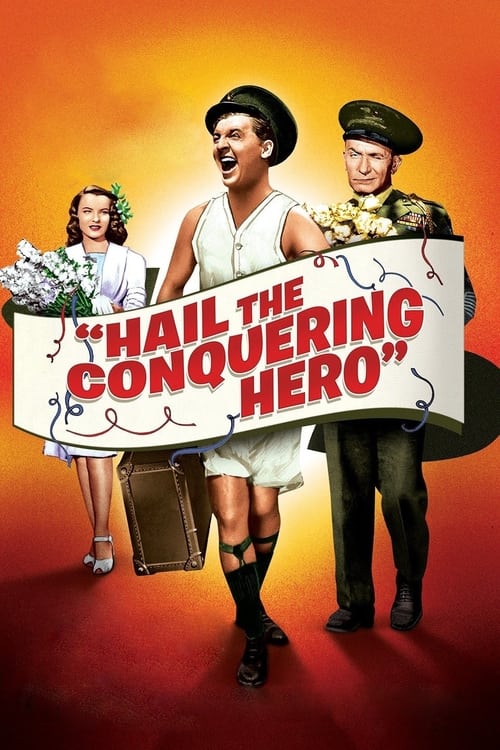
Hail the Conquering Hero
1944 · Preston Sturges
For when you want smart, rapid-fire classic comedy with teeth — a great pick when you're craving wit and chaos but want the laughs to leave a mark. Comfort food with a satirical bite.
What it's about
Woodrow Truesmith, discharged from the Marines for chronic hay fever without ever seeing combat, is too ashamed to go home. A squad of real Marines takes pity on him and talks him into returning wrapped in an invented combat record — and his small town erupts in parades, brass bands, weeping mothers, and a runaway campaign to make him mayor, while Woodrow desperately tries to get off a train that has already left the station.
The experience
Fast, loud, and riotously funny — dialogue and bodies pile up at screwball velocity — but there's a real moral squirm underneath as the lie snowballs. You laugh hard while wincing, which is exactly the point.
Performances
Eddie Bracken is superb as Woodrow — a jittery, sweating portrait of a decent man trapped inside his own legend, escalating panic played with virtuoso comic timing.
The craft
Preston Sturges wrote and directed at the peak of his powers, orchestrating overlapping dialogue, town-square crowd scenes, and marching bands with breathless precision. That he made a comedy skewering hero worship and hometown hype while the war was still on remains one of the boldest tightrope acts in studio-era Hollywood.
Why it matters
The capstone of Sturges's legendary 1940–44 run at Paramount — one of the most concentrated streaks of great films any American writer-director has ever had — and a satire of manufactured heroism that has never stopped being relevant.
Snapshot
Hail the Conquering Hero is the last of the seven films Preston Sturges wrote and directed for Paramount in a four-year burst (1940–1944) that stands among the most concentrated auteur runs in Hollywood history. Made and released while the United States was still at war, it is a comedy about the manufacture of a war hero — and therefore, obliquely, about the machinery of American self-congratulation itself. Woodrow Truesmith (Eddie Bracken), medically discharged from the Marines for chronic hay fever without ever leaving the country, is talked by a squad of real Marines into going home wrapped in a fictitious combat record; his hometown responds with a swelling frenzy of parades, brass bands, and a spontaneous campaign to make him mayor. The picture belongs with The Miracle of Morgan's Creek — its immediate companion, shot in the same period and also starring Bracken — as the boldest of Sturges's assaults on wartime pieties, and it is frequently ranked among his finest achievements. Its distinction lies in the tension between an almost unbearably warm sentiment and a genuinely subversive premise about hero-worship, mother-love, and the mob.
Industry & production
The film was produced and released by Paramount Pictures, the studio where Sturges had won an unusual contractual right to direct his own screenplays beginning with The Great McGinty (1940). By 1943–44 Sturges was Paramount's most celebrated writer-director and one of the highest-paid figures in Hollywood, but his relationship with studio management was fraying. Hail the Conquering Hero proved a flashpoint. The standard account in Sturges scholarship (drawing on his posthumous memoir and biographies such as Diane Jacobs's Christmas in July and James Curtis's Between Flops) is that studio-ordered previews went badly, that Sturges was pressured to recut, and that the friction over this film and The Miracle of Morgan's Creek contributed to his departure from Paramount shortly afterward. Both wartime comedies also had to clear the Production Code Administration and the sensitivities of a military-and-morale-conscious moment, and it remains a point of interest to historians that a satire touching the sanctity of the combat hero passed at all. The exact figures of budget and box-office return I would not state with confidence; the production is better documented for its creative conflicts than for a clean financial ledger, and I will not invent numbers.
Technology
This is a black-and-white, Academy-ratio (1.37:1) studio production of the classical sound era, made almost entirely on Paramount's stages and backlot. The technology is the mature apparatus of early-1940s Hollywood: incandescent lighting, the Mitchell camera, optical printing for titles and transitions, and single-system-adjacent post-synchronized sound recorded on the lot. What matters technologically is less any novelty than the fluency with which Sturges and his crew exploited a fully perfected studio system. The one genuinely demanding technical requirement is acoustic and choreographic rather than mechanical: the film's crowd scenes — a whole town's worth of bands, orators, and well-wishers converging on the Truesmith house — required dense sound mixing of overlapping voices and diegetic brass, and precise coordination of large ensembles within the sightlines of a largely static, deep-focus camera.
Technique
Cinematography
The director of photography was John F. Seitz, one of Paramount's senior cinematographers and a key collaborator on several Sturges films (he also shot Sullivan's Travels and The Miracle of Morgan's Creek, among others in this period, and would soon become central to the studio's film-noir look on Double Indemnity). Seitz's work here is deliberately unshowy in service of the comedy: even, high-key illumination that keeps the whole crowded frame legible, and considerable depth of field so that foreground reaction and background chaos read simultaneously — essential when a gag depends on a mother's face, a marching band, and a scheming politician all being visible at once. The camera generally holds and lets the staging do the work, reserving movement for the parade set-pieces. Seitz's noir sensibility surfaces only glancingly, in the quieter, more melancholy passages of Woodrow's shame.
Editing
The film was cut by Stuart Gilmore, another regular Sturges collaborator. Editing in a Sturges picture is governed by the writer-director's verbal architecture: the cutting must serve overlapping, rapid-fire dialogue and the relentless forward pressure of farce, holding on ensemble two-shots and group compositions long enough for the talk to land, then cutting cleanly on the beat. The parade and rally sequences demand a more montage-driven approach, intercutting the swelling public spectacle with Woodrow's mounting private panic, and the film's comic engine depends on that rhythmic contrast between crowd and cornered individual.
Mise-en-scène / staging
Staging is arguably Sturges's central technical achievement here. The film is built around escalating public tableaux — the returning "hero" met at the station by not one but competing marching bands, the porch-front speeches, the mayoral draft — and Sturges orchestrates these as controlled bedlam, packing the frame with his stock company of character faces while keeping the emotional throughline of Woodrow's entrapment perfectly clear. The small-town iconography — front porches, bunting, the town square — is affectionately exact even as the behavior within it is satirized. The recurring motif of the Marines physically hemming Woodrow in, and of the crowd literally lifting and carrying him, externalizes the theme: he is a man moved bodily by forces he cannot stop.
Sound
Sound is inseparable from the film's meaning. The wall of competing brass bands is a comic idea executed acoustically; the overlapping speech — townsfolk, politicians, Marines, and Woodrow's protests all colliding — is the aural equivalent of the visual crowding. Against this din, the score (see below) supplies ironic martial pomp and the sentimental leitmotif of mother-love. The film's emotional climaxes are frequently built on the sudden subtraction of that noise — the moment the crowd falls silent to hear Woodrow's confession.
Performance
Sturges was a great director of performance ensembles, and the film is a showcase for his repertory company. Eddie Bracken, in the second of his two 1944 Sturges leads, gives a performance of near-hysterical sincerity — sweating, stammering, morally paralyzed — that anchors the farce in real anguish; it is among the definitive Sturges portraits of the decent man overwhelmed. William Demarest, the most durable member of the stock company, plays Sergeant Heffelbower with gruff authority, and Freddie Steele (a former professional boxer) is memorable as the shell-shocked Marine whose fixation on his own dead mother sets the whole deception in motion — a genuinely dark note tucked inside the comedy. Ella Raines supplies the romantic counterweight as Libby, and Raymond Walburn, Franklin Pangborn, Al Bridge, Jimmy Conlin, Georgia Caine, and the rest of the Sturges troupe fill the town with instantly legible comic types. The ensemble's timing — the ability to sustain overlapping chaos without losing a line — is the film's signature performance value.
Narrative & dramatic mode
The dramatic mode is farce built on a single expanding lie, in the classical comic tradition of the impostor whose deception snowballs beyond his control. Sturges tightens the screw relentlessly: each attempt Woodrow makes to confess or retreat only deepens the town's investment and raises the stakes, until the private falsehood has metastasized into a mayoral candidacy and a threat to expose his dead father's real heroism as a fraud by association. The tone is unstable by design, oscillating between exhilarating comic acceleration and passages of real shame and melancholy — the pathos of a good man forced to accept honors he knows he hasn't earned. The resolution turns on confession rather than exposure: Woodrow chooses to tell the truth publicly, and the town, in a characteristically Sturgesian reversal, forgives and even admires him more for the honesty. It is a comedy that earns its happy ending by first taking its hero's disgrace seriously.
Genre & cycle
Formally the film is a screwball-descended American comedy, but its specific cycle is the wartime social satire — a small and risky category in 1944. It is best understood as one half of a matched pair with The Miracle of Morgan's Creek: both are Bracken vehicles from the same stretch, both weaponize small-town Americana, and both smuggle transgressive content (illegitimate wartime motherhood in one, fraudulent wartime heroism in the other) past both the Production Code and patriotic decorum. Within Sturges's own body of work it also belongs to his cycle of satires on American success and public reputation, alongside The Great McGinty (crooked politics) and Christmas in July (accidental fame) — films fascinated by the arbitrariness with which America confers status.
Authorship & method
Hail the Conquering Hero is a paradigm case of Hollywood authorship: Sturges wrote the original screenplay and directed it, exercising the writer-director control that was still rare in the studio system and that he had essentially pioneered at Paramount. His method fused a European-inflected verbal sophistication (Sturges had a cosmopolitan upbringing and a prior career as a Broadway playwright and Hollywood screenwriter) with a democratic delight in American vernacular and physical comedy. Central to that method was his repertory of collaborators. William Demarest and the stock company gave him a reliable ensemble instrument. His cinematographer John F. Seitz provided the clean, deep, legible image his crowded staging required. The score was composed by Werner R. Heymann, a distinguished German émigré composer who had worked in Weimar cinema and with Ernst Lubitsch in Hollywood; Heymann deploys mock-heroic marches and a sentimental mother-theme whose sincerity and irony are perfectly balanced. The editor Stuart Gilmore cut to Sturges's verbal rhythms. Above all, the authorship is legible in the writing: the density of characterization, the moral seriousness beneath the farce, and the willingness to satirize the very sentiments the film also, genuinely, feels.
Movement / national cinema
This is quintessential classical Hollywood cinema at the height of the studio system, and Sturges is one of its defining native satirists. Yet the film sits at a revealing cultural crossing. Sturges himself was a bridge between European wit and American subject matter, and his key musical collaborator, Heymann, was one of the many German-speaking émigrés who shaped 1940s Hollywood. The result is an unmistakably American picture — its landscape, its politics, its idiom all local — informed by an outsider's clarity about American myth-making. It is not part of any formal movement so much as a high expression of the Hollywood comedy tradition, with Sturges standing between the sophisticated Lubitsch line and the more anarchic, populist strain that runs toward Frank Capra (whose earnest faith in the common man Sturges both shares and mercilessly needles).
Era / period
The film is inseparable from its precise moment: the American home front in the third year of the Second World War, when public reverence for servicemen and the returning veteran was at its height and near-sacrosanct. That context is what makes the film audacious. To build a comedy on a fraudulent war hero — and to depict a whole town's patriotic enthusiasm as a stampede as easily aroused by a lie as by the truth — was to touch the most protected sentiment of the day. Sturges's genius was to make the satire cut and comfort at once: the film honors real sacrifice (Woodrow's father genuinely died in the previous war) while exposing the credulity and self-flattery of the reverence built around it. Seen from the period, it is one of the very few Hollywood films of 1944 willing to laugh at the home front's relationship to its own heroes.
Themes
The film's governing theme is the manufacture of heroism — the gap between actual valor and the public performance of honoring it, and how easily a community will supply the second in the absence of the first. Around this cluster several others. Mother-love is pervasive and pointed: the deception is set in motion by a shell-shocked Marine's fixation on returning a son to his mother, and the film treats maternal sentiment as both genuinely moving and dangerously manipulable. Truth and imposture drive the plot, resolved in favor of confession. Small-town democracy and the mob are examined with affectionate skepticism — the same crowd that will draft a fraud for mayor will also, finally, honor his honesty, a duality Sturges refuses to simplify. And beneath it all runs the theme of inherited reputation and paternal legacy: Woodrow is crushed less by fear of exposure than by the shame of dishonoring a genuinely heroic father.
Reception, canon & influence
On release the film was well received critically and has grown steadily in stature. James Agee, then among the most influential American film critics, was an admirer of Sturges in this period, and Hail the Conquering Hero is routinely cited as one of the peaks of Sturges's Paramount run. Sturges earned an Academy Award nomination for his original screenplay, a recognition of writing that remains the film's most celebrated element (I would treat any more specific awards tally with caution rather than overstate it).
Looking backward, the film draws on the classical comic tradition of the escalating impostor, on the American vernacular satire of small-town politics that Sturges had already mined in The Great McGinty, and on the sentimental populism of the Capra tradition, which it simultaneously borrows and subverts. Sturges's own dual formation — Broadway playwright, veteran screenwriter, European upbringing — feeds directly into its verbal sophistication.
Looking forward, its legacy is twofold. Within Sturges's career it marks the effective close of his great period; after leaving Paramount he entered the troubled independent phase (the California Pictures venture with Howard Hughes, The Sin of Harold Diddlebock, Unfaithfully Yours) from which he never fully recovered commercially, which retrospectively casts Hail the Conquering Hero as a summit. Within film culture, Sturges was canonized by the auteurist criticism of the 1950s and 1960s — Andrew Sarris placed him high in the American pantheon — and this film is central to that reassessment. Its deeper influence is thematic and tonal: it is a touchstone for the American tradition of satire that can mock a national myth and honor it in the same breath, an approach whose descendants run through later comedies about celebrity, politics, and manufactured reputation. Its portrait of a mass enthusiasm indifferent to the truth of its object has, if anything, only sharpened in relevance.
A Deleuzian reading
Two brass bands meet Woodrow Truesmith's train, and neither one will stop playing so the other can be heard.
The full Deleuzian reading of Hail the Conquering Hero →
Reception
A hit in 1944 — audiences and critics were amazed a satire this sharp about hero worship got made mid-war — and its stock has only risen since, now regularly cited as the boldest American comedy of the WWII years.
How Hail the Conquering Hero was received, from release to now →
How to watch Hail the Conquering Hero: what to notice on a first viewing
- Watch how the crowd physically hems Woodrow in and carries him. Sturges stages Woodrow surrounded by Marines and lifted bodily by the crowd again and again, so his entrapment is a physical fact, not just a feeling. He is a man moved by forces he cannot stop, and the staging makes that literal.
- Notice how much stays sharp and visible in the background. Seitz shoots with considerable depth of field, so a mother's face, a marching band, and a scheming politician can all be read in the same shot. You get to watch the whole gag land at once instead of being told where to look.
- Listen for two brass bands playing over each other at once. Townsfolk, politicians, and Marines all talk over each other through much of the film, and the emotional high points arrive when that noise suddenly stops. Silence becomes the loudest thing in the movie precisely because it's so rare.
- Watch Bracken sweat and stammer through nearly every scene he's in. Eddie Bracken plays Woodrow at a pitch of near-hysterical sincerity, morally paralyzed, so the farce stays anchored in real anguish rather than pure comic bounce. His discomfort feels real enough that the comedy never stops hurting a little.
- Notice the bunting, porches, and town square dressed for a hero. The small-town iconography is affectionately exact, front porches and flags and a town square built for celebration, even while the behavior inside it is satirized. The town looks lovingly rendered even as the film quietly mocks how it behaves.
The whole guide to watching Hail the Conquering Hero, with the keys for a rewatch →
Influences: the films it descends from and the films it influenced
- The Great McGinty (1940) — Established the writer-director control and vernacular small-town political-machine satire — a nobody elevated by a corrupt system — that Hail reruns with the Marine legend swapped for the ballot box.
- Christmas in July (1940) — Built the exact plot engine Hail escalates: a nervous ordinary schnook (the Eddie Bracken prototype) is accidentally acclaimed for a distinction he didn't earn and must ride the honor to a public confession.
- Meet John Doe (1941) — Supplied the manufactured-folk-hero mechanism — a fake public idol embraced by a credulous crowd — that Sturges borrows wholesale while inverting Capra's sincerity into corrosive irony.
- Mr. Smith Goes to Washington (1939) — Modeled the populist small-town-democracy crowd oratory and mass-enthusiasm tableaux that Sturges stages with competing brass bands and then satirizes from inside.
- Nothing Sacred (1937) — Pioneered the Hecht-scripted satire of celebrity fabricated by press and mob — a public devotion indifferent to the truth of its object — the exact tonal target Sturges sharpens.
- Twentieth Century (1934) — Set the template for theatrical escalating-impostor farce driven by machine-gun overlapping dialogue, the verbal-rhythm comedy Sturges cuts to via Stuart Gilmore's dialogue-paced editing.
- His Girl Friday (1940) — Perfected overlapping, interruptive dialogue and dialogue-driven cutting tempo that Sturges deploys in his crowded home-front crowd scenes.
- Ace in the Hole (1951) — Extends Sturges's portrait of mass enthusiasm indifferent to truth into a full media-circus crowd tableau, the cynical flip side of the small-town welcome.
- A Face in the Crowd (1957) — Carries forward the manufacture-of-heroism theme into television demagoguery: a media idol fabricated and swallowed whole by a credulous public that never examines the man.
- Being There (1979) — Inherits the accidental-blank-hero structure — a passive nobody elevated entirely by the public's projection of significance onto him, never his own claim.
- Bob Roberts (1992) — Descends directly from the manufactured-reputation political satire, staging the fabricated folk-hero campaign with the same both-mock-and-diagnose stance toward small-town democracy.
- The Hudsucker Proxy (1994) — A conscious Sturges-Capra pastiche: rapid overlapping dialogue and the overnight manufacture of a naïf's success, lifting Sturges's tonal double-game of affection and irony.
- Wag the Dog (1997) — Literalizes Hail's premise — deliberately fabricating a fake war hero ('Old Shoe') for public consumption — extending the manufacture-of-heroism satire into media-age statecraft.
- Hail, Caesar! (2016) — An overt homage down to the imperative-verb title, reviving the Sturges studio-era ensemble farce with overlapping dialogue and stock-company crowd staging that mocks and cherishes its subject simultaneously.
- Welcome Mr. Marshall! (1953) — Provides the waiting-and-deflation engine: an entire town mobilizes an ever-more-elaborate welcome founded on a misunderstanding, cresting toward comic anticlimax — the precise structural machine of Villar del Río preparing for Americans who never stop.
- The Miracle of Morgan's Creek (1944) — Its exact companion — same year, same Bracken/Demarest stock company, same John Seitz deep-focus legibility and small-town-mob home-front satire built around a fraudulent claim to honor.
- Sullivan's Travels (1941) — Shares John F. Seitz's clean deep-focus imaging of crowded staging and the stock company, plus the mock-serious register that honors and mocks the same sentiment at once.
- The Lady Eve (1941) — Uses the same repertory ensemble and a confidence-trick imposture structure resolved by confession, scored in the mock-heroic/sentimental balance Werner Heymann brings to Hail.
- The Palm Beach Story (1942) — Its Ale-and-Quail-club anarchy is the same Sturges crowd-tableau technique — a mob of eccentrics overwhelming the frame with overlapping noise — that Hail turns into the welcoming-committee chaos.
Similar films
- The Miracle of Morgan's Creek (1944) — influence & lineage
- Sullivan's Travels (1941) — influence & lineage
- Mr. Smith Goes to Washington (1939) — influence & lineage
- The Lady Eve (1941) — influence & lineage
- The Palm Beach Story (1942) — influence & lineage
- His Girl Friday (1940) — influence & lineage
- Ace in the Hole (1951) — influence & lineage
- The Great Escape (1963) — shared sensibility