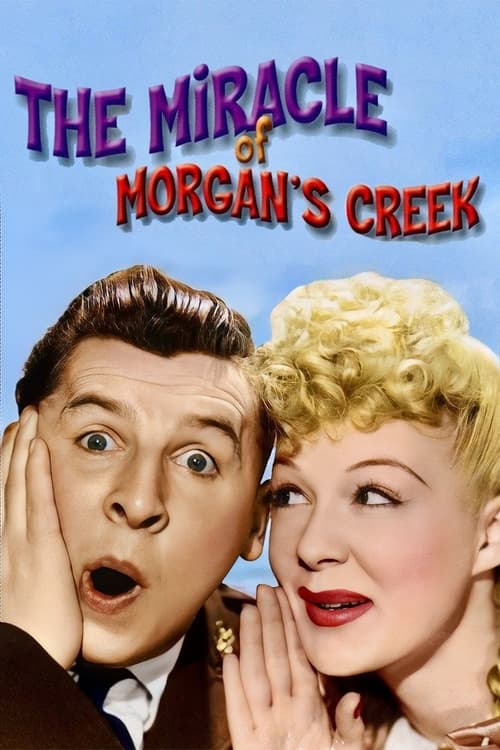
The Miracle of Morgan's Creek
1944 · Preston Sturges
When you want to laugh hard at something fast and clever — a golden-age comedy night, especially satisfying if you enjoy watching a filmmaker outsmart the censors in real time.
What it's about
In a small wartime American town, Trudy Kockenlocker goes to a farewell dance for departing soldiers and wakes up married to a serviceman whose name she can only half-remember — with no husband, no license, and soon a baby on the way. Norval Jones, the hopelessly devoted local boy rejected by the draft board, tries to rescue her reputation, and the town's machinery of respectability grinds into motion against them both. It's a farce built on material no 1944 studio comedy was supposed to touch.
The experience
Breathless, escalating, and genuinely audacious — the dialogue moves at a sprint, the physical comedy keeps topping itself, and half the fun is realizing what the film is getting away with. It's a screwball that plays like a controlled explosion.
Performances
Betty Hutton throws herself into Trudy with unstoppable comic energy, and Eddie Bracken is a marvel of flustered panic as Norval — his stammering, collapsing decency is the film's secret heart.
The craft
Sturges's script is a machine of misdirection, using speed, euphemism, and sheer nerve to smuggle an unwed pregnancy past the Production Code in plain sight. The dense, overlapping dialogue and precision slapstick reward close attention — every scene is doing two things at once.
Why it matters
A high-water mark of 1940s screwball comedy and of Preston Sturges's extraordinary run, still cited as the boldest end-run around Hollywood censorship of its era.
Snapshot
The Miracle of Morgan's Creek is Preston Sturges's most audacious act of comic smuggling: a screwball farce that hangs its entire plot on an unmarried small-town girl who gets pregnant by a soldier whose name she cannot remember, and then dares the Production Code Administration to say so out loud. Trudy Kockenlocker (Betty Hutton) attends a farewell dance for departing troops, is married in a fog of celebration to a serviceman she can only half-recall as something like "Ratzkiwatzki," and wakes to a hangover, a missing husband, a lost marriage license, and — soon — a pregnancy. The lovesick, chronically flustered Norval Jones (Eddie Bracken), 4-F and hopeless, tries to shield her by marrying her under a false name, and the town's machinery of respectability grinds down on both of them until the birth of sextuplets converts scandal into national "miracle." Released by Paramount in early 1944, at the crest of Sturges's astonishing writer-director run, it is at once his fastest, most anarchic film and his sharpest satire of wartime pieties: patriotism, motherhood, small-town virtue, and the hunger for a hero.
Industry & production
The film was produced at Paramount Pictures, where Sturges enjoyed a rare arrangement — he wrote and directed his own material with a degree of autonomy almost unheard of in the studio era, having become, with The Great McGinty (1940), one of the first Hollywood screenwriters to graduate to the director's chair. It belongs to the extraordinary cluster of pictures he made for Paramount between 1940 and 1944, and it was shot in 1942–43 for release in early 1944, its production overlapping closely with its companion piece, Hail the Conquering Hero (also 1944).
The dominant industrial story of Morgan's Creek is its collision with the Production Code. Its premise — pregnancy outside marriage, uncertain paternity, a drunken and unremembered wedding — sat squarely on the Code's forbidden ground, and Joseph Breen's office scrutinized the project. Sturges's tactics for getting it past the censors are the stuff of Hollywood legend: burying the transgressions in a whirlwind of overlapping dialogue and tongue-twisting names, keeping the sexual event entirely offscreen and even nominally within (a lost) marriage, and wrapping the whole in the unimpeachable sanctity of motherhood and a "miraculous" multiple birth. Wartime conditions and the support of Paramount's production head, B. G. "Buddy" DeSylva, are generally credited with helping the film reach screens with its provocations intact. The exact deletions and negotiations vary in the telling, and where specific concessions are concerned the documentary record is thinner than the anecdotes suggest, so it is safest to say the film survived the Code more by dexterity than by permission.
Commercially, the picture was a substantial success — widely reported as one of Paramount's biggest hits of the year and a high point of Sturges's box-office standing — though precise grosses should be treated with caution and are not cited here.
Technology
Morgan's Creek is a conventional product of mid-1940s studio technology: 35mm black-and-white photography on Paramount soundstages, standard Academy ratio, optical sound recording, and the era's incandescent studio lighting. There is no technological novelty to claim; the film's innovations are entirely those of craft and writing rather than apparatus. What the period's mature equipment enabled — fast panchromatic stock, sensitive microphones capable of capturing Sturges's rapid overlapping speech, and cranes and dollies for fluid staging — the film exploits fully, but it introduces nothing new to the toolkit. Its "special effect," such as it is, is comic and rhetorical: the offscreen sextuplet birth and its newspaper-headline aftermath, achieved through montage and sound rather than any technical trick.
Technique
Cinematography
The cinematographer was John F. Seitz, one of Paramount's finest, whose range in this same period ran to the shadowed expressionism of Billy Wilder's Double Indemnity (1944) and later Sunset Boulevard (1950). For Sturges he supplies something different: clean, bright, high-key comic photography that keeps the frame legible and deep enough for ensemble business, so that the eye can follow several actors at once as they collide and interrupt. Seitz's camera is largely a servant of blocking — it holds, pans, and tracks to preserve the integrity of Sturges's long comic takes rather than to editorialize — but its very transparency is a discipline, giving the verbal chaos a stable visual floor.
Editing
The editing is credited to Stuart Gilmore, a frequent Sturges collaborator across the Paramount films. The cutting strategy is characteristically counter-intuitive for comedy: rather than chopping dialogue into shot-reverse-shot fragments, Sturges and Gilmore favor sustained takes that let verbal and physical gags build within a single frame, cutting decisively at the punchline or to launch the next movement. Against this, the film deploys brisk montage for its public, journalistic beats — the spreading rumor, the newspaper sensation, the closing eruption of headlines — so that the private long takes and the public montages play as opposing rhythms, the intimate absurdity of the couple set against the machinery of publicity.
Mise-en-scène / staging
Staging is where Sturges's authorship is most visible. He composes dense, deep tableaux crowded with his stock company of character actors, choreographing entrances, exits, pratfalls, and cross-talk with theatrical precision. The Kockenlocker household — presided over by the apoplectic Constable — is a pressure cooker of doorways, stairs, and slammed exits; the town's civic spaces (the justice's office, the bank, the store) are staged as arenas of social judgment. A signature is the collision of the verbal and the physical: as characters trade impossibly fast dialogue, someone is invariably tripping, falling, or crashing through the frame, William Demarest's tumbles being the film's recurring kinetic punctuation.
Sound
Sound is the film's true medium. Sturges writes for overlapping, machine-gun delivery, comic mispronunciation, and repetition — "Ratzkiwatzki," "Kockenlocker," the whole barrage of near-obscene near-nonsense names that let the film say almost-forbidden things by garbling them. The soundtrack layers dialogue, ambient commotion, and reaction so that meaning arrives in a rush and the censorable point slides by in the noise. On the musical side, the score functions conventionally as period underscoring and source music (the dance-hall send-off, patriotic strains); the specific composing credit is not firmly established in the popular record and is best left unstated rather than guessed.
Performance
Betty Hutton, better known as an explosive musical performer, gives Trudy a manic, tearful, headlong energy that keeps the character sympathetic even as the plot treats her scandalously; her performance is all forward momentum, which is precisely what disarms the material. Eddie Bracken's Norval — stammering, panicking, physically undone by love and anxiety — is one of the great nebbish performances of 1940s comedy, and Bracken would deepen the type weeks later in Hail the Conquering Hero. William Demarest, as Constable Kockenlocker, anchors the film with volcanic exasperation and reliably spectacular falls, while Diana Lynn, as the wised-up younger sister Emmy, delivers adult cynicism from a child's mouth to devastating comic effect. Around them swarms the Sturges stock company — Porter Hall, Al Bridge, Jimmy Conlin, and others — plus a knowing cameo by Brian Donlevy and Akim Tamiroff reprising their Governor McGinty and "Boss" from The Great McGinty, a crossover flourish that treats Sturges's own films as a shared universe.
Narrative & dramatic mode
The dramatic mode is farce escalated to near-hysteria, built on a classic comic engine: a secret that must be kept, a lie that compounds, and a deadline (the pregnancy) that cannot be outrun. Sturges structures the film as a widening gyre of complication — each attempt to conceal Trudy's situation produces a worse tangle, dragging the guileless Norval deeper into legal and social jeopardy (false identity, a bank problem, jail). The tone runs hot and fast, veering between slapstick and genuine cruelty; the town's respectability is a real threat, and for long stretches the comedy is powered by dread. Sturges then resolves the impossible not through the characters' cleverness but through sheer providential absurdity — the sextuplets — a deliberately arbitrary deus ex machina that mocks the very idea of moral resolution while satisfying the Code's demand that virtue be rewarded. The "miracle" is both the happy ending and the joke about happy endings.
Genre & cycle
The film sits at the tail end of the screwball comedy cycle that had flourished since the mid-1930s, and it is one of the cycle's darkest, most subversive specimens. It retains screwball's engine — mismatched couple, escalating misunderstanding, verbal velocity — but strips away the genre's usual affluence and glamour, relocating to a drab wartime small town and swapping romantic sparring for something closer to social panic. It is simultaneously a home-front war comedy, part of the 1944 vogue for pictures about soldiers, sacrifice, and civilian life, and it belongs most tightly to Sturges's own late-Paramount cycle of satires, forming a diptych with Hail the Conquering Hero in its skewering of American hero-worship and communal hypocrisy.
Authorship & method
The Miracle of Morgan's Creek is a total Sturges authorship: he wrote the original screenplay and directed, controlling the film's language, rhythm, and worldview to a degree few contemporaries matched. His method fused the sophistication of a Broadway-trained playwright with the appetite for pratfalls of silent slapstick, and he built repeatable machinery around himself — the stock company of character actors he used like a repertory troupe, and a trusted technical circle. The key collaborators here extend that method: cinematographer John F. Seitz, whose clean deep-focus photography gave the verbal storms a stable visual ground; editor Stuart Gilmore, whose long-take-and-montage strategy preserved Sturges's comic timing; and the ensemble players — above all William Demarest — who functioned almost as instruments of the Sturges style. The writing itself is the auteur signature: the tongue-twisting names, the overlapping speech, the moral daring hidden in verbal camouflage. On the musical authorship, as noted, the record is thin, and no composer is asserted here.
Movement / national cinema
The picture is a product of the classical Hollywood studio system at its height — Paramount's assembly of contract talent, soundstages, and house craft — and of the distinctly American screwball tradition. It has no affiliation with any avant-garde or foreign movement; its lineage is native, running from silent American slapstick (Sennett, the two-reel comedy) through the sound-era comedy of manners. If anything, Sturges represents a specifically American fusion within that system: European-inflected wit (he had a cosmopolitan upbringing) grafted onto homegrown physical comedy and populist satire, aimed squarely at the myths of American small-town life.
Era / period
The film is inseparable from its wartime moment. Its inciting event is a send-off for departing soldiers; its hero is rejected for service (Norval's 4-F status is a running humiliation); its anxieties — hasty wartime marriages, absent men, women's changed circumstances, the pressure to produce and celebrate — are the anxieties of the 1944 home front. Sturges turns these into satire without ever quite breaking faith with the war effort: the sextuplets become a patriotic sensation, the state and even foreign dignitaries rush to claim the "miracle," and private disgrace is laundered into national morale. The film thus reads as a sly commentary on how wartime society manufactures heroes and miracles to meet its emotional needs — the same theme Hail the Conquering Hero pursues through a fraudulent war hero.
Themes
Its central theme is the gap between America's official virtue and its actual conduct — the machinery of small-town respectability exposed as vindictive and absurd. Sturges anatomizes hero-worship and the public appetite for uplift, sexual double standards and the policing of women's bodies, and the way institutions (church, law, press, state) can be stampeded into blessing what they would otherwise condemn once it is framed as a "miracle." Motherhood is treated with genuine tenderness and simultaneously wielded as a satirical shield. Underneath runs a darker current about luck and providence: the film insists, through its outrageous ending, that survival in this world owes less to virtue than to accident — a deeply Sturgesian idea, kin to the fortune-driven fates of The Great McGinty and The Lady Eve.
Reception, canon & influence
Critically, the film was received as a triumph of comic nerve. Its most famous notice came from James Agee, writing in The Nation, who registered astonishment that so transgressive a comedy had slipped past the censors — his much-quoted quip about the Hays Office having been "raped in its sleep" captures the contemporary sense that Sturges had gotten away with the impossible. (The exact wording circulates in several forms; the thrust is reliably his.) The picture consolidated Sturges's reputation, in the mid-1940s, as the most daring comic voice in Hollywood, even as that reputation would fade quickly after he left Paramount.
Influences on the film (backward): It draws on silent American slapstick for its physical vocabulary, on stage farce for its secret-and-lie structure, and on the screwball tradition of the 1930s for its verbal duels and mismatched lovers. Its most direct antecedents are Sturges's own earlier Paramount films, whose stock company, fortune-driven plots, and satirical populism it extends — the McGinty/Boss cameo makes the self-citation explicit.
Legacy (forward): The film is now firmly canonized, widely regarded as among Sturges's two or three finest and one of the great American comedies of the 1940s, and it has been selected for the Library of Congress's National Film Registry as a culturally significant work (I'm not certain of the exact induction year and so do not assert it). Its deepest influence is as a landmark of Production Code subversion — a demonstration that comedy could smuggle genuinely adult subject matter past censorship through velocity, indirection, and framing, an example later filmmakers and critics repeatedly cite. Sturges's writer-director model and his verbal-comic style left a long shadow over American comedy; Billy Wilder among others admired him, and the modern reverence for Sturges among filmmakers like the Coen brothers (whose engagement is most explicit with Sullivan's Travels) keeps his methods in circulation. Morgan's Creek specifically endures as the proof text for how much a Hollywood comedy could say by pretending, very fast and very loudly, not to be saying it.
A Deleuzian reading
A girl comes home from a dance and tries to tell her kid sister the name of the man she married.
The full Deleuzian reading of The Miracle of Morgan's Creek →
Reception
A smash hit in 1944 — one of Paramount's biggest comedies of the year despite (or because of) the scandal of its premise — and it's only grown in stature since, now enshrined in the National Film Registry as the high-water mark of Hays Code-defying audacity.
How The Miracle of Morgan's Creek was received, from release to now →
How to watch The Miracle of Morgan's Creek: what to notice on a first viewing
- Listen for names garbled almost past recognition. Sturges writes overlapping, machine-gun dialogue and mangled names like 'Ratzkiwatzki' and 'Kockenlocker,' a barrage of near-nonsense that lets the film say almost-forbidden things by garbling them. The joke assembles itself in your head, since the words never quite finish being said out loud.
- Watch the Kockenlocker house's doorways and stairs fill up. Sturges composes dense, deep tableaux crowded with his stock company, so nobody enters a room without displacing somebody already standing in it. You feel the house's pressure just from how crowded every single doorway gets.
- Watch Demarest fall whenever the dialogue speeds up. He anchors the film with volcanic exasperation and reliably spectacular pratfalls, a recurring kinetic punctuation to the surrounding verbal chaos. His body keeps translating the film's panic into something you can actually watch happen.
- Notice how the camera holds instead of cutting to reactions. Seitz's clean, deep-focus photography keeps several actors legible at once, largely serving Sturges's blocking rather than editorializing with the camera itself. The chaos stays visually grounded even as the dialogue completely spins out of control.
- Notice the film slows down at home, speeds up outside. Sustained takes let private dialogue build within a single frame, while brisk montage carries the spreading rumor and the newspaper sensation. The two rhythms play as opposing forces, private absurdity against the machinery of publicity.
The whole guide to watching The Miracle of Morgan's Creek, with the keys for a rewatch →
Influences: the films it descends from and the films it influenced
- The Freshman (1925) — Supplies the silent-slapstick physical vocabulary — the eager-to-belong hero and the pratfall-driven set piece — that Sturges channels through William Demarest's tumbling, stumbling body as counterpoint to the verbal storms.
- Twentieth Century (1934) — Establishes the rapid-fire screwball verbal duel between mismatched combatants, the machine-gun exchange rhythm Sturges inherits and accelerates.
- It Happened One Night (1934) — Models the populist small-town-Americana screwball built on a road-trip deception between social opposites, the sentimental-satirical register Sturges adopts and sharpens toward hypocrisy.
- His Girl Friday (1940) — Perfects the overlapping-dialogue technique — actors stepping on each other's lines at velocity — that Sturges deploys so the audience races past the film's censorable implications before registering them.
- The Great McGinty (1940) — Its Governor and Boss (Brian Donlevy, Akim Tamiroff) reappear in cameo, making Morgan's Creek an explicit self-citation and founding Sturges's writer-director-plus-shared-universe template.
- The Lady Eve (1941) — Builds the con-and-reversal plot engine and the repertory stock company (Demarest included) that Morgan's Creek reuses as instruments of a fixed house style.
- Sullivan's Travels (1941) — Codifies the deployment of character actors as a repertory troupe and the abrupt tonal pivots between slapstick and moral seriousness that Morgan's Creek weaponizes.
- The Palm Beach Story (1942) — Constructs farce on a foundational lie sustained by overlapping-speech velocity, the same secret-driven structure Morgan's Creek escalates around Trudy's amnesiac marriage.
- Unfaithfully Yours (1948) — Extends Sturges's fusion of Broadway-playwright verbal precision with slapstick physical humiliation, the writer-director signature carried past his Paramount peak.
- Some Like It Hot (1959) — Wilder, an avowed Sturges admirer, applies the Morgan's Creek playbook — adult subject matter (impersonation, gender, sex) waved past censors through velocity and verbal camouflage rather than open statement.
- What's Up, Doc? (1972) — A deliberate archival revival of 1930s-40s screwball mechanics — overlapping patter, escalating farce chases, mistaken-identity structure — reconstructing the Hawks/Sturges verbal-comic rhythm.
- The Hudsucker Proxy (1994) — Pastiches the Sturges/Hawks rapid-fire dialogue and stylized fast-talking ensemble, keeping the writer-director verbal-comedy method in circulation as explicit homage.
- O Brother, Where Art Thou? (2000) — Takes its title and picaresque populist-Americana satire directly from Sturges's Sullivan's Travels, the most explicit token of the Coens' ongoing engagement with his methods.
- Welcome Back, Mr. McDonald (1997) — Sturges's clockwork plotting and gallery of broad comic types embody the writerly, construction-over-image craftsmanship Mitani names as his own studio-era lineage.
- Hail the Conquering Hero (1944) — Shot back-to-back with the same stock company (Demarest, Eddie Bracken) and a nearly identical machinery — a small-town hero-worship farce spun from an initial deception smuggled past propriety by sheer momentum.
- Double Indemnity (1944) — Shares cinematographer John F. Seitz, whose clean deep-focus method gives both films their stable, precisely-composed visual ground beneath very different tonal registers.
- Arsenic and Old Lace (1944) — Runs the same strategy of smuggling genuinely transgressive material (serial murder) past the Code through farce acceleration, letting breakneck pace and indirection defuse what the plot literally contains.
Similar films
- Hail the Conquering Hero (1944) — influence & lineage
- His Girl Friday (1940) — influence & lineage
- Sullivan's Travels (1941) — influence & lineage
- The Palm Beach Story (1942) — influence & lineage
- The Lady Eve (1941) — influence & lineage
- Remember the Night (1940) — shared sensibility
- The More the Merrier (1943) — shared sensibility
- The Philadelphia Story (1940) — shared sensibility