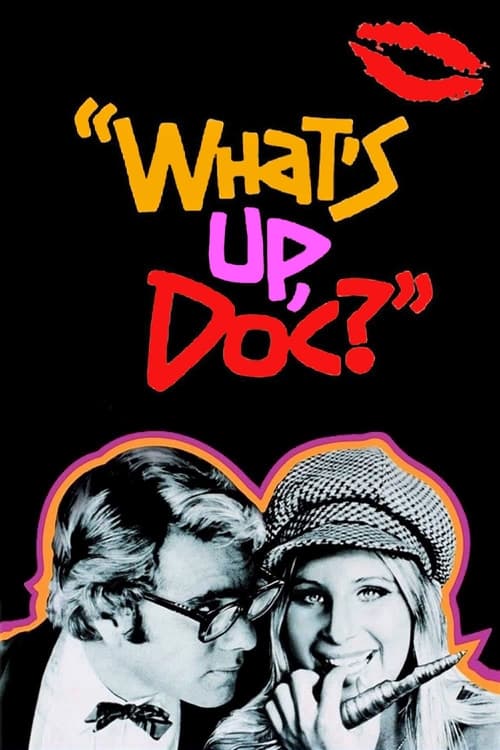
What's Up, Doc?
1972 · Peter Bogdanovich
For when you need a real laugh and nothing heavy — a perfect group watch, date night, or cure for a bad week. Total comfort, executed with dazzling precision.
What it's about
Four identical plaid overnight bags — one full of rocks, one of stolen jewels, one of secret documents, one of a stranger's clothes — get scrambled in a San Francisco hotel. Caught in the middle are a fussy, engaged musicologist and the brilliant walking catastrophe of a woman who decides, instantly, that he belongs to her. Cue mistaken identities, a demolished hotel suite, and a chase through the hills of San Francisco.
The experience
Fast, silly, and relentlessly funny — gags stack on gags until the whole thing tips into gleeful chaos. It's pure pleasure with zero downtime, the kind of comedy that makes a room laugh out loud together.
Performances
Barbra Streisand is a comic force of nature, tossing off wisecracks with total command, while Ryan O'Neal plays the perfect flustered straight man; Madeline Kahn, in her film debut as his fiancée Eunice, steals every scene she touches.
The craft
Bogdanovich rebuilt the 1930s screwball comedy with modern machinery: razor-timed dialogue, slamming-door farce, and a San Francisco car chase so elaborate it became one of the most famous comic set pieces in American film. The physical gags are staged with real stunt craft — this is slapstick as engineering.
Why it matters
A huge hit that proved classic screwball could thrive in the New Hollywood era, and the film that launched Madeline Kahn; it remains the modern benchmark for the genre revival done right.
Snapshot
What's Up, Doc? is Peter Bogdanovich's affectionate, high-velocity resurrection of the 1930s screwball comedy, made at the peak of his early-1970s prominence and released by Warner Bros. in 1972. Barbra Streisand plays Judy Maxwell, a brilliant, footloose troublemaker who latches onto Ryan O'Neal's fussy, engaged musicologist Howard Bannister when four identical plaid overnight bags — carrying, respectively, igneous rocks, stolen jewels, secret government documents, and Judy's belongings — are scrambled in a San Francisco hotel. The confusion escalates into slamming-door farce and one of the most elaborate comic chases in American cinema. The film is at once a New Hollywood product and a deliberate throwback: a director steeped in classical Hollywood using contemporary craft and star power to rebuild a genre that had been dormant for decades.
Industry & production
The film arrived on a wave of goodwill. Bogdanovich had just made The Last Picture Show (1971), a critical triumph that established him as a leading figure among the young directors reshaping Hollywood. What's Up, Doc? was his follow-up, and it paired him with two of the era's most bankable stars, Streisand and O'Neal — the latter fresh from the phenomenon of Love Story (1970). Warner Bros. financed and distributed the picture, and its studio pedigree matters: the film is soaked in the house style and iconography of classic Warner comedy, right down to a title lifted from Bugs Bunny (a Warner property) and a closing sign-off in the spirit of a Looney Tunes cartoon.
The screenplay credit is shared by Buck Henry, David Newman, and Robert Benton, from a story by Bogdanovich. Newman and Benton — the writers of Bonnie and Clyde — worked on earlier drafts, and Henry, one of the sharpest comedy writers of the period, delivered the final screenplay. Bogdanovich has spoken in interviews about conceiving the project explicitly as a screwball revival built around Streisand.
Commercially, the film was a substantial success and stands among the top-grossing releases of 1972; precise ranking and figures vary across sources, so I'll avoid citing a specific number. Its box-office performance helped cement Bogdanovich's brief run as one of the industry's hottest directors, a run he continued with Paper Moon (1973). Accounts of the production, including Bogdanovich's own later recollections, describe creative friction with Streisand, who reportedly did not find the material as funny as her director did; this is well documented in interviews but should be read as remembered anecdote rather than settled fact.
Technology
Technically the film is conventional for a major 1972 studio release: 35mm color photography with anamorphic-style widescreen framing, location shooting in San Francisco combined with soundstage interiors, and optical/mechanical effects rather than anything experimental. Its ambition lies not in novel technology but in the coordination of practical stunt work and location logistics for the extended chase — cars, a runaway delivery of plate glass, ladders, bicycles, a Chinatown parade, and a plunge into San Francisco Bay, all staged for real. The comedy depends on precise physical execution and camera placement rather than on any technical innovation, which is consistent with Bogdanovich's classicist instincts.
Technique
Cinematography
The cinematographer is László Kovács, one of the defining camera artists of New Hollywood (Easy Rider, Five Easy Pieces). Here he works against the grainy, naturalistic register associated with that movement, delivering bright, clean, high-key images appropriate to classical comedy. The San Francisco locations are photographed with postcard clarity — the hills, the cable cars, the bay — and the framing favors legible wide and medium shots that let physical business play out in full view. Kovács's discipline is central to the chase: the geography of streets and stairs stays comprehensible even at high speed, which is what makes the sequence read as comedy rather than chaos.
Editing
Verna Fields edited the film, a few years before her Oscar-winning work on Jaws (1975). The chase sequence is the showcase for her cutting: it sustains momentum across multiple vehicles and gags while preserving spatial and causal clarity, so that each escalation lands as a payoff to what preceded it. The comedy of the film generally relies on tempo — the acceleration of farce, the timing of doors and reversals — and the editing is calibrated to that rhythm.
Mise-en-scène / staging
Production design was by Polly Platt, Bogdanovich's key collaborator and then-wife, who also designed The Last Picture Show and Paper Moon. The staging is built around classic farce architecture: a hotel with interchangeable rooms and identical luggage, converging characters, and doors that open and close on cross-purposes. The running gag of four indistinguishable plaid bags is a mise-en-scène device as much as a plot mechanism — the audience must be able to track objects the characters cannot, and the film stages the swaps for maximum visibility. The climactic set-pieces are choreographed in real urban space, using San Francisco's inclines and landmarks as a comic obstacle course.
Sound
The soundtrack leans heavily on Cole Porter, organized around "You're the Top," which frames the picture and is performed by Streisand. In one of the film's fondest gestures, Streisand's Judy sits at a hotel-lobby piano and sings "As Time Goes By," the song indelibly tied to Casablanca (another Warner classic) — a direct sonic citation of the studio's own heritage. Musical direction and score adaptation are credited to Artie Butler, working largely from Porter's material. Beyond the music, the sound design supports the farce: overlapping dialogue, offscreen crashes, and the escalating clamor of the chase.
Performance
The performances are pitched to genre. Streisand plays Judy as an unstoppable comic force — fast-talking, disruptive, and disarmingly direct — while O'Neal commits to the thankless, essential straight-man role, calibrating his exasperation as the world collapses around him. O'Neal is knowingly cast against his Love Story image, and the film exploits the contrast. The supporting ensemble is crucial: Madeline Kahn makes her film debut as Howard's shrill, controlling fiancée Eunice Burns, a performance of remarkable comic precision that launched her career; Kenneth Mars plays the pompous rival musicologist Hugh Simon; Austin Pendleton is the flustered foundation director Frederick Larrabee; and Sorrell Booke, Stefan Gierasch, and Michael Murphy fill out the tangle of thieves, spies, and functionaries.
Narrative & dramatic mode
The dramatic mode is farce, executed with near-mathematical structure. The narrative engine is the classic screwball premise of mistaken identity and misplaced objects: four identical bags, four sets of pursuers, and a professor whose orderly life is dismantled by a woman who refuses to leave him alone. The plot compounds coincidences deliberately, gathering every character into escalating collisions — a hotel fire, a courtroom, the chase — before resolving in a burst of implausible order. Character arc is minimal and generic by design: the rigid man is loosened, the "wrong" fiancée is dispatched, and the disruptive woman is revealed as the right partner. The romance is the frame; the machinery of comic mishap is the substance.
Genre & cycle
The film is the most conspicuous entry in the early-1970s revival of screwball comedy, and it wears its models openly. Its primary template is Howard Hawks's Bringing Up Baby (1938): an absent-minded academic (paleontologist there, musicologist here), a whirlwind heroine who commandeers his life, a disapproving fiancée, missing possessions, and a farcical spiral toward romance. Bogdanovich, a critic and Hawks admirer before he was a director, treats the genre almost archaeologically — reconstructing its rhythms, character types, and set-piece logic rather than merely quoting them. The film also gestures toward the broader tradition of Hawksian rapid-fire comedy (His Girl Friday) and to Warner Bros.' own comic legacy. It is less a parody than a loving, full-throated attempt to make a screwball comedy as if the form had never lapsed.
Authorship & method
Bogdanovich's authorship is that of the cinephile-director: a former critic and programmer who approached filmmaking as an act of curation and continuation of classical Hollywood. His method here is genre reconstruction — importing the conventions of 1930s comedy and executing them with period fidelity while using modern stars and craft. That sensibility is inseparable from his collaborators. Kovács supplies a clean classical image against his New Hollywood grain; Verna Fields provides the propulsive cutting the chase demands; Polly Platt grounds the farce in coherent, functional design; Buck Henry (with Newman and Benton) supplies the verbal comedy and structural clockwork; and the Porter-based music, adapted by Artie Butler, ties the film to the studio-era songbook. The result feels authored not through personal confession but through a curator's fluency in an inherited form.
Movement / national cinema
The film sits inside New Hollywood — the wave of director-driven American filmmaking that transformed the studios around 1967–1975 — but it is a distinctive, counter-current instance of it. Where much of the movement pursued moral ambiguity, downbeat endings, and formal rupture (and where Bogdanovich's own Last Picture Show offered elegiac naturalism), What's Up, Doc? channels New Hollywood's authorial freedom toward classical revivalism. It is a product of the same industrial moment and the same talent pool — Kovács being the clearest link — but its national-cinema identity is that of an American film reaching backward into its own tradition rather than forward into new modes.
Era / period
The film is set in a contemporary early-1970s San Francisco, but its temperament is nostalgic. It belongs to the specific early-'70s vogue for classic-Hollywood homage that Bogdanovich helped lead, a sensibility that would recur in his Paper Moon (Depression-era Americana) and Nickelodeon (silent-era Hollywood). Within the turbulence of the period — a New Hollywood preoccupied with disillusion — the film's determined lightness reads as a period statement in itself: a bet that audiences of 1972 still wanted the pleasures of pre-war studio comedy.
Themes
For a farce, the thematic content is intentionally light, but consistent. The central opposition is between order and disruption — Howard's regimented world of grants, rivals, and a controlling fiancée versus Judy's improvisational chaos — with the film siding, as screwball always does, with vitality over propriety. Related is the tension between authenticity and pretension: the academic and social posturing of Howard, Hugh Simon, and the foundation world is punctured by Judy's blunt intelligence. The film is also, self-consciously, about movies — a meta-textual celebration of Hollywood's comic past, in which cinephilia itself becomes a theme through constant homage.
Reception, canon & influence
Critically, the film was received as a smart, energetic crowd-pleaser and confirmed Bogdanovich's momentum, though the specifics of individual reviews vary and I'll avoid attributing quotations I can't verify. Its commercial success was significant, and it has retained a firm place in the canon of American comedy; it is frequently cited on lists of the great film comedies and by the American Film Institute among notable laughs in American cinema.
Influences on the film (backward): The debt is explicit and acknowledged — above all to Hawks's Bringing Up Baby, and more broadly to 1930s screwball and to the Warner Bros. comic tradition. The film's citations run from "As Time Goes By" (Casablanca) to its Bugs Bunny title and cartoon-style closing sign-off, situating it as a compendium of classic-Hollywood reference points. Its closing exchange is itself a citation: Judy invokes the famous line from Love Story — "Love means never having to say you're sorry" — and Howard, played by that film's star, dismisses it flatly, a joke that only works because of O'Neal's own screen history.
Legacy (forward): The film's most measurable impact was on its performers and on the viability of the revival itself. It launched Madeline Kahn, who became one of the defining comic actors of the decade (notably in Mel Brooks's films). It sustained Bogdanovich's hot streak into Paper Moon and reinforced the early-'70s appetite for classical homage. As a proof of concept, it demonstrated that the screwball form could still play for modern audiences, and it remains a touchstone reference whenever later filmmakers attempt fast-talking, mistaken-identity, chase-driven comedy. Its extended San Francisco chase, in particular, endures as a model of legible, escalating comic action.
A Deleuzian reading
Four plaid overnight bags, identical down to the tartan.
The full Deleuzian reading of What's Up, Doc? →
Reception
A monster hit on release — the third-biggest film of 1972, behind only The Godfather and The Poseidon Adventure — even as some critics sniffed that it was just recycled Hawks. Fifty years on it's settled comfortably into 'best screwball comedy made after the screwball era,' the middle jewel of Bogdanovich's legendary Last Picture Show / Paper Moon run.
How What's Up, Doc? was received, from release to now →
How to watch What's Up, Doc?: what to notice on a first viewing
- Watch the four identical plaid bags get picked up. Four indistinguishable overnight bags carrying rocks, jewels, documents, and Judy's belongings keep getting swapped, and the film stages every swap so you can actually track it. The reading calls a mixed-up object like this an index of equivocity: one action that could belong to several different situations at once.
- Watch how clearly the chase stays legible at full speed. Kovacs shoots bright, high-key, wide and medium shots that keep San Francisco's hills and streets comprehensible even as the chase accelerates. Clarity, not chaos, is the joke's engine; you need to see exactly what goes wrong to laugh at it.
- Watch O'Neal's composure crumble a little more each scene. O'Neal plays the fussy professor as an increasingly exasperated straight man, his careful order dismantled piece by piece by a woman he cannot get rid of. His unraveling gives the film's chaos a stable point to measure itself against.
- Listen for characters talking over each other at top speed. The soundtrack favors overlapping, rapid-fire dialogue in the Hawksian tradition, with offscreen crashes and escalating clamor building the farce's tempo. The reading calls an offscreen crash like this an index of lack: a gesture whose cause you never see and must supply yourself.
- Notice how often you know something the characters do not. The film repeatedly lets the audience see a mix-up forming well before any character notices, holding that gap open for as long as possible. The reading calls this the relation-image: the joke exists in what you, the viewer, know and hold, not in what happens on screen.
The whole guide to watching What's Up, Doc?, with the keys for a rewatch →
Influences: the films it descends from and the films it influenced
- Bringing Up Baby (1938) — The acknowledged blueprint: the absent-minded academic paired with a chaos-agent heroine, escalating property-destruction gags, and overlapping rapid-fire dialogue that Bogdanovich reconstructs almost beat-for-beat.
- His Girl Friday (1940) — Source of the machine-gun overlapping-dialogue tempo — actors talking over each other at a clip that Bogdanovich revives to give the farce its verbal velocity.
- The Lady Eve (1941) — The con-woman-disrupts-a-buttoned-up-scholar structure; Streisand's Judy verbally seduces and destabilizes O'Neal's Howard exactly as Stanwyck's Eve works on Fonda.
- The Awful Truth (1937) — Model of loose, improvisation-flavored screwball timing and sophisticated sparring that grounds the film's straight-man/disruptor performance contrast.
- It Happened One Night (1934) — Foundational runaway-couple screwball template whose mismatched-lovers-in-transit rhythm underpins the mistaken-identity romance.
- Charade (1963) — Direct precedent for the interchangeable-luggage MacGuffin and comedy-thriller plotting in which identical bags drive the mistaken-identity confusion.
- Bullitt (1968) — The San Francisco hill-street car chase that Doc's climactic chase cites and comically inverts, turning the era's defining action set-piece into slapstick.
- Casablanca (1942) — Supplies the 'As Time Goes By' musical quotation, folded in as one node of the film's dense classic-Hollywood citation network.
- A Wild Hare (1940) — Origin of the 'What's up, Doc?' Bugs Bunny catchphrase and the cartoon-logic gag construction that culminates in the film's 'That's all, folks' sign-off.
- Love Story (1970) — The closing 'love means never having to say you're sorry' gag is a direct citation that only lands because O'Neal is dismissing his own prior star vehicle.
- The Miracle of Morgan's Creek (1944) — A deliberate archival revival of 1930s-40s screwball mechanics — overlapping patter, escalating farce chases, mistaken-identity structure — reconstructing the Hawks/Sturges verbal-comic rhythm.
- A Night at the Opera (1935) — Revives the engineered set piece as narrative spine: the four-identical-cases convergence funnels escalating numbers of bodies into one hotel corridor and room, an explicit stateroom descendant built with the same additive escalation.
- Paper Moon (1973) — The immediate follow-up that extends Bogdanovich's period-fidelity classical reconstruction with the same curatorial method, again pairing O'Neal with Madeline Kahn.
- Young Frankenstein (1974) — Carries forward the Madeline Kahn comic persona this film launched, mining her operatic timing and vamp register into a defining decade of performance.
- Blazing Saddles (1974) — Kahn's Dietrich-parody turn directly extends the classic-Hollywood-citation comic mode and star breakout that Doc first gave her.
- Foul Play (1978) — A San Francisco-set mistaken-identity chase comedy built squarely in Doc's mold — innocent protagonist, converging plotlines, escalating city-street pursuit.
- Noises Off (1992) — Bogdanovich's own return to precision farce-architecture — doors, entrances, and split-second timing — refining the staging discipline that made Doc's set-pieces read cleanly.
- A Fish Called Wanda (1988) — Extends the farce-architecture of converging characters chasing interchangeable loot, with clockwork misunderstandings engineered for legible escalation.
- The Naked Gun (1988) — Inherits the cartoon-logic sight-gag density and the compulsive Hollywood-reference citation that Doc pioneered for the New Hollywood era.
- High Anxiety (1977) — Sibling in the New-Hollywood-nostalgia mode of reverent genre pastiche, reconstructing a classical Hollywood idiom (screwball) with affectionate fidelity rather than mockery.
Similar films
- Bringing Up Baby (1938) — influence & lineage · same viewing thread
- Paper Moon (1973) — influence & lineage
- Charade (1963) — influence & lineage · same viewing thread
- Tootsie (1982) — same viewing thread
- Play It Again, Sam (1972) — shared sensibility
- Annie Hall (1977) — shared sensibility
- The Big Lebowski (1998) — shared sensibility
- Five Easy Pieces (1970) — shared sensibility
All the films related to What's Up, Doc? →
Watch it with: curated runs of related films
- Fast Talk & Fur Coats — A run of quick-witted charmers who disguise, con, and sweet-talk their way across class lines — watch them near each other and the century between Lubitsch and Sean Baker collapses into one long, glittering grift.