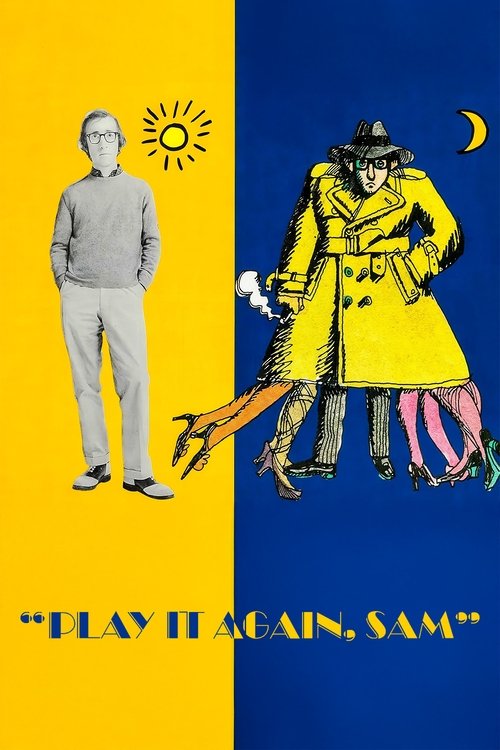
Play It Again, Sam
1972 · Herbert Ross
For when you need a good laugh with some heart in it — a comfort watch for movie lovers, breakup recoverers, and anyone who's ever rehearsed a conversation that then went nowhere near the script.
What it's about
Allan Felix is a neurotic San Francisco film critic whose wife has just walked out, and whose entire romantic education comes from the movies — especially Casablanca. As his happily married best friends try to set him up on a string of catastrophic dates, Allan gets coaching from an unlikely advisor: a hallucinated Humphrey Bogart, who materializes in trench coat and fedora to dispense tough-guy wisdom Allan is constitutionally incapable of pulling off.
The experience
A warm, fast, joke-dense comedy of humiliation — you wince, you laugh out loud, and underneath the pratfalls there's something genuinely sweet about a man learning the difference between the movies and his own life. It breezes by.
Performances
Woody Allen turns romantic panic into full-body slapstick, and Diane Keaton — in their first film pairing — gives the comedy its warmth and its footing; their chemistry is already unmistakable.
The craft
Adapted by Allen from his own Broadway hit and directed with unfussy polish by Herbert Ross, the film's best trick is structural: it opens inside the ending of Casablanca and builds every gag on the gap between screen fantasy and sweaty reality. The Bogart apparition is a simple device milked for both laughs and surprising poignancy.
Why it matters
One of the first mainstream American comedies built entirely out of movie love, it set the template for the Allen–Keaton screen partnership and for decades of comedies about people who learned romance from the movies.
Snapshot
A film critic named Allan Felix, abandoned by his wife and unable to speak to a woman without collapsing into self-sabotage, is coached through his return to dating by the hallucinated ghost of Humphrey Bogart. That premise — adapted by Woody Allen from his own 1969 Broadway play and directed for the screen by Herbert Ross — makes Play It Again, Sam one of the first mainstream American comedies to build its entire dramatic architecture out of cinephilia. It opens literally inside another movie: the final scene of Casablanca (1942), unrolling at full size, before the camera finds Allan slack-jawed in the dark of an empty auditorium. Everything that follows is a comedy about the distance between that screen and that seat.
The film matters for three reasons. It is the first pairing of Woody Allen and Diane Keaton on film, and the template from which Annie Hall (1977) was later built. It is the pivot in Allen's own development from gag-driven parody (Take the Money and Run, Bananas) toward character comedy with a romantic spine. And it is a foundational text for the "imaginary mentor" device and for the broader early-1970s Hollywood nostalgia wave — a movie whose very title is a misquotation of a line nobody says in Casablanca, which turns out to be its subject.
Industry & production
The property arrived at Paramount already tested. Allen's play opened on Broadway at the Broadhurst Theatre in February 1969, with Allen, Keaton, Tony Roberts, and Jerry Lacy in the roles all four would repeat on screen. It was Allen's second Broadway comedy after Don't Drink the Water (1966), and it was a genuine hit — a rare thing for a first-time leading man who had come out of stand-up and the television writers' rooms.
The film was produced for Paramount by Arthur P. Jacobs's APJAC company, best known then for the Planet of the Apes cycle and Doctor Dolittle. This is the crucial industrial fact about the picture: it is a Paramount property, made outside the United Artists relationship that was then housing Allen's own directorial work. Play It Again, Sam opened in May 1972; Everything You Always Wanted to Know About Sex\ (\But Were Afraid to Ask), which Allen wrote and directed for UA, followed in August. Allen did not direct Sam, and the reasons usually offered — that he had already lived with the material through a long stage run, that he preferred to concentrate on the performance, that the picture was simply set up elsewhere — are plausible but not firmly documented; the record here is thinner than the confidence with which it is often repeated.
The most conspicuous production decision was relocating the story from New York to San Francisco. The commonly cited explanation is a threatened labor action in New York that made East Coast shooting risky; this circulates widely but is not securely attested, and it should be treated as received wisdom rather than established fact. What is not in doubt is the effect. San Francisco gives the film fog, hills, a beach, and above all an airport capable of standing in for Casablanca's — and it strips Allan Felix of the New York armature that would define nearly every Allen protagonist afterward. The displacement is quietly productive: Allan is a man out of place, in a city that isn't quite his, borrowing a personality from a movie.
Casting was essentially the stage company transferred intact, joined by Susan Anspach — fresh from Five Easy Pieces (1970) — as the departing wife Nancy, and by Viva, the Warhol Factory performer, as one of Allan's disastrous dates, a small casting joke that briefly imports the underground into a studio comedy.
Technology
Play It Again, Sam is a conventionally equipped 1972 studio picture: 35mm Eastman color negative, spherical lenses, 1.85:1, and a monaural optical soundtrack. It carries none of the technological signature of its contemporaries in the New Hollywood — no zoom-heavy vérité, no long-lens crowd work, no push-processed available light. This is worth stating plainly because its cinematographer, Owen Roizman, had just shot The French Connection (1971), the era's loudest advertisement for handheld, fast-stock, documentary-derived technique. Almost none of that vocabulary appears here.
The one genuinely interesting technical dimension is archival. The film incorporates Casablanca footage as projected image — a Warner Bros. property licensed into a Paramount release — and it does so without optical trickery, simply intercutting the print. Similarly, Bogart's apparitions are achieved not through dissolves, superimposition, or any of the standard optical markers of fantasy, but through ordinary staging: Jerry Lacy walks into the room and stands in the shot. The choice is technologically modest and dramatically decisive, and it is discussed under Technique below.
Technique
Cinematography
Roizman's work is disciplined and largely self-effacing: clean, warm interiors built around practical sources, medium shots that hold two or three actors in frame long enough for a scene to play as written, and a general refusal of the coverage-heavy cutting that would have chopped Allen's dialogue rhythms into fragments. The apartment — the play's principal set — is lit to feel lived in and slightly shabby, which flatters the joke that a man surrounded by film posters and jazz records cannot manage a conversation.
The camera's one sustained flourish is reserved for the ending, where the airport is drowned in fog and lit for silhouette. Roizman is not imitating Arthur Edeson's black-and-white Casablanca photography so much as translating its atmospheric idea into color: diffusion, backlight, figures dissolving into vapor. It is a pastiche that knows it can never be the original, and the gap is the point.
Editing
Marion Rothman, a studio-trained editor whose credits run back through the Fox system of the late 1960s, cuts for performance rather than for pace. Scenes are allowed to run; reaction shots arrive late; the comic beats are given room to die and revive, which is how Allen's writing works.
The film's most consequential editorial decision concerns Bogart. There is no visual grammar separating Allan's hallucination from his reality — no ripple, no soft focus, no cue. Bogart is simply there, occupying the same cutting pattern as everyone else, and the film never adjudicates his ontological status. The effect is to make cinephilia feel like a condition rather than a daydream: the movies are not something Allan retreats into, they are continuous with the room he is standing in. Later fantasy sequences — Nancy roaring off with a motorcycle gang, the imagined romantic deaths — are marked more conventionally, which throws Bogart's unmarked presence into relief.
Mise-en-scène / staging
Ross was, by training and temperament, a man of the theater — a Broadway choreographer before he was a director — and his handling of adapted stage material is the reason he kept being hired for it. The apartment scenes preserve the play's spatial logic: entrances and exits carry meaning, the three-hander of Allan, Linda, and Dick is blocked as a triangle, and Dick's compulsive telephoning (he cannot enter a room without leaving a forwarding number) is staged as a physical running gag rather than a verbal one.
Around this fixed center, Ross opens the film out: the museum, where Allan attempts to seduce a woman contemplating a Jackson Pollock and receives the flattest possible rebuff (asked what she is doing Saturday night, she says she is committing suicide; he asks about Friday); the discotheque; the beach; the airport. The opening-up is competent rather than inspired, and critics have often said so. But it performs a real function — it places a stage-bound neurotic inside an unmistakably contemporary early-'70s world of singles bars, analysis, and Valium.
Sound
The soundtrack is a deliberate collision of eras. Herman Hupfeld's "As Time Goes By" and the Steiner-scored Casablanca material carry the film's fantasy register; Billy Goldenberg — a television composer who had scored Spielberg's Duel (1971) — supplies a light contemporary score for the register Allan actually lives in. The two never blend, and the score is at its best when it declines to help Allan pretend.
Jerry Lacy's Bogart is a sound performance above all: the sibilant drawl, the clipped delivery, the tobacco rasp. It is an impersonation rather than an incarnation, and the film wants it that way. What Allan has internalized is not Bogart but a widely circulated impression of Bogart — the trench coat, the fedora, the wisdom about dames — which is precisely the object the film sets out to dismantle.
Performance
Allen's screen persona arrives here in something close to final form. The physical comedy is at its peak in the pre-date sequence, in which he attempts to arrange himself into casual sophistication and instead destroys his own apartment — a set piece of escalating hydraulic failure that belongs to the tradition of Keaton and Tati as much as to stand-up.
Keaton's performance is the film's other historical event. Her Linda is hesitant, self-interrupting, anxious in a register that is recognizably neurotic without being written as a joke; she plays reaction better than line, and the halting, overlapping speech that would become the Annie Hall voice is already audible. Tony Roberts establishes the type he would reprise across Allen's filmography — the successful, uncomplicated friend whose competence is the measure of the hero's inadequacy. Lacy holds the hardest position, playing a myth without ever being permitted to be a person.
Narrative & dramatic mode
The structure is classical romantic comedy with a supervisory ghost. Allan is deserted; Allan is fixed up; Allan fails; Allan is loved by the one woman he was not trying to impress; Allan must choose between having her and deserving her. The Bogart figure supplies the mentor function that comedy usually assigns to a friend or servant, and the film's real dramatic engine is the slow discrediting of that mentor. Bogart's counsel — that women respond to indifference and force — works exactly once, and works for reasons Bogart does not understand.
The resolution is a knowing rewrite of Casablanca's aerodrome farewell, with Allan renouncing Linda in fog and borrowed cadence, followed immediately by the film's central admission: the speech is from Casablanca, and Linda has seen the film too. This is the mode in which the whole picture operates — sincerity achieved through quotation, and then the quotation confessed. Allan's closing recognition, that the trick was never to be Bogart but to be himself, is the standard maturation beat of romantic comedy, given an unusual twist: what he graduates out of is not immaturity but spectatorship.
Genre & cycle
The film sits at the junction of three cycles. It belongs to the Broadway-adaptation comedy that Paramount and its competitors were still mining heavily in the era of Neil Simon — a genre defined by verbal density, small casts, and interior sets. It belongs to the early-1970s Hollywood nostalgia boom: 1972 alone produced Bogdanovich's screwball revival What's Up, Doc?, and the years around it delivered The Last Picture Show, Paper Moon, The Way We Were, The Sting, and Chinatown, all trading on the memory of studio-era style. And it inaugurates, in embryo, the cycle of anxious, therapy-inflected urban romantic comedies that Allen himself would define — the "nervous romance," where the obstacle to love is not circumstance but the protagonist's own consciousness.
What separates it from its nostalgia-boom siblings is that it does not restage the past. What's Up, Doc? performs screwball; Play It Again, Sam is about a man who cannot stop watching it.
Authorship & method
The authorship question here is unusually live. Allen wrote the play, wrote the screenplay, and stars; the voice, the jokes, the neuroses, and the persona are entirely his, and the film is almost universally filed under his name. Ross directed, and his contribution tends to be either dismissed as anonymous or, in the more considered accounts, credited with exactly the thing Allen's own early films lacked: shape. Allen's contemporaneous pictures are sketch anthologies held together by momentum. Play It Again, Sam is the first film with Allen at its center that has a plot, a romantic arc, and a third act that pays.
Ross's larger career supports the reading. A choreographer turned director, he specialized in adaptation and in actors — The Owl and the Pussycat (1970), The Sunshine Boys (1975), The Turning Point (1977), The Goodbye Girl (1977), later Pennies from Heaven (1981) and Steel Magnolias (1989). He was a craftsman of other people's material, and his signature is the absence of one.
The key collaborators are named above: Roizman on camera, Rothman cutting, Goldenberg scoring. It is worth registering how odd that combination is — a rising cinematographer at the front edge of New Hollywood realism, a studio-system editor, and a television composer, assembled around a Broadway property and a stand-up comedian.
Movement / national cinema
The film is American studio product, but its ancestry is transatlantic. Its founding gesture — a young man modeling himself on Bogart, consulting a poster, rehearsing the lip-stroke — is Belmondo's in Godard's À bout de souffle (1960), transposed from Parisian existential cool to Manhattan-transplanted-to-San-Francisco neurosis. The French New Wave invented the idea that a life could be lived as film criticism; Play It Again, Sam is that idea run through Jewish-American comic tradition, where the same posture produces not a gangster but a man who cannot get the cap off his hair tonic.
That comic tradition is the film's other national lineage: the Borscht Belt and the television writers' rooms of the 1950s, from which Allen, Mel Brooks, and Neil Simon all emerged, with their characteristic machinery of self-deprecation, sexual anxiety, and the punchline as defense.
Era / period
1972 places the film precisely. The Bogart revival was a genuine cultural phenomenon of the 1960s — sustained by American repertory and campus theaters, where Casablanca screenings had become a ritual — and the play and film depend on an audience for whom Bogart worship was a recognizable social type rather than an antiquarian taste. Umberto Eco would later theorize this exact object in his essay on Casablanca as a cult film assembled from archetypes; Allen got there first, as comedy.
The film is also legible as a document of post-sexual-revolution dating: the singles culture, the casual availability that terrifies rather than liberates the protagonist, the analyst, the pills, the marriage in which the husband is never off the phone. And it belongs to the moment when American movies became reflexively conscious of their own history — when the studio past stopped being simply the past and became a resource, a costume, and a problem.
Themes
Cinephilia as prosthesis. Allan does not use movies to escape life; he uses them as instructions for it, and the instructions are wrong. The film's comedy comes from the mismatch between screen behavior and social physics.
The misquotation. The title is a line not spoken in Casablanca. The film's governing insight is that what we inherit from movies is not the movies but our corrupted memory of them — a folk Casablanca, smoother and more usable than the real one.
Masculinity as impersonation. Bogart is a manual for a kind of manhood — hard, laconic, contemptuous of women's autonomy — that the film both indulges and repudiates. Allan succeeds when he abandons it, but the movie is honest about the pull it still exerts; it does not pretend to have outgrown what it critiques.
Friendship and betrayal. The romantic triangle is unusually gentle: Dick is not a villain, merely absent, and Allan's renunciation is an act of loyalty as much as of romance.
Substitution. Every relationship in the film is a stand-in for another — Bogart for a father, Linda for Nancy, the quotation for the feeling. Growing up, in this movie, means learning to speak in one's own voice, which the last scene achieves only by first borrowing someone else's.
Reception, canon & influence
Contemporary reviews were broadly favorable, with the recurring critical note being a split verdict on authorship: praise for Allen's writing and performance and for Keaton, alongside the observation that the direction was efficient rather than distinctive, and that the film succeeded as an Allen picture despite not being one. Commercially it performed well — it was among the more successful of Allen's early appearances — though specific figures should not be asserted here without sources, and its awards profile was slight.
Backward. The film's debts are explicit and layered: Casablanca itself, the American Bogart cult of the 1960s, Godard's À bout de souffle and the New Wave's construction of the cinephile hero, the Broadway comedy of Neil Simon, and the reflexive Hollywood tradition running from Sullivan's Travels and Sunset Boulevard through Hellzapoppin'.
Forward. Its clearest legacy is the imaginary-mentor device: the hallucinated icon who counsels the protagonist, most directly inherited by True Romance (1993), where Clarence's Elvis performs precisely Bogart's function, and echoed across decades of screen fantasy. Its second legacy is the wider strain of American movies about movie love — Steve Martin's Dead Men Don't Wear Plaid (1982), which literally cuts Bogart into new footage, and, most importantly, Allen's own The Purple Rose of Cairo (1985), which inverts the premise by sending the star off the screen into the spectator's world and refuses the happy resolution that Sam grants.
Its largest legacy, though, is internal to Allen's career. Play It Again, Sam is where the Allen–Keaton screen partnership begins, where the neurotic-intellectual persona acquires a romantic plot to inhabit, and where the writer discovers that his comedy could carry a third act. Five years later, Annie Hall would take the same two performers, the same anxieties, and the same reflexive relationship to art, and win Best Picture with them. The film is rarely placed in the first rank of Allen's work, and it should not be — but it is the hinge on which that work turns, and one of the most durable comedies ever made about the strange, mediated business of learning how to live from a screen.
Reception
A hit in 1972 and warmly reviewed, it's now read mostly as the Rosetta Stone for Annie Hall — the first on-screen pairing of Woody Allen and Diane Keaton, and the moment the Allen nebbish persona locked into place, even though Allen didn't direct it.
How Play It Again, Sam was received, from release to now →
How to watch Play It Again, Sam: what to notice on a first viewing
- Watch for any visual cue marking Bogart as a hallucination. The editing gives Bogart no ripple, no soft focus, no signal separating him from reality; he occupies the same cutting pattern as everyone else in the room. Bogart isn't a fantasy Allan escapes into; he's just another person standing in the apartment.
- Listen for two different scores that never blend together. Music from Casablanca carries the fantasy scenes while a separate contemporary score plays under Allan's real life, and the two never mix into one sound. You can hear which world you're in before you can even see it.
- Watch entrances and exits in the apartment scenes. Ross keeps the play's spatial logic intact, blocking Allan, Linda, and Dick as a triangle and staging Dick's compulsive phone calls as a running physical gag. You can read the relationship's shape just from where each person stands in the room.
- Watch Allan destroy his own apartment trying to look casual. Woody Allen builds the pre-date scene as a set piece of escalating physical failure, arranging cushions and records into an image of effortlessness that collapses on him. The comedy is entirely physical here, a body failing at ease rather than a line landing a joke.
- Watch the film posters and jazz records fill Allan's apartment. The apartment is lit to feel lived-in and slightly shabby, crowded with movie memorabilia, which sharpens the joke that a man surrounded by films still can't hold a conversation. His whole room argues that he knows everything about movies and nothing about people.
The whole guide to watching Play It Again, Sam, with the keys for a rewatch →
Influences: the films it descends from and the films it influenced
- Casablanca (1942) — Supplies both the licensed opening reel and the closing blueprint — Ross restages the airport farewell with matched fog, backlit silhouette, trench-coat-and-fedora blocking and 'As Time Goes By,' so the finale is a shot-level recreation rather than an allusion.
- À bout de souffle (1960) — Belmondo thumbing his lip before the Bogart poster is the precise device Allen inherits: a performance built as visible imitation of a screen icon, with the mimicry played as characterization instead of impression-gag.
- Sherlock Jr. (1924) — Establishes the in-camera grammar for a spectator's movie-fantasy intruding into his physical space, and the escalating-object slapstick (props turning on the body) that governs Allen's hair-dryer and record-album destruction routines.
- Blithe Spirit (1945) — Lean's staging rulebook for an apparition visible to one character only — strict eyeline discipline and blocking that keeps the non-seeing characters' sightlines and crossings uninterrupted — is exactly how Bogart is placed in Allen's apartment.
- Sunset Boulevard (1950) — The film-haunted interior as psychological set: a character who projects her own screen past into the present room, which is how Allen's apartment is dressed and lit around the Bogart poster.
- Sullivan's Travels (1941) — The reflexive Hollywood comedy whose structural argument is that movies instruct their audience in how to live — the thesis Sam dramatizes by making the instruction literal and audible.
- The Odd Couple (1968) — The Neil Simon apartment two-hander grammar Ross works inside: sustained dialogue scenes blocked around furniture and door entrances, cut to the stage version's punchline rhythm rather than to conventional coverage.
- The French Connection (1971) — Roizman's grainy available-light location method from the previous year, imported wholesale for the San Francisco exteriors so the street material carries documentary texture deliberately at odds with the proscenium interiors.
- Take the Money and Run (1969) — Allen's own sketch-anthology construction — persona and gag rhythm with no third act — is the direct precursor Sam corrects; the same voice given a romantic plot isolates what a shaping director contributed.
- The Owl and the Pussycat (1970) — Ross's prior Broadway two-hander adaptation, where he developed the cut-for-performance method — trimming to the actors' timing beats instead of to coverage — that he then applies to Allen and Keaton.
- Annie Hall (1977) — Takes the same two performers and generalizes Sam's unmarked-fantasy editing — apparitions, direct address and interpolated memory dropped into realist scenes with no dissolve, ripple or optical marker to license them.
- Pennies from Heaven (1981) — Ross pushes the interpolated-fantasy device to full register-switch — characters drop out of the realist frame into a borrowed period movie idiom mid-scene, the mechanism Sam uses in miniature for Bogart's entrances.
- Dead Men Don't Wear Plaid (1982) — Takes the licensed-archival-footage device to its limit by lighting, lensing and blocking new material to match 1940s noir plates, so Martin plays two-shots opposite Bogart instead of merely being counseled by him.
- Zelig (1983) — Converts Sam's archival borrowing from quotation into compositing — the persona is optically inserted inside the newsreel rather than advised from beside it.
- The Purple Rose of Cairo (1985) — Exact inversion of the premise: the screen figure crosses out of the projection into the spectator's world, and Allen withholds the consoling third-act resolution Sam grants.
- True Romance (1993) — Clarence's Elvis in the bathroom mirror reproduces Bogart's function and staging exactly — a hallucinated icon shot in shot/reverse as a physical scene partner, dispensing tactical advice the protagonist then acts on.
- Fight Club (1999) — Extends the imaginary-mentor device to feature-length structure by blocking, lighting and cutting the projection as a fully diegetic scene partner, so the audience accepts him as present until the film revokes it.
- The Heartbreak Kid (1972) — The same-season stage-derived romantic-humiliation comedy that also holds the shot on the performer through sustained social cringe rather than cutting away on the joke, proving the editing approach was a 1972 mode, not a Ross idiosyncrasy.
- The Goodbye Girl (1977) — Ross reapplies the Sam method to Simon: stage-written dialogue paced entirely by cutting to Dreyfuss's delivery, with the camera subordinated to the actor's timing.
Similar films
- Annie Hall (1977) — influence & lineage
- The Purple Rose of Cairo (1985) — influence & lineage
- Casablanca (1943) — shared sensibility
- Manhattan (1979) — shared sensibility
- What's Up, Doc? (1972) — shared sensibility
- The Big Chill (1983) — shared sensibility
- When Harry Met Sally... (1989) — shared sensibility
- The Awful Truth (1937) — shared sensibility