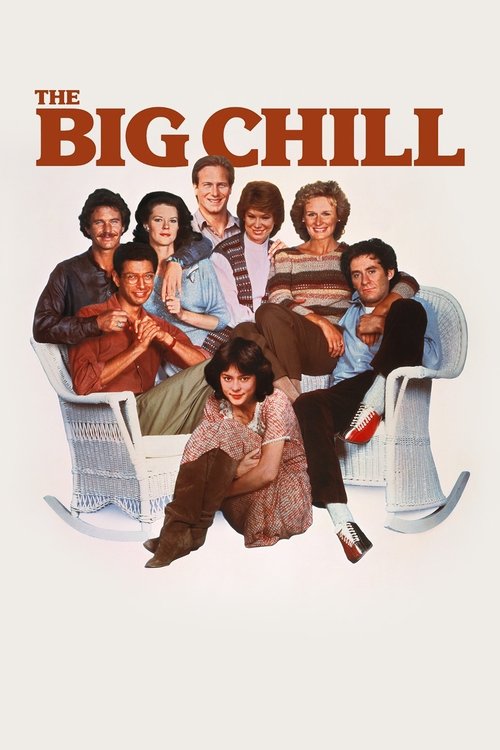
The Big Chill
1983 · Lawrence Kasdan
For a reflective night when you're thinking about old friends, roads not taken, or a reunion coming up — comfort food with an aftertaste. Best watched when you're willing to feel a little wistful.
What it's about
Seven college friends from the late-'60s reunite for a weekend in a South Carolina house after the funeral of the one among them who seemed most brilliant — dead by his own hand. Over three days they cook, dance to old records, argue, flirt, and cut small deals with each other, all while circling the question none of them wants to say out loud: what happened to the people they meant to become?
The experience
Bittersweet and conversational — a hangout movie shadowed by grief, where the laughs and the Motown singalongs keep bumping into regret. It's cozy on the surface and quietly needling underneath, the kind of film that plays differently at every age you watch it.
Performances
A murderers' row of an ensemble — Glenn Close, Kevin Kline, William Hurt, Jeff Goldblum, Tom Berenger, Mary Kay Place, and JoBeth Williams — all working in genuine chamber-piece balance, no one grandstanding, everyone landing.
The craft
Kasdan builds the whole film from talk — overlapping, evasive, funny conversation in one house over one weekend — and makes it feel effortless. The wall-to-wall Motown and '60s-soul soundtrack was a landmark, practically inventing the modern needle-drop nostalgia score.
Why it matters
It became the defining portrait of baby-boomer midlife reckoning and the template for the reunion ensemble drama, while its soundtrack changed how Hollywood used pop music to sell memory.
Snapshot
Seven friends who met at the University of Michigan in the late 1960s reconvene in a South Carolina house for the weekend following the suicide of Alex, the one among them who had seemed most gifted and most committed. Over roughly seventy-two hours they cook, drink, dance, argue, sleep with each other, jog, watch football, and negotiate a series of small transactions — a sperm donation, a business proposition, a real-estate deal — while never quite saying aloud that the person they are mourning is also, in some measure, the person they used to be.
The Big Chill is Lawrence Kasdan's second film as director, made after Body Heat (1981) and after his run as a screenwriter on The Empire Strikes Back, Raiders of the Lost Ark, and Return of the Jedi. It is a chamber piece in a decade of blockbusters, and it was constructed with an unusual degree of deliberation: an ensemble rehearsed and housed together, a single principal location, a soundtrack of Motown and 1960s pop deployed as continuous emotional commentary. Its commercial success was substantial and its cultural afterlife larger still — the film became shorthand for boomer self-examination, a reference point invoked as often in reproach as in praise, and a template that television and film ensembles have been reworking ever since. Whether that afterlife represents the film's achievement or its flattening is one of the more interesting questions in American cinema of the period.
Industry & production
The film was produced by Carson Productions — the company associated with Johnny Carson — and released by Columbia Pictures in September 1983. Michael Shamberg produced. The budget was modest by studio standards of the moment, and the picture's economics rested on a small cast, one main location, and a compressed shooting schedule; the principal above-the-line expense that was not conventionally modest was the music licensing, since the soundtrack draws on a dense catalog of Motown and other 1960s recordings in their original form rather than in cover versions or score approximations.
Kasdan's leverage came from a specific place in the early-1980s industry. Having written the two most successful sequels and one of the most successful original adventures of the era, he possessed the credibility to direct a talky, star-free ensemble drama, and Body Heat had demonstrated he could deliver a stylish picture on a controlled budget. The commercial logic was still not obvious. Columbia was betting on an ensemble of actors who were, at the time, largely known from television, theater, and supporting roles rather than from marquee credits: Tom Berenger, Glenn Close, Jeff Goldblum, William Hurt, Kevin Kline, Mary Kay Place, Meg Tilly, JoBeth Williams. Several of them became stars in the years that followed, which has produced a retrospective illusion that the film was cast with names.
Production took place in and around Beaufort, South Carolina, with the Tidalholm house serving as the central location. Kasdan had the ensemble live and rehearse together for a period before shooting — a practice more common in theater than in American studio filmmaking of the period — and the result is visible in the overlapping, unforced rhythm of the group scenes. The cast's familiarity is not simulated; it was manufactured under controlled conditions.
The production's most discussed decision was made in the cutting room. Kevin Costner was cast as Alex and appeared in flashback material that was shot and then removed from the finished film; Costner remains in the picture only as the corpse being dressed under the opening credits, his face never shown. Kasdan has spoken publicly about the choice over the years, and the reasoning that has been consistently reported is structural rather than performance-related: showing Alex alive would have converted a film about the survivors' projections into a film about a man, and would have adjudicated arguments the movie wanted to leave open. The excision is the single most consequential act of construction in the picture. Kasdan later cast Costner in a leading role in Silverado (1985), which is generally read as making good on the cut.
The film was a significant commercial success in the United States relative to its cost and played in theaters for an extended run. It received Academy Award nominations including Best Picture, Best Original Screenplay for Kasdan and Barbara Benedek, and Best Supporting Actress for Glenn Close. It did not win in those categories.
Technology
The Big Chill is technologically conservative, and deliberately so. It was shot on 35mm color negative and finished for conventional theatrical release; it makes no use of the optical and mechanical innovations — motion control, extensive opticals, Steadicam bravura, Dolby-showcase mixing — that were reorganizing the industry Kasdan had just come from. The relevant technological fact about the film is not what it used but what it declined.
There are two genuine technological dimensions worth naming. The first is sound: the film was released in Dolby Stereo, and the music is mixed with a fullness and presence that matters enormously to how the picture works. The songs are not background texture at low level; they occupy the soundtrack at something close to the scale they would have on a home stereo, which is precisely the register the film wants.
The second is the record album itself as a technology of memory. The film is unusually attentive to the physical apparatus of listening — records selected and put on, a kitchen radio, music playing from a source inside the house rather than from the score. This diegetic anchoring is a formal choice with a technological premise: these characters' emotional lives are stored on a medium they own and can operate, and the film keeps showing us the operation.
The ancillary technology story is commercial. The soundtrack album was a very large seller and did much to consolidate the 1980s pattern of the film soundtrack as a self-sustaining product, and — more specifically — to establish the compilation of licensed back-catalog recordings, rather than newly composed score or newly recorded songs, as a viable commercial form. That model became ubiquitous, and its costs and habits shaped a great deal of subsequent American filmmaking.
Technique
Cinematography
John Bailey photographed the film. Bailey had shot Ordinary People (1980) and American Gigolo (1980) and was among the most versatile American cinematographers of the period; his work here is characterized by warmth, softness, and an almost complete refusal of visual assertion.
The photography's governing problem is a practical one: a house, a large group, extended conversation, and a need to keep eight or nine people legible in the frame without the coverage becoming mechanical. Bailey and Kasdan solve it largely through depth and layering. Characters are frequently arranged at different distances from the camera and at different heights — someone seated in the foreground, someone standing in a doorway behind, someone crossing at the rear — so that a single sustained setup can carry several simultaneous relationships. The house's actual architecture, with its verandas, staircase, and connected rooms, is used as a system of frames within the frame.
The light is warm and predominantly motivated: lamps, windows, kitchen fixtures, the blue of a television. Bailey pushes toward the underlit in the night scenes, letting faces fall into partial shadow rather than filling to a conventional glamour level. The overall palette runs to browns, ambers, and the greens of the South Carolina exteriors, and the film has a slightly burnished quality that reads as domestic rather than nostalgic — the warmth of a house that is lived in, not the amber of a flashback.
The camera moves, but rarely announces itself. There are slow lateral drifts and reframings that follow conversation, and the opening titles sequence is a notable exception in its formal deliberateness: the intercutting of Alex's body being dressed by a mortician with the friends receiving the news, all of it carried by Marvin Gaye's "I Heard It Through the Grapevine." That sequence establishes the film's method — image and song working as counterpoint rather than illustration — before a word of dialogue is spoken.
Editing
Carol Littleton edited the film, as she had Body Heat and would several later Kasdan pictures. Her work here is the film's least visible and most consequential technical achievement.
The central editorial challenge is that The Big Chill has no plot in the conventional sense. It has a weekend, a large cast, and a set of relationships that must be established, complicated, and partially resolved without the armature of goal-directed action. Littleton's solution is a mode of construction closer to musical form than to dramatic structure: scenes are grouped into movements, conversations are cut in and out of at oblique points rather than at their beginnings and ends, and the film moves laterally between clusters of characters in a way that keeps all nine in the audience's active attention.
The cutting within scenes is patient. Littleton lets exchanges run, favors two-shots and group shots over rapid singles, and often stays with a listener rather than cutting to a speaker — which is how the film generates its considerable subtext, since so much of what these people mean is registered in the faces of those not talking.
The songs function as editorial structure as much as sound design. Musical sequences — the kitchen cleanup to "Ain't Too Proud to Beg," the football and dancing passages — operate as rhythm sections that bracket and release the dialogue scenes, and Littleton cuts these with a looseness that mimics the way people actually move around a shared space. The elimination of the Costner flashbacks was, in the end, an editorial decision as much as a directorial one, and the film's coherence depends on it: what remains is a present tense with a hole in it.
Mise-en-scène / staging
The house is the film's organizing intelligence. Kasdan stages almost everything in terms of who is where, and the architecture is treated as a social diagram: the kitchen as the space of intimacy and labor, the bedrooms as the space of confession and negotiation, the porch as the threshold where people go to be half-alone, the living room as the arena of the group.
The staging of ensembles is genuinely skillful. Kasdan will hold nine people in a room and orchestrate them so that the frame keeps producing legible relationships — pairings forming at the edges, someone withdrawing while a conversation continues, a subject picked up in one room and finished in another. Movement between rooms substitutes for cutting; characters carry conversations through doorways.
Costume and set decoration carry a great deal of characterological information without commentary. Harold and Sarah's house is affluent, tasteful, and slightly sterile in a way the weekend disorders. Nick's van, Sam's television-star grooming, Michael's magazine-journalist patter, Karen's suburban propriety, Chloe's out-of-time hippie casualness — each is established visually before it is established verbally. The film's most quoted running joke, the group's collective consumption of leftovers and the constant preparation of food, is staged rather than remarked upon.
Sound
The soundtrack is the film's most famous element and the one most often misunderstood as mere nostalgia programming. The songs — Marvin Gaye, the Rolling Stones, Procol Harum, the Temptations, Aretha Franklin, Creedence Clearwater Revival, the Beach Boys, among others — are used with considerable structural precision. They are frequently diegetic or semi-diegetic, sourced from a record player or radio in the house; they are placed at moments where the characters cannot articulate what they feel; and they are almost never used to celebrate the past straightforwardly. "I Heard It Through the Grapevine" over a corpse being dressed is a bleak joke about secondhand knowledge. "You Can't Always Get What You Want" as a funeral recessional is the film's thesis delivered by the deceased's own taste.
There is an original score by Kasdan's frequent collaborator, but its role is deliberately minor — the songs do the work that score would normally do. This is the film's most influential formal decision.
The dialogue mix privileges overlap and simultaneity. The group scenes are written and mixed so that several conversations can be heard at once with one foregrounded, which is uncommon in mainstream American filmmaking of the period outside of Altman's practice, and it is a large part of why the ensemble feels like a set of long-standing relationships rather than a collection of characters taking turns.
Performance
The performances are the reason the film survives its own reputation. Kasdan's rehearsal period produced an ensemble that plays as a group first and as individuals second — a rare and difficult thing.
Glenn Close's Sarah carries the film's grief most directly; her shower scene, in which the sobbing is heard and half-seen rather than performed toward the camera, is the picture's most exposed moment and is played almost entirely without dialogue. Kevin Kline's Harold works in a register of genial competence that keeps cracking in small, precisely calibrated ways. William Hurt's Nick is the film's most difficult performance — a man whose damage is presented obliquely, whose sarcasm is a functioning defense system, and whose war injury is disclosed late and without emphasis; Hurt plays him with a coiled stillness that resists the audience's sympathy. Jeff Goldblum's Michael, Tom Berenger's Sam, Mary Kay Place's Meg, and JoBeth Williams's Karen each occupy distinct comic and dramatic registers without the ensemble tipping into caricature. Meg Tilly's Chloe, the youngest and the outsider, is played with an affectlessness that operates as the film's structural irritant: she knew Alex most recently and is least invested in the group's mythology, and her flat, literal statements repeatedly puncture the others' self-narration.
Narrative & dramatic mode
The Big Chill is a unity-of-place ensemble drama built on the classical reunion structure: a group is assembled by an external event, held together in a confined space for a bounded duration, and dispersed. The dramatic engine is not a goal but a pressure — the accumulated weight of what everyone has become, forced into contact with what everyone believed.
The film's most important structural decision, as noted, is the absence of Alex. He is a negative space that each character fills differently, and because we never see him, the audience cannot adjudicate between their accounts. Alex functions as a screen for projection: to Sarah he is a love affair and a betrayal, to Nick a mirror of his own arrested talent, to Meg a sexual and moral question, to Chloe simply the man she was living with. The film's ambivalence about the 1960s is entirely routed through this figure — Alex is both the one who kept faith and the one who could not survive keeping it, and the film does not resolve which reading is correct.
The dramatic mode is comic in texture and elegiac in structure. Kasdan and Barbara Benedek write dialogue that is fast, funny, and heavily ironized, and the film's most serious material arrives inside jokes. This is a specific American mode — comedy as the socially permitted form of intimacy among people who cannot speak plainly — and The Big Chill uses it consistently.
The sperm-donation plot is the narrative's most audacious element and the one that has aged most interestingly. Meg wants a child; Sarah offers her husband; Harold agrees. The film treats this as a gesture of generosity within the group's private economy, and it stages the arrangement as tender rather than transgressive. Whether this reads as a genuine alternative ethics or as the boomer capacity to reframe self-interest as generosity is a question the film raises and, characteristically, declines to answer.
The ending is quietly refusing. Nothing is resolved. The weekend ends, a business proposition is floated, and the group agrees, jokingly, never to leave — a joke that lands as an admission. The film's last movement is a return to routine, not a transformation.
Genre & cycle
The film sits at the intersection of several forms. It belongs to the ensemble reunion drama, whose immediate American antecedent is John Sayles's Return of the Secaucus 7 (1980) — a lower-budget, independently produced film with a nearly identical premise, made three years earlier. The relationship between the two pictures has been debated since 1983. Kasdan has stated that he had not seen Sayles's film when he wrote his own, and the two scripts do differ substantially in register and construction. The convergence is best understood as two filmmakers arriving independently at the same generational subject at the moment it became available for examination.
Beyond that, the film participates in the tradition of the country-house drama — Chekhov and Renoir at its origin, with the confined group, the interrupted idyll, and the social comedy that shades into loss. It also belongs to the specific American cycle of early-1980s films examining the political and personal residue of the 1960s: Reds (1981), The Return of the Secaucus 7, Running on Empty (1988) later in the decade.
Within Kasdan's own work it is the second entry in a career defined by genre reconstruction: Body Heat rebuilds film noir, Silverado rebuilds the Western, The Accidental Tourist (1988) and Grand Canyon (1991) return to the contemporary ensemble drama. The Big Chill is the least generic of these and, arguably, the one that created a genre rather than revisiting one.
Authorship & method
Kasdan's method here is explicitly collaborative and rehearsal-based. He co-wrote with Barbara Benedek, whose contribution to the film's female characters has been noted in accounts of the production and whose presence on the script matters: the women in The Big Chill have interior lives that are not simply functions of the men's.
The core collaborators recur across Kasdan's filmography. Carol Littleton edited Body Heat, The Big Chill, Silverado, The Accidental Tourist, Grand Canyon, and Wyatt Earp; she is as central to the Kasdan sensibility as any single figure. John Bailey shot The Big Chill, Silverado, and Grand Canyon. The music supervision and the original score work were handled within this same circle of long-term relationships.
Kasdan's directorial signature, insofar as he has one, is a preference for legibility over assertion. He does not build sequences around visual ideas; he builds them around the arrangement of people, and he trusts writing and performance to carry meaning. This has led some critics to describe him as an essentially literary director, which is fair as description and unfair as dismissal — the staging skill in the group scenes is not a lesser achievement than a bravura camera move.
The film's authorship is genuinely divided in one respect: the songs are co-authors. The emotional architecture of the picture is substantially delegated to recordings Kasdan did not make, which is a real ceding of authorial control and an unusual one.
Movement / national cinema
The Big Chill is a mainstream American studio film with no formal allegiance to any movement. Its interest as national cinema is sociological. It arrives in 1983, midway through the Reagan presidency, at the precise moment when the generation that had defined itself through the political culture of the 1960s was consolidating professional and economic power. The film is a document of that transition, made from inside it, and its refusal to condemn its characters is both its integrity and the source of most complaints against it.
It stands apart from the dominant American cinema of its moment — the effects-driven adventure film Kasdan himself had helped invent, the high-concept comedy, the teen picture. Its closest structural relatives in the period are American independent films, not studio ones, which is part of why Secaucus 7 keeps being invoked.
Era / period
The film's temporal structure is double: a 1983 present continuously interrogating a late-1960s past that we never see. The absence of flashbacks — enforced by the removal of the Costner material — means the 1960s exist in the film only as talk, as songs, and as an absent man. This is the film's most rigorous formal idea.
The 1983 present is rendered with specificity: the running shoes, the video recorder, the athletic clothing, the professional vocabularies of medicine, law, magazine journalism, television, and pharmaceutical sales. The characters' careers are the film's real evidence about what happened to the counterculture — not betrayal exactly, but absorption.
The period detail that matters most is affective. The film catches a particular early-1980s emotional weather: the sense that a shared project had ended without anyone announcing it, and that the people who had been in it were now individually successful and collectively bereft.
Themes
Disillusionment and its comforts. The film's title names a cooling — of conviction, of ardor, of the sense that the world was going to be remade. But the film is not tragic about this. Its characters have found substantial compensations, and the movie is honest enough to show that the compensations are real.
Friendship as an economy. The group operates a private system of exchange: sex, money, children, absolution. Harold gives Meg a child; Karen and Sam settle old business; Nick and Chloe form something new; Harold offers Michael a real-estate deal. The film presents this as love and also, quietly, as transaction.
Grief that cannot find its object. Nobody in the film mourns Alex adequately, because nobody knew him in the same way and because each of them is partly mourning themselves. The film's emotional accuracy lies in showing grief displaced into activity — cooking, running, sex, arguing about football.
Self-justification as a generational habit. Michael's famous line about rationalizations being more important than sex is the film's most direct self-diagnosis, and it is delivered as a joke by the character least willing to examine himself.
Youth as a country you cannot return to. Chloe, who was never there, is the film's control group. She is unmoved by the mythology and consequently the freest person in the house.
Reception, canon & influence
Critical reception. The film was widely reviewed and broadly, though not unanimously, praised. Admirers credited the writing, the ensemble, and the emotional precision; the ambivalence in the reviews clustered around the same points that have organized the film's reputation ever since — that its characters are affluent and articulate enough to make their suffering feel cushioned, that the songs do emotional work the drama might have earned, and that the comparison to Return of the Secaucus 7 is not flattering. Pauline Kael was notably unimpressed; her critique, and others in the same vein, treated the film as flattery of its audience. The Academy nominations for Picture, Original Screenplay, and Close's supporting performance indicate the industry consensus. Its commercial performance far exceeded expectations for a dialogue-driven ensemble film.
Influences on the film (backward). The country-house ensemble tradition running from Chekhov through Renoir's The Rules of the Game. Robert Altman's overlapping-dialogue ensembles of the 1970s, particularly Nashville (1975), as a method for handling large groups. Return of the Secaucus 7 (1980), whether or not by direct transmission, as the immediate American precedent. The 1970s American cinema of adult disappointment — the films of Paul Mazursky in particular share the register of affluent people examining their own choices with rueful humor. And the classical Hollywood reunion picture, of which The Big Chill is a late and self-aware instance.
Legacy (forward). The film's influence is unusually broad and runs along three lines.
The soundtrack model. The Big Chill did more than any other single film to establish the licensed back-catalog compilation as a mode of film scoring and as a commercial product. The practice of a period pop soundtrack carrying a film's emotional structure — visible everywhere from Scorsese's usage to the Tarantino generation to the routine needle-drops of contemporary prestige television — has The Big Chill as a decisive commercial precedent, whatever its artistic antecedents.
The ensemble reunion form. Its structure has been reworked continually: Peter's Friends (1992) in Britain, Grand Canyon (1991) by Kasdan himself, The Best Man (1999), This Is Where I Leave You (2014), and a long line of others. The film's premise became so recognizable that "a Big Chill for [generation X]" was a standard pitch formulation for years — Reality Bites (1994) and Singles (1992) were both discussed in those terms.
Television. The film's most durable influence may be on television. The friends-as-chosen-family ensemble, the apartment or house as the show's real setting, the mixture of rapid comic dialogue with sudden emotional exposure — this describes thirtysomething (1987–1991) almost exactly, and it describes a great deal of what followed, up through Friends and its many descendants. thirtysomething was frequently characterized on arrival as a weekly Big Chill.
As a phrase. "The Big Chill generation" entered general usage as a description of the boomer cohort, which is a rare kind of cultural penetration and also the source of the film's critical difficulty. The film became a synecdoche for boomer self-regard, and it has been attacked in those terms by people who have often not seen it recently. A viewer returning to it now is likely to find a more skeptical, more melancholy, and considerably funnier film than its reputation predicts — one that is quite clear-eyed about the fact that its characters are talking a great deal in order not to say something.
A Deleuzian reading
A mortician's hands are buttoning a dead man's shirt.
The full Deleuzian reading of The Big Chill →
Reception
A zeitgeist smash in 1983 — Best Picture nominee, monster soundtrack — it's since slid from generational touchstone to Exhibit A of boomer self-congratulation, with cinephiles routinely pointing to John Sayles' scrappier Return of the Secaucus Seven as the version that deserves the flowers.
How The Big Chill was received, from release to now →
How to watch The Big Chill: what to notice on a first viewing
- Notice how many people sit at different depths in one shot. Bailey and Kasdan hold someone in the foreground, someone in a doorway behind, someone crossing at the rear, all in one sustained setup, all through the house. One camera position can carry three separate relationships at once.
- Watch characters carry a conversation through a doorway. Kasdan lets people move between rooms mid-sentence instead of cutting, so a doorway keeps opening onto whoever's still talking in the next room. The house itself does the work editing would normally do.
- Listen for a record being chosen and set on the turntable. Kasdan motivates nearly every song from inside the house, a radio or record player the characters actually operate, rather than adding music from outside the scene. The music becomes something these people own and choose, not something the movie hands them.
- Watch the face of whoever isn't talking after a joke lands. Littleton often cuts to a listener instead of the speaker, holding on the one person not laughing while the joke keeps going around the room. Feeling shows up on a face with nowhere left to go, which is where the film keeps its real information.
- Track how much time goes to cooking, jogging, and football. The weekend keeps filling itself with ordinary activity rather than plot, scenes that don't advance any goal but simply pass the hours together. The activity is where the group's grief actually goes, since nobody names it directly.
The whole guide to watching The Big Chill, with the keys for a rewatch →
Influences: the films it descends from and the films it influenced
- The Rules of the Game (1939) — Establishes the country-house ensemble grammar Kasdan and John Bailey reuse — deep-staged frames where a foreground confidence plays against a second conversation visible in an adjoining room, with the camera drifting laterally between clusters rather than cutting to whoever is speaking.
- Who's Afraid of Virginia Woolf? (1966) — The single-house, drink-lubricated chamber piece whose acts are structured by rounds of talk and party games, and whose central figure — the invented son — never appears, the same absent organizing presence Alex supplies in the Beaufort house.
- Faces (1968) — Model for the long rehearsal-built ensemble scene in which the camera stays on listeners: coverage weighted toward reaction rather than the speaker, so a joke lands and the cut finds the one face not laughing.
- Bob & Carol & Ted & Alice (1969) — Mazursky's register of affluent, articulate people auditing their own choices in wide four-shots held long enough for the rueful comedy to curdle — the exact tonal machine of the kitchen and dinner-table scenes.
- Mean Streets (1973) — Back-catalog pop used as score rather than accompaniment, cued to entrances and dropped in mid-track from a diegetic jukebox — the artistic antecedent for the record-player motivation Kasdan gives nearly every needle drop.
- American Graffiti (1973) — Wall-to-wall licensed period singles replacing an original score entirely, motivated by an on-screen source and re-recorded through real spaces (Murch's 'worldizing') so the songs sit in the room — the technical template for the Motown cues playing off the house stereo.
- Nashville (1975) — Supplies the method for handling a large group without a lead: overlapping multi-track dialogue in which the audience selects a thread, and a roving camera that picks figures out of a crowd instead of assigning a protagonist.
- Ordinary People (1980) — John Bailey's immediate precedent for the same job — a grieving household lit almost entirely from motivated practicals and windows, with the dead son as the unseen figure every conversation is organized around and the drama carried in dinner-table reaction cutting.
- Return of the Secaucus 7 (1980) — The direct American precedent for the form: ex-activists in a rented house over one weekend, no plot engine, structure generated by reshuffling the group into two-handers so each pairing exposes a different piece of shared history.
- Body Heat (1981) — Assembles the crew and the look — Bailey shooting from practical sources (lamps, ceiling fans, slatted light) and Carol Littleton cutting to breath rather than beat — a house style Kasdan then transplants from noir to the ensemble comedy of manners.
- Moral (1982) — Extends the generational-cohort ensemble form, reuniting a friend group to reckon with abandoned ideals — the same friends-as-a-collective-protagonist device.
- We All Loved Each Other So Much (1974) — Transplants the choral-generational reckoning outside Italy — a reunion of former idealists auditing how their politics decayed into comfort, the same ensemble-of-compromised-friends inventory Scola pioneered.
- St. Elmo's Fire (1985) — Restages the seven-friend ensemble with a post-college cohort, keeping the rotating-pairs scene structure and the group house/bar as a single fixed stage, while swapping the licensed back catalog for a contemporary composed theme.
- Grand Canyon (1991) — Kasdan's own reworking with Littleton again cutting: the same rhythm of long confessional monologue answered by held reaction, but the chamber is exploded across a city so the ensemble must be intercut rather than staged in depth.
- Peter's Friends (1992) — Near-literal British transposition — a country-house New Year reunion played by a troupe with real prior working history (Footlights), structured by decade-keyed needle drops and a withheld revelation released in the final act.
- Singles (1992) — Takes the compilation soundtrack to its commercial conclusion: songs chosen as a curated album, played diegetically off stereos and club stages, and used to partition the film into chapter-titled vignettes in place of plot.
- Reservoir Dogs (1992) — Inherits the licensed-catalogue-as-score model wholesale — no original music, every cue justified by an on-screen radio DJ, and the soundtrack conceived as a saleable object — while inverting the warm nostalgia into ironic counterpoint.
- The Best Man (1999) — Runs the reunion-weekend engine on a Black professional cohort: a secret embedded in a manuscript detonates across paired conversations in a single hotel/house complex, with a soul and R&B compilation carrying the emotional transitions.
- Rachel Getting Married (2008) — Extends the single-house weekend ensemble with a dead sibling as the absent organizing figure, but answers Kasdan's needle drops by making all music literally diegetic — musicians playing live on set — and covering the ensemble handheld with reaction-first framing.
- The Breakfast Club (1985) — Confines an ensemble to a single house for a weekend of group self-examination scored to pop standards used as emotional triggers—the confined-group-discovers-itself confessional structure immediately preceding Hughes.
- Remember the Titans (2000) — Uses a curated Motown source-music soundtrack as the film's primary emotional spine and nostalgic period signifier rather than as background — Titans' exact music strategy.
- Sunny (2011) — Donates the funeral architecture: a death gathers a dispersed cohort, and a wall-to-wall period pop compilation does the narrating that dialogue can't, each cue keyed to who these people were rather than who they are.
- Diner (1982) — Arrives one year earlier with the same architecture from the other direction: a fixed location, a plotless hangout, and comic dialogue rounds recorded loose enough to feel improvised, with the sudden emotional exposure buried inside the joke.
Similar films
- American Graffiti (1973) — influence & lineage
- Ordinary People (1980) — influence & lineage
- Nashville (1975) — influence & lineage
- Stand by Me (1986) — shared sensibility
- The Long Goodbye (1973) — shared sensibility
- The Last Picture Show (1971) — shared sensibility
- The Graduate (1967) — shared sensibility
- Husbands (1970) — shared sensibility