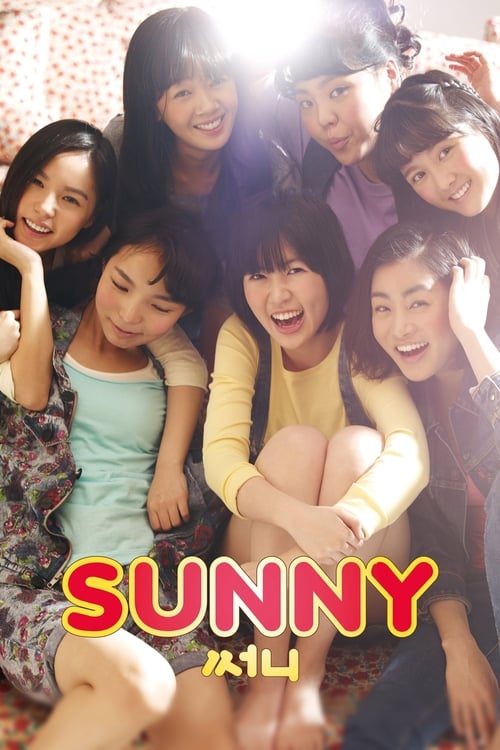
Sunny
2011 · Kang Hyoung-chul
For when you miss your oldest friends and want a film that makes you laugh, cry, and text the group chat afterward. Pure comfort with real feeling — a great pick for a night when you need your heart warmed and wrung out.
What it's about
Seven girls form an inseparable gang in a 1980s Korean high school; twenty-five years later they've scattered into ordinary, compromised adult lives. When the group's former leader, now dying, asks to see them all one last time, a wealthy but invisible housewife sets out to track down each friend — and the film cuts between the middle-aged search and the riotous schoolgirl past. It's a comedy about friendship with a countdown running underneath it.
The experience
A crowd-pleaser that swings hard between laugh-out-loud teenage anarchy and open melodrama, and earns both — energetic, nostalgic, and unafraid of a big emotional payoff. Expect to laugh for an hour and then get ambushed.
The craft
Kang Hyoung-chul cuts between timelines with real showmanship, matching faces and gestures across twenty-five years so the past and present rhyme, all set to a lovingly deployed 1980s pop soundtrack. The period recreation is affectionate and detailed without turning into a museum piece.
Why it matters
A word-of-mouth sleeper that became one of the biggest Korean hits of its era and a touchstone for the nostalgia-driven ensemble film — beloved enough to spawn remakes abroad.
Snapshot
Sunny is a two-timeline ensemble comedy-melodrama that cuts between a group of seven Korean schoolgirls in the mid-1980s and the same women, scattered and middle-aged, twenty-five years later. Its engine is a deathbed request: Chun-hwa, the gang's former leader, is dying of stomach cancer and asks Na-mi — now an affluent, largely invisible Gangnam housewife — to find the other five before she goes. The search structures the second act as an episodic quest, each reunion delivering a compressed biography of a life that did not turn out as promised, while the 1980s material accumulates toward the rupture that broke the group apart.
Released in the spring of 2011 by CJ Entertainment, the film became one of the defining commercial events of the Korean 2010s: a sleeper that opened respectably and then grew through word of mouth to somewhere in the region of seven million admissions, placing it among the two or three biggest domestic titles of its year. More consequentially, it did so by activating an audience the Korean multiplex had largely stopped courting — women in their thirties, forties and fifties, attending in groups, often repeatedly. Sunny is the film usually credited with igniting the bokgo (retro) wave that dominated Korean popular culture for the rest of the decade, and it remains among the most widely remade Korean films in Asia.
It is also a film with a genuine argument inside it, and a genuine problem: it stages the mid-1980s — the decade of the Chun Doo-hwan dictatorship, of Gwangju's aftermath and the democratization struggle — as the background to a girls' turf war, with riot police, tear gas and street protest functioning as production texture behind a Cyndi Lauper needle-drop. Whether that is a sly displacement or an evacuation of history is the central critical question the film has generated.
Industry & production
Sunny was Kang Hyoung-chul's second feature, and it arrived under unusual conditions: his debut, Scandal Makers (Speed Scandal, 2008), had been one of the largest Korean hits of its year, drawing north of eight million admissions on a modest budget and a high-concept comic premise. That success bought Kang the rare thing in the mid-budget Korean system of the late 2000s — the ability to make a female-ensemble period picture with no bankable male star, an unproven young cast, and a structure that alternates comedy with terminal illness.
The film sits squarely inside the vertically integrated Korean studio model at its 2010s peak: CJ Entertainment financing and distributing into the CGV multiplex circuit, with the release strategy built around holding screens rather than front-loading them. This mattered. Sunny was not a first-weekend film; its performance curve — modest open, sustained or rising midweek grosses, long tail — is the signature of word-of-mouth playing to an audience that does not follow opening-weekend discourse. Korean exhibition in 2011 was still capable of rewarding that pattern in a way it would be less able to a decade later, when screen allocation tightened around tentpoles.
The commercial lesson the industry drew was demographic. Korean film production through the 2000s had been organized around young male-skewing genre cinema — gangster films, thrillers, historical action — and a middle-aged female audience was widely treated as television's territory. Sunny demonstrated that this audience existed theatrically, would show up in groups, and would return. The consequences were visible almost immediately in the greenlighting of Architecture 101 (2012) and in television's turn toward the Reply franchise.
Detailed English-language documentation of the production itself — budget, schedule, below-the-line credits — remains thin, and I will not manufacture specifics where the record is unclear.
Technology
Sunny was made at the hinge of the Korean industry's conversion from photochemical origination to digital capture: the Arri Alexa had arrived in 2010, RED cameras were already in mid-budget circulation, and by 2012–13 film origination in Korean commercial features had become the exception. Exhibition had converted faster still — by 2011 the Korean multiplex chains were substantially digital, which is part of why a film with Sunny's legs could be held and shifted across screens fluidly rather than being constrained by print logistics.
What matters technologically in the film is less the capture format than the digital intermediate, which by this point was standard across CJ's slate and which Sunny uses as a structural rather than cosmetic tool. The two time-frames are graded as distinct color worlds: the 1980s pushed warm, golden, slightly bloomed and softened, with grain either retained or reintroduced; the present cooled, cleaner, harder-edged, its whites and glass surfaces unforgiving. The grade does narrative work — it tells you which memory you are in before a single object of period design appears, and it encodes the film's thesis that the past is not merely earlier but warmer.
Equally significant is a technology the film declines. Sunny does not de-age or prosthetically bridge its cast; it casts two complete ensembles and asks the audience to perform the match itself. In 2011 this was simply the practical choice; in retrospect it looks like the right one, because the film's emotional mechanism depends on the small, uncanny gap between the young face and the old one — a gap seamless VFX would have closed and thereby destroyed.
Technique
Cinematography
The camera divides along the same axis as the grade. The 1980s material is mobile and gregarious: wider lenses, ensemble staging in depth, tracking shots that move with the group through corridors, markets and streets, framing seven bodies as a single organism. The present is more static, more separated, built on singles and two-shots in interiors that isolate women inside their households and workplaces. Na-mi's Gangnam apartment is shot with the flat symmetry of an advertisement — a life that photographs well and is unbearable to live in.
The film's best visual idea is that adolescence is rendered as space and adulthood as frame: the girls are almost never alone in the image, the women almost always are, and the recovery of the group is registered cinematographically before it is registered emotionally, in the simple fact that the compositions start filling up again.
Editing
Sunny is fundamentally an editing film. Its transitions between 1986 and 2011 are associative rather than chaptered — a gesture, an object, a piece of music, a face turned at the same angle carries the cut across twenty-five years, so that memory arrives unbidden rather than as a formal flashback. The middle section's quest structure is handled through compressed reunion set-pieces, each functioning as a self-contained short film with its own tonal register (farce, humiliation, quiet devastation) before returning to the search.
The finale is the film's most ambitious cutting: the funeral and the remembered dance are intercut until the two ensembles occupy the same choreography, the older women's bodies completing movements the girls began. It is a straightforwardly sentimental effect executed with real rhythmic precision, and it is the reason the ending survives its own contrivance.
Mise-en-scène / staging
The production design is archaeological, and consciously so: cassette tapes and portable players, hand-copied lyric sheets, permed hair, uniforms, the tteokbokki shop and the record store as the twin civic institutions of teenage life, the boxy interiors of a Korea not yet rich. The 1980s spaces are cluttered and tactile; the 2011 spaces are curated and empty. Costume carries the class narrative more efficiently than dialogue — the visual distance between Na-mi's schoolgirl uniform and her adult wardrobe is the film's account of what happened to her.
The staging of the girls as a "gang" borrows from a well-established iconography of Korean school-delinquency cinema, and the film uses that inheritance knowingly: the formation walk, the confrontation, the code of loyalty are all quoted from a male genre and reoccupied by girls.
Sound
The soundtrack is the film's second script. Boney M.'s "Sunny" supplies the group's name and returns as the closing figure; Cyndi Lauper's "Girls Just Want to Have Fun" scores the climactic street brawl; Richard Sanderson's "Reality," from La Boum and enormously popular in 1980s Korea, anchors the romantic register. Alongside these sit Korean pop recordings of the era, and the mix of Western and domestic hits is itself historically precise: this is the sound of a generation whose youth culture was assembled from imported records circulating in a country under curfewed authoritarian rule.
The most discussed sound decision is the brawl. Kang stages a girls' fight against the sonic backdrop of a democratization protest — chants, tear gas, riot shields — and then floods the whole thing with an American pop single, so that the political soundtrack of the decade is literally overwritten by its consumer soundtrack. Read generously, this is the film telling you exactly what it is doing. Read harshly, it is the film doing it without acknowledgment.
The other significant sonic device is dialect. Na-mi's Jeolla accent, and the eruptive cursing tic she deploys when enraged, is played for comedy but carries real information about regional stigma and class within Korean society — the film's sharpest and least sentimental piece of characterization.
Performance
The double casting is the film's central performative gamble, and it works because the young ensemble was cast for physiognomic and behavioral rhyme rather than for star wattage. Shim Eun-kyung's young Na-mi was the breakout — a performance of enormous physical comic invention that launched a career culminating in Miss Granny (2014), itself a film about a woman occupying two ages at once. Kang So-ra's Chun-hwa supplies the group's gravity; Min Hyo-rin's Su-ji supplies its unreachable glamour and its wound. On the adult side, Yoo Ho-jeong's Na-mi is a study in muffled competence, and the casting of an actress familiar to Korean audiences since the late 1980s is itself part of the nostalgic apparatus; Jin Hee-kyung's dying Chun-hwa refuses pathos almost entirely, playing the illness as an administrative problem to be solved before time runs out.
Narrative & dramatic mode
The structure is a braided dual timeline with a deadline: the present-day narrative is a countdown (find five women before one dies), the past narrative a slow disclosure (what happened that ended the friendship). The two converge on the same event from opposite directions, which is a classical and highly efficient design.
Tonally the film is a comedy that turns, and its risk is the turn. For roughly its first half Sunny operates as broad ensemble farce; it then asks the audience to accept terminal cancer, class humiliation, domestic violence and disfigurement inside the same frame. Kang manages the modulation largely through the music, which stays consistent even as the register shifts, and through refusing to let any single reunion resolve cleanly.
The ending — Chun-hwa's will, which redistributes fates among the survivors — is the film's most criticized move. It resolves structural problems (poverty, unemployment, an abusive marriage) through private philanthropy, and it does so with a warmth that makes the objection feel churlish and does not answer it. It is a wish-fulfillment ending, and it is honest enough about being one that the sentiment lands even as the politics don't.
Genre & cycle
Sunny belongs to the Korean school-gang nostalgia cycle whose commercial template was set by Kwak Kyung-taek's Friend (2001) — a colossal domestic hit built on the same skeleton: an adolescent gang, a shared code, a rupture, an adult reckoning. Once Upon a Time in High School (2004) and the broader run of period high-school films consolidated the form. What Sunny does is gender-flip it wholesale, and the flip is not cosmetic: where the male cycle ends in violence, betrayal and death, Sunny ends in a funeral that is also a reunion, and where the male films treat the past as a wound that determines the present, Sunny treats it as a resource that might redeem it.
Internationally the closest structural relative is The Big Chill (1983) — reunion-by-funeral, ensemble, period soundtrack as connective tissue — with Now and Then (1995) and the Stand by Me lineage supplying the doubled-cast childhood-friendship template. The instructive contrast within Korean cinema is Lee Chang-dong's Peppermint Candy (1999), which runs backward through the same decades and insists that the 1980s were a trauma that deformed everyone who passed through them. Sunny runs the same territory and metabolizes it as pop. The two films are, in effect, the two available Korean positions on the 1980s.
Authorship & method
Kang Hyoung-chul directed from his own screenplay, as he had on Scandal Makers, and the throughline across his three features to date — Scandal Makers (2008), Sunny (2011), Swing Kids (2018) — is unmistakable: each is organized around music and performance as the mechanism by which an improvised social unit is formed. A pop-star father and the daughter he didn't know he had; seven girls who name themselves after a record; a tap-dance troupe assembled in a Korean War POW camp. Kang's method is to find the number, and then build the family around it.
His comic construction is dense and gag-forward — he writes in beats rather than scenes — and his weakness is the same as his strength: an unwillingness to let a difficult situation stay difficult without a joke or a song arriving to relieve it. Swing Kids, which put that instinct against the Korean War and underperformed commercially, suggests he knows the limitation and has tried to work against it.
On collaborators I have to be candid: below-the-line credits for Sunny — cinematographer, editor, composer, production designer — are inconsistently documented in accessible English-language sources, and I will not assign names I cannot verify. What can be said with confidence is that the film's most consequential creative decisions sit in music supervision (the needle-drop program is the score, in effect) and in the two-tier casting, and that both bear Kang's authorial signature as writer-director.
Movement / national cinema
Sunny arrives after the Korean New Wave's international breakthrough (Park Chan-wook, Bong Joon-ho, Kim Ki-duk, Hong Sang-soo) and belongs to a different formation: the mature, confident, domestically-oriented Korean commercial cinema of the 2010s, made for Korean audiences first, with export as a secondary and largely intra-Asian proposition. It is a national cinema film in the strict sense — its pleasures are keyed to shared Korean generational memory, its jokes to regional dialect, its politics to a specific decade of Korean state violence.
Yet it also demonstrated something about the portability of Korean structures as opposed to Korean content. The film's premise proved so cleanly transferable that it was remade in Japan as Sunny: Our Hearts Beat Together (2018, dir. Hitoshi One), relocated to 1990s Shibuya youth culture; in Vietnam as Go Go Sisters (Tháng Năm Rực Rỡ, 2018, dir. Nguyễn Quang Dũng); and in Indonesia as Bebas (2019, dir. Riri Riza), reset in 1990s Jakarta. Additional remakes in other territories were reported at various points; the three above are the ones that were completed and released. This makes Sunny an early and important case of the Korean film functioning as an exportable format — a model that would define the Korean content industry's economics through the following decade.
Era / period
The film's memory-layer is set in the mid-1980s under Chun Doo-hwan, a period defined by military rule, the unresolved atrocity of Gwangju in 1980, campus and street mobilization, curfew-era social discipline, and simultaneously an aggressive state promotion of consumer and mass culture. That doubleness — repression plus a state-sponsored pop boom — is precisely what Sunny captures, whether or not it intends the critique. The girls' world of imported singles, uniforms and street brawls is not separate from the world of tear gas outside; it is the same government's product.
The present layer, 2011, is the Korea of post-IMF-crisis stratification: apartment-price wealth, precarious self-employment, educational arms races, and a cohort of women in their forties who were the first generation to be told they could have careers and the last to be structurally prevented from keeping them. The film's melancholy is specific to that cohort, and much of its box-office performance can be read as that cohort recognizing itself onscreen for the first time in years.
Themes
The organizing theme is the disappearance of the middle-aged woman — from her own life, from her family's attention, from the national cinema. Na-mi's rediscovery of the group is not nostalgia for youth per se but for a period when she was a subject: loud, dangerous, consequential, seen.
Running beneath that is class as fate. The seven girls begin at roughly the same starting line; twenty-five years later they occupy wildly divergent positions, and the film is unsentimental about how little of that divergence is deserved. Su-ji's disfigurement in the film's climactic violence functions as the hard version of this argument — beauty as capital, and its destruction as an economic event.
Then nostalgia as both consolation and ideology. Sunny is at once the most effective nostalgia machine in modern Korean cinema and, in flashes, a film that knows what nostalgia costs: the political content of the 1980s survives in it only as texture, which is exactly how memory actually processes decades, and exactly what makes memory politically unreliable.
Finally mortality and inheritance. Chun-hwa's illness supplies the deadline, and her will supplies the resolution; the film's proposition is that what one woman leaves the others is not money but permission — to be, again, the people they were before the world assigned them their roles.
Reception, canon & influence
Domestically, Sunny was a phenomenon, and an unusual one: a film whose grosses climbed on word of mouth, with repeat attendance and group bookings concentrated among an audience the industry had written off. It performed strongly at the domestic awards season, with the young cast — Shim Eun-kyung especially — collecting newcomer honors; I would rather flag that the precise slate of wins is inconsistently reported than list ceremonies I can't confirm. Critical response was warm but not unanimous: praise for the ensemble, comic construction and emotional efficiency, alongside serious reservations about the deus-ex-testament resolution and about the film's handling of the 1980s. That second objection — that Sunny converts the democratization struggle into set dressing — has become the standard scholarly frame for discussing it, and later films, most explicitly 1987: When the Day Comes (2017), can be read as the corrective.
Backward, the film draws on Friend (2001) and the Korean high-school gang cycle for structure, on The Big Chill and the American ensemble-reunion film for its funeral architecture, on Now and Then and Stand by Me for the doubled-cast friendship template, and on the actual record collections of Korean teenagers in the 1980s for its soundtrack — Boney M., Cyndi Lauper, the La Boum theme, and the domestic pop that circulated alongside them.
Forward, its influence is broad and easy to trace. It opened the Korean 2010s retro boom: Architecture 101 (2012) took the dual-timeline nostalgia structure into the 1990s and became a comparable hit, and tvN's Reply series (1997, 1994, 1988) built an entire television franchise on the same operation of period-accurate pop culture plus generational recognition. It rehabilitated the female ensemble as a commercially viable proposition in Korean film, however slowly the industry acted on the lesson. It made Shim Eun-kyung a lead, and the through-line from Sunny to Miss Granny (2014) — another age-doubling nostalgia hit that generated its own cascade of Asian remakes — is direct. And through its Japanese, Vietnamese and Indonesian versions it helped establish the Korean commercial feature as a licensable format across Asia, a model that now underpins a substantial share of the region's content economy.
Its standing today is that of a beloved popular classic rather than a critical monument — the film Korean audiences reach for when they want to feel time pass, and the film Korean critics reach for when they want to argue about what a country is allowed to forget.
Reception
A modest opener that word-of-mouth turned into a months-long sleeper smash — over 7 million admissions, one of Korea's biggest films of 2011 — and it's since settled in as a beloved modern classic of Korean crowd-pleaser cinema rather than a dated hit.
How Sunny was received, from release to now →
How to watch Sunny: what to notice on a first viewing
- Watch how full the 1980s frames are compared to now. The teenage scenes track all seven girls moving together through corridors and markets, while the present-day scenes isolate each woman alone in her own household or job. You feel what the group gave each of them just by how much space they used to share.
- Notice what small object or gesture carries the cut across decades. The film jumps between 1986 and the present using a face turned the same way or a familiar piece of music, so a memory arrives instead of a formal flashback. The cutting itself behaves the way memory does, triggered rather than announced.
- Listen for which pop song plays under each big turn. Boney M., Cyndi Lauper, and Korean hits of the era do a lot of the film's storytelling, standing in for feelings the characters never say out loud. The soundtrack functions as a second script running under the dialogue.
- Notice the distance between a school uniform and an adult wardrobe. Costume tracks what happened to each woman more efficiently than any line of dialogue does, especially for Na-mi. You can read a whole class story just by comparing what someone used to wear to what they wear now.
The whole guide to watching Sunny, with the keys for a rewatch →
Influences: the films it descends from and the films it influenced
- Friend (2001) — Supplies the Korean school-gang template Sunny gender-flips wholesale — the named cohort introduced in a lateral tracking lineup, the uniform-and-haircut iconography as period marker, and the adult-frame-around-teenage-past structure in which one member's fate detonates the reunion.
- Once Upon a Time in High School (2004) — Establishes the archaeological approach to Korean school period design that Sunny inherits — regulation uniforms, name tags, chalk-dust classrooms and corridor geography reconstructed to the year, so that the set itself carries the date without a title card.
- The Big Chill (1983) — Donates the funeral architecture: a death gathers a dispersed cohort, and a wall-to-wall period pop compilation does the narrating that dialogue can't, each cue keyed to who these people were rather than who they are.
- Now and Then (1995) — The doubled-cast female friendship group — adult and adolescent actresses matched by face and gesture rather than by makeup or de-aging — with a reunion bracket that cuts between the two casts on shared behavioral tics.
- Stand by Me (1986) — The episodic quest built from discrete self-contained set pieces strung on a walk, each one a comic bit that turns without warning into a wound, and an adult voice retrospectively sanctifying the group.
- American Graffiti (1973) — Invents the needle-drop wall as clock and narrator — near-continuous period pop bridging parallel storylines — and the closing 'where they ended up' epilogue that Sunny converts into the will-reading roll call.
- Peppermint Candy (1999) — Fixes the 1980s riot line — tear gas, shield walls, conscript police — as the axis on which a Korean life is measured; Sunny stages the identical street and then scores it to pop, a citation that only reads as refusal because Lee's version exists.
- La Boum (1980) — Not just a licensed cue but a technique: Richard Sanderson's 'Reality' arrives as an object inside the fiction — the record a teenager owns and plays — so the song functions as prop and memory trigger rather than underscore.
- Scandal Makers (2008) — Kang's own prior feature sets his method: screenplays written in gag beats rather than scenes, with a musical performance as the mechanism that welds strangers into a family unit — seven girls naming themselves after a record is the same engine.
- Architecture 101 (2012) — Ports Sunny's dual-timeline machinery forward a decade — doubled casting for the young and adult leads, period-exact pop (Kim Dong-ryul, cassette-tape gifting) as the memory hinge, and cuts between eras motivated by an object rather than a dissolve.
- Miss Granny (2014) — Industrializes Sunny's age-doubling solution — Shim Eun-kyung again playing the younger body with no de-aging VFX, carrying an older woman's vocal rhythm — and pins the emotional peak to a retro song performed straight to camera; its Asian remake cascade follows Sunny's format-export path.
- Reply 1988 (2015) — Scales Sunny's operation to serial television: period-accurate consumer archaeology (snack packaging, TV broadcasts, chart pop) plus a present-day frame that withholds one identity, so recognition of the era and recognition of the person resolve together.
- Sunny: Our Hearts Beat Together (2018) — The licensed Japanese remake proves the structure is transposable as a format — it swaps the Korean 1980s for the 1990s kogal/Komuro-era pop economy while keeping the double-cast, the deathbed testament and the intercut dance finale intact.
- Go-Go Sisters (2018) — The Vietnamese remake re-solves the film's hardest craft problem locally — finding a domestic pop canon and a period street conflict that can carry the same pop-over-history substitution — confirming the design travels, not just the plot.
- 1987: When the Day Comes (2017) — The explicit corrective: it restages the same 1987 protest streets Sunny used as comic backdrop, replacing needle-drop scoring with procedural relay editing that hands the story from one witness to the next until the crowd itself becomes the protagonist.
- Swing Kids (2018) — Kang running his own method against harder material — the number-first construction and intercut musical finale, but now cross-cut with a POW camp massacre, an attempt to make the song stop relieving the situation.
- 20th Century Girl (2022) — Rebuilds the Sunny frame for 1999 — camcorder tapes, pagers and CD players as dated props doing exposition — and reuses the posthumous-document reveal, withholding a written testament until the final act reorganizes the whole flashback.
- Soulmate (2023) — The Korean female-ensemble braided timeline that cross-cuts youth and middle age, dating each strand through period pop and technology markers exactly as Soulmate keys its Korean generational specificity.
- Love Untangled (2025) — Establishes the Korean model of reconstructing one specific year through wall-to-wall era pop needle-drops used as an emotional index rather than mere background.
- Sing Street (2016) — Parallel solution to the same problem: a band formed from a period record collection, with the era's chart pop diegetically sourced and a climactic performance shot as a collision between the imagined ideal version and the shabby real one.
- Our Times (2015) — Runs the same adult-present/teen-past dual timeline as a female-centered nostalgia machine, with period needle-drops and a marquee-cast reveal of the grown characters — Our Times' late-reveal payoff in parallel.
Similar films
- 20th Century Girl (2022) — influence & lineage
- My Sassy Girl (2001) — shared sensibility
- Soulmate (2023) — shared sensibility
- Miracle in Cell No. 7 (2013) — shared sensibility
- Love in the Big City (2024) — shared sensibility
- Even If This Love Disappears Tonight (2025) — shared sensibility
- Peppermint Candy (2000) — shared sensibility
- Bangalore Days (2014) — shared sensibility