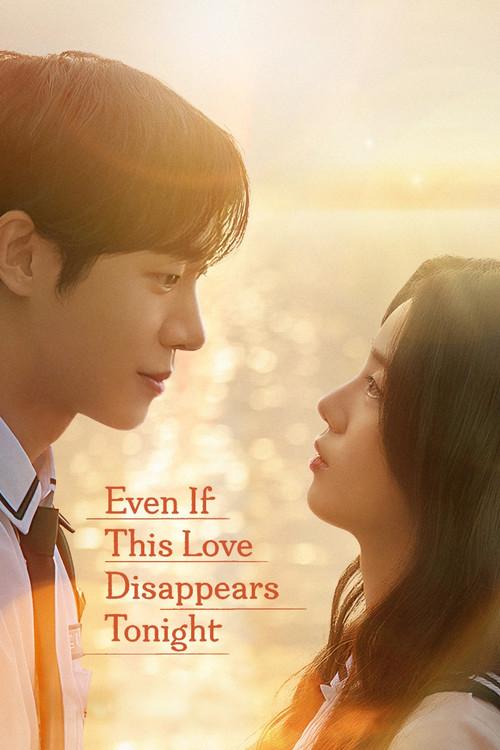
Even If This Love Disappears Tonight
2025 · Kim Hye-young
For when you need a good cry and want a pure, uncomplicated love story to deliver it — a comfort watch in the tearjerker tradition, best with tissues in reach.
What it's about
A high school girl wakes every morning with no memory of the day before — her life reassembled each dawn from notes she leaves herself. When a shy classmate starts dating her, every day becomes a first meeting, and he has to decide how much of himself to pour into a love she can't carry overnight. A Korean remake of a beloved Japanese novel, it's a romance built on repetition, patience, and borrowed time.
The experience
Gentle, slow-burning, and openly sentimental — it moves at the pace of routines and small gestures, then aims squarely for your tear ducts. Expect a soft melancholy throughout and a finale designed to wreck you.
The craft
Kim Hye-young shoots the romance in the polished, light-drenched style of Korean youth melodrama — school corridors, seasons turning, faces held in close-up — and structures the film around repetition, letting small variations in the couple's daily rituals carry the emotion. The writing keeps its high-concept premise grounded in ordinary teenage tenderness.
Why it matters
A transnational remake of a hit Japanese novel and film, it's part of the ongoing exchange between Japanese and Korean romance cinema and a fresh entry in the durable amnesia-love-story tradition.
Snapshot
Even If This Love Disappears Tonight — released and cataloged in fuller form as Even If This Love Disappears From the World Tonight — is a 2025 South Korean romantic melodrama directed by Kim Hye-young. It is a transnational remake, adapting Misaki Ichijo's Japanese novel Konya, Sekai kara Kono Koi ga Kietemo (published 2020, Media Works Bunko) and following the 2022 Japanese film version directed by Takahiro Miki. The premise is a fixture of the amnesia-romance tradition: a high school girl, Han Seo-yoon (Shin Si-ah), lives with anterograde amnesia following a traffic accident and cannot form new long-term memories, waking each day to notes that re-explain her own life; a reserved classmate, Kim Jae-won (Choo Young-woo), enters her orbit through a scheme that curdles into genuine love. The film runs 108 minutes, opened theatrically in South Korea on 24 December 2025, and was subsequently acquired by Netflix, streaming from 4 February 2026 — a release pattern that situates it squarely within the contemporary economy of exportable Korean romance. Reported box office figures place its theatrical gross in the low single-digit millions (roughly $5.7 million per aggregator listings); as with much of this cadre of mid-budget melodrama, granular financial and technical documentation in English-language sources remains thin, and I flag that limitation where it recurs below.
Industry & production
The production sits at the intersection of two well-established industrial currents: the Korean mid-budget "well-made" romance and the cross-border traffic in Japanese junai (pure-love) intellectual property. It was produced through a coalition of companies — Blue Fire Studio, Red Ice Entertainment, and O'FAN House — with the participation of Kadokawa, the Japanese media conglomerate that controls the source novel and its Media Works Bunko imprint. Kadokawa's involvement is the tell: rather than a loose "inspired by," this is a licensed, rights-holder-blessed remake, part of a longer pattern of Japanese publishers shepherding their properties into Korean-language versions for the broader Asian and streaming markets. Theatrical distribution was handled by By4M Studio, with Song Hyo-jeong credited as producer.
The most consequential industrial fact is the Netflix acquisition. A December theatrical bow followed roughly six weeks later by global streaming reflects the now-standard windowing for Korean romance titles that are conceived from the outset as travel-ready — a modest domestic run functioning as a marketing and prestige platform before the film's real audience is reached through the platform's international recommendation engine. This dual life (Korean theatrical / global streaming) shapes everything from the film's relatively contained 108-minute runtime to its emphasis on legible, universal emotional beats that survive subtitling.
One documented paratextual detail bears noting because it is verifiable rather than promotional invention: original novelist Misaki Ichijo publicly praised the Korean remake, and coverage reported a handwritten message from the author calling it his ideal realization of the story. Beyond this, the detailed production history is not richly documented in accessible sources.
Technology
No specialized or novel production technology is on the public record for this film, and I will not manufacture one. It belongs to the ordinary technical baseline of mid-2020s Korean commercial cinema: digital acquisition, a conventional theatrical delivery pipeline, and a finish calibrated for both a cinema screen and, crucially, downstream streaming compression on Netflix. The relevant "technology" here is less a camera or a process than a distribution infrastructure — the streaming platform as the film's ultimate exhibition technology, which conditions grading choices (high-key, saturated imagery that reads cleanly on domestic displays) and the overall gloss and polish of the presentation. Where the amnesia premise might, in another film, motivate visual-effects work or interface graphics (Seo-yoon's notes, phone reminders, the diaristic apparatus by which she reconstructs herself daily), the surviving descriptions suggest these are handled through production design and the physical prop of the notebook rather than through digital augmentation. Any more specific claim about the film's technical toolkit would be speculation.
Technique
Cinematography
Cinematography is credited to Lee Seok-min. The single most consistent descriptor in early responses is chromatic: reviewers characterize the film's palette as a perpetual, golden "eternal sunset," a warm magic-hour register sustained across scenes. This is a legible and deliberate strategy for the material. Anterograde amnesia collapses the protagonist's world into an unending present tense — every day is, experientially, the same day — and a light scheme that refuses the ordinary passage from morning to night to morning visually literalizes that suspension. Golden-hour lensing also does sentimental work native to the genre: it flatters faces, softens edges, and lends even mundane classroom-and-riverbank geography the aura of memory-in-the-making. Beyond this dominant palette, the fine grain of the camera work — lens choices, camera movement, blocking of the frame — is not well documented in available English sources, and I decline to invent specifics.
Editing
Lee Kang-hee is credited as editor. The structural challenge the cut must solve is native to every amnesia narrative: how to render, for a continuous-memory audience, a heroine for whom continuity does not exist. Films in this lineage typically resolve the problem through motifs of repetition and reset — the recurring "first meeting," the daily return to the notebook, the loop that the audience perceives as a loop but the character cannot. The reported emotional engine of the film, in which "every first meeting feels as genuine as the last," implies an editorial rhythm built on patterned recurrence rather than conventional dramatic escalation, with the tragedy in the back half (Jae-won's terminal heart condition and death, and the subsequent concealment of his existence to spare Seo-yoon repeated grief) demanding a shift in tense and knowledge that the cut must manage carefully. The specific editorial architecture, however, is not documented in detail in accessible sources.
Mise-en-scène / staging
The staging works within the iconography of the Korean and Japanese school romance: classrooms, corridors, riverbanks, and the intimate clutter of a bedroom that doubles, for Seo-yoon, as an external memory system. Production design carries unusual narrative weight here because the heroine's continuity is outsourced to objects — notes, a diary, and, significantly, her own artwork, through which (per plot summaries) she unconsciously preserves memories that have been deliberately erased from the documentary record around her. The physical environment thus becomes a battleground between remembering and forgetting: props are not decoration but plot mechanism. The film's world is small and repeatable by design, its restricted set of locations mirroring the closed loop of its protagonist's cognition.
Sound
Music is credited to composer Hong Dae-sung. In the Korean romantic-melodrama tradition, scoring and song placement are load-bearing rather than atmospheric — the genre has long leaned on signature themes and vocal ballads (the "OST culture" that Korean film and television export as a product in its own right) to cue and amplify feeling. It is reasonable, given the property and the market, to expect a piano- and strings-forward romantic score punctuated by songs, though the specific soundtrack details and any sound-design strategies around the amnesia motif are not documented in the sources I can verify, and I leave them unstated rather than fabricated.
Performance
The film rests almost entirely on its two leads. Shin Si-ah plays Han Seo-yoon, and her performance was recognized with a Best New Actress (Film) nomination at the Baeksang Arts Awards — the most significant verifiable critical marker the film has earned, and a meaningful one given Baeksang's standing in Korean awards culture. The role is a technical gauntlet: Seo-yoon must be freshly, sincerely present in each "first" encounter while the audience carries the accumulated weight she cannot, a balance that fails if it reads as either mechanical repetition or unearned familiarity. Choo Young-woo plays Kim Jae-won, whose arc moves from schemer to sincere partner to doomed beloved. Reviewers single out the pair's chemistry as the film's central achievement — the mechanism that makes recurrence feel renewed rather than redundant. The supporting cast includes Cho Yu-jung as Choi Ji-min (the best friend whose act of concealment drives the film's ethical center of gravity), Jin Ho-eun as Jeong Tae-hoon, and Jo Han-chul as Kim Seong-hyeon.
Narrative & dramatic mode
The dramatic mode is pure melodrama in the classical sense — a form organized around excess feeling, moral clarity, and the "too late," in which obstacles are not villains but conditions (illness, memory, mortality) that no virtue can overcome. Its structure is the memory-loop romance: a repeating present that the audience experiences as accumulation and the heroine as perpetual reset. This produces the genre's characteristic dramatic irony, weaponized to the maximum — we remember what she cannot, and later, after concealment, we know what she is not permitted to know. The narrative deploys a double engine of pathos: first the anterograde amnesia (love that must be re-won daily), then a second, escalating catastrophe (Jae-won's terminal illness and death) that converts the film from a story about a girl who cannot keep memories into a story about a boy who becomes the memory that must be hidden. The best friend's decision to erase all trace of Jae-won so that Seo-yoon will not grieve him anew each day is the film's true moral crux — an act of love indistinguishable from an act of theft — and the artwork through which Seo-yoon's suppressed memory resurfaces supplies the redemptive turn the mode requires.
Genre & cycle
The film belongs to two overlapping cycles. The first is the international anterograde-amnesia romance, whose reference points include 50 First Dates (2004), which made the "she forgets him every day" premise a mainstream device, and The Vow (2012); within Korean cinema the adjacent lineage of memory-loss melodrama runs through A Moment to Remember (2004). The second, more proximate cycle is the wave of Japanese "pure love" (junai) adaptations — the sentimental, illness-and-mortality-inflected romances that flowered around Crying Out Love in the Center of the World (2004) and continued through properties like Yoru Sumino's I Want to Eat Your Pancreas. Ichijo's novel is a late entry in that literary vein, and this film is its Korean-language transplant, following the 2022 Japanese screen version. The remake thus sits at a genuinely interesting cultural node: a Japanese sentimental property, refracted through Korean melodramatic idiom (with its own deep tradition of terminal-illness romance from Christmas in August onward), and delivered to a global audience by an American streaming platform.
Authorship & method
Kim Hye-young directs from a screenplay credited to Lee Yu-jin and Jo Ba-reun, working from Ichijo's novel. Detailed, verifiable biographical and methodological information about Kim in English-language sources is limited, so rather than characterize an auteur signature I cannot substantiate, I note what the work itself evidences: a directorial approach organized around a controlled sensory scheme (the sustained golden palette) and a wager on two young actors' chemistry as the film's structural load-bearing element. The key collaborators are cinematographer Lee Seok-min, whose eternal-sunset lighting is the film's most-remarked formal choice; composer Hong Dae-sung; editor Lee Kang-hee, who manages the loop-and-reset architecture the premise demands; and screenwriters Lee Yu-jin and Jo Ba-reun, whose adaptation had to localize a Japanese property into Korean high-school texture while preserving the dual-catastrophe structure. Producer Song Hyo-jeong and the Blue Fire / Red Ice / O'FAN House / Kadokawa production coalition complete the principal creative-industrial team.
Movement / national cinema
As a work of South Korean cinema, the film is a product of a mature commercial industry with one of the world's most developed melodramatic vocabularies — a tradition that runs from the "trendy" romance of the 1990s and 2000s (and its television counterparts, the Winter Sonata/Autumn in My Heart lineage) through to today's globally distributed K-content. It is not, however, an art-cinema or festival-circuit work in the mold that dominates Western perceptions of Korean film; it belongs to the popular, sentiment-driven mainstream that constitutes the industry's commercial base. Its transnational DNA — Japanese source, Korean execution — also makes it a case study in intra-Asian media flow, the increasingly routine circulation of stories and formats across the Korea–Japan cultural border.
Era / period
The film is emblematic of the mid-2020s streaming era of Korean romance. Everything about its shape — the compact runtime, the emotionally legible and translation-durable storytelling, the brief theatrical window feeding a rapid Netflix release — reflects a moment in which mid-budget romantic dramas are financed and structured with global streaming as their primary destination and theatrical release as a prestige antechamber. It arrives at a point when Korean content enjoys unprecedented worldwide reach, and when remaking a beloved Japanese property for that reach is a rational commercial strategy rather than a novelty.
Themes
The film's governing theme is memory as the substance of love: if love is the accumulation of shared history, what becomes of it when one partner cannot accumulate? The anterograde premise stages the romantic idea that love is chosen anew each day rather than merely inherited from yesterday — a consoling inversion of the tragedy. Running beneath it is the theme of protective deception: the best friend's erasure of Jae-won poses the film's sharpest ethical question — whether sparing someone grief by stealing their past is mercy or violation. The recurring motif of art as involuntary memory (Seo-yoon's drawings preserving what has been documentarily deleted) proposes that some traces of the beloved survive below the level of conscious recall, that the body and the hand remember what the mind cannot. And, in the manner of its junai and Korean-melodrama forebears, the film meditates on mortality and the present tense — the way impending loss (his illness, her condition) intensifies the value of a single, unrepeatable day.
Reception, canon & influence
Early critical reception, as reflected in aggregator scores and reviews, has been warm rather than seismic: responses converge on the leads' chemistry and the film's sustained golden aesthetic as its strengths, framing it as an effective, sincerely felt entry in a familiar genre rather than a reinvention of it. The most concrete institutional recognition is Shin Si-ah's Best New Actress (Film) nomination at the 2026 Baeksang Arts Awards. Comprehensive critical documentation remains limited, consistent with the film's recency and its mid-budget profile.
Influences on the film (backward): its lineage is explicit and layered — Ichijo's 2020 novel and its Media Works Bunko junai context; the 2022 Japanese film adaptation directed by Takahiro Miki that immediately precedes it; the broader amnesia-romance canon (50 First Dates, The Vow) and Korea's own terminal-illness and memory-loss melodramas (Christmas in August, A Moment to Remember).
Legacy (forward): it is too soon, and the record too thin, to make firm claims about influence, and I will not overstate them. What can be said is that the film is a data point in an ongoing pattern — the licensed Korean remake of Japanese sentimental IP, packaged for theatrical prestige and streaming reach — and that its principal forward-looking asset may be Shin Si-ah, whose Baeksang recognition marks her as a performer to watch. Any larger legacy will only become legible with time.
Sources: Wikipedia), MyDramaList, IMDb, AsianWiki), Rotten Tomatoes, TMDB, Letterboxd
Reception
A quiet Christmas-Eve 2025 theatrical release that opened modestly, then crossed 800,000 admissions to become the first Korean film of 2026 to break even — and shot straight to No.1 on Netflix Korea's movie chart the day it hit streaming in February 2026.
How Even If This Love Disappears Tonight was received, from release to now →
How to watch Even If This Love Disappears Tonight: what to notice on a first viewing
- Notice the light staying gold in almost every scene. Lee Seok-min holds a warm, perpetual magic hour across classrooms, riverbanks, and bedrooms alike, refusing the ordinary passage from morning into night. The light itself tells you time is not moving the way it moves for everyone else.
- Notice the notes and diary scattered around her room. Seo-yoon's whole continuity is kept in objects, notes taped up, a diary by the bed, drawings on the wall, so her room functions as a memory she carries outside her own head. The props are not decoration, they are doing the work her own mind cannot do.
- Notice how often the same introduction happens again. The film returns repeatedly to a version of the same first meeting, and each time it is played as freshly and sincerely as the last. You carry the accumulation she can't, which is the whole shape of watching this story.
- Listen for the piano returning under quiet moments. A piano and strings-forward score rises at each tender beat, in the Korean melodrama tradition where a signature theme carries as much weight as dialogue. The music is cueing you toward feeling before the scene has fully earned it, on purpose.
- Watch Seo-yoon meet Jae-won like it's the first time. Shin Si-ah plays each encounter freshly sincere rather than mechanically repeated, while Choo Young-woo's Jae-won grows steadily more genuine across scenes that reset for her but not for him. Their chemistry is what makes each reset feel renewed instead of just repeated.
The whole guide to watching Even If This Love Disappears Tonight, with the keys for a rewatch →
Influences: the films it descends from and the films it influenced
- Even If This Love Disappears From the World Tonight (2022) — The direct source film: it fixes the dual-catastrophe withholding structure and the diary/journal-as-external-memory device that the Korean version reproduces beat-for-beat, including the third-act reveal that recontextualizes every earlier 'reset.'
- 50 First Dates (2004) — Originates the daily-reset anterograde-amnesia mechanic in which the partner must re-court the beloved each morning, forcing the repetition-loop editing rhythm of re-introduction that structures the couple's scenes here.
- The Vow (2012) — Post-trauma amnesia melodrama that turns shared props and re-staged 'first' encounters into the courtship engine, modeling memory-as-obstacle romance where the lover rebuilds intimacy the partner cannot retain.
- A Moment to Remember (2004) — Codifies the Korean memory-loss weepie's grammar of dramatic-irony withholding — the audience grasps the coming erasure before the couple does — the exact information-management the adaptation localizes into high-school texture.
- Christmas in August (1998) — Pioneers the restrained Korean terminal-romance register built on warm domestic light and photographs/objects as memory relics, the understated props-as-memory tradition the film's golden scheme extends.
- Il Mare (2000) — Korean melodrama constructed on temporal displacement and letters as memory conduits between lovers out of sync in time — the mailbox/correspondence device foreshadows the loop-and-reset architecture of communication across a memory gap.
- Crying Out Love in the Center of the World (2004) — The template 'Sekachu' junai boom film — terminal-illness school romance framed around cassette-tape and keepsake relics — establishing the Media Works Bunko sentimental IP mode this novel and film descend from.
- My Tomorrow, Your Yesterday (2016) — Miki's earlier nonlinear-time junai where the two leads live time in opposite directions, rehearsing the dramatic-irony reveal structure — one partner secretly knowing the ending — that he carries into the 2022 source film.
- Be With You (2004) — Junai memory-return melodrama organized around a seasonal loop (the rainy weeks) in which a lost partner reappears without memory, an early instance of the reset-and-reunion cycle the premise demands.
- Be With You (2018) — The paradigm Korean licensed remake of a Japanese junai memory-melodrama — same industrial model of localizing sentimental IP into Korean seasonal texture — and the closest sibling in production strategy and memory-loop plotting.
- Your Name (2016) — Contemporary junai whose signature golden magic-hour palette and name-/memory-forgetting mechanism define the exact aesthetic-plus-amnesia register the film's 'eternal sunset' cinematography and memory-loss hook operate within.
- A Werewolf Boy (2012) — Korean melodrama framed as recovered memory, using a warm nostalgic palette and a single withheld note/keepsake to trigger the deferred emotional payoff — the same props-as-memory and delayed-reveal mechanics.
- The Beauty Inside (2015) — Korean romance whose gimmick is a partner who cannot be visually recognized day to day, converting a two-hander into a repeated re-identification loop sustained purely by performed chemistry rather than continuity.
- More Than Blue (2009) — Korean terminal-illness two-hander that builds its climaxes on OST-ballad cues and a late dramatic-irony reveal of concealed illness, sharing the ballad-scored weepie architecture and secret-knowledge structure.
- Eternal Sunshine of the Spotless Mind (2004) — Memory-erasure romance whose editing reconstructs a relationship from dissolving fragments, the arthouse pole of the memory-loop craft the film applies in a mainstream melodramatic key.
- Call Me by Your Name (2017) — Sun-saturated summer romance where sustained golden-hour lighting and lingering two-hander staging carry emotion over incident — the warm-palette cinematographic strategy the film's DP adopts as its load-bearing formal choice.
Similar films
- A Moment to Remember (2004) — influence & lineage
- Your Name. (2016) — influence & lineage
- Eternal Sunshine of the Spotless Mind (2004) — influence & lineage
- 20th Century Girl (2022) — same viewing thread
- Drawing Closer (2024) — same viewing thread
- The Last 10 Years (2022) — same viewing thread
- Love Untangled (2025) — shared sensibility
- 18x2 Beyond Youthful Days (2024) — shared sensibility
All the films related to Even If This Love Disappears Tonight →
Watch it with: curated runs of related films
- Love on Borrowed Time — A run of romances where the calendar is the antagonist — watch these back to back when you want to be wrecked, gently, and don't mind seeing the same shape (limited days, remembered love) rhyme across four countries.