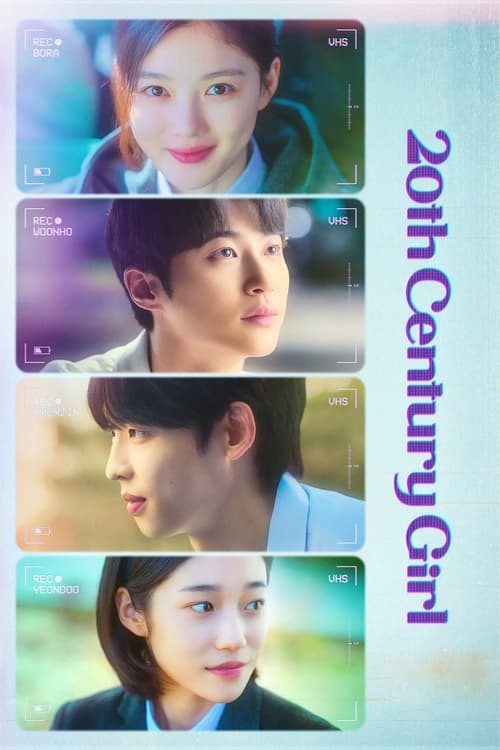
20th Century Girl
2022 · Bang Woo-ri
For when you want to fall in love and have your heart gently broken in the same evening — a cozy, tissues-within-reach night in. Comfort viewing with a sting.
What it's about
Seoul, 1999: a seventeen-year-old girl agrees to spy on a boy at school for her hospitalized best friend, who's hopelessly smitten with him. Armed with camcorders, pagers, and a post at the family video-rental shop, she throws herself into the reconnaissance — until the mission tangles her up in a first love of her own. A love triangle blooms among the CRT monitors and dial-up chirps, remembered from a present day looking back.
The experience
It starts as pure teen-comedy fizz — schemes, misunderstandings, screwball timing — then deepens into something achingly bittersweet. The nostalgia isn't just set dressing; by the end it's doing real emotional work, and it will very likely make you cry.
Performances
Kim Yoo-jung is luminous in the lead, selling both the comic scheming and the raw first-love vulnerability without a visible seam between them.
The craft
The Y2K production design is affectionately exact — pagers, video-store shelves, school uniforms, the particular teal of late-nineties electronics — and the gadgets matter because they record, tying the period detail directly to the film's ideas about memory. The framing from the present day gives every sunny scene a faint shadow. Debut direction with real screwball snap and a long emotional fuse.
Why it matters
Bang Woo-ri's debut became a word-of-mouth favorite in the wave of Korean romance reaching global audiences through streaming, and a touchstone of Y2K nostalgia done with substance.
Bang Woo-ri's debut feature is a Y2K time capsule with a long fuse: Seoul in 1999, a video-rental counter, camcorders, pagers, and a seventeen-year-old (Kim Yoo-jung, luminous) deputized to surveil a boy on her hospitalized best friend's behalf — reconnaissance that curdles, inevitably, into feeling. The setup is pure teen-comedy contraption, and Bang plays it with real screwball snap, but the film belongs to the grand tradition of Korean first-love melodrama, where nostalgia is never just décor: the period gadgets matter because they record, and recording is what memory does to the people we lose track of. The production design is affectionately exact — CRT monitors, dial-up chirps, school uniforms, the particular teal of late-nineties electronics — and the film's structure, framed from a present day looking back, lets all that texture accumulate weight before revealing why it was being remembered so carefully. A Netflix release that found a devoted global audience largely by word of mouth, and one of the tenderest recent entries in cinema's oldest genre: the love story told at twenty years' distance.
Reception
It dropped quietly on Netflix in late 2022 and snowballed into a global word-of-mouth hit, and it got a second wind in 2024 when Byeon Woo-seok's Lovely Runner fame sent a whole new wave of viewers back to it.
How 20th Century Girl was received, from release to now →
Influences: the films it descends from and the films it influenced
- Love Letter (1995) — Established the East Asian first-love template of memory delivered through analog media — a piece of correspondence to/from the past reopens a buried romance — the exact engine of 20CG's mailed videotape frame.
- The Classic (2003) — Dual-timeline framed flashback in which a daughter decodes her mother's old love letters, the present-day frame reconstructing a past courtship — structurally the same 'read the artifact, unlock the flashback' device 20CG uses.
- My Sassy Girl (2001) — Codified the Korean romcom's screwball tonal whiplash — broad comic set-pieces snapping abruptly into weeping melodrama — the tempo and mood-shift grammar 20CG inherits wholesale.
- Architecture 101 (2012) — Intercuts an analog-era student romance with a present-day reunion, mining unrequited first love and proxy feeling through period-precise 1990s texture — the melodrama-of-remembrance mode 20CG apes.
- Sunny (2011) — Uses a present-day narrator to reconstruct a lost girlhood through obsessive period production design and a wall-to-wall pop-hit soundtrack, treating the past as an ensemble time capsule.
- A Werewolf Boy (2012) — Bookends its romance with an elderly woman returning to a first love preserved perfectly unchanged, using the aged-narrator frame to render nostalgia as a sealed time capsule — 20CG's closing-frame logic.
- Il Mare (2000) — Conducts an entire romance through a single analog delivery device (a time-crossing mailbox), making love a matter of mediated messages and delay — the analog-object-as-conduit motif.
- Cyrano de Bergerac (1990) — The definitive proxy-wooer plot: one party covertly gathers the beloved's secrets to help another court them and falls in love themselves — the 'surveillance-turned-love' mechanism driving 20CG's plot.
- Sixteen Candles (1984) — Set the teen-comedy craft of high-school crush geometry — the pining go-between, the unattainable senior — played at bright comic timing and scored to pop, the Hughes idiom 20CG localizes.
- Amélie (2001) — Builds romance around a covert benefactor who orchestrates others' love lives from the shadows via gathered intel and whimsical schemes — the same benevolent-surveillance matchmaker craft.
- Ditto (2000) — Stages a romance entirely through an analog transmission device (a ham radio bridging years), making outmoded technology the medium of longing across time — 20CG's Y2K-tech-as-romance device.
- Reply 1988 (2015) — Weaponizes forensic analog period reconstruction — pagers, cassette walkmen, boxy TVs, era-exact set dressing — as the primary nostalgia texture, the same fetishistic 1990s prop design 20CG builds its world from.
- On Your Wedding Day (2018) — Frames a high-school first love that recurs and mutates across later life stages, structuring the whole film as a melodrama of the one who got away — 20CG's retrospective ache in the same register.
- Tune in for Love (2019) — A Netflix Korean romance of 1990s analog culture (radio dedications, IMF-era detail) told across years of near-misses, sharing 20CG's platform, period palette, and missed-timing melodrama.
- Our Beloved Summer (2021) — Turns on recording-as-remembrance — a documentary tape shot in youth resurfaces to reopen a first love years later — the same 'archived footage reactivates the past' premise as 20CG's videotape.
- More Than Blue (2021) — A Korean first-love melodrama that withholds a key perspective until a late reveal reframes the whole romance, using structural concealment to detonate its tearjerker turn much as 20CG's frame recontextualizes its story.
- Love Untangled (2025) — Its nearest contemporary: a Netflix Korean retrospective first-love piece set in 1999 built on period props and warm-diffused adolescence, extending the identical platform-nostalgia craft.
Similar films
- Sunny (2011) — influence & lineage
- My Sassy Girl (2001) — influence & lineage
- Even If This Love Disappears Tonight (2025) — same viewing thread
- The Last 10 Years (2022) — same viewing thread
- Love Untangled (2025) — shared sensibility
- 18x2 Beyond Youthful Days (2024) — shared sensibility
- Girls Like Girls (2026) — shared sensibility
- House of Hummingbird (2019) — shared sensibility
All the films related to 20th Century Girl →
Watch it with: curated runs of related films
- Love on Borrowed Time — A run of romances where the calendar is the antagonist — watch these back to back when you want to be wrecked, gently, and don't mind seeing the same shape (limited days, remembered love) rhyme across four countries.