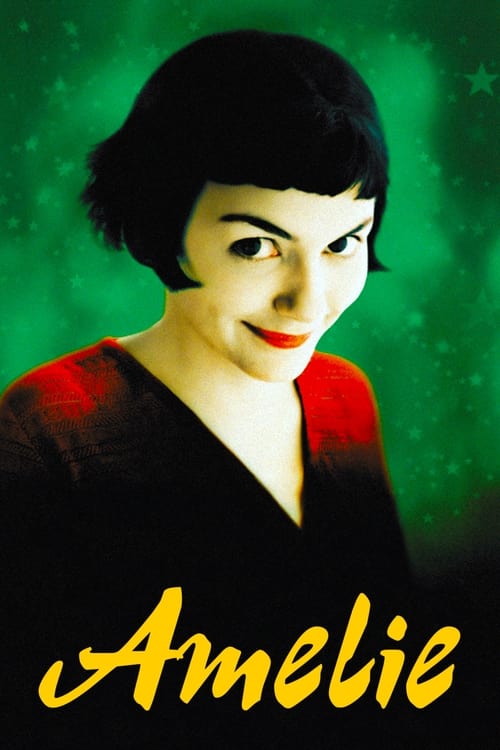
Amélie
2001 · Jean-Pierre Jeunet
For a cozy night in when you want to fall back in love with the world — comfort viewing with real charm, the film to reach for when everything feels gray and you need Paris in candy colors.
What it's about
A painfully shy waitress in a Montmartre café finds a stranger's childhood keepsake hidden in her apartment wall, and returning it awakens something in her: a talent for secretly fixing other people's lives. She becomes a one-woman conspiracy of kindness — matchmaking regulars, avenging a bullied grocer's assistant, nudging her withdrawn father toward adventure — until a handsome oddball who collects discarded photo-booth pictures turns her scheming back on herself. The only life she can't seem to engineer is her own.
The experience
Pure effervescence — fast, playful, and stuffed with visual jokes, but with a thread of loneliness running underneath that keeps the sweetness from being empty. It moves like a wind-up toy and leaves you grinning at strangers.
Performances
Audrey Tautou became a star here, and it's easy to see why: she plays Amélie almost silently, doing most of the work with enormous eyes and tiny conspiratorial smiles, making a character who barely speaks feel completely knowable.
The craft
Jeunet shoots Paris like a storybook — saturated greens and reds, swooping camera moves, digital touches that let objects and photographs come to life — while Yann Tiersen's accordion-and-piano score gives the whole thing its heartbeat. Every frame is designed within an inch of its life, and the density of visual invention rewards a big screen and repeat viewings.
Why it matters
One of the most successful French exports of its era, it defined turn-of-the-millennium whimsy, made Audrey Tautou an international star, and shaped a decade of quirky, hyper-designed romantic comedy — while sparking real debate about its postcard-perfect Paris.
Snapshot
Le Fabuleux Destin d'Amélie Poulain — released internationally as Amélie — is Jean-Pierre Jeunet's fourth feature and his first made in France after the Hollywood detour of Alien Resurrection (1997). It follows Amélie Poulain (Audrey Tautou), a sheltered young waitress at a Montmartre café who, galvanized by the discovery of a stranger's childhood keepsake hidden in her apartment wall, resolves to engineer small acts of kindness and mischief in the lives of those around her, all while struggling to claim happiness for herself. Built from a comic-book visual grammar, a saturated digital palette, and Yann Tiersen's accordion-and-piano score, the film became one of the most commercially and culturally successful French exports of its era, an emblem of turn-of-the-millennium whimsy that also drew sharp dissent over its idealized vision of Paris.
Industry & production
Amélie was a French production assembled by producer Claudie Ossard — Jeunet's collaborator since Delicatessen (1991) — through Claudie Ossard Productions and Union Générale Cinématographique (UGC), with participation from France 3 Cinéma, MMC Independent (Germany), and television and regional financing typical of French features of the period. Shooting took place largely in and around Montmartre, including the real Café des Deux Moulins on the Rue Lepic, which the film transformed into a tourist destination.
The casting history is well documented: Jeunet originally intended the English actress Emily Watson for the lead, but the role foundered on language and scheduling (Watson's commitment to Gosford Park is the commonly cited factor), and Jeunet reconceived the part for a French actress after encountering Audrey Tautou's face on a poster for Vénus Beauté (Institut) (1999). Tautou, then little known internationally, was launched to global stardom by the role. The ensemble draws on Jeunet's repertory of distinctive faces — Dominique Pinon, Rufus, Yolande Moreau, Jamel Debbouze — alongside Mathieu Kassovitz, himself a celebrated director (La Haine), as the love interest Nino, and the voice of André Dussollier as narrator.
Commercially, the film was a phenomenon. It became one of the highest-grossing French-language films of its time, drew very large audiences in France and abroad, and performed exceptionally for a subtitled release in North America. I won't cite specific gross figures from memory, as the precise totals vary by source; what is firmly established is that it was an international blockbuster by the standards of French art-house cinema and a durable catalog title.
The film's awards profile reinforced its prestige: it received five Academy Award nominations (including Best Foreign Language Film, Original Screenplay, Cinematography, Art Direction, and Sound) but won none; it took multiple Césars, including Best Film and Best Director, and won BAFTA recognition. A notable industry footnote is its absence from the 2001 Cannes competition — its non-selection, associated with festival head Gilles Jacob, became a minor controversy given the film's subsequent success.
Technology
Amélie holds a real place in the history of film technology as one of the earliest features to be finished through a full digital intermediate — the entire film scanned to digital, color-graded, and recorded back to film. The grading work was carried out at the Paris facility Duboi (Duran Duboi). Where most films of 2001 still relied on photochemical timing, Jeunet and cinematographer Bruno Delbonnel used the digital pipeline to push the image far beyond naturalism: skies and walls were pulled toward saturated greens and golds, reds intensified, and the overall palette unified into the warm, storybook tonality that became the film's signature. This places Amélie alongside O Brother, Where Art Thou? (2000) as a foundational demonstration of what digital grading could do as an authorial tool rather than a corrective one — a precedent that reshaped the look of mainstream cinema over the following decade.
Beyond grading, the film deploys digital compositing and visual effects throughout for its magical-realist flourishes: a beating heart visible through clothing, a body dissolving into water, talking photographs and animated décor. These are integrated as expressive punctuation rather than spectacle.
Technique
Cinematography
Bruno Delbonnel's photography — which earned him his first Academy Award nomination and effectively launched an international career (later Harry Potter and the Half-Blood Prince, Inside Llewyn Davis, Darkest Hour) — is central to the film's identity. Working closely with Jeunet, Delbonnel favored wide-angle lenses pressed close to faces, producing the slightly distended, caricatural intimacy that recalls comic-book panels. The camera is restless and choreographed: sweeping crane moves, whip-pans, snap zooms, and impossible tracking shots that glide through walls and across the city. Combined with the heightened grade, the cinematography constructs a Paris that is recognizably real yet manifestly fabricated — a city of memory and fairy tale.
Editing
Hervé Schneid, Jeunet's regular editor, cuts the film at a brisk, list-making tempo. The opening sequences are exemplary: rapid montages cataloging characters' likes and dislikes ("Amélie likes…"), narrated inventories that establish the film's encyclopedic, miniaturist sensibility. The editing braids together multiple lives and timelines, uses freeze-frames and direct-address asides, and accelerates or arrests motion for comic and lyrical effect. The rhythm is precise rather than frenetic — each digression is closed off cleanly, reinforcing the sense of a narrator arranging the world like a collector arranging objects.
Mise-en-scène / staging
Production designer Aline Bonetto built a Montmartre of crowded, tactile interiors — the café, Amélie's apartment, the grocer's, the photo-booth corners of the Gare de l'Est — densely furnished with props that reward freeze-frame attention. The staging is object-driven: the traveling garden gnome, the tin box of childhood treasures, the album of discarded photo-booth portraits, the recipe of small pleasures (cracking crème brûlée, skipping stones). Every space is color-coordinated to the warm palette, and the geography is curated to exclude the ordinary ugliness of a real city — a choice that is both the film's charm and the focus of its critics.
Sound
The sound design supports the magical-realist register, foregrounding small intimate textures — the snap of a sugar crust, the whir of machinery — and earned the film one of its Oscar nominations. But the dominant sonic element is Yann Tiersen's score (see Authorship).
Performance
Audrey Tautou's performance anchors the film's tone: large dark eyes, a watchful stillness punctuated by sudden delight, and a capacity to address the camera and the audience without breaking the character's interiority. Her Amélie is shy to the point of avoidance, and Tautou plays the comedy of a do-gooder who can rescue everyone but herself. Around her, Jeunet's ensemble works in broad, affectionate caricature — Kassovitz's gentle oddball Nino, the café's lovelorn and jealous regulars, the brittle hypochondriac, the housebound painter (Serge Merlin) who becomes Amélie's confidant. The mode is theatrical and stylized rather than naturalistic, consistent with the film's overall design.
Narrative & dramatic mode
The film operates as an omniscient fable. André Dussollier's third-person narration frames the story as a tale being told, supplying biographical footnotes, statistical asides, and ironic commentary. The structure is episodic — a chain of interventions Amélie stages in others' lives — strung along a single forward arc: her own halting movement toward Nino. Coincidence, fate, and orchestrated chance are the narrative's engine, and the mode is comic-romantic with a melancholy undertow rooted in solitude and missed connection. Direct address, intertitles, and the cataloging impulse give the film a literary, almost children's-book texture.
Genre & cycle
Amélie is a romantic comedy, but one heavily inflected by magical realism and by Jeunet's particular brand of fabulist whimsy. It is frequently grouped, loosely, with the French cinéma du look lineage (Beineix, Besson, Carax) for its high-gloss surface and its prioritizing of style and atmosphere over social realism — though Jeunet's roots are in animation, comics, and short-film fantasy rather than that movement proper. It also belongs to a broader cycle of feel-good, design-forward European comedies of the late 1990s and early 2000s that found unusual crossover success in the American specialty market.
Authorship & method
Jeunet is the film's clear author, working from a screenplay he co-wrote with Guillaume Laurant, his regular writing partner. Jeunet's method is meticulous and storyboard-driven, a sensibility carried over from his beginnings in animation and from the two features he co-directed with Marc Caro — Delicatessen (1991) and The City of Lost Children (1995). Amélie softens the dystopian grotesquerie of those films into something warmer, but retains the obsessive control of frame, the love of mechanical contraptions and lists, and the casting of singular faces.
The key collaborators are unusually legible in the finished work:
- Bruno Delbonnel (cinematography) — co-architect of the wide-angle, hyper-saturated look.
- Yann Tiersen (music) — uniquely, the score was largely assembled from Tiersen's pre-existing albums after Jeunet discovered the composer's recordings; Tiersen then composed additional material. The accordion, toy piano, musical saw, and waltzing piano figures (notably "La Valse d'Amélie" and "Comptine d'un autre été") became inseparable from the film and made Tiersen internationally famous.
- Hervé Schneid (editing) — Jeunet's longtime editor, responsible for the film's list-like, digressive rhythm.
- Aline Bonetto (production design) — builder of the curated, color-keyed Montmartre.
- Guillaume Laurant (co-writer) — Jeunet's continuing screenwriting collaborator.
Movement / national cinema
The film sits at a particular moment in French national cinema: a domestically financed, distinctly French production that achieved global reach, and was promoted (and sometimes criticized) as an image of France itself. Its postcard Montmartre fed a tourism boom and made the film a quasi-official emblem of Parisian charm. That very iconicity provoked the most famous critical attack on the film, by Serge Kaganski, who argued in the French press that Amélie offered a nostalgic, sanitized, ethnically homogenized Paris scrubbed of the city's actual diversity and grit — a reading that became a touchstone in debates about the film's politics. Whether one accepts that critique, it correctly identifies the film's deliberate exclusion of the contemporary, multicultural city.
Era / period
Amélie is a film of the year 2001 that is set in a curiously timeless present — it nominally takes place around the death of Princess Diana in 1997, a real event woven into the plot as the trigger for Amélie's awakening, yet its visual world feels detached from any specific decade. Technologically it is a landmark of the early digital-intermediate era; culturally it belongs to the optimistic, pre-9/11 turn-of-the-millennium moment, and its sunny escapism was sometimes read, after the fact, as the close of that mood.
Themes
The film's governing themes are solitude and connection — the difficulty of reaching across the small distances between people. Amélie is a guardian-angel figure who can orchestrate happiness for strangers while remaining paralyzed before her own desire, and the drama turns on whether she can become, as the narrator puts it, the protagonist of her own life rather than the director of others'. Surrounding this are the film's celebrated motifs: the savoring of small sensory pleasures; nostalgia and memory (the recovered childhood box, the album of lost faces); chance and fate as benevolent forces; and a redemptive vision of everyday Paris. Underneath the whimsy runs a real melancholy — about loneliness, grief, the missed life — which gives the sweetness its weight.
Reception, canon & influence
Critically, Amélie was widely embraced as a delight — praised for Tautou's performance, Delbonnel's images, Tiersen's score, and Jeunet's inventiveness — and it converted that acclaim into rare crossover box office and a five-nomination Oscar run. It was not without dissent: beyond Kaganski's political critique, some reviewers found its relentless cuteness cloying or its sentimentality manipulative. That tension — irresistible charm versus contrived whimsy — has shadowed the film's reputation ever since, but it remains a fixture of best-of-the-2000s and best-of-French-cinema lists and a reliable repertory and streaming favorite.
Influences on the film (backward): Jeunet's own animation-and-comics background and his Caro-era features are the proximate sources. Beyond that, critics have located Amélie in a French tradition of poetic, humane Paris-fables — the warmth of René Clair and the poetic realism of Marcel Carné — and in the visual comedy of Jacques Tati, alongside the photographic Paris of Robert Doisneau and Brassaï. The hyper-stylized surface aligns it with the cinéma du look. These lineages are widely cited; the specific weighting among them is interpretive rather than documented.
Legacy (forward): The film's most concrete legacy is technological and aesthetic — it helped normalize aggressive digital color grading as an expressive choice, and its saturated, warm-toned "look" was widely imitated in advertising, music video, and indie film. It is frequently named as a touchstone for the "twee"/quirky-romantic strain of 2000s cinema, with films like (500) Days of Summer and Garden State invoked as descendants in tone and music-driven sentiment. Yann Tiersen's score became one of the most recognizable and most imitated film scores of its decade. The film made Audrey Tautou an international star (leading to A Very Long Engagement, again with Jeunet, The Da Vinci Code, and Coco Before Chanel) and launched Bruno Delbonnel into a major cinematography career. And as cultural artifact, it durably reshaped the global image of Montmartre — a rare case of a film redrawing the tourist map of the city it romanticized.
A Deleuzian reading
Start with the spoon.
The full Deleuzian reading of Amélie →
Reception
A colossal crowd-pleaser in 2001 — five Oscar nominations, France's biggest export hit in years — it later became the go-to punching bag for 'twee', with critics (famously Serge Kaganski in Les Inrockuptibles) attacking its postcard-perfect, sanitized Montmartre. It has since settled into beloved comfort-classic status, backlash largely absorbed.
How Amélie was received, from release to now →
Influences: the films it descends from and the films it influenced
- Delicatessen (1991) — Establishes Jeunet's storyboard-locked wide-angle compositions and love of Rube-Goldberg mechanical contraptions and obsessive lists, the grammar Amélie inherits and warms.
- The City of Lost Children (1995) — Darius Khondji's green-gold, lens-distorted grade and the casting of singular, caricatural faces prototype the digitally-pushed color and character gallery Delbonnel refines in Amélie.
- Jules et Jim (1962) — The breathless omniscient voiceover cataloging characters' tastes and fates, plus freeze-frames and rapid associative montage, is the direct template for Amélie's narrator listing likes and dislikes.
- The 400 Blows (1959) — Codifies the freeze-frame as emotional punctuation, a device Schneid's editing deploys throughout Amélie's digressive rhythm.
- Mon Oncle (1958) — Precise, near-wordless comic framing of a gadget-filled world where mechanisms perform the gags supplies the visual-comedy lineage critics locate in Amélie's contraptions and sight gags.
- Le Jour se lève (1939) — Poetic realism's studio-built, atmosphere-soaked working-class Paris is the humane fable-Paris tradition Aline Bonetto's curated Montmartre descends from.
- Diva (1981) — Founding cinéma du look text: glossy saturated surfaces and fetishized, color-keyed production design over narrative depth, the stylistic movement Amélie belongs to.
- Mauvais Sang (1986) — Cinéma du look's hyper-saturated primary palette and expressive artificial color foreshadow Amélie's aggressive digital-intermediate grading.
- Annie Hall (1977) — Direct address to camera and a digressive, associative structure that pauses to annotate minor characters establishes the fourth-wall intimacy Tautou uses with the lens.
- Run Lola Run (1998) — Deploys the same trick of rapid-montage flash-forwards snapping the future fates of incidental characters, kinetic editing as omniscient bookkeeping.
- Women on the Verge of a Nervous Breakdown (1988) — Fully saturated primary palette calibrated to a character's emotional state, domestic objects charged with symbolic and narrative weight through deliberate framing, Parisian interiors staged as theatrical containers — the visual and mise-en-scène vocabulary of Women on the Verge absorbed and transposed into a French register of whimsy.
- Billy Liar (1963) — Stages a daydreamer's whimsical inner imaginings as formally playful interludes erupting within an otherwise grounded milieu, extending the fantasy-counterpoint tradition.
- A Very Long Engagement (2004) — Jeunet reunites Tautou, Tiersen, Schneid and the sepia digital-grade workflow, extending Amélie's exact craft package onto a wartime canvas.
- Micmacs (2009) — Revives the mechanical-contraption whimsy, ensemble of eccentric oddballs, and color-keyed frames as Jeunet's own continuation of the method.
- (500) Days of Summer (2009) — Carries forward the non-linear episodic narration, on-screen graphic interjections, and music-cue-driven twee romance that Amélie made the template for 2000s indie.
- The Science of Sleep (2006) — Extends the handmade magical-realism strain, literalizing a daydreamer's interior life through tactile in-camera whimsy rather than seamless effects.
- Stranger than Fiction (2006) — Builds a whole film on Amélie's device of an omniscient narrator who annotates and gently steers a passive protagonist's small, routine-bound life.
- Garden State (2004) — Inherits the music-driven sentimentality and curated-quirk visual deadpan, with the soundtrack carrying emotional weight as Tiersen's score does in Amélie.
- Good Bye, Lenin! (2003) — Yann Tiersen's solo-piano cycles literally carry over as the film's emotional key, paired with the same omniscient, whimsical retrospective voiceover narrating an interior world.
- Survive Style 5+ (2004) — Codified the heavily-graded, saturated storybook palette and hyperreal whimsical production design that reads like a feature-length advert — Sekiguchi's exact chromatic register.
- Scott Pilgrim vs. the World (2010) — Fused whimsical live-action with animation overlays to externalize a character's interior state, licensing Scott Pilgrim's cartoon-annotated emotional reality.
- Mary and Max (2009) — Jeunet's omniscient whimsical narrator who catalogs a lonely heroine's tiny private likes and dislikes is the exact narrative device Elliot uses to itemize Mary's and Max's quirks and comforts.
- Kamikaze Girls (2004) — Establishes the template of a candy-hued, over-graded storybook palette married to omniscient voiceover that pauses the film to catalog each character's private likes and dislikes — the exact digressive character-inventory device Nakashima uses for Momoko and Ichigo.
- Rye Lane (2023) — Source for the hyper-saturated storybook palette and whimsical fantasy inserts that turn a real city into a magical-realist playground, romance rendered as visual delight rather than kitchen-sink observation.
- The Royal Tenenbaums (2001) — Shares the omniscient literary narrator, chaptered episodic structure, and meticulously color-keyed, prop-curated production design as a parallel storybook formalism.
- Elling (2001) — Released the same year, it uses warm omniscient voice-over to frame a pathologically shy protagonist's small ventures into the world as quiet triumphs — the identical narrated-introvert device.
- Ratatouille (2007) — Giacchino's accordion-and-musette Parisian score shares the whimsical French sound palette Yann Tiersen popularized, scoring a storybook, over-saturated Paris.
- Memories of Matsuko (2006) — Digital hyper-color grading plus whimsical CGI embellishment and a briskly narrated reconstruction of one woman's life from anecdotal fragments — the advertising-slick storybook-biography mode Nakashima adopts wholesale.
- 20th Century Girl (2022) — Builds romance around a covert benefactor who orchestrates others' love lives from the shadows via gathered intel and whimsical schemes — the same benevolent-surveillance matchmaker craft.
- The Chorus (2004) — Contemporary sibling in exportable French heritage-nostalgia — pairs a warm-toned recreated past with an instantly popular, melody-forward composer score (Tiersen there, Coulais here) engineered for international emotional appeal.
- Moonrise Kingdom (2012) — Shares the narrated fabulist whimsy and total production-design control of a saturated, hand-tuned world in which every prop is authored to carry feeling.
- Castaway on the Moon (2009) — Parallel whimsical urban-solitude fable assembled from a chain of small concrete objects and gestures that connect two lonely strangers across a city.
- Lisbela and the Prisoner (2003) — Near-contemporary sibling in image-craft: the saturated storybook color, frontal legible framing, and direct-address narration that turn whimsical romance into a hand-tinted, self-narrating fable.
- Big Fish (2003) — Contemporary parallel in saturated golden-green magical realism driven by a mischievous omniscient narrator who literalizes whimsy into vignettes, the same storyteller-controls-the-image device.
- Paddington 2 (2017) — Parallel storybook-city aesthetic — heightened saturated palette, whimsical wide framing, and a benevolent-trickster plot mechanism where a lone innocent quietly re-engineers a community's happiness.
Similar films
- Mon Oncle (1958) — influence & lineage
- Jules and Jim (1962) — influence & lineage
- The 400 Blows (1959) — influence & lineage
- Delicatessen (1991) — influence & lineage
- The Young Girls of Rochefort (1967) — same viewing thread · often watched together
- The Umbrellas of Cherbourg (1964) — same viewing thread · often watched together
- Ratatouille (2007) — same viewing thread
- Lola (1961) — same viewing thread
All the films related to Amélie →
Watch it with: curated runs of related films
- Storybook France in Full Color — A run of saturated, big-hearted French confections that rhyme on candy-box color, romantic longing, and the magic hiding in an ordinary day.