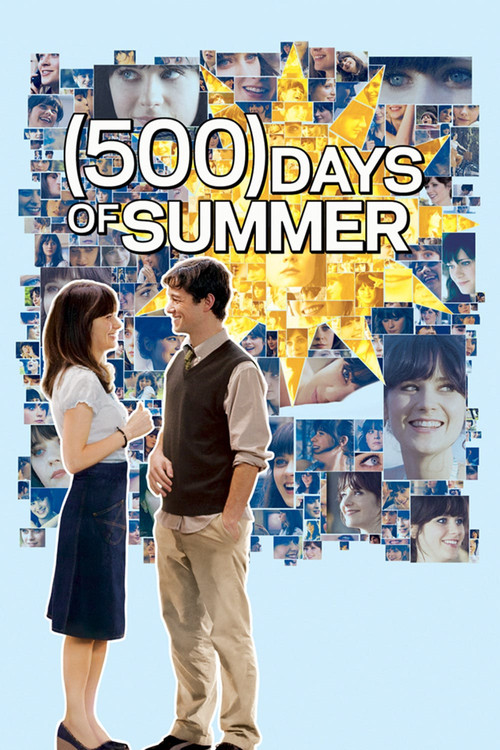
(500) Days of Summer
2009 · Marc Webb
For when you're nursing a heartbreak or picking apart an old one — comfort food that doubles as therapy. Watch it young and side with Tom; rewatch it later and realize what the film was telling you all along.
What it's about
Tom writes greeting cards, believes in destiny, and falls hopelessly for Summer, the new girl at the office who tells him upfront she doesn't believe in love. The film shuffles through the 500 days of their relationship out of order — day 28 next to day 320 — as Tom sifts the wreckage of a breakup trying to figure out where it all went wrong. It's a romantic comedy about the story we tell ourselves versus the person actually standing in front of us.
The experience
Playful and inventive on the surface — musical numbers, split screens, a wry narrator — with a bruise underneath. It's funny and charming right up until it holds a mirror to every idealized crush you've ever had, and that sting is the point.
Performances
Joseph Gordon-Levitt makes Tom's self-deception sympathetic rather than pathetic, and Zooey Deschanel plays Summer with just enough opacity that the film's whole argument about projection rests on her.
The craft
The nonlinear structure is the masterstroke — a day counter shuffles the romance so you feel the gap between memory and reality — and the film's formal playfulness (an expectations-versus-reality split screen, a spontaneous dance sequence) always serves the emotional point. Scott Neustadter and Michael H. Weber's script, drawn from real heartbreak, is one of the sharpest of its era.
Why it matters
It became the defining indie romance of its moment, launched the 'manic pixie dream girl' debate into the mainstream, and its reputation has kept evolving as audiences re-litigate who was really at fault.
Snapshot
(500) Days of Summer is a deconstructed romantic comedy that narrates the rise and collapse of a relationship out of chronological order, shuffling across the 500 days of its title with an on-screen day counter. Its narrator warns at the outset that this is "not a love story" but "a story about love," and the film keeps that promise by inverting the genre's machinery: the ardent believer, Tom Hansen (Joseph Gordon-Levitt), is a greeting-card writer who mistakes infatuation for destiny, and Summer Finn (Zooey Deschanel), the object of his idealization, never shares his faith in fate. The screenplay by Scott Neustadter and Michael H. Weber — drawn, by the writers' own account, from Neustadter's real heartbreak — treats a familiar quirky-indie surface as a Trojan horse for a colder argument about projection, self-deception, and the stories men tell themselves about women. Directed by Marc Webb in his feature debut and released by Fox Searchlight, it became one of the defining American independent romances of its era and a lasting reference point in debates about how movies mythologize love.
Industry & production
The film sits squarely within the late-2000s Fox Searchlight model: a specialty-division studio cultivating modestly budgeted, festival-launched pictures with distinctive voices and crossover potential, the same pipeline that produced Little Miss Sunshine (2006), Juno (2007), and Slumdog Millionaire (2008). (500) Days of Summer was made on a modest budget characteristic of that program; I won't cite a precise figure, as reported numbers vary and I can't verify one. It premiered at the Sundance Film Festival in January 2009 and was released theatrically by Fox Searchlight in the summer of 2009, where it performed strongly relative to its cost and expanded from a platform release on the strength of reviews and word of mouth.
The project originated with two first-time screenwriters, Neustadter and Weber, who wrote it as a semi-autobiographical response to a failed relationship. That authorial origin matters to the production's identity: the film's insistence that Tom is an unreliable romantic — not a hero to be vindicated — flows directly from the writers' stated intention to interrogate their own younger sentimentality. Casting Gordon-Levitt, then transitioning from child-actor and independent-drama work (Brick, Mysterious Skin) toward leading-man roles, and Deschanel, already associated with a certain wistful indie persona, gave the film performers whose existing images it could both use and complicate.
Technology
The film belongs to the last cohort of American independents made largely with photochemical, celluloid-based capture rather than digital cinema cameras, and its warm, slightly nostalgic image is consistent with a film-originated look; I'll flag that I can't independently confirm the exact camera and stock. Its more conspicuous technological gestures are compositing and animation rather than acquisition format: a hand-drawn animated bluebird in the celebratory dance number, a sequence in which the live-action world dissolves into a pencil sketch as Tom's mood collapses, and a split-screen construction that required precise planning and post-production assembly. These are relatively low-tech, artisanal effects by blockbuster standards, and that restraint is part of the film's aesthetic argument — its magic is bounded, ironic, and always tethered to Tom's subjectivity.
Technique
Cinematography
Eric Steelberg's photography gives the film a sun-warmed, postcard clarity that flatters both its lovers and its unusual setting: downtown Los Angeles, framed not as noir sprawl but as a repository of handsome older architecture. The camera repeatedly organizes the city into compositions Tom, an aspiring architect, would admire — a visual rhyme with his suppressed vocation. Color functions almost programmatically: blue, associated with Summer, threads through wardrobe and décor, and the palette is at its most saturated and golden during the relationship's ascent, cooling and graying as it declines. Because the timeline is scrambled, the cinematography does quiet narrative work, letting light and color signal emotional register when chronology alone cannot.
Editing
Editing is the film's defining formal instrument. Alan Edward Bell assembles the story as a mosaic of numbered days delivered out of order, so that a scene of joy may cut directly against its later ruin, and the audience reads each moment through knowledge the characters lack. The most celebrated set piece — a split screen dividing "Expectations" from "Reality" as Tom arrives at a party — depends entirely on the cut and the frame: the two panels drift apart as his hopeful fantasy and the disappointing actual evening diverge, until reality swallows the screen. Elsewhere the film uses match cuts, montage, and repetition (returning to the same locations and gestures on different days) to make its structural thesis legible: memory is not linear, and love in retrospect is an act of editing.
Mise-en-scène / staging
The production design leans into a curated, retro-inflected indie texture — vinyl records, vintage-styled clothing, IKEA showrooms playacted as a shared home — that is knowingly twee and, crucially, filtered through Tom's romantic gaze. The greeting-card office, with its walls of manufactured sentiment, externalizes the film's critique of commodified emotion. Los Angeles locations are staged as characters: a downtown bench overlooking the skyline (at Angels Knoll) becomes the film's recurring emotional vantage point, the place where Tom sketches the city and where the relationship's meaning is negotiated. Staging often isolates Tom within frames that emphasize his projection onto Summer rather than genuine mutual exchange.
Sound
Music is nearly a second script. The Smiths function as a diegetic shibboleth — Tom and Summer bond over "There Is a Light That Never Goes Out," and Morrissey's romantic melancholy scores Tom's sensibility — while Regina Spektor, Simon & Garfunkel's "Bookends," and other needle-drops mark the film's shifts in mood and time. The exuberant morning-after dance number set to Hall & Oates's "You Make My Dreams" is the film's most quoted musical sequence, a burst of choreographed euphoria complete with the animated bird. The original score by Mychael Danna and Rob Simonsen underlays these songs with a light, unsentimental orchestral touch. Voiceover narration frames the whole, lending the mock-authority of a fable to a story about self-delusion.
Performance
Gordon-Levitt plays Tom as sincere, funny, and quietly culpable — charming enough to hold audience sympathy while revealing, over the film's runtime, the entitlement beneath his romanticism. His performance modulates finely between comic buoyancy (the dance number) and raw deflation (the "Expectations/Reality" party). Deschanel's Summer is deliberately opaque, a performance built on withholding: she is warm but honest about her disbelief in permanence, and the film's design forces us to notice how much of "Summer" is Tom's invention rather than the person on screen. Chloë Grace Moretz, as Tom's precociously wise younger sister, supplies the film's clearest voice of correction. The interplay between the two leads — affectionate, mismatched, never quite meeting — carries the picture.
Narrative & dramatic mode
The dramatic mode is ironic and retrospective. A framing narrator and title cards establish a storybook register that the film then undercuts, and the nonlinear structure converts the audience into analysts sifting evidence alongside a heartbroken Tom. This is a memory-narrative in which the unreliability lies not in fabricated events but in interpretation: the same relationship reads as fated romance or doomed mismatch depending on which day we occupy. The film withholds catharsis of the conventional kind — the couple does not reunite — and instead offers recognition, as Tom belatedly grasps that he authored a story Summer never agreed to. Its comedy is a delivery system for a fundamentally corrective, even melancholy, argument about desire.
Genre & cycle
(500) Days of Summer is best understood as an anti-romantic comedy: it adopts the beats, iconography, and charm of the genre in order to critique the expectations the genre instills. It belongs to a late-2000s cycle of Sundance-incubated, music-forward, stylistically playful indies — kin to Garden State (2004), Juno, and Eternal Sunshine of the Spotless Mind (2004) in its temporal experimentation — while positioning itself against the wish-fulfillment logic of studio romance. Its explicit disavowal ("this is not a love story") signals genre self-awareness that had, by 2009, become a recognizable indie stance. The film's lasting genre significance is less that it invented anything than that it crystallized a skeptical, deconstructive attitude toward the romantic comedy for a generation of viewers.
Authorship & method
The dossier's clearest authorial signature is collaborative. Marc Webb, arriving from music videos, brought a fluency with song-driven montage, tonal shifts, and stylized set pieces directly into his feature debut; the film's structure and its willingness to break form reflect that background. Scott Neustadter and Michael H. Weber, writing their breakthrough screenplay, supplied the confessional core and the crucial decision to make Tom wrong — an authorial ethics that resists reading the film as endorsement of Tom's romanticism, a point the writers have made in interviews. Eric Steelberg (cinematography) and Alan Edward Bell (editing) translated the script's temporal games into legible image and rhythm, while composers Mychael Danna and Rob Simonsen and the curated song selections shaped its emotional grammar. The method throughout is one of ironic sincerity: sincere enough to move audiences, ironic enough to indict the very feelings it evokes.
Movement / national cinema
The film is a product of American independent cinema in its studio-specialty-division phase — the Fox Searchlight strand of Sundance-launched, mid-budget pictures aimed at educated crossover audiences. It carries the DNA of American indie "quirk" (a term critics applied, sometimes pejoratively, to this period's twee production design and needle-drop soundtracks) while inheriting, at a remove, the temporal fragmentation and self-aware romance associated with the French New Wave and with New Hollywood touchstones about disillusioned young men. It is not the product of a formal movement so much as a well-defined commercial-artistic ecosystem at a particular moment in American film.
Era / period
Released in 2009, the film captures a specific cultural instant: the tail end of the indie-quirk boom, a moment of hipster taste-making organized around vinyl records, vintage aesthetics, and canonical alt-rock affinities. Its Los Angeles is nostalgic and analog, largely insulated from the smartphone-and-social-media saturation that would soon reshape both dating and movies about it. Made just as digital cinema was overtaking film, it reads in retrospect as a late artifact of a more photochemical, mixtape-minded sensibility — and its enduring circulation online has kept it culturally present well beyond its release year.
Themes
At its center is the gap between projection and reality — the human tendency to fall in love with an idealized image and to author a narrative the other person never consented to. Related themes proliferate: the commodification of emotion (Tom's greeting cards sell manufactured sentiment, and the film asks whether his own feelings are any more authentic); fate versus chance, dramatized in Summer's disbelief and the film's closing turn toward "Autumn"; the tension between vocation and drift, as Tom's abandoned architectural ambition becomes a measure of his self-neglect; and the unreliability of memory, made structural by the shuffled timeline. The film's most discussed thematic legacy concerns gendered fantasy — its careful, if imperfect, effort to expose rather than celebrate a man's habit of turning a woman into a symbol.
Reception, canon & influence
Critically, the film was widely praised on release for its wit, formal inventiveness, and the chemistry of its leads, and it became a signature success of Fox Searchlight's specialty slate; it recovered its modest cost comfortably and endured as a repertory and streaming favorite. (I'm characterizing the consensus rather than citing specific figures or quotations, which I can't verify precisely.)
Looking backward, its influences are legible: the memory-shuffling romance of Eternal Sunshine of the Spotless Mind; the disillusioned-young-man tradition of New Hollywood; the self-aware indie romance of Annie Hall and the mismatched-couple template it revised; and the music-video craft Webb imported wholesale. Its Smiths-and-vinyl sensibility places it in direct dialogue with the Garden State strand of soundtrack-driven indie.
Looking forward, its influence is disproportionate to its size. It helped propel Marc Webb to major-studio work, most notably The Amazing Spider-Man (2012), and consolidated Joseph Gordon-Levitt's transition to leading roles; Zooey Deschanel's persona here fed directly into her later television stardom. Most durably, the film became the central case study in the popular discourse around the "manic pixie dream girl" — a term coined by critic Nathan Rabin in 2007, not for this film, but which crystallized around Summer as audiences debated whether the movie endorsed or critiqued the trope. That the writers have repeatedly insisted Tom is the problem, and that the film contains an explicit rebuke of his idealization, has kept the debate alive for over a decade. (500) Days of Summer thus occupies an unusual canonical position: beloved as a romance by many of the very viewers its structure was designed to challenge, and cited by scholars and critics as a landmark in how twenty-first-century cinema learned to interrogate its own romantic myths.
A Deleuzian reading
He comes out of her building in the morning and the street starts dancing for him.
The full Deleuzian reading of (500) Days of Summer →
Reception
A Sundance darling and sleeper hit in 2009, it was embraced as the smart, sad rom-com for the indie generation — then spent the 2010s being flipped on its head, as rewatchers (and Joseph Gordon-Levitt himself) argued the film was always critiquing Tom, not siding with him.
How (500) Days of Summer was received, from release to now →
How to watch (500) Days of Summer: what to notice on a first viewing
- Watch the numbered day card before each scene and do the arithmetic. The counter promises an orderly filing system, then Webb and editor Alan Edward Bell refuse to run the days in order. A joyful day sits next to a ruinous one. You stop watching a story unfold and start sifting evidence, which is exactly what heartbreak makes a person do.
- Notice how often blue turns up in Summer's clothes and rooms. Eric Steelberg threads blue through wardrobe and decor wherever Summer is. The light runs golden and saturated while things are rising, then grays out as they fall. Because the timeline is scrambled, color often tells you where you are emotionally before the day counter tells you when.
- Watch how little Tom actually does during the morning-after dance number. Gordon-Levitt grins and walks. Strangers fall into step, a marching band arrives, an animated bird lands on his finger. The choreography belongs to the street, not to him. His happiness is something happening to him, not something he made, which is true of the whole relationship.
- Listen for the songs Tom and Summer share, starting with the Smiths. A shared favorite record becomes Tom's proof of destiny. Webb, coming from music videos, keeps letting needle drops carry the emotional information the shuffled scenes withhold. A shared record collection is not fate, and the soundtrack lets you hear Tom mistake one for the other.
- Look at the walls of greeting cards in Tom's office. Tom writes sentiment for feelings nobody in particular is having, surrounded by racks of it. The film keeps returning him to that room between relationship scenes. His job manufactures the same ready-made emotions he lives by, which makes you ask how much of his love he wrote himself.
The whole guide to watching (500) Days of Summer, with the keys for a rewatch →
Influences: the films it descends from and the films it influenced
- Annie Hall (1977) — Establishes the retrospective romance-autopsy told in shuffled fragments with direct-to-camera address and split-screen — the confessional post-mortem template Neustadter and Weber openly revise.
- Two for the Road (1967) — Intercuts a couple's relationship across multiple non-adjacent timelines so honeymoon euphoria and decay sit in the same montage — the editing logic behind the shuffled-day structure and the Expectations/Reality split.
- Eternal Sunshine of the Spotless Mind (2004) — Reconstructs a failed romance through subjective, non-chronological memory that privileges emotional order over calendar order, the direct precedent for the unreliable-memory shuffle.
- The Graduate (1967) — Codifies the drifting, disillusioned young man scored by a curated pop soundtrack (Simon & Garfunkel) used as interior monologue rather than diegetic filler.
- Garden State (2004) — The immediate model for soundtrack-as-authorship indie, curating melancholy guitar-pop (The Shins, the Smiths sensibility) so specific needle-drops carry the emotional beats.
- High Fidelity (2000) — A music-obsessive man narrates and re-litigates his past relationships straight to camera, self-servingly reordering events — the withholding, unreliable male narrator 500 Days indicts.
- Amélie (2001) — Saturated storybook production design plus whimsical fantasy inserts that externalize a character's inner life into stylized set pieces, feeding the twee palette and animated asides.
- Punch-Drunk Love (2002) — Uses a color-coded emotional palette and abrupt tonal swerves to render an indie romance as formally heightened, near-musical grammar rather than naturalism.
- The Umbrellas of Cherbourg (1964) — Blocks a doomed romance into color-saturated, seasonally-partitioned movements ending in anti-cathartic non-reunion — the bittersweet chaptered structure without a happy landing.
- Little Miss Sunshine (2006) — A music-video-trained director, like Dayton and Faris, importing compressed visual wit and a structuring needle-drop soundtrack into the indie dramedy — extending Sunshine's lineage of commercial-craft directors bringing economy to bittersweet comedy.
- The Man Who Copied (2003) — Non-linear romantic comedy driven by a wry omniscient narrator, chapter cards and associative montage that formalize the mechanics of a love story — the same accessible-but-playful architecture.
- When Harry Met Sally... (1989) — The corrective descendant: it keeps the split-screen (expectation vs. reality) and the shuffled dated-chapter structure but points them at the male fantasy WHMS underwrites, using the same devices to indict rather than reassure.
- Ruby Sparks (2012) — Literalizes projection-vs-reality: a writer authors an idealized woman who rebels against his fantasy, turning the manic-pixie-dream-girl rebuke into plot mechanism.
- Blue Valentine (2010) — Cross-cuts courtship bliss against marital collapse so the two timelines indict each other, extending the Expectations/Reality contrast into a feature-length structural device.
- Her (2013) — Externalizes commodified, projected love through a warm color-coded palette, dramatizing a man idealizing a partner who was never what he imagined — the projection critique restaged.
- La La Land (2016) — Seasons-titled structure, needle-drop-adjacent musical set pieces, and an anti-cathartic what-if finale that denies romantic closure the way 500 Days denies the reunion.
- Comet (2014) — Tells a relationship entirely through a shuffled, non-chronological multi-timeline cut, pushing the nonlinear-romance editing grammar to its structural extreme.
- Paper Towns (2015) — Explicitly dramatizes and dismantles the manic-pixie-dream-girl projection ('she's a person, not an idea'), restating the 500 Days thesis as narrative argument.
- The Amazing Spider-Man (2012) — Webb imports his own indie-romance grammar — handheld intimacy, awkward halting flirtation, the two-hander built on overlapping mumbled dialogue — which becomes the Garfield-Stone stairwell/hallway scenes that critics singled out as the reboot's best material.
- The Amazing Spider-Man 2 (2014) — Webb's music-video/indie-romcom method — slowing down for a young couple's texture and comic timing — is the authored register that survives intact in the Peter–Gwen scenes.
- The Fault in Our Stars (2014) — Screenwriters Neustadter and Weber's signature unsentimental-romance mode — voice-over subjectivity plus curated indie needle-drops — carries straight into Fault.
- People We Meet on Vacation (2026) — Its day-numbered, non-sequential timeline lets the audience know the ending while the character doesn't, weaponizing edit order to produce dramatic irony — the same interleaved-chronology-for-irony craft the seed employs.
- We Live in Time (2024) — Popularizes the day-labeled non-linear romance whose associative jump-cuts between good and bad phases invite the viewer to reassemble the arc — a lighter precedent for the film's fragmented, cue-withholding chronology.
- Scott Pilgrim vs. the World (2010) — Composites hand-drawn comic and video-game graphics into live action at music-video pace, applying the same graphic-overlay stylization to a self-deluding indie-romance protagonist.
- Frances Ha (2012) — Chapter-carded twee indie built on curated needle-drops and an opaque, withholding lead performance in the same 2009-era quirk register.
- Us and Them (2018) — Shuffles a romance's highs and lows out of chronological order around a breakup so the audience reads the ending back into the beginning — the same non-linear, retrospective ache Liu organizes her editing around.
- Rye Lane (2023) — Shares the fragmented, formally playful indie-romcom vocabulary — including a musical/karaoke set-piece and stylized breaks from realism — to chart heartbreak and recovery.
- Juno (2007) — Extends Juno's non-linear titled-chapter structure and indie-music-curation-as-narration into quirky romance, riding the same specialty-label soundtrack cross-promotion model.
- Flipped (2010) — Reorders a romance into subjective, non-chronological replays driven by needle-drop scoring, a contemporary variant of Flipped's POV-doubled editing.
- Sidewalls (2011) — Shares the nonlinear parallel construction, chaptered day-card structure and essayistic narration over an architecture-preoccupied romance — a near-contemporary indie built from the same formal kit.
- My Sassy Girl (2001) — A non-linear, retrospective male narrator dissects a relationship with an elusive, willful woman, shuttling between comic and mournful registers — the Western cousin of MSG's reconstructed, register-switching post-mortem on love.
- Jab We Met (2007) — Webb's nonlinear anatomy of a romance that interrogates the manic-pixie projection is a reflexive sibling in complicating the MPDG archetype that Geet both embodies and rebukes.
Similar films
- High Fidelity (2000) — influence & lineage
- Eternal Sunshine of the Spotless Mind (2004) — influence & lineage
- Annie Hall (1977) — influence & lineage
- Scott Pilgrim vs. the World (2010) — influence & lineage
- La La Land (2016) — influence & lineage
- The Worst Person in the World (2021) — same viewing thread
- Lady Bird (2017) — same viewing thread
- Voicemails for Isabelle (2026) — same viewing thread
All the films related to (500) Days of Summer →
Watch it with: curated runs of related films
- Funny Because It Aches — A run of tender, deadpan dramedies where love, grief, and the panic of becoming yourself all get metabolized through jokes — watch these when you want to laugh and cry in the same scene.