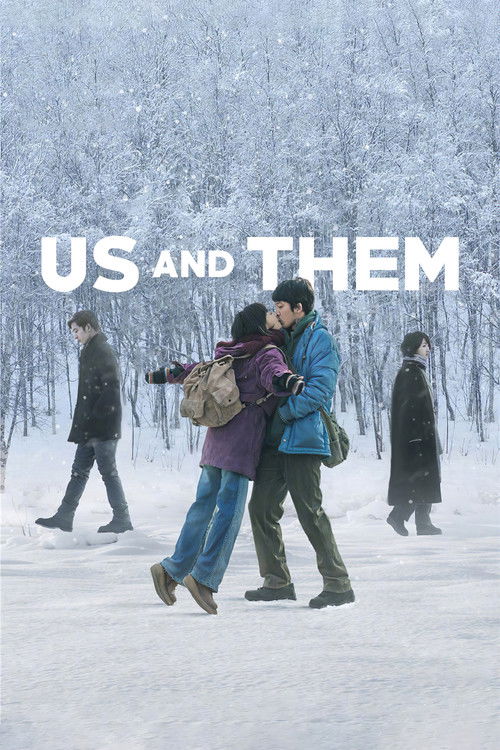
Us and Them
2018 · René Liu
For when you need a good cry about the one that got away, or a rainy-night wallow in nostalgia and what-ifs. Bring tissues; it's a comfort in the way sad songs are.
What it's about
Two young provincials meet on a packed train home during China's Spring Festival migration and fall in love while scraping out a life in Beijing's rented rooms and internet cafés. Ten years after drifting apart, they run into each other again and take stock of everything gained and lost in between.
The experience
A slow-burn tearjerker that earns its tears — wistful, aching, and tender about the ordinary compromises that pull people apart. It sneaks up on you and then doesn't let go.
Performances
Zhou Dongyu is extraordinary as Xiaoxiao, playing her with a bruised buoyancy that makes both the hopeful past and the guarded present feel true, with Jing Boran matching her as Jianqing.
The craft
Director René Liu — the singer whose ballads soundtracked a generation of Chinese heartbreak — splits the timeline elegantly: the remembered past in warm color, the present-day reunion in black and white, an inversion of nostalgia's usual palette that lands like a quiet verdict. The recurring train journeys home give the romance its measure and its rhythm.
Why it matters
Liu's directing debut struck a nerve with China's generation of young urban migrants, becoming a touchstone romance about the cost of chasing a future in the big city.
René Liu — the Taiwanese singer and actress whose ballads soundtracked a generation of Chinese heartbreak — made her directing debut with a romance pitched precisely at that generation: the 'Beijing drifters,' young provincials chasing futures in the capital's rented rooms and internet cafés. Xiaoxiao and Jianqing meet on a packed train during the Spring Festival migration, the world's largest annual movement of people, and the film keeps returning to those journeys home as the measure of everything gained and lost between them. Liu splits the timeline elegantly: the remembered past unfolds in warm color, the present-day reunion in black and white — an inversion of nostalgia's usual palette that lands like a quiet verdict. Zhou Dongyu, one of the finest faces in contemporary Chinese cinema, plays Xiaoxiao with a bruised buoyancy opposite Jing Boran's stubborn dreamer. Produced by Zhang Yibai, the film became a box-office phenomenon in China — among the highest-grossing films ever directed by a woman at the time — before Netflix carried it worldwide. Its emotional engine is a very old one, handled without shame: the person you loved when you had nothing.
Reception
It opened to a record-shattering Labor Day weekend in China in 2018 — then got engulfed in a presale ticket-refund scandal, with mass bulk cancellations sparking accusations of inflated numbers and a genuine industry reckoning. The controversy has since faded, and it now lives a second life as a Netflix-era cry-movie passed between international viewers.
How Us and Them was received, from release to now →
Influences: the films it descends from and the films it influenced
- Comrades: Almost a Love Story (1996) — Establishes the mainland-migrant-lovers template Us and Them runs on — two economic drifters who fall together in hardship, part, and are structurally reunited years later, the whole romance measured against the passage of time and money.
- Spring Subway (2002) — Producer Zhang Yibai's own glossy urban-romance grammar — stylized Beijing longing, voiceover confession, couples framed against transit — is the house melodrama style he transplants into his protégée's debut.
- Beijing Bicycle (2001) — Sixth-Generation beipiao realism: the cramped rentals, courier hustle, and social precarity of migrant youth scraping by in Beijing that grounds the 'love in poverty' texture of Lin Jian and Xiaoxiao's early years.
- Last Train Home (2009) — Renders the chunyun Spring Festival migration as human drama, supplying the crowded-train-home-for-New-Year frame that Us and Them uses as its recurring narrative anchor and site of both meeting and parting.
- The Wizard of Oz (1939) — Canonical palette split coding one world in monochrome and the other in color; Us and Them inverts it — the shared past glows in color while the present-day reunion drains to black-and-white.
- A Matter of Life and Death (1946) — Reverses the expected palette (Technicolor for the living world, monochrome for the beyond); Us and Them borrows that counter-intuitive assignment to make the vibrant past feel more alive than the drained present.
- Wings of Desire (1987) — Uses black-and-white for a detached, unlived state and bursts into color at the moment of embodied feeling — the exact emotional logic by which Us and Them reserves color for the time the couple were truly together.
- Under the Hawthorn Tree (2010) — Launched Zhou Dongyu as the fragile, chaste first-love ingénue; Us and Them trades on and matures that established screen persona of yearning restraint.
- You Are the Apple of My Eye (2011) — Template for the pan-Chinese youth-nostalgia romance told from an older narrator looking back at a first love that got away, framed by a present-day reunion — the genre scaffolding Liu inherits.
- Blue Valentine (2010) — Intercuts the warm ascent of a courtship against the cold present-day of its collapse, distinguishing the two eras by grade and texture — the split-timeline, palette-differentiated structure at the heart of Us and Them.
- Our Times (2015) — Carries the frame-flashback first-love model forward with present/past color-coding and a pop-ballad-driven nostalgia payload in the Our Times mold.
- Better Days (2019) — Extends the Zhou Dongyu intimate two-hander into a grittier register, carrying forward the realist close-quarters romance/melodrama of precarious young people that Us and Them typified.
- (500) Days of Summer (2009) — Shuffles a romance's highs and lows out of chronological order around a breakup so the audience reads the ending back into the beginning — the same non-linear, retrospective ache Liu organizes her editing around.
- So Young (2013) — The direct precedent for Liu's move — a Chinese actress's directorial debut in campus-nostalgia romance that became a box-office phenomenon, proving the star-turned-director youth-melodrama play.
- Soul Mate (2016) — Zhou Dongyu again, in a dual-timeline melodrama built on letters, returns, and a reunion that reframes everything before it — the same reunion-as-decoder-ring structure and lead performer.
- La La Land (2016) — Its counterfactual 'what if we'd stayed together' imagined-alternate-life coda is precisely the device Us and Them stages in its black-and-white sequence — a montage of the future the lovers didn't get.
- Eternal Sunshine of the Spotless Mind (2004) — Reconstructs a dissolved relationship through fragmented, subjective memory in which the palette and vividness of scenes track emotional presence — the same memory-as-editing principle behind the inverted nostalgia grade.
- Soulmate (2023) — A Chinese two-timeline melodrama built entirely on 'staying versus leaving,' braiding a color-past romance against a present-day reunion in the same retrospective idiom.
Similar films
- So Long, My Son (2019) — shared sensibility
- Even If This Love Disappears Tonight (2025) — shared sensibility
- Past Lives (2023) — shared sensibility
- Soulmate (2023) — shared sensibility
- 18x2 Beyond Youthful Days (2024) — shared sensibility
- Your Name Engraved Herein (2020) — shared sensibility
- Cloud (2007) — shared sensibility
- Falling in Love Like in Movies (2023) — shared sensibility