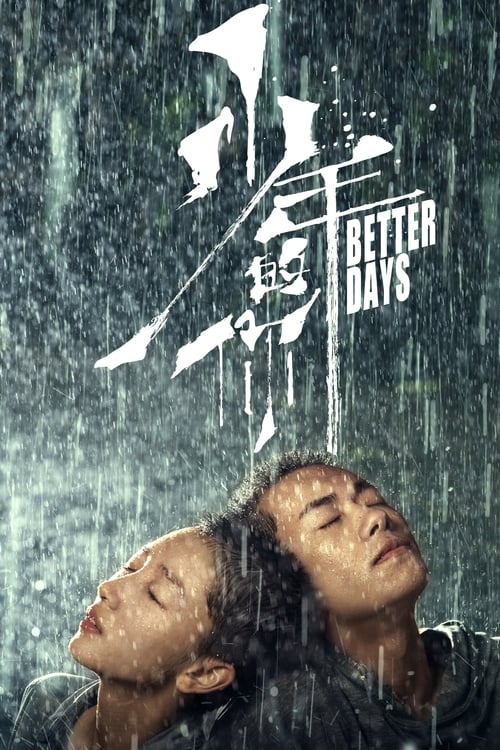
Better Days
2019 · Derek Tsang Kwok-Cheung
For when you want a film that puts you through the wringer and earns it — a heavy, heart-in-throat drama for a night when you're ready to feel protective of two kids against the world. Challenge, not comfort, though there's real warmth in it.
What it's about
A quiet schoolgirl in a Chinese exam-prep pressure cooker is tormented by classmates in the final months before the gaokao, the college entrance exam that will decide her whole future. Her only protection comes from a street kid the system has already written off, and their wary alliance grows into something tender even as the danger around her tightens. It's part social exposé, part crime story, part doomed romance.
The experience
Intense and close to the skin — the camera presses right up against faces, so you feel every flinch of shame and every flicker of trust. It's bruising and sad, but the tenderness at its center keeps pulling you through.
Performances
Zhou Dongyu is tiny and ferocious in the lead, and pop idol Jackson Yee, in his first dramatic role, matches her with a guarded stillness — their chemistry carries the film.
The craft
Derek Tsang shoots in bruising handheld close-up, turning the film into a study of skin, shame, and watchfulness; the exam-season atmosphere — chanting classrooms, stacked textbooks, fluorescent nights — is rendered with documentary conviction. The intimacy of the framing makes it hit hard even on a small screen.
Why it matters
Pulled by censors, delayed, then a colossal hit in China that forced a national conversation about school bullying — and it carried Hong Kong to an Oscar nomination for Best International Feature.
A bullied schoolgirl in the crucible of China's gaokao — the college entrance exam that decides everything — finds her only protection in a street kid the system has already discarded. Derek Tsang Kwok-Cheung, son of Hong Kong stalwart Eric Tsang, shoots their alliance in bruising close-up: faces filling the frame, handheld cameras pressing so near that the film becomes a study of skin, shame, and watchfulness. Zhou Dongyu, tiny and ferocious, plays against pop idol Jackson Yee in his first dramatic role, and their wary tenderness carries a film that is part social exposé, part crime melodrama, part doomed romance. Its path to screens was as fraught as its subject — yanked from the Berlinale, delayed by censors, then a colossal domestic hit that forced a national conversation about school bullying. It went on to an Academy Award nomination for Best International Feature, the rare mainland-set drama to move festival juries, censors' critics, and multiplex audiences alike.
Reception
Its road to screens was chaos — yanked from Berlin days before its 2019 premiere, then surprise-dropped in China with barely any notice — but it exploded into a $230M+ hit, and a Best International Feature Oscar nomination for Hong Kong in 2021 sealed its climb from censorship casualty to modern classic.
How Better Days was received, from release to now →
Influences: the films it descends from and the films it influenced
- Soul Mate (2016) — Tsang's own prior two-hander pins the camera in extreme intimate proximity to a female dyad (again anchored by Zhou Dongyu), rehearsing the skin-close handheld shot/reverse-shot grammar Better Days scales up to a boy-girl pair.
- Under the Hawthorn Tree (2010) — Zhang cast the unknown Zhou Dongyu as a fragile first-love innocent shot in soft available-light close-ups — the exact vulnerable-ingenue persona Better Days both inherits and roughens.
- Suzhou River (2000) — Lou's restless subjective handheld that presses the lens into a doomed urban couple's faces — and his career-long tangle with mainland censors — is the Sixth-Generation template Better Days works within.
- Rosetta (1999) — The Dardennes' unbroken handheld that trails a precarious teenager from behind the nape and holds on her face in tight social-realist proximity is the physical-camera method Yu Jing-pin adapts to shadow Chen Nian.
- In the Mood for Love (2000) — Doyle's cramped, telephoto intimate framing that isolates two bodies in slivers of foreground clutter gives Better Days its Hong Kong grammar of yearning held at suffocating close range.
- The Devotion of Suspect X (2008) — Higashino's plot engine — a devoted protector who conceals a body and engineers a false confession to take the fall for a beloved — is the crime-melodrama machinery driving Better Days' second half.
- Confessions (2010) — Nakashima's cold, stylized anatomy of classroom cruelty and revenge established the East Asian school-bullying-as-thriller register that Better Days converts into social-problem drama.
- Beijing Bicycle (2001) — Wang's Sixth-Generation portrait of a working-class adolescent abandoned by every institution supplies the theme of social abandonment and the grimy realist texture beneath the melodrama.
- Infernal Affairs (2002) — The Eric Tsang–starring HK crime melodrama of doubled identities, moral loyalty and self-sacrifice is the industrial lineage (through Derek's father) that Better Days inherits as pedigree and tone.
- You Are the Apple of My Eye (2011) — Ko codified the Chinese-language campus template of exam-pressure, nostalgic voiceover and an idealized classmate crush — the youth-film scaffolding Better Days darkens with gaokao dread.
- Us and Them (2018) — A contemporaneous mainland doomed-romance weepie built on a two-hander of precarious young lovers, extending the same tear-jerking youth-melodrama market Better Days topped a year later.
- Soulmate (2023) — Tsang's follow-up extends his contrasting-dyad method and retrospective framing—an interrogation-and-flashback structure—around two bonded young women, the direct authorial lineage Soulmate remakes from.
- Sister (2021) — Post–Better Days, it rides the same wave of intimate handheld social-problem drama anchored by Zhang Zifeng as an against-type young lead carrying institutional-abandonment stakes.
- Better Days–era idol casting (Jackson Yee) (2019) — Tsang's stripping of TFBoys idol Jackson Yee into a bruised, shaven-headed street kid modeled the against-type serious-role pivot mainland idols (Yi Yang Qianxi's later films) now use to shed pop personas.
- So Young (2013) — A defining mainland campus-nostalgia hit that, like Better Days, mines the collective anxiety of Chinese student life for melodrama, sharing the youth-cinema commercial wave.
- Cry Me a Sad River (2018) — A near-simultaneous Chinese youth film that centers school bullying and a girl's social ostracism, sharing Better Days' subject matter and its problem-drama framing.
- A Silent Voice (2016) — Yamada's bullying drama uses tight intimate framing (feet, averted faces, crossed-out expressions) to render victim shame — a parallel formal approach to interiorizing classroom violence.
- Big World (2024) — Jackson Yee's earlier de-glamorized, physically committed lead — bruised, dialect-inflected, Method-adjacent — the immediate prior instance of the immersive-preparation craft he brings to Big World.
Similar films
- A Sun (2019) — same viewing thread
- A Brighter Summer Day (1991) — same viewing thread
- Big World (2024) — same viewing thread
- So Long, My Son (2019) — same viewing thread
- Close (2022) — shared sensibility
- House of Hummingbird (2019) — shared sensibility
- Days of Being Wild (1990) — shared sensibility
- Monster (2023) — shared sensibility
All the films related to Better Days →
Watch it with: curated runs of related films
- Sinophone Slow Cinema — A run of Chinese-language films — Taiwan's New Wave and its mainland and Bi Gan heirs — where time pools and city, family, and memory recur; watch them near each other, from A Brighter Summer Day to An Elephant Sitting Still, for how they rhyme on drift and the weight of the past.