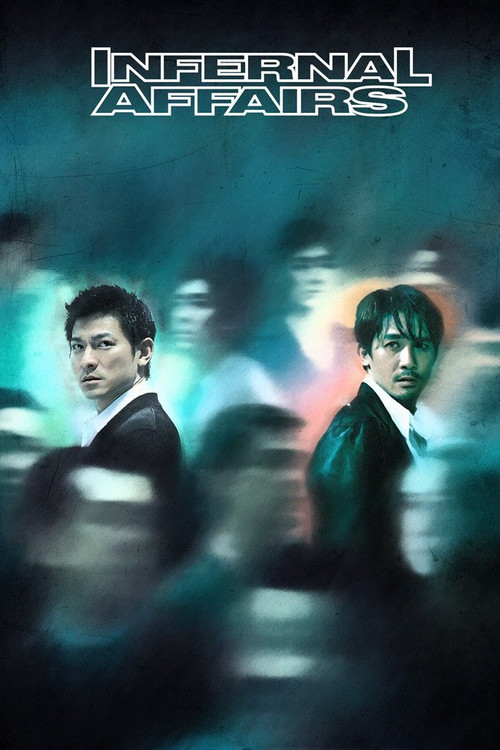
Infernal Affairs
2002 · Alan Mak Siu-Fai
For when you're craving a taut, intelligent thriller that grips you for two hours and leaves a bruise — high tension, zero flab, and more soul than you expect walking in.
What it's about
A cop has spent years undercover inside a Hong Kong triad; a triad soldier has spent the same years rising through the police force. When a botched drug bust makes it obvious each organization has a mole, both men are ordered to find the traitor — meaning each is hunting himself, and the other. Two men who have impersonated someone else so long they're no longer sure who's underneath.
The experience
Lean, sleek, and almost unbearably tense — a cat-and-mouse game compressed into rooftop meetings, coded phone calls, and split-second near-misses, with a current of real sadness about lives spent in disguise. It moves fast and cuts deep.
Performances
Tony Leung and Andy Lau are magnetic as the two moles — Leung all frayed nerves and exhausted decency, Lau smooth and unreadable — and their scenes together crackle precisely because each man is studying his own reflection.
The craft
The filmmaking is all cool surfaces and razor editing: glass towers, rooftops, cross-cut surveillance sequences that turn a phone's ringtone into a weapon. It's a masterclass in generating dread from stillness and silence rather than gunfire.
Why it matters
It single-handedly revived Hong Kong cinema's commercial and critical fortunes, spawned a trilogy, and was remade in America into a Best Picture winner — but the original remains the tighter, sadder film.
Snapshot
A Hong Kong police officer and a triad operative have each been placed undercover inside the other's organization. Years pass. Neither man can surface. When a drug summit forces the rival institutions into direct surveillance of one another, both moles race to identify themselves — and to eliminate the threat before they are exposed. Infernal Affairs takes the procedural mechanics of the cop-thriller and compresses them into an exercise in existential dread: the film's real subject is not which man survives but whether either can still claim to be the person he was sent to impersonate. Its title derives from the Buddhist term Avíci (無間地獄), the lowest plane of hell in which the condemned suffer without intermission — no gap, no respite, no exit. Both protagonists are already there.
Industry & production
By 2002, the Hong Kong film industry was in prolonged contraction. Admissions had fallen sharply from the peaks of the late 1980s and early 1990s; the Asian financial crisis of 1997–98 had depressed the regional market; home-video piracy was endemic; and Hollywood blockbusters were commanding screens that had once been occupied by local productions. The major studios of Hong Kong's golden commercial era — Golden Harvest, Cinema City — had either restructured or collapsed. Local talent was migrating to mainland co-productions or to Hollywood.
Against this backdrop, Infernal Affairs was produced by Media Asia Films with a relatively lean budget, financed in part through a pre-sale and distribution arrangement that reflected the industry's reduced appetite for local risk. The film was shot quickly and brought in on schedule. Its domestic theatrical performance on release in December 2002 was immediately recognized as extraordinary: audiences who had been absent from Hong Kong cinemas returned in numbers that provoked widespread commentary about a possible revitalization of the local industry. The film spawned two sequels within a year — Infernal Affairs II and Infernal Affairs III, both released in 2003 — and the franchise as a whole consolidated Media Asia's position as a major production entity. Warner Bros. secured remake rights before the original's Hong Kong theatrical run had ended, eventually producing Martin Scorsese's The Departed (2006).
Technology
The film was shot on 35mm in the academy ratio, with no significant recourse to digital intermediate processing beyond standard laboratory work by the standards of its moment. Andrew Lau, functioning as both co-director and director of photography, worked in a mode he had refined across the Young and Dangerous series of the 1990s: fast glass, high-contrast printing, a palette that emphasizes nocturnal Hong Kong's fluorescent-and-shadow grammar. The film's technological interest lies less in its image-capture methods than in the role it assigns to communication devices within its diegesis. Mobile phones, short-wave radios, and surveillance equipment are not merely plot props; they constitute the film's central metaphor of identity as signal — readable, interceptable, jammable. The moment when a phone's display confirms or denies a character's affiliation carries as much weight as any act of physical violence.
Technique
Cinematography
Andrew Lau's cinematography is disciplined and declarative rather than expressive for its own sake. Two locations carry disproportionate visual weight: the rooftop, which opens and closes the film, and the elevator shaft, used for a pivotal scene late in the second act. The rooftop is established as liminal space — neither ground-level institutional reality nor aerial abstraction, but a threshold between roles, between lives. Lau shoots it in gray and white, draining color warmth in a manner consistent with the film's Buddhism-tinged sense of bleached-out spiritual existence. Interior sequences — interrogation rooms, the record shop where Yan works as cover, Lau's apartment — are lit to emphasize planes of glass and reflection, so that characters are continually doubled by their own images without the film resorting to programmatic mirror shots. The climactic rooftop sequence achieves its visual compression through tight focal lengths that collapse depth: the two men occupy the same plane, distinctions between foreground and background eliminated.
Editing
The editing, credited to Pang Chi-Leung, structures the film around a principle of withheld simultaneity. The two protagonists share almost no screen time for the film's first half; their stories are cut in parallel, but with sufficient temporal dislocation that the viewer is kept alert to what each man does not yet know about the other. When the film's timeline converges — during the drug summit surveillance sequence — Pang's cutting acquires an urgency that the earlier sections have carefully rationed. The film resists the quick-cut grammar that was standard for Hong Kong action filmmaking in the 1990s; the editing rhythm slows when characters are under surveillance, as though the film is itself watching them with the patience of a system that will eventually close.
Mise-en-scène / staging
The staging of the film's confrontations and confessions makes sustained use of obstructed eyelines: characters frequently speak without facing one another, or are separated by glass or doors, so that direct communication becomes a kind of dramatic event rather than a default mode. When Yan and Lau finally face each other on the rooftop in the film's final act, the staging is almost Bressonian in its reduction — two men, a flat horizon, nothing decorative. This restraint is tonally legible as the visual equivalent of the Buddhist epigraph: there is no ceremony left, no theatrical distance from consequence. The record shop set recurs across multiple scenes as a space of false normalcy — Yan browsing vinyl among civilians — and its warmth makes it read, retrospectively, as the thing he has lost.
Sound
Chan Kwong-Wing's score is the film's most emotionally direct element, and the one most frequently cited in discussions of its tone. Melancholic strings and modal piano carry the weight that the screenplay deliberately withholds from dialogue; the film's central theme functions less as action accompaniment than as a continuous underscore of elegiac futility. The score is not triumphalist at any point, even in scenes of apparent resolution. Sound design makes pointed use of radio static and broken transmission — the frequency gap between two men who cannot speak plainly to each other rendered as acoustic texture.
Performance
Tony Leung Chiu-Wai's performance as Yan is, by any measure, the film's critical center. Leung works almost exclusively through the face: the suppression and controlled release of affect that he had developed across films for Wong Kar-wai (Happy Together, In the Mood for Love) is here deployed not in the register of romantic longing but of exhausted duty. Yan's interiority is legible as the labor of a man who has inhabited a false self for so long that the authentic self has become difficult to locate even to him. Andy Lau's performance as Inspector Lau is the structural mirror: where Leung performs internalized suffering, Lau performs the efficient surface of a man who has successfully buried his origins — until the film forces him to dig. Anthony Wong as Superintendent Wong and Eric Tsang as triad boss Sam provide genre-experienced authority that grounds the film's more psychological ambitions within the operational reality of crime cinema.
Narrative & dramatic mode
Infernal Affairs belongs to a mode of drama organized around dramatic irony as its primary source of tension rather than suspense in the Hitchcockian sense. The audience knows both moles from the outset; the question is never who they are but whether they will be known. This creates a film that operates simultaneously as thriller (procedural revelation) and tragedy (the structural inevitability of one or both men's destruction). The screenplay, by Alan Mak and Felix Chong, manages this dual register with conspicuous economy: dialogue scenes are spare, rarely explaining what the visual grammar has already made plain. The film's structure — cold open establishing both infiltrations, an ellipsis of years, then a convergent present tense — compresses what might have been a multi-season television narrative into ninety-seven minutes without sacrificing psychological credibility.
Genre & cycle
The film is in explicit dialogue with Hong Kong's heroic bloodshed tradition — the crime films of John Woo (A Better Tomorrow, The Killer, Hard Boiled) and Ringo Lam (City on Fire) — while also marking a conscious departure from it. Where heroic bloodshed aestheticized violence through balletic slow motion and operatic sentiment, Infernal Affairs withholds spectacle. Its action sequences are brief, percussive, and consequence-immediate rather than choreographed. The yìhéi ethic (義氣, roughly: loyalty-among-brothers) that structured heroic bloodshed is here examined as a trap rather than celebrated as a code: both protagonists have obligations to institutions that will not protect them, and the film regards fraternal loyalty with the same cold irony it directs at institutional law.
The film participates in a cycle of psychologically complex Hong Kong crime films of the late 1990s and early 2000s that includes Johnnie To's work — The Mission (1999), PTU (2003) — in which the genre's traditional energies are refracted through formal austerity and philosophical weight. Infernal Affairs is the most commercially successful of these films and the one that most directly influenced what came after.
Authorship & method
The film's dual directorship reflects a genuine division of labor. Andrew Lau Wai-Keung brought technical facility, knowledge of Hong Kong street locations, and experience in high-output commercial production; he had directed eleven entries in the Young and Dangerous franchise and understood the genre's grammar as a practitioner. Alan Mak Siu-Fai brought the film's literary and structural ambitions; he co-wrote the screenplay with Felix Chong and was the primary architect of its Buddhist conceptual framework. The collaboration produced a film that is neither purely commercial genre exercise nor purely auteur statement — which may be precisely why it succeeded as widely as it did.
Felix Chong's contribution to the screenplay is significant and often underacknowledged. The structural economy of the script — the way the parallel narratives are set up and then converged — reflects a craft of plotting that Chong brought to subsequent films, including the Overheard series (2009, 2011, 2014). Chan Kwong-Wing's score was integral to the film's reception and to the tone that distinguishes it from contemporaneous Hong Kong crime cinema. The collaboration between Lau and Mak continued immediately with both sequels, though those films — working as prequel and partial sequel respectively — lack the original's compression.
Movement / national cinema
Infernal Affairs is inseparable from the context of post-handover Hong Kong cinema. The 1997 return to Chinese sovereignty had generated a wave of films processing anxiety about identity, loyalty, and institutional belonging; the thriller premise — a man inside an institution who does not belong there, whose real allegiances are elsewhere — maps with too much precision onto Hong Kong's political condition to be read as purely generic coincidence. The film does not make this allegory explicit, and there is no scholarly consensus on whether Mak and Chong consciously intended it; what is legible is that the film's emotional core — the anguish of a man who cannot say who he is, trapped in a role that the institution has determined for him — resonated with audiences whose own sense of institutional belonging was in question.
The film belongs to a generation of Hong Kong filmmakers — Mak, Chong, Johnnie To, Milkyway Image — who were negotiating between a fading local commercial tradition and the demands of the expanding mainland market. That Infernal Affairs achieved its success on terms that were entirely Hong Kong-specific, without significant mainland co-production input, makes it a document of the local industry's capacity to produce culturally specific work under structural pressure.
Era / period
The film arrives at the end of what might be called Hong Kong cinema's second commercial era: after the golden age of the 1980s–early 1990s, after the handover anxieties and Asian financial crisis disruptions of 1997–2000, and before the full integration of mainland co-production financing that would transform the industry in the 2010s. It represents a moment of consolidation — a film that proved the audience for Hong Kong popular cinema had not disappeared but had been waiting for work of sufficient ambition. In global terms, 2002 is the year of Minority Report, Spider-Man, and The Lord of the Rings: The Two Towers; Infernal Affairs achieved its international attention not through genre spectacle but through a seriousness of psychological purpose that distinguished it from the dominant blockbuster mode.
Themes
The film's primary thematic burden is the Buddhist concept it names in its title: Avíci, the hell of continuous, unrelenting suffering. The opening epigraph — drawn from the Nirvana Sutra — establishes that what follows will be a meditation on entrapment without exit. Both protagonists are in hell: not metaphorically but structurally, in the sense that their roles admit no resolution that does not destroy them. The film refuses the genre's usual moral arithmetic, in which the undercover agent's suffering is redeemed by eventual return to identity; Yan's case, in particular, stages that return as too late and too costly to count as rescue.
Identity dissolution is the film's sustained preoccupation. Both men have performed their infiltration roles for so long that the performance has absorbed the performer. The film does not sentimentalize this as liberation — the triad operative who has become a police inspector is not freer for having remade himself — but regards it as a species of death-in-life consistent with its Buddhist framework.
The film also engages, more quietly, with questions of memory and evidence: what constitutes proof of who one is, when the institutional record has been forged. The final act turns partly on the question of documentation — recordings, files, the bureaucratic traces of identity — and the film's conclusion, which has a different valence in the theatrical cut than in the director's cut released later, interrogates whether institutional survival and personal integrity can coexist.
Reception, canon & influence
Critical and awards reception: Infernal Affairs was received in Hong Kong as an event film — a revitalization of local cinema at a moment when its decline seemed structural rather than cyclical. At the 22nd Hong Kong Film Awards (2003), it won Best Film, Best Director (shared between Mak and Lau), Best Actor (Tony Leung Chiu-Wai), Best Film Editing, and Best Original Film Score, among others. International critical reception followed over the subsequent years as the film circulated through film festivals and, more significantly, through the anticipatory attention generated by the Scorsese remake announcement. Time magazine listed it among the best films of the decade; it appears consistently in poll-based canons of Hong Kong and Asian cinema.
Influences on the film (backward): The film draws directly on Hong Kong's heroic bloodshed tradition (Woo, Lam), particularly City on Fire (1987), which itself sourced from Jean-Pierre Melville. Melville's influence — the cold proceduralism, the existential fatalism, the stripped-down masculinity of Le Samouraï and Le Cercle Rouge — is legible throughout. Michael Mann's Heat (1995) is a plausible comparison for the dual-protagonist structure and the use of urban institutional space as dramatic landscape, though direct influence is not established in the scholarly or journalistic record. The film's Buddhist conceptual framework draws on a tradition of Hong Kong cinema that engages with Chinese philosophical and religious thought as a lens on moral crisis.
Legacy and influence (forward): The most consequential direct influence is The Departed (2006), which won Martin Scorsese his only Academy Award for Best Director and Best Picture. Scorsese's film transposed the Hong Kong material to South Boston with extensive structural fidelity while shifting the register — louder, more visceral, more Americanly ironic. The comparison has become a permanent feature of film-critical discourse, and while The Departed tends to receive greater institutional recognition in English-language canons, critical consensus generally acknowledges the Hong Kong original as the aesthetically superior work.
Beyond the Scorsese remake, Infernal Affairs influenced the subsequent direction of Hong Kong and broader East Asian crime cinema: the psychologically complex, formally restrained thriller became a viable commercial mode in part because of the film's success. Johnnie To's subsequent work at Milkyway Image — Election (2005), Exiled (2006), Drug War (2012) — is in dialogue with the space Infernal Affairs helped define. The film's influence on Korean crime cinema is noted but incompletely documented in the scholarly literature. Its position in the Hollywood remake economy — acquired before release, remade by a canonical American director — established a template for how Hong Kong genre product could circulate globally in the 2000s that subsequent films (including several by Johnnie To) were acquired but not produced against.
Infernal Affairs now occupies a secure place in the canon of Hong Kong cinema alongside the best work of Woo, Lam, and To. Its particular achievement — to make a film of genuine philosophical weight within the constraints of commercial genre production, at a moment when the industry's capacity to do so was genuinely in doubt — gives it a historical significance that extends beyond its considerable formal and dramatic merits.
A Deleuzian reading
Start with the rooftop.
The full Deleuzian reading of Infernal Affairs →
Reception
A monster hit that single-handedly jolted Hong Kong cinema out of its post-handover slump in 2002, it went from regional phenomenon to global canon after Hollywood came calling — and the 2022 Criterion trilogy box sealed its 'modern classic' status in the West.
How Infernal Affairs was received, from release to now →
Influences: the films it descends from and the films it influenced
- Le Samouraï (1967) — Melville's method of rendering professional identity as pure exterior performance — Alain Delon's zero-expression face as a mask the camera never penetrates — is the direct formal template for Tony Leung's suppressed-affect technique and Infernal Affairs' governing principle that interior psychological states must be inferred from stillness rather than displayed.
- Pickpocket (1959) — Bresson's systematic reduction of mise-en-scène to functional gesture — locations stripped of decor, faces stripped of expression, confrontations staged as bare spatial relations between bodies — is the explicit formal method behind Infernal Affairs' final rooftop sequence and its consistent refusal of theatrical emphasis in scenes of maximum dramatic weight.
- A Better Tomorrow (1986) — The heroic bloodshed genre's moral grammar — loyalty encoded as brotherhood, betrayal punished by operatic sacrifice, the outlaw's cathartic exit — is the generic system that Infernal Affairs systematically denies both protagonists; the film's dramatic irony is only legible to viewers fluent in Woo's promises who recognize that neither mole can access the heroic resolution the genre has trained them to expect.
- The Killer (1989) — The elegiac underscore convention — melancholic orchestral scoring applied to doomed male partnerships under institutional pressure — that Infernal Affairs inherits as its primary emotional register, then structurally subverts by deploying the same musical grammar for men who are adversaries rather than comrades, making the score's lament ironic rather than sincere.
- The Conversation (1974) — Coppola's formal device of surveillance technology — recording equipment, interception gear — as the mechanism through which the surveiller's own identity dissolves rather than the surveilled subject's: the specific logic of a communication system becoming an instrument of the operator's existential self-revelation that Infernal Affairs directly inherits for its mobile phone and short-wave radio scenes.
- Young and Dangerous (1996) — Lau's entire visual vocabulary as director-cinematographer across this triad series — high-contrast 35mm printing, fast glass resolving nocturnal Hong Kong into fluorescent-against-shadow planes, fluid handheld grammar for men moving through criminal and institutional space — is imported into Infernal Affairs without modification, making the series the visual laboratory in which the later film's cinematographic language was developed.
- The Mission (1999) — To's method of staging professional criminal men through geometric spatial precision and extended silence — bodies placed in relation to architecture rather than to dialogue, tension produced by withheld rather than spoken meaning — directly informs Infernal Affairs' obstructed-eyeline staging and its principle that confrontation scenes should be stripped of all theatrical scaffolding.
- Hard Boiled (1992) — Lau and Mak systematize the undercover-identity-dissolution narrative that Hard Boiled deploys as its primary subplot, elevating the device to the central structural and thematic subject—a direct formal consequence of the heroic bloodshed cycle's sustained engagement with the figure of the infiltrator.
- City on Fire (1987) — The culmination of Lam's undercover-identity lineage, directed by City on Fire's own cinematographer Andrew Lau, who carries the fractured-allegiance theme and tactile HK crime texture into the mole-versus-mole structure.
- Bullet in the Head (1990) — Carries forward Tony Leung's dramatic depth and the HK-crime moral-reckoning melodrama, building suspense from divided loyalty in the tradition Bullet showcased.
- The Departed (2006) — William Monahan's screenplay directly imports Infernal Affairs' parallel-convergent structure and its use of dramatic irony — each mole's knowledge asymmetry against the other — as the primary tension mechanism; Thelma Schoonmaker's editing replicates Pang Chi-Leung's withheld simultaneity principle, transplanting the formal device intact into the Boston Irish gangster idiom.
- Overheard (2009) — Felix Chong (co-writer of Infernal Affairs) and Alan Mak (co-director) extend their own surveillance-technology-as-identity-metaphor — the mobile phone and short-wave radio of the original replaced by stock-market wire-taps — but preserve the identical formal logic: a communication interception becomes the moment of existential revelation rather than merely plot confirmation.
- I Saw the Devil (2010) — Kim extends Infernal Affairs' dramatic irony device — the protagonist who cannot stop performing the role that is destroying him — into the revenge thriller: the surveiller/surveilled inversion becomes literal as the detective repeatedly releases his prey to continue hunting him, converting Infernal Affairs' existential role-entrapment from structural metaphor into explicit plot mechanism.
- Drug War (2012) — To pushes Infernal Affairs' undercover identity-erasure structure into a Mainland Chinese production context where the informant's cover becomes so total that the parallel-convergent editing can no longer locate a stable self for either investigator or criminal — the formal tension between institutional role and personal identity that Infernal Affairs originated is pressed to its logical elimination.
- Infernal Affairs II (2003) — IA1's cinematographic infrastructure — shallow depth of field isolating protagonists against urban bokeh, parallel editing cross-cutting between undercover identities with near-metronomic rhythm — is the inherited template IA2 transforms by shifting the palette from cool surveillance-blue to warm amber and the genre register from compressed thriller to dynastic chronicle.
- New World (2013) — The intercutting-information-parity structure — parallel mole plots in which audience knowledge is calibrated exactly to each institutional side — is the direct architectural template for New World's dual-track suspense engine and its withheld-omniscience narrative design.
- The Gangster, the Cop, the Devil (2019) — The institutional mirror structure — police and triad as organizational reflections of each other rendered through alternating parallel editing — is the formal architecture Akinjeon borrows for its cross-institutional alliance and its framing of hierarchy as shared social logic.
- Better Days (2019) — The Eric Tsang–starring HK crime melodrama of doubled identities, moral loyalty and self-sacrifice is the industrial lineage (through Derek's father) that Better Days inherits as pedigree and tone.
- The Raid 2 (2014) — Supplies the dual-loyalty undercover architecture — the mole whose identity corrodes under prolonged infiltration — that Evans grafts onto an action frame ('infernal-affairs-lineage').
- Vikram (2022) — The undercover thriller built on withheld allegiances and a structural reversal — its concealed-identity, reveal-timed screenplay architecture underpins Vikram's own mid-film flip of who is hunting whom.
- Dhurandhar (2025) — The mole-thriller's signature cross-cut — two men in separate rooms working the same signal, intercut on matched eyelines so the audience holds information neither character has — plus tight over-the-shoulder coverage that keeps a face fully lit while it lies.
- PTU (2003) — Developed within the same post-handover psychological crime cycle, PTU deploys the same slow surveillance rhythm and tight-focal-length compression to depict Hong Kong law enforcement as an institution that traps its agents as thoroughly as any criminal organization — the editing principle of withheld information as primary tension mechanism is shared, suggesting parallel formal development rather than linear influence.
- Election (2005) — Extends the post-handover Hong Kong crime film's Bressonian staging reduction — the refusal of theatrical emphasis in scenes of maximum violence, the plain architectural space as existential arena — from Infernal Affairs' individual identity-trap into an institutional succession ritual, applying the same formal austerity to triad democracy that Infernal Affairs applied to the mole's impossible structural position.
- Memories of Murder (2003) — Bong's investigative procedural deploys the same slow surveillance rhythm and editing patience — information withheld from investigators rather than disclosed, institutional failure accumulating without cathartic resolution — that Infernal Affairs establishes for its parallel-mole structure, forming a contemporaneous Korean branch of the psychological crime cycle's formal departure from action-genre momentum.
- A Bittersweet Life (2005) — Kim absorbs Infernal Affairs' suppressed-affect performance paradigm — the protagonist's impassive face as the site of catastrophically suppressed loyalty conflict, interior states visible only through controlled micro-expression — and combines it with Lau's high-contrast nocturnal 35mm cinematography, making this the Korean crime cinema's most precise formal absorption of the Hong Kong model.
- Asura: The City of Madness (2016) — Source of the informant-caught-between-two-masters structure — the mole architecture and divided-loyalty tension Han Do-kyung's character mechanically descends from.
- Land of Fear (2000) — Extends the same craft of identity dissolution under deep cover, structuring suspense around a man who has been undercover so long the question of which self is authentic becomes the film's engine.
Similar films
- The Departed (2006) — influence & lineage · same viewing thread
- The Mission (1999) — influence & lineage
- A Better Tomorrow (1986) — influence & lineage
- PTU (2003) — influence & lineage
- Infernal Affairs II (2003) — same viewing thread
- Serpico (1973) — same viewing thread
- A Bittersweet Life (2005) — influence & lineage · often watched together
- In the Mood for Love (2000) — often watched together
All the films related to Infernal Affairs →
Watch it with: curated runs of related films
- Undercover and Underworld — A run of cops, criminals, and the moles planted between them — watch these back-to-back for how loyalty curdles into betrayal across one corrupt city after another, from the Boston docks to Hong Kong to Marseille-by-way-of-New-York.