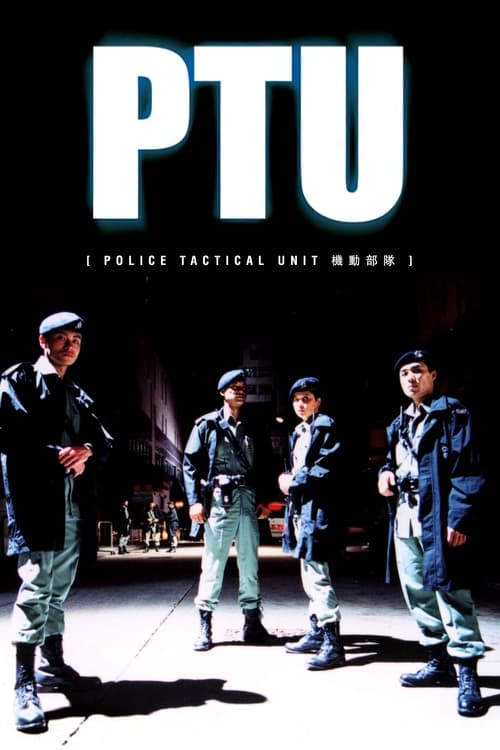
PTU
2003 · Johnnie To
A perfect late-night watch — when you want something moody, stylish, and tight rather than loud, and you're happy to let atmosphere do the talking. Comfort food for crime-movie lovers with a taste for the offbeat.
What it's about
One night in Hong Kong's Tsim Sha Tsui district, a clumsy plainclothes detective loses his service revolver in a scuffle. A uniformed Police Tactical Unit squad quietly closes ranks to recover it before dawn — off the books — while triad rivalries simmer around them and coincidence keeps tightening the net. Everything has to resolve before sunrise.
The experience
Cool, coiled, and strange: long hushed stretches of men walking empty neon streets, flashes of deadpan humor, and a dread that builds toward a single explosive release. At a lean eighty-odd minutes, it never wastes a frame.
Performances
Simon Yam gives the PTU sergeant a calm, ambiguous authority that keeps you guessing where his loyalty ends, while Lam Suet is perfect as the sweaty, hapless detective whose mistake sets the night in motion.
The craft
Johnnie To stages the film like choreography: figures arranged in pools of streetlight, slow synchronized walks, whole scenes built on geometry and silence instead of action. The emptied-out nighttime city is practically a character, and the compositions reward a big, dark screen.
Why it matters
Widely considered one of To's signature films and a high point of post-handover Hong Kong cinema, it helped cement his international reputation as the great stylist of the modern crime picture.
Snapshot
PTU is Johnnie To's nocturnal procedural about a single night in Tsim Sha Tsui, in which a clumsy plainclothes detective loses his service revolver and a uniformed Police Tactical Unit closes ranks to recover it before dawn. Produced through Milkyway Image, the company To co-founded with Wai Ka-fai in 1996, the film distills the studio's house obsessions — fate, coincidence, masculine loyalty, the city after midnight — into a lean, near-abstract exercise in style. Running a tight eighty-odd minutes, it trades the kinetic gunplay of the heroic-bloodshed era for stillness, geometry, and dread. It is widely regarded as one of To's signature works and a high-water mark of the post-handover Hong Kong crime film: a movie in which almost nothing happens for long stretches, and that nothingness is the point.
Industry & production
PTU emerged from Milkyway Image at a moment when the company had established itself as the most distinctive auteur-driven outfit in a contracting Hong Kong industry. To and Wai Ka-fai ran a two-track operation — commercial comedies and romances that paid the bills, and darker, more personal crime pictures that defined the brand — and PTU belongs emphatically to the second track. It was a low-budget production, and its most-cited production fact is its protracted, fragmentary shooting schedule: by well-attested accounts the film was shot intermittently over roughly two to three years, almost entirely at night, fitted around To's many other commitments. That stop-start method, born of economics, became an aesthetic asset — it allowed To to control the empty streets and to compose with patience rather than coverage.
The film appeared in 2003, the same year SARS devastated Hong Kong public life and the local box office, and amid a years-long industry contraction following the 1997 handover and the late-1990s regional financial crisis. Against that backdrop, Milkyway's model — small crews, repertory casts, controlled locations — looks like a survival strategy as much as an artistic one. The recurring ensemble (Simon Yam, Lam Suet, Maggie Siu, Ruby Wong) and crew were collaborators To used repeatedly across this period, which kept costs down and shorthand high.
Technology
PTU is not a film of technological novelty, and it would be false to claim otherwise. It was shot on 35mm with conventional equipment; its innovations are entirely in craft and restraint rather than apparatus. The relevant "technology" is really a lighting and exposure philosophy: working at night with sodium-vapor street lamps, practical signage, and carefully augmented sources, To and cinematographer Cheng Siu-Keung exploited film stock's response to mixed urban light to build a palette of cold blues, sodium amber, and pooled darkness. The decision to empty the streets — to stage a major commercial district as a depopulated stage set — is a production-design and logistics achievement more than a technical one. Any account that frames PTU as technically groundbreaking would be inventing a story the film does not tell; its modernity is one of sensibility.
Technique
Cinematography
Cheng Siu-Keung's photography is the film's signature. Working in long, composed takes, he frames the city as a geometry of empty intersections, glistening pavement, and receding perspectives, lit so that figures emerge from and dissolve into shadow. The camera favors stillness and slow, deliberate movement over handheld immediacy; characters are often held in wide or medium-wide shots that emphasize the space around them, the void of the nocturnal city pressing in. The color design — teal-and-amber long before that pairing became a digital-grading cliché — is achieved through location light and stock response, lending the images a hard, lacquered surface. The celebrated PTU patrol sequences, in which the uniformed unit advances down a street in formation, are shot with an almost ceremonial regard for blocking and depth, turning routine policing into choreography.
Editing
The cutting (editorial work credited within the Milkyway stable, with Law Wing-Cheong among To's regular collaborators of the period) is patient and architectural. PTU withholds; it lets scenes run past the point a conventional thriller would cut, building tension through duration rather than fragmentation. The film cross-cuts several plot lines — the lost gun, a gangland murder, an Anti-Triad investigation, a mainland firearms deal — but does so without panic, allowing each thread to simmer separately until the convergence. The climactic shootout, by contrast, is compressed and sudden, its violence arriving fast precisely because the preceding film has been so slow and quiet.
Mise-en-scène / staging
Staging is where PTU is most radical. To treats the street as a proscenium: the emptied districts of Tsim Sha Tsui become a near-theatrical space in which figures are positioned with geometric precision. Standoffs are blocked as tableaux — bodies held in tense stasis, sightlines and gun-lines drawn across the frame — recalling the formal confrontations of To's earlier The Mission (1999). The depopulated city is plainly unrealistic, and deliberately so; it abstracts Hong Kong into a stage for fate to operate. Props and gestures carry weight: a dropped gun, a frisked suspect, a slip on the wet ground. The famous inciting accident — the detective losing his weapon during a scuffle and fall — is staged almost as slapstick, then curdles into the night's organizing catastrophe.
Sound
The soundscape is austere and crucial. For long passages PTU runs on ambient city sound — footsteps, distant traffic, the hum of the empty street — with dialogue kept sparse and functional. Chung Chi-Wing's score is minimal and atmospheric, deploying restrained synth and percussive motifs that pulse beneath the silence rather than swelling over it. The result is a sustained low-level dread; when sound does spike, in the final exchange of gunfire, the contrast is shattering. Silence here is not absence but tension held under pressure.
Performance
Performances are pitched to the film's cool register. Simon Yam, as the PTU sergeant who takes charge of recovering the lost gun, plays authority as quiet, hard-edged control — a professional whose loyalty to a fellow officer licenses casual brutality toward suspects, his calm itself a kind of menace. Lam Suet, as the hapless Anti-Triad detective who loses the weapon, supplies the film's pathos and comedy: a sweating, overmatched everyman whose small failure metastasizes. Maggie Siu plays the investigating inspector with brisk, unsentimental authority, the one figure pursuing the night's events by the book. The ensemble works in shorthand, underplaying throughout; the restraint is consistent with To's anti-melodramatic method.
Narrative & dramatic mode
The dramatic mode is compression and convergence. PTU obeys a near-unity of time and place — one night, a few interlocking districts — and builds from a small, almost absurd catalyst toward a fated collision. Its narrative engine is the Milkyway theme par excellence: chance. Separate, self-interested actors — cops covering for one of their own, triads warring over a murdered boss's son, an inspector following procedure, gun smugglers from across the border — pursue unrelated aims until coincidence funnels them to the same intersection at the same moment. The lost gun is a MacGuffin whose recovery, when it comes, is almost arbitrary, an outcome of luck rather than competence or justice. The film is less interested in plot mechanics than in mood and in the moral texture of policing — the tribal solidarity that leads good officers to bend or break the rules for each other.
Genre & cycle
PTU sits at the intersection of the police procedural, film noir, and the existential crime film. It belongs to the early-2000s Hong Kong crime cycle but defines itself against that cycle's dominant blockbuster, Infernal Affairs (2002): where Infernal Affairs is glossy, twist-driven, and star-laden, PTU is minimalist, mood-driven, and art-house in temper. It is closest kin to To's own The Mission, sharing its still standoffs, its repertory cast, and its conception of professional men bound by code. Within Milkyway's filmography it stands with the studio's most rigorous "cop and criminal as mirror" pictures, stripping the genre down to atmosphere, procedure, and fate.
Authorship & method
PTU is a near-definitive statement of To's mature method. To directs with a sculptor's patience, privileging composition and duration over momentum, and treating the crime film as a vehicle for formal experiment. The collaboration is essential to the result: cinematographer Cheng Siu-Keung is the co-author of the film's nocturnal look, his long-take, low-key photography inseparable from To's vision; composer Chung Chi-Wing supplies the spare, anxious score; Law Wing-Cheong worked within the editorial and directorial team To cultivated at Milkyway and would later steer the franchise's spin-offs. The screenplay is credited to Milkyway's core writers, with Yau Nai-Hoi — To's most important screenwriting collaborator of the era — central to the studio's writing process; the script's deliberate thinness, its preference for situation over exposition, is a feature, not a flaw. To's well-documented willingness to shoot over years, at night, in fragments, reflects a method that prizes control of image and atmosphere above scheduling efficiency.
Movement / national cinema
The film is a key text of post-handover Hong Kong cinema and of the Milkyway Image "movement" — less a formal school than a recognizable house style of fatalistic, stylized crime films made under To and Wai Ka-fai's stewardship. It is profoundly a Hong Kong film: rooted in the geography of Tsim Sha Tsui and Kowloon, in the institutional culture of the Hong Kong Police, and in an anxiety about order and authority that critics have often read against the post-1997 condition. The emptied, depopulated streets lend themselves to allegory — a city evacuated of its inhabitants, its order maintained by men working in the dark — though the film never presses such readings explicitly.
Era / period
PTU is a product of Hong Kong cinema's lean years. The local industry had contracted sharply through the late 1990s and early 2000s; production volumes fell, stars decamped or diversified, and the 2003 SARS epidemic compounded the slump. Within that environment, PTU exemplifies how Milkyway sustained ambitious authorship on modest means — small budgets, controlled locations, repertory talent, extended schedules. Its very austerity is legible as a response to its period: a cinema doing more with less, finding in restriction a distinctive minimalist aesthetic that would not have arisen from the flush, maximalist industry of the early 1990s.
Themes
At its core the film concerns solidarity and the moral cost of loyalty: the unwritten code by which police protect their own, and the violence and corner-cutting that code licenses. It is preoccupied with professionalism and procedure — the rituals of the patrol, the frisk, the search — and with how thin the line is between order and its breakdown. Chance and fate govern the narrative: the night's catastrophe springs from an accident, and its resolution from coincidence, expressing a worldview in which competence matters less than luck. Running beneath these is an interest in the city after dark as a moral space, an emptied stage where institutions and criminals contend in the absence of the public they nominally exist to serve. Honor, face, and the precariousness of authority — recurrent To concerns — thread throughout.
Reception, canon & influence
Reception. PTU was strongly received by critics and has grown in stature since release, frequently cited among To's finest films and as a touchstone of Milkyway minimalism. It circulated on the international festival and art-house circuit, where its formal control won To recognition as a major auteur beyond the Hong Kong market. It earned Hong Kong Film Award recognition in its year, though I'd flag that the precise tally of its competitive trophies is something the record states inconsistently, and I won't assert specific wins I can't verify; its lasting reputation rests more on critical esteem than on awards-night totals.
Influences on the film (backward). PTU draws on the cool, minimalist policier of Jean-Pierre Melville — the professional ethos, the pared-down style, the gunmen and lawmen as mirror images — an influence To has acknowledged across his work. Its central premise, a policeman who loses his gun and must recover it through a long night, unmistakably echoes *Akira Kurosawa's Stray Dog (1949), the canonical lost-weapon procedural. Within To's own filmography, The Mission (1999) is the immediate stylistic forebear, supplying the still standoffs and geometric staging that PTU* refines.
Legacy (forward). PTU helped consolidate the Milkyway nocturnal-city aesthetic that runs through To's subsequent crime films and influenced a broader turn toward minimalism and mood in Hong Kong genre cinema. It proved durable enough to seed a franchise: Milkyway developed a series of PTU / Tactical Unit spin-off films later in the decade, produced under To and directed largely by collaborators such as Law Wing-Cheong, extending the original's milieu across multiple entries. More diffusely, the film's emptied streets, controlled color, and patience-as-tension have been widely admired and emulated, and it remains a frequent reference point for critics tracing the art of restraint in contemporary crime cinema. Its standing today is that of a quiet classic — a film whose influence is measured less in box-office than in the directors and critics who treat it as a model of how much a thriller can withhold.
A Deleuzian reading
A uniformed unit moves down the center of an empty street, flashlights swinging in slow arcs, boots finding a rhythm nobody rehearsed.
The full Deleuzian reading of PTU →
Reception
A modest performer at home in 2003, PTU quietly became the film that sealed Johnnie To's international auteur reputation — it won him Best Director at the Hong Kong Film Awards and now sits near the top of most 'best HK films of the 2000s' lists.
How PTU was received, from release to now →
Influences: the films it descends from and the films it influenced
- Stray Dog (1949) — Supplies the lost-weapon procedural template PTU transposes wholesale — a cop must recover his service pistol across one oppressive stretch of city time, the missing gun as MacGuffin that motivates a structured night-walk through the underworld.
- Le Samouraï (1967) — Models the pared-down policier of ritual and silence — the lawman as professional craftsman defined by gesture and code rather than dialogue, exposition withheld so behavior and procedure carry the film.
- Le Cercle Rouge (1970) — Establishes the cop-and-criminal-as-mirror-images structure and the extended near-wordless set-piece sustained purely on patience and procedure, the rhythm of waiting that PTU's standoffs inherit.
- Bob le Flambeur (1956) — Originates the location-shot nocturnal-city policier — code-bound underworld figures drifting through emptied pre-dawn streets, the depopulated metropolis itself becoming the film's moral atmosphere.
- The Mission (1999) — The immediate stylistic forebear: To's frozen-tableau standoffs and geometric blocking of gunmen held motionless in static deep-focus frames, suspense generated by stillness, which PTU refines and intensifies.
- A Hero Never Dies (1998) — Codifies the Milkyway fatalism of chance-and-fate and the loyalty-and-code ethos, treating gunmen and lawmen as ritual figures governed by luck and honor rather than psychology.
- The Killer (1989) — The heroic-bloodshed code of brotherhood and the cop/killer doubling that To inherits but de-romanticizes — Woo's operatic gun-ballet stripped of slow-motion lyricism down to PTU's cold, withheld stillness.
- Exiled (2006) — Pushes the PTU/Mission geometric standoff into balletic Mexican-standoff tableaux — gunmen frozen in symmetrical static compositions, violence suspended in stillness before erupting.
- Tactical Unit (2008) — The direct franchise spin-off produced by To and steered by his Milkyway editor-collaborator, extending PTU's exact milieu — the unity-of-time night patrol and emptied-street procedural — across multiple entries.
- Drug War (2012) — Carries the procedural restraint and situation-driven storytelling onto the mainland, suspense built from professional method and ambient tension rather than backstory, the cop-criminal pairing observed with the same cool detachment.
- Drive (2011) — Inherits the Melville-via-Milkyway minimalism — a near-silent professional defined by code, violence long withheld then sudden, set against a controlled neon nocturnal palette and emptied-city patience descended from To's restraint.
- The Yellow Sea (2010) — To's technique of withholding spatial establishing shots in nocturnal pursuit sequences, keeping the viewer disoriented within location rather than oriented above it — a formal device Na applies directly to Yanbian and Busan city space.
- The Gangster, the Cop, the Devil (2019) — Night-city crime film lit entirely in amber sodium-vapor with criminal hierarchy staged as parallel bureaucracy to law enforcement; Akinjeon's tripartite spatial logic and warm nocturnal palette derive directly from this template.
- Infernal Affairs (2002) — Shares the post-handover Hong Kong police procedural register and the teal low-key digital nocturne, cop and mole as moral mirror — the same cool, controlled palette and restraint emerging in the same HK genre moment.
- Heat (1995) — Parallel construction of the nocturnal metropolis as depopulated geometric space, with professional cop and criminal mirrored across it and ambient sound used as score — the same patience-as-tension applied to procedure.
- Collateral (2004) — Contemporary night-city procedural built on unity of time and place across a single nocturnal shift, ambient-minimalist sound and emptied streets carrying mood in place of incident.
- Breaking News (2004) — Same Milkyway moment and crew, foregrounding the virtuoso unbroken long take and Cheng Siu-Keung's low-key nocturnal photography as the procedural's primary expressive device.
- Election (2005) — Extends the Milkyway minimalism of situation-over-exposition and deliberate narrative thinness, the triad ritual staged in tableau with the same withholding of plot machinery.
- Infernal Affairs II (2003) — To's method of building Hong Kong's nighttime ambient urban texture — wet pavement, institutional machinery, layered acoustic presences — into a structurally active element of the crime narrative is the contemporaneous formal practice IA2 shares for embedding personal drama in the sensory grain of the post-handover city.
- Mad Detective (2007) — To and Cheng Siu-keung develop the specific deep-focus nighttime composition and precision actor-blocking grammar that carries directly into Mad Detective's procedural sequences; the film is the clearest Milkyway craft-continuity case, sharing director, DoP, and production infrastructure.
Similar films
- The Mission (1999) — influence & lineage
- Exiled (2006) — influence & lineage
- Stray Dog (1949) — influence & lineage
- Infernal Affairs (2002) — influence & lineage
- The Killer (1989) — influence & lineage
- Police Story (1985) — shared sensibility
- A Better Tomorrow (1986) — shared sensibility
- Hard Boiled (1992) — shared sensibility