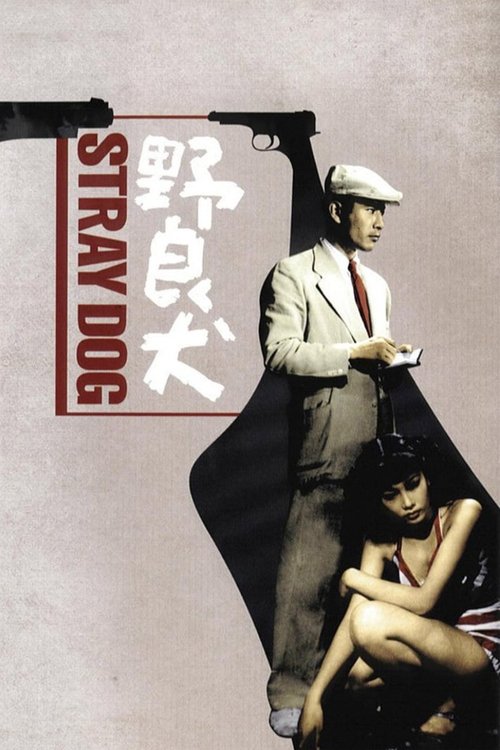
Stray Dog
1949 · Akira Kurosawa
When you want a classic crime picture with real weight — a noir night in that also happens to be a time machine into postwar Tokyo. Absorbing rather than punishing; it earns its darkness with pure storytelling drive.
What it's about
Tokyo, 1949, in the middle of a brutal heatwave. Rookie detective Murakami has his pistol lifted by a pickpocket on a packed bus, and the theft becomes his obsession: he goes undercover into the black markets and back alleys to recover it, while the gun turns up in crimes that escalate as the days burn on. A veteran detective, Satō, takes the young cop under his wing, and the hunt slowly becomes a mirror — the thief is a desperate ex-soldier from the same ruined generation as the man chasing him.
The experience
Sweat-soaked and relentless — you can feel the heat coming off the screen, and the guilt tightening around Murakami with every crime his stolen gun commits. It's a manhunt that keeps turning into a moral question, and it grips like a modern thriller despite being over seventy-five years old.
Performances
Toshirō Mifune, young and coiled, plays Murakami's shame and obsession with a physical intensity that's riveting; Takashi Shimura's seasoned, humane Satō is the perfect counterweight, and their scenes together set the template for decades of mentor-and-rookie cop pairings.
The craft
Kurosawa fuses Hollywood thriller mechanics with near-documentary footage of Tokyo's black markets and crowded streets, so the city itself — ruined, sweltering, alive — becomes a character. The heatwave is a masterclass in atmosphere: fans, sweat, glare, and packed bodies doing the work a score usually does.
Why it matters
A founding document of the police procedural and the buddy-cop dynamic, made just before Rashomon carried Kurosawa to world fame; it fixed the image of the detective whose hunt for a criminal becomes an examination of himself.
Snapshot
Stray Dog (Nora inu) is Akira Kurosawa's postwar police thriller, a sweat-soaked procedural set during a Tokyo heatwave in which a rookie homicide detective, Murakami (Toshirō Mifune), has his Colt pistol lifted by a pickpocket on a crowded bus and spends the film hunting it down as the weapon is used in escalating crimes. Made in 1949, between Drunken Angel (1948) and the international breakthrough of Rashomon (1950), it belongs to Kurosawa's crucial formative period, when he was fusing Hollywood genre craft with a documentary attention to the ruined, black-market city around him. The film pairs Mifune with Takashi Shimura as the veteran detective Satō, establishing a mentor-and-protégé dynamic that would echo through decades of cop cinema. It is at once a taut manhunt, a portrait of the après-guerre ("apure-gēru") generation adrift in occupied Japan, and a moral mirror-study in which detective and criminal are revealed as two versions of the same displaced young veteran.
Industry & production
Stray Dog was produced under the aegis of the Film Art Association (Eiga Geijutsu Kyōkai), the independent unit formed by Kurosawa and collaborators in the turbulent aftermath of the Tōhō labor strikes of 1946–1948, and released through Shintōhō. The Tōhō strikes had fractured the studio and pushed several of its filmmakers toward independent and satellite production arrangements; Stray Dog is a product of that unsettled industrial moment. It was made under the Allied Occupation, whose censorship apparatus (SCAP's CIE and CCD) still shaped what Japanese films could depict — a context that helps explain the film's oblique but persistent attention to postwar deprivation, demobilized soldiers, and the gray economy of the black markets rather than to the war itself or the occupiers directly.
Kurosawa has described writing the story first as a novel, in the manner of Georges Simenon, before adapting it into a screenplay — an unusual working method he recounts in his memoir Something Like an Autobiography. The shooting script was co-written with Ryūzō Kikushima, the beginning of a long and important writing partnership that would extend through Yojimbo, High and Low, and other later films. The production leaned heavily on location work in the real streets, alleys, and market districts of a Tokyo still visibly scarred by the war, which required both logistical improvisation and a tolerance for the punishing summer conditions the film so vividly dramatizes.
Technology
The film was shot in black-and-white on the film stock and equipment available to a resource-constrained Japanese industry during the Occupation, when materials were scarce and production values were hard-won. Its most consequential "technology" is arguably methodological rather than mechanical: the semi-documentary approach of taking cameras into actual locations — crowded thoroughfares, cramped tenements, baseball stadiums, black-market stalls — rather than confining the action to studio sets. This aligns Stray Dog with the international vogue for location-shot, quasi-documentary crime pictures of the late 1940s, of which Jules Dassin's The Naked City (1948) is the touchstone. The extended montage of Murakami wandering the ruined city (see Cinematography and Editing) depended on unobtrusive, near-candid street photography, and much of that footage was captured by Kurosawa's assistant director Ishirō Honda — later famous as the director of Godzilla — working essentially as a documentarian in the postwar streets.
Technique
Cinematography
The photography is credited to Asakazu Nakai, one of Kurosawa's most important recurring cinematographers. Nakai's work here is organized around a single governing sensation: heat. The film is saturated with images of physical discomfort — glistening skin, fluttering fans, panting dogs, wilting bodies — so that the meteorological oppression becomes a continuous visual pressure on the drama. The celebrated centerpiece is a long, near-wordless montage, running several minutes, in which Murakami disguises himself as a demobbed, down-and-out veteran and drifts through the black markets searching for the gun-runner who rents out pistols. Built from layered dissolves and superimpositions of the teeming, ravaged city, it is one of the most admired passages of pure visual storytelling in Kurosawa's early cinema — an ethnographic descent into the postwar underworld that also externalizes the detective's growing identification with the criminal milieu. The climactic capture, by contrast, moves into a lyrical register: a struggle in a field, mud and flowers, the long-awaited breaking of the heat.
Editing
Kurosawa was a famously hands-on editor who typically cut his own films, and Stray Dog is a showcase of his montage instincts. The wandering-the-city sequence is the obvious set piece — an extended cadenza of superimposition and rhythmic cutting that suspends the plot to immerse the viewer in atmosphere and psychology. Elsewhere the editing drives a procedural tempo: the methodical accumulation of leads, interrogations, and dead ends, punctuated by bursts of pursuit. Kurosawa modulates between patient, almost documentary observation and sudden kinetic acceleration, a control of pacing that anticipates the propulsive structure of his later thrillers. (Precise editing-department credits for the film are less consistently documented in English-language sources; what is secure is Kurosawa's habitual authorship over the cut.)
Mise-en-scène / staging
Kurosawa stages Stray Dog as a study in environment and endurance. Interiors are crammed and airless; the mise-en-scène foregrounds the paraphernalia of a sweltering summer and a poor, crowded city. He repeatedly uses deep, layered compositions in which foreground action plays against a busy, populated background, so that the individual investigation is always embedded in a mass of ordinary postwar life. The doubling motif — cop and criminal as mirror images — is staged spatially as well as thematically, culminating in the final confrontation where the two young men, indistinguishable in the mud, wrestle to exhaustion. The intrusion of children, music, and everyday continuity around the violent climax is characteristic of Kurosawa's refusal to isolate crime from the social world that produces it.
Sound
The score is by Fumio Hayasaka, Kurosawa's most significant musical collaborator of the period (their partnership includes Drunken Angel, Rashomon, Ikiru, and Seven Samurai). Stray Dog makes pointed use of diegetic and contrapuntal sound: popular tunes, a piano heard drifting during the tense finale, radio and street noise, the ambient din of markets and ballparks. Hayasaka's music and Kurosawa's sound design work to bind the manhunt to its social soundscape and to sharpen ironic juxtapositions — beauty or banality playing against dread. The oppressive summer is rendered aurally as well as visually, through the drone of cicadas and the enervated hush of the heat.
Performance
Toshirō Mifune, in one of his early roles for Kurosawa, plays Murakami with a raw, anguished intensity — guilt-stricken, obsessive, physically wound-up — that differs markedly from the swaggering personae he would later make iconic. Takashi Shimura's Satō is his counterweight: seasoned, humane, unhurried, the moral and professional ballast against Murakami's feverish self-recrimination. The Mifune–Shimura pairing, already explored in Drunken Angel, is here reconfigured into the older-mentor / younger-hothead template. Supporting performances flesh out the postwar demimonde — the showgirl, the pistol-broker, the criminal Yusa himself — with a naturalism that suits the film's documentary texture.
Narrative & dramatic mode
The film operates as a police procedural built on a single, almost fable-like premise: a detective loses his gun, and each bullet fired from it deepens his sense of complicity. The dramatic mode is investigative and cumulative — a chain of interrogations, tailings, and inferences — but Kurosawa continually converts procedure into moral inquiry. The stolen weapon functions as a device linking Murakami to the crimes committed with it, so that the manhunt doubles as a reckoning with his own capacity for desperation and violence. The revelation that both Murakami and the killer Yusa are returned soldiers who had their belongings stolen on the way home — one turning toward the law, the other toward crime — gives the narrative its tragic symmetry: circumstance, not character, seems to divide the redeemed from the damned.
Genre & cycle
Stray Dog is a landmark early example of the police procedural and a clear participant in the late-1940s international crime cycle shaped by American film noir and the semi-documentary crime picture. Its DNA connects it to Hollywood noir's fatalism and to the location-shot realism epitomized by The Naked City; Kurosawa openly admired Western crime fiction and cited Simenon as a model. At the same time it helped seed enduring genre templates — the buddy-cop dynamic and the mentor/rookie pairing, the doppelgänger relationship between hunter and hunted — that would recur across decades of crime cinema and television. It sits at a hinge point, importing genre conventions while nativizing them within the specific conditions of occupied Japan.
Authorship & method
The film is a foundational document of the "Kurosawa-gumi," the recurring ensemble of collaborators who defined his cinema. Beyond Kurosawa's own direction and editorial control, it features screenwriter Ryūzō Kikushima (here beginning a partnership that would run through Yojimbo and High and Low), cinematographer Asakazu Nakai, composer Fumio Hayasaka, and stars Toshirō Mifune and Takashi Shimura — several of whom would form the nucleus of Kurosawa's greatest work. Notably, assistant director Ishirō Honda shot much of the documentary street footage for the great market-wandering montage. Kurosawa's own method here is revealing: he wrote the story as a Simenon-style novel first, and he later expressed dissatisfaction with the finished film, feeling it was too visibly technical and over-engineered — a self-critique that underscores how deliberately constructed the picture is.
Movement / national cinema
Stray Dog is a central artifact of postwar Japanese cinema under the Occupation, a period when the industry was rebuilding amid censorship, labor upheaval, and material scarcity, and when filmmakers were absorbing and reworking Hollywood and European models. Kurosawa emerges in these years as the most internationally legible of Japan's directors, and Stray Dog exemplifies the humanist, socially observant strain of his early work — attentive to the poor, the dispossessed, and the moral texture of everyday life. Alongside contemporaries like Ozu and Mizoguchi working in very different registers, Kurosawa here stakes out a cinema that is at once genre-literate and rooted in the concrete realities of a defeated, occupied nation.
Era / period
The film is inseparable from its precise moment: Tokyo in the summer of the late 1940s, a city of rubble, black markets, demobilized soldiers, dance halls, and baseball crowds, still under Allied Occupation. Its "stray dogs" are the après-guerre generation — young men whose formative years were consumed by war and whose return to civilian life offers few footholds. Kurosawa treats the period not as backdrop but as cause: the heat, the poverty, the moral vertigo of a society remaking itself all bear directly on why Yusa becomes a killer and why Murakami is so haunted. Few films capture the physical and social atmosphere of Occupation-era Tokyo as vividly.
Themes
The film's governing metaphor is the stray dog itself: the abandoned, desperate creature that will bite when cornered, and the thin line separating the "mad dog" criminal from the disciplined servant of order. Central themes include the doubling of cop and criminal (both war-scarred veterans divided by a single choice); guilt, complicity, and responsibility, dramatized through the stolen gun; the corrosive weight of postwar dislocation and poverty; and the tension between a deterministic view of crime as the product of circumstance and Satō's more settled moral clarity that individuals must answer for their acts. Heat operates as a pervasive symbol of moral and social pressure, released only in the final storm. Threaded through it all is a humane, ambivalent compassion — Kurosawa withholds easy condemnation even as he affirms the necessity of justice.
Reception, canon & influence
Made just before Rashomon carried Kurosawa to worldwide attention, Stray Dog has come to be regarded as one of the essential films of his early maturity and a key early police procedural. Retrospective criticism has consistently praised its atmospheric evocation of postwar Tokyo, its bravura wandering montage, and its psychologically charged doubling of detective and criminal; its enduring status is reflected in its inclusion in prestige repertory and home-video canons (it is a longstanding title in the Criterion Collection). Kurosawa's own retrospective verdict was cooler — he judged the film overly technical — a dissent that has become part of its critical lore rather than a mark against its reputation.
Looking backward, the film's influences are well attested: Georges Simenon's crime fiction (which Kurosawa named as a model), the fatalism of American film noir, and the location-based semi-documentary crime cycle exemplified by The Naked City. Looking forward, its legacy is substantial. Stray Dog is frequently cited as a formative text for the police procedural and the buddy-cop film, its mentor/rookie and hunter/hunted-as-mirror-images templates recurring across later crime cinema and television. Within Kurosawa's own career it consolidated the ensemble and thematic concerns — the moral seriousness, the social realism, the fascination with guilt and duality — that he would carry into Rashomon, Ikiru, Seven Samurai, and the later masterpiece of crime and conscience, High and Low. As both a superb thriller and a document of its shattered time, it remains one of the most influential of postwar Japanese crime films.
A Deleuzian reading
Everyone in this film is wet.
The full Deleuzian reading of Stray Dog →
Reception
A hit at home in 1949 but soon overshadowed abroad when Rashomon made Kurosawa a world name — for decades it was filed under 'early, minor Kurosawa.' Now it's been reclaimed as one of the great postwar noirs and the ancestor of the modern police procedural.
How Stray Dog was received, from release to now →
How to watch Stray Dog: what to notice on a first viewing
- Watch for sweat, fans, and panting dogs in every scene. Asakazu Nakai photographs Tokyo in the summer of 1949 as one continuous physical condition. Shirts go dark down the spine and stay dark. Fans turn and move nothing. Nobody in this film is ever dry. The heat is the pressure the whole story runs on, and it is applied to you in the first five minutes.
- Look at the people behind Murakami's head in every shot. Kurosawa stacks his compositions deep, so foreground action always plays against a crowded, populated background. The crew shot in real thoroughfares, tenements, stadiums, and black-market stalls rather than on sets. The investigation is never lifted out of the city producing it. A hundred other people are broke and waiting in every frame.
- Count the minutes Murakami walks the markets without speaking. He puts on the rags of a demobbed soldier and drifts. Several minutes of layered dissolves and superimpositions, legs, stalls, sun, faces that never look at the camera. Nothing gets solved. The thriller stops working for a while and you are left only looking. The man who comes out of it is not the one who went in.
- Notice that the gun's crimes happen off screen. The Colt does its damage somewhere else. It returns to Murakami as a report, a number, a fact on a desk. You almost never see the weapon in the hand that is using it. A gun you can see is a prop. One firing in a part of the city you cannot picture becomes a debt he keeps paying.
- Listen for music drifting in from somewhere else. Fumio Hayasaka and Kurosawa build the track out of the world: radio, market din, popular tunes, a ballpark crowd, cicadas under everything. The score seldom tells you what to feel about a scene. Ordinary pleasant noise keeps playing against dread, which is how the film keeps the crime inside daily life.
The whole guide to watching Stray Dog, with the keys for a rewatch →
Influences: the films it descends from and the films it influenced
- M (1931) — Structures a citywide manhunt as parallel montage cross-cutting hunters and hunted, and frames the criminal as the pursuers' uncanny double — the mirror-image template Kurosawa reworks in the detective/pickpocket pairing.
- The Naked City (1948) — Its semi-documentary method — a police investigation shot on real streets with newsreel-style observation of a living city — is the explicit model Kurosawa cited for the market-wandering footage Honda gathered.
- Bicycle Thieves (1948) — Supplies the neorealist device of a protagonist trudging across an impoverished postwar city in search of a single stolen object, filmed on location amid unstaged crowds — the spine of Stray Dog's lost-pistol quest.
- La Nuit du carrefour (1932) — Establishes the atmospheric, novelistic Maigret procedural whose method Kurosawa adopted directly by first drafting Stray Dog as a Simenon-style crime novel before scripting it.
- Rome, Open City (1945) — Pioneers the semi-documentary shooting of a war-scarred capital, welding staged melodrama to authentic ruined locations — the postwar-rubble aesthetic Kurosawa transposes to Occupation Tokyo.
- Double Indemnity (1944) — Codifies the American noir fatalism and heat-soaked, sweat-and-shadow entrapment that Kurosawa borrows for Murakami's descent, right down to the oppressive summer air as a moral climate.
- Drunken Angel (1948) — The immediately prior film that forged the Mifune/Shimura pairing and the sweltering black-market sump milieu, carrying the same postwar-dislocation atmosphere into a crime register a year later.
- High and Low (1963) — Kurosawa's own return to the procedural, reprising the detective-and-criminal-as-mirror structure and the Kikushima screenwriting partnership, now built around a patient, method-driven investigation.
- The French Connection (1971) — Extends the location semi-documentary procedural into handheld, grab-shot street pursuit, treating the city itself as the interrogated suspect exactly as Stray Dog does.
- Heat (1995) — Builds its architecture on the cop and criminal as symmetrical doubles — twinned, interchangeable men on opposite sides — the doubling-motif Stray Dog seeded in crime cinema.
- Se7en (1995) — Drives its procedural through the weary veteran / green rookie mentorship, the buddy-detective pairing whose template Stray Dog is repeatedly credited with fixing.
- Zodiac (2007) — Inherits the obsessive-accumulation procedural — dossier detail piled on detail, the investigation dissolving into the investigator — that Stray Dog's methodical legwork montage anticipated.
- Memories of Murder (2003) — Fuses a mismatched detective pairing with a humid, sweat-drenched summer where oppressive heat becomes structural pressure, the exact heat-as-atmosphere device Kurosawa deploys throughout.
- Cure (1997) — Carries the Japanese procedural into psychological doubling, dissolving the boundary between detective and quarry until the investigator is contaminated by what he hunts.
- Do the Right Thing (1989) — Weaponizes heat-as-pressure as an overt structural engine — a single scorching day escalating a neighborhood to violence — the same rising-temperature dramaturgy that governs Stray Dog's climax.
- PTU (2003) — Supplies the lost-weapon procedural template PTU transposes wholesale — a cop must recover his service pistol across one oppressive stretch of city time, the missing gun as MacGuffin that motivates a structured night-walk through the underworld.
- Isle of Dogs (2018) — A postwar-Japan procedural literally about a dog and contagious moral rot supplies the sweaty urban-decay mise-en-scène and Japanese-city iconography of Megasaki and Trash Island.
- Pitfall (1962) — Its documentary-textured tracking through postwar ruin and heat-blasted slums, shot in high-contrast black-and-white, models the crime-genre-as-social-survey camerawork Pitfall applies to the miners' shanties.
- When a Woman Ascends the Stairs (1960) — Kikushima's screenwriting method in embryo — narrative driven by the traceable circulation of a single object through an institution, with long documentary passages of a city's low-end commerce — which he transposes from police procedure to bar-hostess bookkeeping, giving the 1960 film its unusual specificity about capital, guarantors and start-up money.
- Le Samouraï (1967) — Descends from the same Simenon lineage into a cool, minimalist fatalism, tracking cop and criminal through a rain-and-heat city with procedural precision and doubled surveillance.
Similar films
- Drunken Angel (1948) — influence & lineage
- High and Low (1963) — influence & lineage
- Cure (1997) — influence & lineage
- Heat (1995) — influence & lineage
- Rashomon (1950) — shared sensibility
- Yojimbo (1961) — shared sensibility
- Seven Samurai (1954) — shared sensibility
- Sword of the Stranger (2007) — shared sensibility