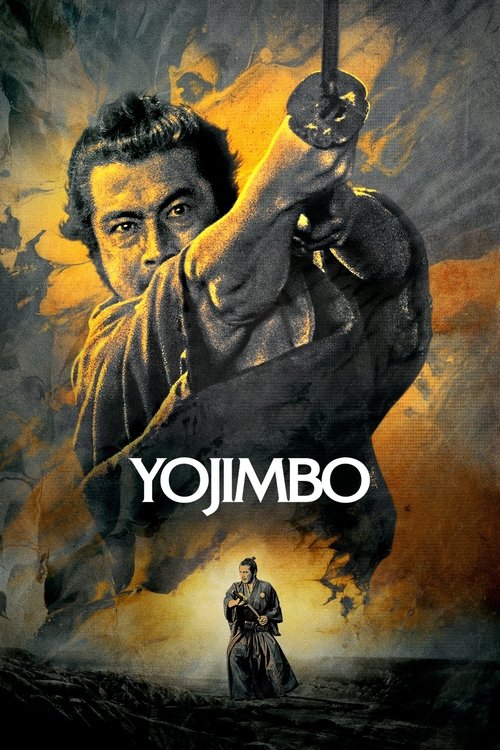
Yojimbo
1961 · Akira Kurosawa
When you want to watch the smartest guy in the room run circles around everyone — pure, wicked fun with a body count. Comfort viewing for anyone who likes their heroes sardonic and their villains deserving.
What it's about
A scruffy, nameless ronin wanders into a dusty village in feudal Japan and finds it torn apart by two rival bosses fighting over the gambling trade. Sizing up the situation with amused contempt, he hires himself out as a bodyguard to both sides — and starts quietly engineering a war that will let the town's rot burn itself out.
The experience
Playful, cruel, and endlessly entertaining — a dark comedy wearing a samurai film's clothes. It swaggers along at the hero's own insolent pace, punctuated by bursts of swordplay that are over almost before you register them.
Performances
Toshiro Mifune is magnetic: all rolling shoulders, chin-scratching, and lazy contempt, he turns a man watching a town destroy itself into one of cinema's great physical performances. Tatsuya Nakadai makes a memorably modern, pistol-toting menace opposite him.
The craft
Kurosawa composes the wide black-and-white frame like a chessboard, the village's single street becoming an arena you learn by heart, while Masaru Sato's jaunty, percussive score gives the mayhem a sly comic bounce. The violence lands in short, shocking flurries that made everything before it look stagey.
Why it matters
One of the most imitated films ever made — it was lifted wholesale for A Fistful of Dollars, effectively igniting the spaghetti western, and its wandering stranger-for-hire became a permanent archetype of popular cinema.
Snapshot
One of the most imitated films ever made, Yojimbo takes a structure borrowed from American hardboiled crime fiction and solders it to the Japanese chambara tradition, producing a template so durable that it has been remade, referenced, and re-engineered across six decades and at least three continents. Its protagonist — a nameless ronin who wanders into a corrupt village, plays its two criminal factions against each other, and departs when the blood has dried — is among the most consequential character archetypes in postwar popular cinema. The film operates simultaneously as genre entertainment, dark comedy, social allegory, and formal exercise in widescreen composition and explosive editing rhythm. That it spawned, without authorization, Sergio Leone's A Fistful of Dollars (1964) and thereby the spaghetti western cycle is the most spectacular single instance of cross-cultural influence in twentieth-century cinema.
Industry & production
By 1961 Akira Kurosawa occupied an unusual position within Toho: artistically sovereign, commercially vital, and expensive. The international success of Rashomon (1950) and the domestic triumph of Seven Samurai (1954) had given him latitude that few directors in the Japanese studio system enjoyed, but the commercial disappointment of The Bad Sleep Well (1960) — a corporate noir of considerable ambition — created pressure toward more overtly marketable subject matter. Yojimbo was that recalibration, though nothing about it was cynical.
The screenplay, co-written with Kurosawa's regular collaborator Ryuzo Kikushima, grafts the plot architecture of Dashiell Hammett's 1929 novel Red Harvest — an operative who arrives in a corrupt town and engineers the mutual destruction of its rival criminal gangs — onto the conventions of the Edo-period jidaigeki. Kurosawa acknowledged the Hammett debt in interviews; the transplantation was deliberate and structural rather than inadvertent. The script also absorbs the visual rhetoric of the American Western's solitary moral agent entering a lawless town, a tradition Kurosawa had engaged throughout his career through his well-documented admiration for John Ford and other Hollywood directors. The cross-pollination ran in multiple directions simultaneously, and was recognized as such by critics in Japan from the outset.
Produced by Tomoyuki Tanaka through Toho, the film was shot in 1960–61. Toho constructed the film's single primary location — a long, unpaved village street flanked by feudal-era merchant buildings — as an elaborate studio set, giving Kurosawa precise control over sight lines, atmospheric conditions, and spatial relationships. This artificial geography would prove central to the film's visual and dramatic logic.
Technology
Yojimbo was shot in TohoScope, Toho's proprietary anamorphic widescreen format yielding an aspect ratio of approximately 2.35:1. Kurosawa had already demonstrated facility with widescreen on The Hidden Fortress (1958), but Yojimbo represents a still more confident exploitation of the format. The horizontal expanse of the village street becomes the film's organizing spatial fact: distances are legible, power relations are encoded through position within the frame, and the isolated figure of the ronin standing at the center or edge of the composition acquires an almost geometric authority.
The production made extensive use of telephoto lenses, which compress spatial depth, flatten figures against backgrounds, and lend action sequences a dense, crowded energy quite different from the open clarity of standard focal lengths. This telephoto tendency — which Kurosawa would develop further through the 1960s and carry into his late color films — is already a pronounced stylistic signature in Yojimbo, and its influence on subsequent action cinema worldwide is difficult to overstate.
Technique
Cinematography
Kazuo Miyagawa, who had photographed Rashomon a decade earlier, returned to work with Kurosawa on Yojimbo. Miyagawa's lighting for Rashomon was lyrical and expressionistic; for Yojimbo he adopted a harder, more documentary-inflected approach suited to the film's sardonic register. The village is shot in unforgiving daylight for much of the film, dust perpetually suspended in the air, the surrounding landscape arid and indifferent. Interior spaces — the innkeeper's sake shop, the rival merchants' compounds — are rendered in chiaroscuro that owes something to the American noir tradition the film consciously engages. The combination produces images that are simultaneously earthbound and formally elegant, and that establish the decaying village as a moral environment before any dialogue confirms it.
Editing
Kurosawa's editing in Yojimbo is among the most rhythmically sophisticated of his career. The film alternates between extended observational passages — the ronin watching from a rooftop or a sake barrel, assessing, withholding action — and eruptions of sudden, precisely calibrated violence. The editing of the action sequences cuts not to match movement in a conventionally invisible way but to amplify kinetic impact: each cut arrives like a blow, and the cumulative rhythm creates sequences in which violence feels both instantaneous and predetermined. The contrast between watchful stillness and explosive cutting mirrors the protagonist's own behavioral alternation, and this formal principle — which Kurosawa may have arrived at partly through his acknowledged admiration for American genres and partly through his own extended practice — became enormously influential on action cinema in both East and West.
Mise-en-scène / staging
The spatial logic of Yojimbo is built around a single axis: the village street. Kurosawa stages confrontations along this axis repeatedly, so that its geography becomes encoded in the viewer's spatial memory and each new deployment of the space carries the weight of all previous deployments. The street functions as the American Western's main street does — as the arena of social contest — but in Yojimbo the arena is also a tactical instrument that the protagonist uses with deliberate intelligence rather than simply inhabiting.
Staging frequently places Mifune's ronin at elevated vantage points — the watchtower is a recurring motif — or separated from other characters by meaningful distances that encode social and moral separation. The film's blocking is at once theatrical (characters hold positions, address the frame directly) and deeply cinematic in its exploitation of telephoto compression. The production design and set dressing create a world of visible rot: broken fences, crumbling walls, abandoned houses. The village is not simply poor but actively dissolving, its social order having collapsed under factional violence before the film's action begins. This environmental storytelling requires no exposition.
Sound
Masaru Sato's score is one of the most distinctive in Japanese cinema of the period. Rather than drawing on traditional Japanese musical idioms or the sweeping orchestral register of mainstream jidaigeki scoring, Sato composed music that incorporates brassy, jazz-inflected passages alongside more percussive and sardonic motifs. The effect is deliberately anachronistic — the score signals ironic distance from the conventions of the samurai film, matching the screenplay's dark comedy. The recurring theme associated with Mifune's ronin has a loping, slightly absurd quality that underscores his mercenary self-interest without undercutting his lethality. Sato's tonal incongruity is a formal expression of the film's genre-hybridizing project; it also anticipates, and may have partially inspired, Ennio Morricone's similarly ironic approach to scoring A Fistful of Dollars three years later.
Performance
Toshiro Mifune's performance is among the landmarks of screen acting in world cinema. The ronin — who improvises the name Sanjuro Kuwabatake, roughly "thirty-year-old mulberry field," from the landscape he is looking at when asked — is established through physical behavior as much as through dialogue: a rolling shoulder, a reflexive scratch at his stubble, a quality of contained and watchful alertness that can convert without warning into devastating speed. Mifune had played heroic samurai for Kurosawa before; here the character is explicitly mercenary, amoral by conventional standards, motivated by self-interest and obscure private judgment. Mifune plays this ambiguity with complete commitment, making the character simultaneously comic and genuinely frightening.
Tatsuya Nakadai, in an early major role, plays Unosuke, the silk merchant's son who carries a pistol — the film's crucial modern intrusion into the period setting. Nakadai's reptilian stillness provides a counterweight to Mifune's kinetic physicality, and the pistol raises stakes that swordsmanship alone cannot resolve. The weapon functions as both narrative device and thematic emblem: it is what allows Unosuke to capture and torture Sanjuro, and it literalizes the film's interest in the collision between a traditional social order and an oncoming modernity that does not respect its codes.
Narrative & dramatic mode
The plot of Yojimbo is a manipulation engine. The ronin arrives, assesses the situation with rapid pragmatic intelligence, and proceeds to sell his services to both factions while engineering their mutual destruction. This is, formally, the structure of the hardboiled detective plot transposed from investigation to orchestrated violence. The narrative mode is predominantly ironic: outcomes are anticipated by the protagonist — and, increasingly, by the audience — before they arrive on screen, so that the pleasure lies not in surprise but in watching a superior intelligence execute a plan against inferior adversaries. This is closer to comedy than to conventional thriller structure.
The film sustains a tonal register unusual in Japanese chambara of the period: a sustained dark comedy that never tips into pure farce. The corrupt merchants are buffoons as well as villains; their henchmen are cowards who swagger. The humor is cold, even mordant. When the film does become brutal — the torture sequence, the final confrontation — the tonal shift is total, and the laughter stops. This controlled modulation between comedy and violence is one of the film's most demanding formal achievements, and one of the things that most clearly separates it from the genre films it superficially resembles.
Genre & cycle
Yojimbo is generically hybrid in ways that were unprecedented in Japanese popular cinema. Its primary genre is chambara — the sword-fighting film, a subgenre of jidaigeki with established conventions, heroic types, and iconography. But Kurosawa grafts onto these conventions the plot structure of American hardboiled crime fiction, the visual rhetoric of the Western (the lone stranger, the corrupt town, the showdown), and elements of the crime film (represented most immediately by The Bad Sleep Well). The result is a genre film that simultaneously fulfills and quietly deconstructs its genre conventions — its hero is a samurai who behaves like a private eye; its village feels like a frontier town; its tone owes as much to the cynicism of Dashiell Hammett as to the bushido tradition.
The film helped catalyze a cycle of darker, more morally ambiguous jidaigeki through the 1960s — films in which ronin protagonists navigated corrupt social worlds with mercenary competence rather than feudal loyalty — and was part of the cultural moment from which both the Zatoichi series and Masaki Kobayashi's bleaker samurai films emerged, though the precise influence relationships within this cycle are complex and sometimes difficult to disentangle.
Authorship & method
Kurosawa's collaborative method was intensive and long-established by 1961. The director worked closely with Kikushima through multiple screenplay drafts, and was known to conduct detailed pre-production visualization through storyboarding and extended production design conferences in which every spatial decision was rehearsed before shooting began. His relationship with Toshiro Mifune — spanning from Drunken Angel (1948) through Red Beard (1965), the defining director-actor partnership of postwar Japanese cinema — was by Yojimbo so practiced as to be almost intuitive in its efficiency. Kurosawa shaped Mifune's screen persona while Mifune provided a physical and emotional vocabulary the director's films could not have achieved otherwise; Yojimbo represents the partnership at or near its creative peak.
Kazuo Miyagawa's contribution as cinematographer was substantive and conceptually aligned: he brought technical mastery of the anamorphic frame and a sophisticated approach to lighting that could modulate between realism and expressionism within a single scene. Masaru Sato provided a score whose genre-bending tonal stance was as considered as anything in the film's visual or dramatic register. Kurosawa's editing, applied to material he had supervised at every preceding stage, integrated these contributions into a unified whole.
Movement / national cinema
Yojimbo sits at a particular inflection point in Japanese postwar cinema. The late 1950s and early 1960s saw the international consolidation of Japanese film's critical reputation — driven partly by Kurosawa's own festival recognition — while simultaneously the studios faced the commercial pressure of television and the cultural challenge of the Japanese New Wave (Nagisa Oshima, Masahiro Shinoda, Yoshishige Yoshida), whose work confronted studio genre conventions directly. Kurosawa's response was characteristically oblique: not the politically confrontational cinema of the New Wave but a formal and generic innovation from within the studio system, working with genre conventions rather than against them.
The film also participates in a broader tendency within postwar Japanese culture to negotiate the relationship between Japanese tradition and Western modernity. Kurosawa conducted this negotiation throughout his career by working simultaneously in Japanese period settings and with Western literary and dramatic sources. Yojimbo's Hammett meeting jidaigeki, its pistol meeting sword, stages this negotiation explicitly within its own diegesis and makes it the film's central dramatic and thematic action.
Era / period
1961 falls in the early years of Japan's high-growth economic era, a period of rapid industrialization and urbanization that produced acute cultural tensions around tradition and modernity. The samurai film, commercially dominant through the 1950s, was both at its commercial peak and under aesthetic pressure from filmmakers who questioned whether its codes of honor and loyalty retained any authentic meaning in contemporary Japan. Yojimbo does not answer this question directly but dramatizes it: its ronin inhabits a world in which the feudal order has already dissolved, where the samurai's skills have become a commodity like any other, and where the only stable moral reference point is the individual's private and finally inexplicable decision about when to act.
Themes
The film's central concern is the individual's relation to a corrupt social order. The ronin's mercenary self-presentation — he tells the innkeeper Gonji openly that he cares for no one and sells his sword to the highest bidder — is gradually complicated by the emergence of something like a private moral code: he helps a family escape the village, and his final assault is motivated at least partly by personal grievance and perhaps by something less legible and more principled. Kurosawa refuses to sentimentalize this ambiguity or resolve it through conventional heroic framing.
The pistol as emblem of modernity is a sustained thematic thread. Unosuke's weapon places Sanjuro in genuine danger that his swordsmanship cannot address, and figures the anxiety about technological obsolescence that runs through much of Kurosawa's work. The traditional martial code is shown to be both powerful and vulnerable to a force it was not designed to face.
The film also engages class and commerce with unusual directness for the period. The two rival factions are merchants — silk and sake — whose struggle for market control is indistinguishable from organized violence. The samurai, a figure whose social function presupposes a stable feudal order, here operates in a world of pure commercial conflict, his skills commodified, his loyalty purchasable. This vision of the samurai's condition is more disenchanted than Kurosawa's earlier period films and anticipates the darker samurai cinema that followed through the decade.
Reception, canon & influence
Yojimbo was a major commercial success in Japan on its 1961 release, confirming Kurosawa's standing as Toho's most bankable prestige director. Japanese critics recognized the genre-blending as sophisticated rather than cynical. International critical reception was positive, continuing the art-house attention that Rashomon had inaugurated, though the film did not win the major festival prizes that Rashomon and Ikiru had secured.
Backward influences: The debts are primarily to Dashiell Hammett (Red Harvest, for the manipulated gang-war plot), to American Westerns in the Ford and Mann tradition, and to the conventions of the Japanese chambara. The film can also be read in relation to commedia dell'arte structures — the trickster servant who plays masters against one another, as in Goldoni — though there is no established evidence that Kurosawa consciously engaged this tradition; the structural parallel is suggestive rather than demonstrable.
Forward legacy: No other single film demonstrates more vividly how completely a structural template can migrate across cultures, genres, and media. Sergio Leone's A Fistful of Dollars (1964) reproduced the narrative of Yojimbo in a Spanish landscape with an American lead, inaugurating the spaghetti western cycle that would reshape popular action cinema globally and produce, among other consequences, the reinvention of the American Western by Once Upon a Time in the West (1968) and the international careers of Clint Eastwood and Ennio Morricone. Toho recognized the adaptation as unauthorized, sued Leone's producers and distributors, and prevailed: Toho received a financial settlement and the rights to distribute A Fistful of Dollars in Japan and several Asian territories. The episode is among the best-documented intellectual property disputes in film history and a remarkable illustration of the speed with which cinema's most durable archetypes cross cultural and generic borders.
Walter Hill's Last Man Standing (1996), starring Bruce Willis, is an acknowledged remake transposing the story to Prohibition-era Texas, testifying to the template's continued commercial vitality more than three decades after the original. The broader archetype of the taciturn outsider who defeats opponents not through invulnerability but through superior information management and tactical patience has recurred with sufficient regularity across action cinema, gaming, and serialized television to constitute a distinct narrative type.
Kurosawa returned the character immediately in Sanjuro (1962), a sequel featuring the same ronin (here called Tsubaki Sanjuro) in a different political situation. That film's climactic arterial spray — produced practically and arriving without warning — remains one of the most startling images in Japanese popular cinema and suggests that Kurosawa's interest in pushing the chambara's violence to discomfiting extremes outlasted Yojimbo's more comedic equilibrium. Together the two films represent the fullest expression of the Mifune-Kurosawa collaboration's darkly comic register, and their combined influence on world cinema is, by any measure, without parallel in the work of a Japanese director before or since.
A Deleuzian reading
He is asked his name, and he looks at a field.
The full Deleuzian reading of Yojimbo →
Reception
A big commercial hit in Japan on release — popular enough that Kurosawa made the sequel Sanjuro the very next year — and it never needed a rescue: it's been canon more or less continuously ever since, with Mifune taking Best Actor at Venice in 1961.
How Yojimbo was received, from release to now →
Influences: the films it descends from and the films it influenced
- Drunken Angel (1948) — The first major Kurosawa-Mifune collaboration established the physical performance grammar — unconscious self-grooming tics, coiled stillness before explosive movement — that Yojimbo would crystallize into Sanjuro's definitive body language.
- Rashomon (1950) — Cinematographer Miyagawa Kazuo's chiaroscuro method — shafts of light cutting darkness to sculpt faces and movement within enclosed space — established the visual grammar Kurosawa transposed directly into Yojimbo's town interiors.
- Shane (1953) — Stevens codified the lone stranger's spatial relationship to a contested single-street community — the outsider who reads social topology tactically and whose violence resolves an existing power deadlock — the structural archetype Kurosawa transposed into chambara.
- Man of the West (1958) — Mann's telephoto staging compressed Western landscape into claustrophobic confrontation corridors, making spatial containment do psychological work; Kurosawa absorbed this into Yojimbo's single-street-axis blocking and the pervasive sense that no escape route exists.
- The Hidden Fortress (1958) — Kurosawa's first Tohoscope feature trained the unit to use the elongated frame for simultaneous multi-plane action and elevated vantage-point compositions, developing the widescreen visual grammar Yojimbo would refine into precision.
- Samurai II: Duel at Ichijoji Temple (1955) — Kurosawa recycles and ironizes Mifune's Inagaki-developed lone-samurai physicality—controlled ferocity, spatial mastery of the killing ground—using the Samurai trilogy's canonized action template as substrate for genre-revisionist self-awareness.
- Humanity and Paper Balloons (1937) — The cynical, honorless ronin whose swordsmanship serves no noble cause carries forward the anti-jidaigeki deflation of the samurai myth that Yamanaka pioneered.
- Sanjuro (1962) — The direct sequel redeploys the identical Mifune physical vocabulary and ironic-anticipation editing, then pushes the kinetic-impact cutting to its logical terminus: the climactic arterial spray erupting from absolute stillness that Kurosawa had withheld from Yojimbo's more comedic register.
- A Fistful of Dollars (1964) — Leone's unauthorized transposition reproduces Yojimbo's gang-manipulation plot beat for beat — same three-act organization, same hero immunity through tactical information advantage — replacing the jazz-inflected score with Morricone's electric guitar/trumpet hybrid while proving the template's cross-cultural portability.
- Django (1966) — Corbucci extends the single-street-axis staging and the taciturn outsider's tactical patience — absorbed from Yojimbo via Leone's adaptation — into explicit spatial violence, with the coffin-as-prop literalizing the spaghetti western's debt to chambara's staging of one against mass.
- The Good, the Bad and the Ugly (1966) — Leone extends the telephoto compression and stillness-explosion contrast editing absorbed from Yojimbo into the tripartite eye-gun-eye close-up grammar, formalizing as pure cinematic syntax what Kurosawa's kinetic-impact cutting had implied.
- Once Upon a Time in the West (1968) — Leone's fullest elaboration of the Kurosawa-derived vocabulary: the monumental pre-violence pause, face-filling telephoto close-ups, and the elevated vantage point revealing spatial domination — techniques originating in Yojimbo's staging elevated here to mythic, operatic scale.
- Last Man Standing (1996) — Hill's acknowledged remake transposes Yojimbo's gang-manipulation structure to Prohibition Texas, with compressed staging and Bruce Willis's physical minimalism functioning as a conscious echo of Mifune's performance economy across a thirty-five-year lineage.
- Kill Bill Vol. 1 (2003) — Tarantino's explicit chambara-western synthesis deploys telephoto compression in corridor fight sequences and the stillness-explosion editing structure — citing the Kurosawa-Leone lineage directly — as the formal spine of a genre essay built on Yojimbo's kinetic-impact cutting tradition.
- For a Few Dollars More (1965) — Leone transposes Kurosawa's ronin structure—the lone professional who manipulates rival factions while feigning allegiance to both—directly into FAFDM's bounty hunter premise; the ronin's laconic physical stillness under provocation becomes the template for Manco's minimalist performance archetype.
- Le Samouraï (1967) — Kurosawa's staging of the ronin — command of space through stillness, decisive movement withheld until the last possible moment, the warrior defined by spatial positioning rather than expression — gave Melville the visual grammar for Costello's entrances and exits; the samurai-as-solitary-professional is the direct conceptual source Melville transposes to Paris streets.
- Ghost Dog: The Way of the Samurai (1999) — Establishes the masterless swordsman moving between warring criminal factions with detached competence, the rōnin-among-gangsters armature Jarmusch literalizes by arming his samurai with a pistol-as-sword.
- The Equalizer (2014) — The wandering ronin who reads a corrupt power structure and surgically plays its factions against one another, the samurai-justice lineage behind McCall's tactical patience.
- The Hidden Blade (2004) — The chambara virtuosity of the decisive, balletic kill against which Yamada defines his anti-spectacular single-strike duels and the secret 'hidden blade' technique.
- Harakiri (1962) — Kobayashi deploys the same social-corruption allegory through systematic ironic inversion — a lone figure exploiting institutional procedure against its authors — with confrontations staged along single-room axes that share Yojimbo's spatial grammar without directly deriving from it.
- High and Low (1963) — The same Kurosawa-Mifune partnership and Tohoscope format, with the social-corruption allegory remapped vertically across industrial Yokohama while sharing Yojimbo's protagonist tactic of superior information management and the stillness-explosion editing rhythm.
- Pale Flower (1964) — Shinoda's yakuza film shares the jazz-inflected score aesthetic, chiaroscuro interior cinematography, and the lone protagonist's moral detachment within criminal social ecology — a parallel response to the same postwar Japanese studio moment, without direct derivation.
- Sword of Doom (1966) — Okamoto's Toho chambara extends Yojimbo's moral ambiguity to outright nihilism using the same studio apparatus and production resources, with town-street confrontations staged along the same single-axis spatial logic and an equally jazz-adjacent score.
- Samurai Rebellion (1967) — Contemporary revisionist jidaigeki using Mifune to expose feudal corruption rather than celebrate it, part of the same 1960s turning of the genre against its own myth.
- Samurai III: Duel at Ganryu Island (1956) — Deploys the same Mifune-restraint performance and reduction-staging — a lone master reading opponents through economy of movement rather than spectacle.
- The Bad Sleep Well (1960) — The very next film, carrying over Masaru Satō's ironic, restrained scoring and Mifune's cynicism, applying the same jaundiced view of institutions (here two rival gangs) to a period setting.
Similar films
- Rashomon (1950) — influence & lineage · same viewing thread
- Harakiri (1962) — influence & lineage · same viewing thread
- Sanjuro (1962) — influence & lineage
- A Fistful of Dollars (1964) — influence & lineage
- Drunken Angel (1948) — influence & lineage
- High and Low (1963) — influence & lineage
- The Hidden Fortress (1958) — influence & lineage
- Django (1966) — influence & lineage
All the films related to Yojimbo →
Watch it with: curated runs of related films
- The Samurai Code on Trial — A run of chanbara films that draw the sword only to turn it against the myth of honor itself — watch them together and the bushido ideal keeps curdling into cruelty, nihilism, and doubt.