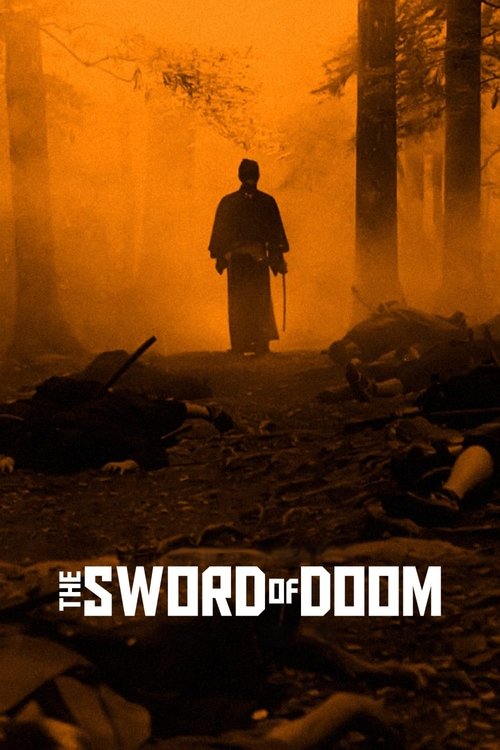
The Sword of Doom
1966 · Kihachi Okamoto
For when you want darkness without apology — a film that stares into the void and doesn't blink. This is a challenge, not a comfort watch, and it's best taken late at night when you can let it get under your skin.
What it's about
In the dying days of the Shogunate, a master swordsman named Ryunosuke cuts people down without motive or remorse — not for money, not for honor, just because his blade wants to move. The film follows him through duels, political intrigue, and the wreckage he leaves in families and factions across Edo-period Japan, as a way of killing becomes a way of being. Around him, history itself is coming apart, and a young swordsman with a legitimate grievance is circling closer.
The experience
Cold, hypnotic, and genuinely frightening — this is a samurai film that feels more like a horror movie about a man's soul. The violence arrives in sudden, virtuosic bursts between long stretches of dread, and it builds toward a finale of almost delirious intensity.
Performances
Tatsuya Nakadai is unforgettable as Ryunosuke — dead-eyed, almost serene, playing evil not as rage but as absence. Toshiro Mifune appears as a rival master whose few scenes carry enormous moral weight, and one confrontation between the two is among the most electric in the genre.
The craft
Shot in stark black-and-white widescreen, it turns snow, mist, and lamplight into instruments of menace — one nighttime fight in falling snow is pure visual poetry. The swordplay choreography is savage and precise rather than heroic, and the compositions reward the biggest, darkest screen you can find.
Why it matters
A touchstone of 1960s Japanese cinema's dark turn, it stripped the samurai film of its honor code and showed how far the genre could go into pure nihilism — later screen killers without conscience owe it a debt.
Snapshot
A swordsman without a soul walks through history until history burns down around him. The Sword of Doom (Daibosatsu Tōge, lit. "Great Bodhisattva Pass") is Kihachi Okamoto's adaptation of the opening sections of Nakazato Kaizan's immense, unfinished serial novel, refracted through the cold, nihilistic sensibility of 1960s Toho studio filmmaking. Tatsuya Nakadai plays Ryunosuke Tsukue, a technically peerless swordsman who kills without motive, scruple, or regret—a villain so absolute he bends the grammar of the jidaigeki around him. The film ends not with resolution but with conflagration and madness, a formal enactment of the void at its center. Shot in stark black-and-white Tohoscope, it stands as one of the great nihilist texts in world cinema: a samurai film that refuses every consolation the genre had trained audiences to expect.
Industry & production
The Sword of Doom was produced by Toho Co., Ltd. at the peak of the studio's prestige jidaigeki cycle, a period when Toho was distributing internationally and competing with the chambara output of Daiei and Shochiku. The project was rooted in a literary property with enormous popular and cultural recognition: Nakazato Kaizan began serializing Daibosatsu Tōge in the Tokyo Nichinichi Shimbun in 1913, continuing intermittently for three decades; the author died in 1944 without completing it. By most reckonings it is one of the longest novels in Japanese literary history, and the figure of Ryunosuke Tsukue had become, in the intervening half-century, a touchstone for the Japanese popular imagination—a figure of aristocratic evil whose sword skill derives not from discipline or virtue but from the terrifying blankness of a man without conscience.
The property had been adapted before. Hiroshi Inagaki made a version in the mid-1930s, and Tomu Uchida directed a celebrated three-part adaptation between 1957 and 1959, which treated the material with a relatively classical gravity. Okamoto's approach was sharper, more compressed, and more overtly invested in the existential implications of the protagonist. Only the novel's opening movement is dramatized; the film neither resolves the story nor pretends to. The screenplay was written by Shinobu Hashimoto, the Toho writer whose earlier collaborations with Kurosawa on Rashomon, Ikiru, and Seven Samurai had helped establish the studio's international reputation. Hashimoto's script strips the novel to its moral skeleton: a series of killings, entanglements, and political turbulences that accumulate around an unreachable center.
Technology
The Sword of Doom was shot in Tohoscope, Toho's in-house anamorphic widescreen process yielding a 2.35:1 aspect ratio, in black and white. The decision to retain monochrome in 1966, when color production had become the industry standard for prestige product, was not merely economic; the widescreen black-and-white frame allowed for the deep-shadow expressionism that the material demanded. The dense blacks in the film's interiors—candlelit dojos, dark hallways, snow-blanketed roads—are not achievable in the same register in color, and the final sequence in a burning building relies on the high-contrast interplay of firelight and darkness that black-and-white photochemistry handles with a directness color cannot replicate. The decision aligns The Sword of Doom with the late-monochrome aesthetic also visible in contemporaneous Japanese work by Masaki Kobayashi (Kwaidan, 1964, was color, but Harakiri, 1962, used black-and-white to parallel effect) and in European art cinema, where black-and-white remained a prestige aesthetic marker well into the mid-decade.
Technique
Cinematography
The precise identity of Okamoto's director of photography on this film is a point where the English-language record is thinner than it should be; available sources indicate Hiroshi Murai as the cinematographer, a Toho staff DP who worked regularly in Okamoto's orbit. What the images demonstrate, regardless of attribution, is a disciplined approach to the widescreen frame in which space functions as moral geometry. Dueling sequences unfold in wide, clean compositions that emphasize the emptiness surrounding the combatants—Ryunosuke does not fill the frame so much as haunt it. Close-ups of Nakadai's face are deployed sparingly, which means that when the camera does move into his eyes, the vacancy registered there carries enormous weight. The opening sequence at Daibosatsu Pass—a mist-shrouded mountain road, an old man killed in a moment of pure caprice—establishes the visual logic immediately: open landscape, a figure of inexplicable menace, the suggestion that the natural world is indifferent to what passes through it.
Editing
The editing maintains the measured pace of classical Toho jidaigeki through most of the film, allowing scenes their political and interpersonal texture before releasing into violence. Sword fights, unlike the kinetically extended duels of Kurosawa's jidaigeki, tend toward brevity—Ryunosuke kills quickly, without ceremony, and the cuts reflect this: action that other directors would expand, Okamoto compresses. The escalating madness of the film's final extended sequence inverts this. As Ryunosuke moves through a burning house cutting down waves of attackers, the cutting becomes increasingly fragmented and hallucinatory, the editing tempo rising against the flickering firelight to produce a crescendo that cannot resolve, only stop. The film ends mid-action, mid-sentence narratively, and the cut to black that terminates it is one of the most deliberately unsatisfying—and most honest—endings in the genre.
Mise-en-scène / staging
Okamoto's staging throughout belongs to the tradition of theatrical spatial legibility characteristic of studio-era Toho, but he inflects it with a choreographic coldness suited to his protagonist. Scenes in dojos and training halls are staged with exacting formality; the bodies of other characters are frequently arranged in positions of subordination or fear relative to Ryunosuke's place in the frame. The Shinsengumi sequences introduce historical texture through period-accurate costuming and staging of group formations, but Okamoto keeps the political mechanics at a certain remove—Ryunosuke moves through history without being of it, and the staging literalizes this by repeatedly placing him slightly outside the geometric centers occupied by organized groups of men. The burning-house finale draws on theatrical tradition (the tachimawari of kabuki, the grand climactic setpieces of earlier jidaigeki) while exceeding them in its hallucinatory excess.
Sound
Masaru Satō's score occupies a characteristic late-1960s Japanese film register: jazz inflections, percussive attack, passages of near-silence punctuated by sharp instrumental interventions. Satō had composed for Kurosawa's Yojimbo and Sanjuro, films that also used music to work against genre expectation, and his work for Okamoto carries a similar astringency. The score refuses the swelling romanticism of traditional period-drama composition; it is colder, more angular, occasionally dissonant in ways that align it with the film's moral dissonance. Sound design in the violence sequences is precise and unadorned—the clean, brief sounds of killing, without musical cushioning.
Performance
Tatsuya Nakadai's performance as Ryunosuke Tsukue is the film's central artistic fact. By 1966 Nakadai had established himself, through work with Kurosawa (The Hidden Fortress, Yojimbo, High and Low, Sanjuro) and Kobayashi (Harakiri, Kwaidan), as the most versatile and technically accomplished actor in Japanese cinema. What he finds for Ryunosuke is something more radical than the controlled menace he brought to those earlier roles: a quality of absolute vacancy. He does not play evil as an active condition but as the absence of its opposite—no warmth, no hesitation, no relationship with other human beings that registers as real engagement. His eyes in medium shot are clinically blank. When the film's final sequence tips into hallucinatory terror, Nakadai's face finally breaks open—but what emerges is not emotion in any redemptive sense, only a kind of internal weather. Toshiro Mifune, in a supporting role as the righteous swordmaster Shimada, functions as the film's moral counterweight: Mifune's physically expansive, humanly grounded presence throws Nakadai's absence into relief. That Mifune's character never confronts Ryunosuke in direct combat is one of the film's shrewdest structural choices—the confrontation is perpetually deferred, and the void at the center never fills.
Narrative & dramatic mode
The film's dramatic mode is rigorously anti-cathartic. Classical tragic structure posits a protagonist whose fall generates recognition and purgation; The Sword of Doom denies recognition entirely. Ryunosuke does not understand what he is—the concept of understanding does not appear to apply to him—and the narrative, following his logic, moves not toward insight but toward intensification and dissolution. The plotting proceeds through a series of moral crimes (the murder at the pass, a betrayal during a sword competition that has the character of a cold execution, the destruction of several families collateral to his passage) surrounded by the historical turbulence of the Bakumatsu period, the final years before the Meiji Restoration when the Shogunate and its enforcers, the Shinsengumi, were beginning their terminal decline. History provides context without causation; Ryunosuke would be what he is in any era.
Genre & cycle
The Sword of Doom belongs to the revisionist or "dark samurai" cycle of the 1960s, a broad tendency across multiple Japanese studios to interrogate and in some cases overturn the ideological assumptions embedded in classical jidaigeki. Where the classical form—particularly as codified in postwar popular culture and in the early films of Kurosawa—had understood the samurai as a vehicle for exploring questions of loyalty, honor, duty, and social obligation, the revisionist cycle foregrounded the violence and exploitation underlying the feudal order. Kobayashi's Harakiri (1962) is the landmark text in this tendency; Hideo Gosha's Three Outlaw Samurai (1964) and Sword of the Beast (1965) develop adjacent territory. Okamoto's contribution is distinctive in its philosophical extremity: where most revisionist films retain a moral framework against which the corruption of samurai ideals can be measured, The Sword of Doom vacates that framework at the level of its protagonist's psychology. Ryunosuke is not a samurai who has failed some standard of virtue; he is a being for whom virtue is a category that does not apply.
Authorship & method
Kihachi Okamoto (1924–2005) worked across genres at Toho—war films, comedies, and samurai pictures—with a consistent formal intelligence and a particular affinity for moral ambiguity and dark irony. His earlier samurai film Samurai Assassin (1965), also produced by Toho and starring Nakadai, had explored a figure of historical violence in the late Shogunate; The Sword of Doom deepened this exploration by removing the residual sympathies that qualified Samurai Assassin's protagonist. Okamoto would return to comparable territory with Kill! (1968), a black comedy adaptation of the same Gōryū Shugoro source material Kurosawa had used for Sanjuro, and with Red Lion (1969). His method combined a classical Toho studio professionalism—precise compositions, clean editing rhythms, reliable control of large action sequences—with a willingness to allow philosophical darkness to go unresolved. Shinobu Hashimoto's screenplay is a key instrument of this: Hashimoto's structural economy, developed over years of collaboration with Kurosawa, here serves a purpose anti-Kurosawa in its ethical valences. Where Hashimoto's scripts for Kurosawa typically locate, beneath the surface tumult, a residual humanism, his script for The Sword of Doom is designed to make that residual humanism impossible to locate.
Movement / national cinema
The film sits at a specific juncture in Japanese cinema history: the late high-classical period of the studio system (Toho, Shochiku, Daiei all producing at volume) intersecting with the challenge of the Japanese New Wave (Ōshima, Yoshida, Shinoda) and the emergence of internationally visible art cinema. The Sword of Doom is not a New Wave film—it operates within the studio system's genre conventions and production structures—but it absorbs certain New Wave temperamental dispositions: the refusal of consolatory narrative, the critique of national myth (the samurai as expression of Japanese virtue), the interest in moral vacancy as a philosophical condition rather than a dramatic obstacle. It belongs to the movement of postwar Japanese cinema through the ruins of idealism, a cinema continuously reprocessing the question of what violence means and what it leaves behind.
Era / period
The historical setting—the Bakumatsu period, roughly the 1860s, as the Tokugawa shogunate entered its final crisis—is load-bearing in ways beyond backdrop. The Shinsengumi, the shogunate's special police force whose members were drawn from warrior and lower-samurai classes and deployed as instruments of violent political suppression, appear here as an organizational structure that Ryunosuke moves through without being organized by. The Bakumatsu period as a setting had particular resonance in 1960s Japanese popular culture: it represented a historical moment of violent transition, of old orders collapsing and new ones not yet consolidated, a period of maximum instability in which individual violence and political violence became difficult to distinguish. For Japanese audiences living through the political turbulence of the early 1960s—the Anpo protests of 1960, the subsequent transformation of political engagement into cultural pessimism—the setting carried contemporary charge without requiring allegorization.
Themes
The film's central theme is the relationship between mastery and emptiness. Ryunosuke's sword technique is, by the film's internal logic, powered by his absence of moral conscience: a fighter who has no attachment to outcome, no fear of death, no human ties to defend or protect, is a fighter who cannot be anticipated or deterred. The Buddhist framework embedded in the title (Daibosatsu—Great Bodhisattva—is a figure of compassion and enlightenment) is invoked negatively: Ryunosuke represents an inversion of Buddhist liberation, a being who has detached from human ties not through wisdom but through some original defect, and whose "freedom" from ordinary emotional life is indistinguishable from damnation. The film also engages the theme of violence as inheritance and propagation: Ryunosuke's killings generate grief and resentment in survivors who then become vectors for further violence, a chain the film tracks carefully enough to suggest structural critique of a society organized around the institutionalization of killing.
Reception, canon & influence
Backward influences: The film's most immediate debt is to its source material's cultural standing—the figure of Ryunosuke Tsukue was already, by 1966, a recognized archetype in Japanese popular culture, and Okamoto's adaptation both honors and radicalized that archetype. The Tomu Uchida trilogy of 1957–1959 established one interpretive framework; Okamoto's film is in implicit dialogue with it, representing a more existentially severe reading of the same character. The broader influence of Akira Kurosawa's jidaigeki—the commitment to historical texture, the visual grammar of outdoor action—is pervasive in the film's production context, even as Okamoto works systematically against Kurosawa's humanism.
Reception and canonization: Critical reception of The Sword of Doom has been consistently high in Japan and, following its international circulation through Toho International distribution and subsequent art-house and repertory exhibition, in Western critical discourse. Nakadai's performance has been recognized across decades of retrospective evaluation as one of the great villain performances in the history of cinema. The film holds a significant position in Japanese film canon as both a genre achievement and a philosophical statement.
Forward influence: The nihilistic samurai archetype that The Sword of Doom crystallizes with unusual purity would become a recurrent figure in subsequent Japanese popular media—in manga and anime as well as in film, the swordsman of absolute, motiveless danger echoes this film's template. Its influence on international directors drawn to Japanese genre cinema is more difficult to trace precisely, but the film's reputation among Western filmmakers interested in the samurai tradition—from the late 1960s martial-arts film boom through the emergence of directors like Jim Jarmusch (Ghost Dog, 1999) and their explicit engagement with samurai cinema—is well documented. The abrupt, unresolved ending has been cited as an influence on subsequent filmmakers willing to close genre narratives without generic satisfaction. That the film is unfinished—that it ends not because the story concludes but because it cannot conclude—remains its most radical formal proposition, an honest mirror to the source material's incompleteness and to the moral conditions it inhabits.
A Deleuzian reading
An old man kneels at the top of a mountain pass, praying to be released from a life that has outlasted its use.
The full Deleuzian reading of The Sword of Doom →
Reception
In Japan it was just one more adaptation of Nakazato's much-filmed serial novel and its planned sequels never materialized; decades later, a Criterion release turned it into a Western cult object and it's now routinely called one of the darkest, greatest samurai films ever made.
How The Sword of Doom was received, from release to now →
Influences: the films it descends from and the films it influenced
- Daibosatsu Toge (1957) — Uchida's three-film adaptation of the same Nakazato Kaizan source established Ryunosuke Tsukue's screen vocabulary — the cold-sword archetype whose kills carry no moral weight — and the character's dramatic incompleteness; Okamoto radicalizes Uchida's reading by stripping away the residual romanticism that made Uchida's Tsukue legible and refusing any psychological motivation the viewer can assemble into a coherent subject.
- Rashomon (1950) — Shinobu Hashimoto co-authored Rashomon's epistemologically open narrative structure — the principle that moral truth may be constitutively irresolvable rather than merely withheld — and carries that structural logic into The Sword of Doom's screenplay, making its abrupt open ending philosophically principled rather than arbitrarily inconclusive: the story cannot end because the moral problem cannot be resolved.
- The Human Condition III: A Soldier's Prayer (1961) — Kobayashi's epic extracted from Nakadai a sustained performance vocabulary for a man hollowed by systematic violence — the physical grammar of stillness-as-danger, the unblinking affect that registers as void rather than calm — which Okamoto then concentrates and purifies into Ryunosuke's absolute vacancy, stripping away the residual humanity Kobayashi kept legible in Kaji.
- Harakiri (1962) — Kobayashi's Tohoscope compositions establish the technique of placing Nakadai's body in widescreen negative space as a formal signal of moral isolation — the figure dwarfed by architectural geometry it cannot belong to — and the same spatial grammar that Okamoto appropriates to make Ryunosuke's vacancy readable through composition rather than psychology; Nakadai's stillness here is the direct performative ancestor of his vacancy in Sword of Doom.
- Onibaba (1964) — Shindo and cinematographer Kiyomi Kuroda develop a system of high-contrast monochrome photography in which shadow volume and light geometry encode moral condition directly — darkness as ethical atmosphere rather than atmospheric decoration — establishing the monochrome-shadow-expressionism technique that Okamoto's cinematography inherits for Ryunosuke's world, where visual texture and moral texture are made identical.
- Pale Flower (1964) — Shinoda pairs Toru Takemitsu's dissonant jazz-adjacent score with a protagonist of complete interior absence in a genre film — the combinatorial formula of contemporary Western musical idiom functioning as estrangement device for a figure operating outside moral norms — which Okamoto inherits directly: Masaru Sato's jazz-inflected scoring of Ryunosuke performs the same alienation of genre convention through incongruous musical sophistication.
- Samurai Assassin (1965) — Okamoto's own preceding Nakadai vehicle, also set in the late Shogunate, developed the compressed-cut choreography for chanbara violence — bodies falling in abrupt edits that deny the viewer contemplative distance from the kill — which The Sword of Doom then escalates: the finale's hallucinatory fragmentation is the logical intensification of the editing grammar Okamoto had already validated in this film.
- Samurai I: Musashi Miyamoto (1954) — Okamoto inverts Inagaki's spiritual-formation arc — Ryunosuke achieves technical perfection alongside moral emptiness — while retaining the same kengeki grammar of stillness-before-violence and elliptical time; the inversion is only fully legible against Inagaki's positive template.
- Samurai II: Duel at Ichijoji Temple (1955) — Okamoto deploys the Toho chanbara production apparatus—widescreen depth staging, orchestral scoring, precision-against-numbers set-pieces—that Inagaki's trilogy established as prestige template, inverting its moral framework to produce nihilistic anti-hero study.
- Samurai III: Duel at Ganryu Island (1956) — Extends the Toho-Mifune swordsman iconography while inverting Inagaki's humanist restraint into nihilist compulsion, using the same held-stillness-before-strike editing.
- Goyokin (1969) — Gosha's first color samurai film extends the moral-geometry widescreen composition of dark-revisionist jidaigeki into Eastmancolor while preserving the same organizing principle — frame depth and figure placement encoding ethical position rather than spatial information — demonstrating how the visual system that Sword of Doom exemplifies translates into the subsequent decade's color palette without losing its philosophical function.
- Lone Wolf and Cub: Sword of Vengeance (1972) — The Ogami Ittō archetype — a swordsman whose violence is mechanical, purposive, and stripped of psychological legibility, who moves through genre narrative as instrument rather than subject — extends the Tsukue template that Sword of Doom crystallized into popular form; Misumi's editing of kill sequences, with abrupt cuts that compress the moment of death rather than dwell on it, directly inherits Okamoto's choreographic grammar.
- Lady Snowblood (1973) — Fujita applies Okamoto's compressed-cut violence editing to a female avenger protagonist who, like Ryunosuke, exists as instrument rather than psychological subject — the editing cuts away at the instant of contact, refusing to extend the kill into spectacle — and the episodic, accumulative structure of violence without cathartic release follows The Sword of Doom's anti-cathartic narrative template.
- Ghost Dog: The Way of the Samurai (1999) — Jarmusch's protagonist adheres to an absolute code regardless of circumstance — the Tsukue structure remoralized but equally irresolvable within genre convention — and pairs it with a hip-hop score that functions exactly as Sword of Doom's jazz score does: a contemporary Western musical idiom that estranges the genre imagery and signals the film's analytical distance from its own conventions; the ending refuses genre satisfaction on the same principled basis.
- 13 Assassins (2010) — Miike's antagonist Naritsugu — a figure of motiveless aristocratic cruelty with no psychological origin the film offers or requires — is the Tsukue archetype in period reconstruction; the forty-minute battle sequence's editing, accumulating violence until spatial coherence dissolves into hallucinatory fragmentation, extends Okamoto's finale technique to its logical extreme, testing how far compressed-cut choreography can be sustained before the action ceases to be legible as action.
- Zatoichi (2003) — Pioneers the abrupt detonation of mass swordplay erupting out of held stillness, the on/off violence dynamic Kitano builds his editing around.
- Demons (1971) — Centers a morally void swordsman driven by pure nihilism through expressionist night duels, prefiguring Shura's protagonist as an agent of meaningless slaughter.
- Sword of the Stranger (2007) — Its snow-and-shadow set-piece dueling and study of a swordsman's ethics-of-violence supply the moral chill and the arena-as-crucible staging echoed in the temple snowfield finale.
- Lone Wolf and Cub: Baby Cart at the River Styx (1972) — Its amoral, Buddhist-doomed swordsman and swarming multi-opponent set-pieces model the theme/buddhist-fatalism and the cruel-swordplay choreography Misumi ritualizes.
- Sword of the Beast (1965) — Released the same year and working the same dark-revisionist jidaigeki project, Gosha deploys high-contrast Tohoscope black-and-white to place his ronin protagonist in landscapes that function as moral diagrams — widescreen negative space calibrated to ethical rather than geographic purpose — demonstrating that Okamoto's spatial grammar is a shared property of the dark-samurai revision movement, not an idiosyncratic solution.
- Branded to Kill (1967) — Suzuki applies the same formal cluster — protagonist of psychological vacancy, jazz score functioning as genre estrangement device, editing fragmentation that refuses narrative coherence, abrupt unresolved ending — to yakuza genre rather than samurai, confirming that these are Japanese New Wave formal properties portable across genres rather than period-specific conventions; the two films share a method of using genre expectation as a surface to systematically perforate.
- Kill! (1968) — Okamoto returns with Nakadai to the same Hashimoto-adjacent source territory — both this film and Sanjuro draw on Gōryū Shugoro's material — redeploying the compressed violence choreography and the figure of the samurai outside conventional ethics through black comedy rather than tragedy, making the shared formal grammar visible by inflecting it differently: the widescreen moral geometry reads as irony here where it reads as dread in The Sword of Doom.
- Sanjuro (1962) — The violence-and-restraint dialectic taken to nihilistic inversion: Nakadai's compulsive killer is the dark counterpart to Mifune's restrained ironist, both films using sustained-medium-shot grammar and the wide frame to build confrontation psychology from stillness.
- Yojimbo (1961) — Okamoto's Toho chambara extends Yojimbo's moral ambiguity to outright nihilism using the same studio apparatus and production resources, with town-street confrontations staged along the same single-axis spatial logic and an equally jazz-adjacent score.
- Red Beard (1965) — Toho black-and-white Tohoscope jidaigeki scored by Masaru Satō and starring Mifune as a stern master-swordsman, sharing Red Beard's exact craft ecosystem the year after its release.
- Samurai Rebellion (1967) — Same Toho anamorphic monochrome-scope house style and Nakadai cast as the nihilistic swordsman, extending the era's darkening of the jidaigeki hero.
- The Human Condition II: Road to Eternity (1959) — Places Nakadai at the center of a high-contrast Grandscope monochrome frame, extending the Nakadai screen persona and the same anamorphic black-and-white idiom into nihilist territory.
- The Tale of Zatoichi (1962) — Nihilistic swordsman in black-and-white 'scope whose composed calm is shattered by eruptions of carnage, extending the stillness-then-slaughter cutting logic.
- Three Outlaw Samurai (1964) — Pushes the same 1960s cruel-chanbara idiom — nihilistic swordsman, elliptical propulsive cutting, high-contrast scope compositions — toward pure amorality.
Similar films
- Harakiri (1962) — influence & lineage · same viewing thread
- 13 Assassins (2010) — influence & lineage · same viewing thread
- Rashomon (1950) — influence & lineage · same viewing thread
- Branded to Kill (1967) — influence & lineage
- Yojimbo (1961) — same viewing thread
- Demons (1971) — same viewing thread
- Samurai Rebellion (1967) — same viewing thread
- The Hidden Blade (2004) — same viewing thread
All the films related to The Sword of Doom →
Watch it with: curated runs of related films
- The Samurai Code on Trial — A run of chanbara films that draw the sword only to turn it against the myth of honor itself — watch them together and the bushido ideal keeps curdling into cruelty, nihilism, and doubt.