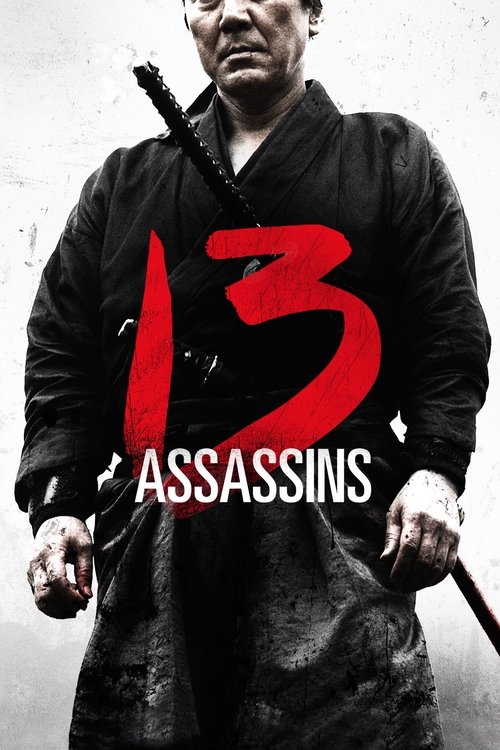
13 Assassins
2010 · Takashi Miike
For when you want an epic — the kind of night where you clear the schedule, turn it up loud, and let a movie build to something enormous. Intense and violent, but deeply satisfying: an underdog mission story played completely straight.
What it's about
At the twilight of Japan's feudal era, a shogunate official secretly recruits a band of samurai for an impossible mission: assassinate a sadistic young lord who is protected by his bloodline and about to rise to real power. Thirteen men against an army, planning one perfect ambush in a town they'll turn into a trap. It's a story about men who've outlived their purpose choosing, at last, something worth dying for.
The experience
A slow, coiling first half — recruitment, planning, mounting dread — that detonates into one of the longest and most ferocious battle sequences ever filmed. It's brutal and exhilarating in equal measure, with a streak of gallows humor, and the villain's cruelty gives the finale real moral charge.
Performances
Kōji Yakusho anchors the film as the veteran leader Shinzaemon, weary gravity slowly kindling into joy at having a real fight again, and Goro Inagaki makes the young lord memorably, serenely monstrous.
The craft
Takashi Miike, a director famous for wild excess, works here with startling discipline: classical widescreen compositions, patient buildup, and then a forty-five-minute siege staged with mud, fire, and practical mayhem that never loses geographic clarity. It's a big-screen, big-sound film — the battle earns every decibel.
Why it matters
Widely hailed as the modern peak of the samurai film and Miike's international breakthrough into the arthouse mainstream, proving the classic swordplay epic could still be made at full scale and full seriousness.
Snapshot
A late-Edo-period revenge epic in which thirteen ronin and retainers are recruited by a senior Shogunate official to assassinate Lord Naritsugu Matsudaira — a sadistic, untouchable half-brother of the Shogun — before he can ascend to the council of elders and drag Japan back into civil war. Structured as a slow-burn procedural for its first half and an unrelenting forty-five-minute siege in its second, 13 Assassins is a remake of Eiichi Kudo's 1963 jidaigeki of the same name, here inflated to international scale while remaining faithful to the original's moral architecture: the question is not whether the assassination will succeed but what it costs to die well, and whether the samurai code can bear its own contradictions. Among Takashi Miike's most formally disciplined and widely celebrated films, it was Japan's submission for the Academy Award for Best International Feature Film at the 83rd ceremony and won the Blue Ribbon Award for Best Film in Japan.
Industry & production
The project originated as a prestige remake commission, with the 1963 Toei chambara picture serving as the property to be reconceived for contemporary international audiences. Screenplay duties went to Daisuke Tengan, who had collaborated with Miike on Audition (1999) and is the son of director Shōhei Imamura — a lineage that brings a certain literary seriousness to the script's structural economy. British producer Jeremy Thomas, whose Recorded Picture Company has long brokered prestige Asian co-productions for Western markets, backed the film internationally. Japanese production was handled through Sedic International alongside TBS and other domestic partners.
Miike, working at his characteristically compressed pace, shot the film in a period that his interviews suggest was tight even by his standards. The logistical centerpiece was the construction of the village of Ochiai, a purpose-built set that the assassins transform into a mechanized killing field — a maze of trapdoors, firetraps, and collapsing structures. Exact construction costs and shooting-day breakdowns have not been comprehensively published, but accounts indicate the climactic battle sequence alone consumed a substantial portion of the schedule and required extensive coordination of stunt performers, pyrotechnics, and horse-work on a scale unusual for Japanese production of the period.
Technology
13 Assassins was shot on conventional celluloid, not digital, a choice that aligns with its classicist ambitions and contributes to the muted, earth-toned look that distinguishes it from the hyper-saturated palette of many contemporary Asian action productions. The decision grounds the film aesthetically in the Toei jidaigeki tradition even as it exceeds that tradition's budgetary scope. The battle sequence deploys practical fire effects and physical stunts to a degree that deliberately distances itself from the wire-work and CGI-assisted martial arts cinema that had dominated East Asian action films in the previous decade (the wuxia cycle associated with Zhang Yimou and Wong Kar-wai's martial arts departure). No significant digital-enhancement techniques have been prominently documented for the action sequences, which achieves its scale through choreography, crowd work, and in-camera pyrotechnics rather than compositing.
Technique
Cinematography
The director of photography is Nobuyasu Kita, and his approach is one of controlled restraint for approximately the film's first ninety minutes. The camera holds in mid and long shot during political and domestic scenes, respecting the formality of Edo-period spatial codes — men kneel, bow, and speak at measured distance, and Kita's compositions honor those geometries. Interiors lean toward a chiaroscuro influenced as much by Kurosawa's monochrome work as by Kudo's original, though rendered in subdued color rather than black and white. As the film enters the village-trap sequence, the visual grammar does not so much break as fracture: the camera becomes handheld and reactive, pushed into the mass of bodies, smoke, and fire in a way that creates textural contrast with everything preceding it. The shift is earned precisely because Kita has trained the eye to expect stillness.
Editing
The editing amplifies the film's binary structure: the first half is shaped in long scenes that allow exposition and moral deliberation to breathe; the second half, once the first sword clears its scabbard in Ochiai, is cut with escalating compression. The editorial strategy during the battle avoids the rapid cutting of Hollywood action films (the Bourne-style sub-two-second average shot length) while still accumulating intensity — cuts tend to follow action beats rather than anticipate them, keeping spatial orientation legible even as the choreography grows chaotic. The result is that the audience retains a sense of the village's geography and of who remains alive among the thirteen, which allows individual deaths to register as losses rather than merely as statistics.
Mise-en-scène / staging
The film's conceptual staging achievement is the Ochiai village set, which functions as a dramaturgical as well as spatial structure. Shinzaemon's group has essentially authored the battlefield: every passage, building, and trap is an expression of their collective tactical intelligence. This means that the environment itself is characterized, that the mise-en-scène of the battle is simultaneously an expression of the protagonists' interior lives — their willingness to die and their professional ingenuity are made visible in the space. Miike and his production designer (Yuji Hayashida) layer the village with escalating visual escalation: what begins as sword-fighting in relatively open lanes becomes, as the sequence extends and the dead accumulate, a passage through increasingly claustrophobic, fire-lit corridors.
Sound
Composer Kōji Endō provides a score that leans toward austerity, employing traditional Japanese instrumentation in restrained configurations that recall the minimalist scoring strategies of Masaru Satō's work for late Kurosawa rather than the operatic excess of more recent samurai scoring. The score largely withdraws during the battle's most intense passages, allowing the physical sound design — the specific grain of steel, the wet acoustics of close-quarters fighting, the crackle of burning buildings — to constitute the soundscape. This choice privileges documentary texture over melodramatic intensification and contributes to the film's formal claim to seriousness.
Performance
Kōji Yakusho anchors the film as Shinzaemon Shimada, the senior samurai who accepts the assassination commission with the understanding that it is a death sentence for himself and his men. Yakusho, one of the most consistently accomplished performers in contemporary Japanese cinema (Shōhei Imamura's The Eel, Kiyoshi Kurosawa's Cure, Rob Marshall's Memoirs of a Geisha), pitches Shinzaemon at a register of exhausted dignity: a man who has waited his entire life for a death with meaning and greets the assignment with something that, in a less repressed emotional vocabulary, might be called joy. Gōrō Inagaki, against type as the boyishly sadistic Naritsugu, manages to make the villain's violence feel genuinely pathological rather than conventionally theatrical — his pleasure in cruelty is rendered as a kind of blank curiosity, which proves more disturbing than rage. Yūsuke Iseya as Koyata, the wild hunter-figure who joins the group as a thirteenth member and functions as a liminal, almost supernatural presence, provides tonal relief without undercutting the film's gravity.
Narrative & dramatic mode
The film observes a strict procedural dramaturgy in its first half: the problem is identified, the recruiter is commissioned, the recruits are assembled, the plan is devised. This structure is legible to audiences of The Dirty Dozen (1967) and Seven Samurai (1954) alike and functions as a genre compact — the audience accepts a degree of exposition in exchange for the promise of spectacular payoff. What distinguishes Tengan's screenplay from a simple genre exercise is its insistence on the cost of the plan. Each recruitment scene is also a death scene in miniature: men who have been living in diminishment — impoverished, dishonoured, purposeless in a time of forced peace — agree to die as an act of professional restoration. The moral paradox that animates the film's drama is crystallized in the relationship between Shinzaemon and his rival Hanbei Kitou (Hiroki Matsukata), Naritsugu's loyal samurai captain, who serves his master not out of ignorance of the lord's crimes but because loyalty, in the samurai code, is prior to justice. Both men are presented as morally coherent within their frameworks; the film does not resolve the tension.
Genre & cycle
13 Assassins belongs to the jidaigeki (period drama) and specifically to the chambara (sword-fighting) tradition — a genre with deep roots in Japanese cinema extending from the silent era through the Toei studio system's golden age (roughly the 1950s through 1970s). Within that tradition, its closest antecedent is the "group jidaigeki" cycle associated with Eiichi Kudo's films at Toei: The Thirteen Assassins (1963), The Great Killing (1964), and Eleven Samurai (1967), which channeled the social turbulence of their period into narratives of collective sacrifice against corrupt authority. Miike's film consciously rehabilitates and internationally markets this cycle, operating in productive dialogue with the Western critical consensus that the genre peaked with Kurosawa and had declined since. It arrives in a period when the prestige jidaigeki had some international visibility — Yōji Yamada's The Twilight Samurai (2002) had received an Oscar nomination, and there was a modest critical appetite for Japanese period films that took their genre seriously.
Authorship & method
Takashi Miike is, by any accounting, one of cinema's most anomalous directorial figures: a filmmaker who by 2010 had made over seventy features and who works across horror, yakuza, musical, children's film, manga adaptation, and art cinema with apparent indifference to the generic distinctions that would constitute a career for most directors. His reputation in international cinephile culture rested primarily on extreme-content films — Audition (1999), Ichi the Killer (2001), Visitor Q (2001) — whose transgressive aesthetics had earned him festival notoriety and cult status. 13 Assassins represents neither an aberration nor a culmination of that trajectory but rather a demonstration of the argument his defenders had always made: that Miike's prolificacy and generic range reflect not indiscipline but an essentially cinephilic disposition, an ability to modulate register and restraint according to the requirements of the material. The classicism of 13 Assassins is not a renunciation of earlier work but a different mode of the same energy.
The collaboration with Daisuke Tengan is significant: Tengan's screenplays tend toward formal rigor and elliptical emotional restraint, and his is likely a moderating influence on the more chaotic impulses in Miike's instincts. Cinematographer Nobuyasu Kita and composer Kōji Endō both serve the film's austere register. What might be considered a collaborative auteurism operates here — Miike provides the kinetic imagination and the scale of the battle concept; Tengan structures the moral drama with the seriousness the material demands.
Movement / national cinema
The film situates itself unambiguously within Japanese genre cinema while simultaneously pitching its formal ambitions at international critical reception. Japanese cinema in the 2000s existed in an internationally bifurcated state: J-horror had achieved global genre penetration (Nakata's Ring, Shimizu's Grudge), anime had its own separate circuits, and prestige art cinema (Koreeda, the later Kawase) was winning festival prizes, but the genre jidaigeki had limited traction outside Japan. 13 Assassins was positioned — through Venice, through Thomas's international distribution, through its scale — as a corrective to this marginalization, an argument that Japanese genre cinema could compete with Hollywood epic on formal terms. Its success in this positioning is partial: it was celebrated in critical circles internationally but did not achieve wide theatrical distribution in Western markets in the manner of, say, a Park Chan-wook film of the same period.
Era / period
The film is set in 1844, during the Tenpō reforms and the final decades of Tokugawa rule — a period of enforced peace (the Pax Tokugawa) that had rendered the samurai class structurally superfluous. Feudal Japan's prohibition on conflict had drained the warrior class of purpose: samurai maintained rank without function, becoming, in the film's own framing, men who could not live as samurai but had no other vocabulary for existence. The historical specificity matters because it grounds the film's central theme — the search for a meaningful death — in material conditions rather than abstract code. The choice of Naritsugu as villain is also historically calibrated: a lord who craves war not out of ideology but out of appetite, who would restore the very conditions of violence that Tokugawa peace suppressed. The assassination is thus simultaneously reactionary (preserving an order the samurai serve) and radical (killing a man the system protects).
Themes
The film is primarily concerned with purposeful death — the Japanese concept of junshi (dying in service to a lord) and the broader Bushido valorization of death as completion rather than terminus — but it complicates this theme by distributing it across multiple perspectives. Shinzaemon's readiness to die is presented as earned: a man who has served with distinction in a peacetime that cannot use his skills. Hanbei's readiness to die in service of Naritsugu, a manifestly evil man, poses the harder question: is loyalty itself a virtue, or is it moral abdication dressed in ceremonial clothing? The film refuses to resolve this, allowing Hanbei to die with honor intact while making clear that his cause was indefensible.
Secondary themes include the relationship between institutional corruption and individual conscience; the nature of collective action and what assembling a group of men willing to die together requires of each of them; and the historical transition from feudal to modern Japan, which the film treats with the ambivalence appropriate to its source tradition — the end of the samurai era is simultaneously a liberation and a loss.
Reception, canon & influence
Backward influences. The film's most direct ancestor is Kudo's 1963 original, which Tengan's screenplay follows closely in structure while expanding in scale. Beyond that, the film is in conscious dialogue with Kurosawa — Seven Samurai (1954) above all, particularly in the recruitment sequence and the spatial logic of the climactic battle (a prepared defensive position against superior numbers), but also Kagemusha (1980) and Ran (1985) in their treatment of the end of an era as moral catastrophe. The Western genre is also present: the binary narrative structure (preparation / execution) and the assembly of specialists recalls the American heist and war films of the 1960s, and there are traces of Leone's spaghetti westerns in the moral symmetry between the lead protagonist and the lead antagonist. The jidaigeki cycle of Kudo, Satsuo Yamamoto, and Tai Katō at Toei in the 1960s provides the genre framework.
Critical reception. 13 Assassins premiered at the Venice Film Festival in 2010 to strongly positive reviews and subsequently received wide critical acclaim on international release. It was frequently cited as among the best films of 2010 in Western critical year-end rankings and consolidated Miike's reputation beyond his cult-transgressive identity. Critics noted both the formal restraint of the first half and the extraordinary sustained achievement of the battle sequence, which was widely described as among the most impressive extended action sequences in contemporary cinema. Mark Kermode and other prominent British critics were vocal advocates. The film holds exceptionally high approval ratings on aggregation sites, unusual for an Asian-language genre film of its period.
Forward legacy. 13 Assassins has not yet demonstrably seeded a wave of direct imitators, but its influence operates at the level of permission: it established that the jidaigeki could be made at international scale and marketed to non-specialist audiences without reduction to pastiche. It contributed to a modest rehabilitation of the classical chambara tradition in critical discourse and demonstrated, within Miike's own career, that his directorial range encompassed classical formal restraint as fully as transgressive extremity. For Western viewers coming to it without knowledge of the 1963 Kudo film, it frequently serves as an entry point to the broader Toei period-drama tradition and to the group-jidaigeki cycle in particular. Its long battle sequence has been discussed as a case study in sustained action-film editing and spatial choreography in film education contexts, though the extent of its formal influence on subsequent action filmmaking remains to be traced with precision.
A Deleuzian reading
Watch Kōji Yakusho's face when Shinzaemon is handed the commission.
The full Deleuzian reading of 13 Assassins →
Reception
The shock in 2010 was that Takashi Miike — the madman behind Audition and Ichi the Killer — delivered a stately, classical samurai epic that competed at Venice; it's since settled in as arguably his most acclaimed film in the West and a modern jidaigeki benchmark.
How 13 Assassins was received, from release to now →
Influences: the films it descends from and the films it influenced
- 13 Assassins (1963) — Tengan's screenplay transplants Kudo's binary structure (deliberation/execution) scene-by-scene; the corrupt lord as target, the assassination-mission premise, and the narrative pivot from ethical debate to kinetic action are taken wholesale into Miike's expanded remake.
- Seven Samurai (1954) — The recruitment-sequence format — each specialist introduced through a single defining act establishing their utility — and the defensive-position battle logic of outnumbered men holding prepared ground against superior numbers are structural devices Miike directly inherits.
- Harakiri (1962) — Kobayashi's strategy of extended compositional restraint in severe long shots during the first half, building moral pressure before physical eruption, and the framing of Bushido as institutional hollowness enforcing loyalty to a corrupt order, structure Miike's film at the level of both form and argument.
- Kagemusha (1980) — The use of static wide shots and minimal traditional instrumentation to convey feudal inevitability, with the dying order's weight registered through stillness rather than action, establishes the elegiac mode and score-restraint approach Miike inherits for the film's first half.
- Ran (1985) — The extended battle sequence choreographed across a purpose-composed wide-shot landscape, with score withdrawal during the fighting itself and battle rendered as spectacle of moral catastrophe rather than heroic triumph, directly models Miike's approach to the climactic village sequence.
- The Great Killing (1964) — Kudo's second Toei jidaigeki establishes the group-assassination procedural format: a functional hero ensemble differentiated by specialty, plotting against entrenched institutional power with inside knowledge, building toward a single coordinated act — the ensemble-staging template Miike scales up.
- Once Upon a Time in the West (1968) — Leone's construction of exact moral symmetry between protagonist and antagonist — each defined by a code the other mirrors — and his discipline of extended pre-action restraint that defers violence to heighten its eventual impact, are formal strategies Miike imports directly into chambara form.
- The Dirty Dozen (1967) — The binary narrative architecture in which the entire first act is a procedural assembly and qualification of specialists for a single mission, with no dramatic action until the second-act execution, gives Miike the Western-genre structural template for his preparation-then-battle division.
- The Wild Bunch (1969) — Peckinpah's cross-cutting technique tracking multiple simultaneous combatants through rapid spatial fragmentation, combined with purposeful-death framing that renders the climactic confrontation as elegy for a dying code rather than triumph, are both operative in Miike's extended battle sequence editing.
- Lone Wolf and Cub: Sword of Vengeance (1972) — Misumi's chambara style — extreme practical violence rendered with composed long-shot framing and minimal musical accompaniment, within a Bushido framework where death is sought as purposeful completion rather than avoided — establishes the tonal and formal register Miike inherits for his action sequences.
- The Hidden Fortress (1958) — Miike's jidaigeki revival deploys multi-camera filming of the sustained village battle—simultaneous angles on melee and crowd movement without cutting away from blocking continuity—and telephoto compression of armed groups advancing through confined space in direct homage to Kurosawa's multi-camera action grammar, while the widescreen ensemble staging in planning sequences descends from Hidden Fortress's approach to distributing a large cast across the 2.35:1 frame.
- The Sword of Doom (1966) — Miike's antagonist Naritsugu — a figure of motiveless aristocratic cruelty with no psychological origin the film offers or requires — is the Tsukue archetype in period reconstruction; the forty-minute battle sequence's editing, accumulating violence until spatial coherence dissolves into hallucinatory fragmentation, extends Okamoto's finale technique to its logical extreme, testing how far compressed-cut choreography can be sustained before the action ceases to be legible as action.
- Rurouni Kenshin (2012) — The critical permission established by 13 Assassins — that classical chambara could reach international non-specialist audiences without pastiche reduction — underwrites Otomo's franchise, which adopts comparable period accuracy, practical stunt choreography, and the group-combat procedural structure for mainstream release.
- Blade of the Immortal (2017) — Miike applies the chambara classicism and practical-effects-only action aesthetic developed in 13 Assassins to a manga source, retaining the handheld battle cinematography, ensemble spatial logic, and the purposeful-death Bushido thematic framework within an extended multi-adversary combat architecture.
- Hara-Kiri: Death of a Samurai (2011) — Miike's immediate follow-up operates in the identical classicist jidaigeki mode established in 13 Assassins: Tengan screenplay discipline, long-shot compositional restraint, and Bushido as a vehicle for institutional critique — the same author working the same formal register on adjacent material.
- The Raid: Redemption (2011) — Both films structure their entire second half as a single sustained location-locked battle using a purpose-built environment as an active combatant, with handheld camera during fighting, practical-effects-only choreography, and defenders exploiting architectural knowledge against superior numbers.
- The Assassin (2015) — Hou's wuxia art film shares the formal strategy of long-shot static restraint punctuated by sudden brief violence, minimal score, and natural environment as dramatic agent rather than backdrop — both films use the historical action genre as a vehicle for compositional severity and elliptical emotional restraint.
- The Hidden Blade (2004) — Belongs to the same 2000s jidaigeki revival and shares the late-feudal setting of clan rot and duty, but restores spectacle — defining itself against the very restraint Yamada championed.
- The Last Samurai (2003) — A contemporary jidaigeki revival that foregrounds the doomed last-stand massed battle in direct descent from the Kurosawa choreography Zwick also borrows.
- The Twilight Samurai (2002) — Part of the same mid-2000s jidaigeki revival Twilight helped reopen; though it restores mass spectacle, it too grounds its swordsmen in class grievance and duty rather than romantic heroism.
Similar films
- Harakiri (1962) — influence & lineage · same viewing thread
- Seven Samurai (1954) — influence & lineage
- Ran (1985) — influence & lineage
- Kagemusha (1980) — influence & lineage
- Samurai Rebellion (1967) — same viewing thread
- The Twilight Samurai (2002) — same viewing thread
- The Last Samurai (2003) — same viewing thread
- The Sword of Doom (1966) — same viewing thread
All the films related to 13 Assassins →
Watch it with: curated runs of related films
- The Samurai Code on Trial — A run of chanbara films that draw the sword only to turn it against the myth of honor itself — watch them together and the bushido ideal keeps curdling into cruelty, nihilism, and doubt.