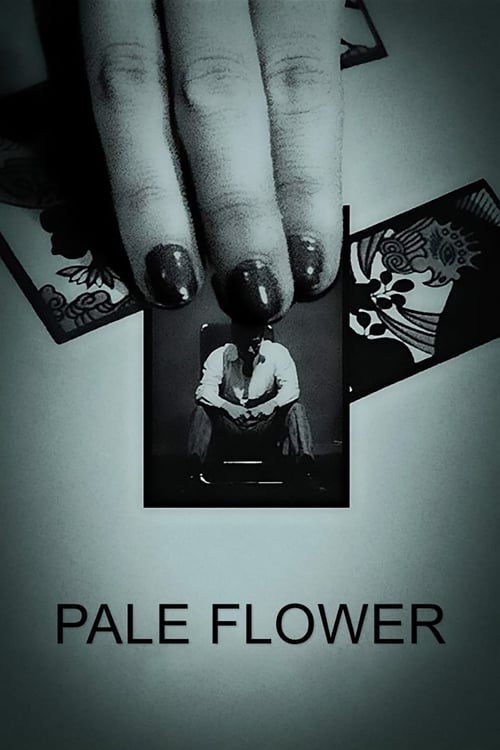
Pale Flower
1964 · Masahiro Shinoda
For a late night when you want something sleek, doomed, and impossibly stylish — noir as a slow drug rather than a rush. Moody-challenge territory, not a comfort watch, but an easy film to fall under the spell of.
What it's about
A middle-aged yakuza walks out of prison after serving time for murder and returns to the gambling dens to find the gang world quietly reshuffled around him. At the card table he meets Saeko, a beautiful young woman of mysterious means who plays not for money but for the pure sensation of risk — and keeps hunting bigger stakes. Their strange, wordless bond, hovering somewhere between romance and mutual free-fall, pulls them both toward the edge.
The experience
Cool, spare, and hypnotic — a lean 90-odd minutes of nocturnal atmosphere where the card games play like séances and the mood is pure controlled menace. It's the kind of film that lowers your pulse and raises the hair on your neck at the same time.
Performances
Ryo Ikebe's weathered stillness as Muraki gives the film its gravity, and Mariko Kaga is magnetic as Saeko — all bright-eyed serenity over a bottomless appetite for danger.
The craft
Gorgeous widescreen black-and-white turns Japan's back-alley gambling parlors into abstract theaters of light and shadow, while Toru Takemitsu's avant-garde score builds music from the slap and shuffle of the cards themselves. The sound design alone rewards good speakers; the images reward total darkness.
Why it matters
A defining work of the Japanese New Wave and a touchstone of the country's crime cinema — its icy, existential take on the gangster film influenced generations of stylists in Japan and beyond.
Snapshot
A yakuza named Muraki walks out of prison after a two-year stretch for murder, returning to Osaka's gambling dens to find a world reorganized around him. There he meets Saeko, a young woman of mysterious means who gambles not for money but for the sensation of pure risk. Their entanglement — not quite romantic, not quite nihilistic, suspended somewhere between fascination and mutual destruction — forms the film's entire dramatic architecture. Pale Flower (Kawaita Hana, literally "Dried/Withered Flower") is seventy-five minutes of disciplined existential cinema: spare, hypnotic, and mercilessly cool. It belongs to the first wave of the Japanese New Wave at Shochiku, shares DNA with Melville's crime asceticism and Camus's moral philosophy, and stands as one of the definitive articulations of postwar Japanese alienation rendered through genre film.
Industry & production
Pale Flower was produced by Shochiku, the studio where Shinoda had trained and from which the Japanese New Wave's Shochiku faction — alongside Nagisa Oshima and Yoshishige Yoshida — emerged in the early 1960s. The source material is a short novel by Shintaro Ishihara, published in 1955. Ishihara is a figure of cultural paradox: he was the literary progenitor of the taiyozoku (Sun Tribe) genre, whose debut novel Season of the Sun triggered a cycle of youth-delinquency films, and he later became a prominent right-wing nationalist politician. His "Pale Flower" novella is quieter and more existentially inward than the Sun Tribe work, and Shinoda recognized in it a vehicle for his own formal preoccupations.
The screenplay was adapted by Masaru Baba, a regular Shinoda collaborator. Upon completion, the film was shelved by Shochiku for roughly a year before its theatrical release. Studio accounts of the time attributed the delay to discomfort with the film's darkness and its perceived sympathy for criminal milieu, though the protracted review also reflected broader institutional anxiety about the New Wave directors' departures from Shochiku's commercial conventions. The delay is historically significant: it meant a film completed in the climate of early Japanese New Wave iconoclasm reached audiences at a slightly different cultural moment, when the movement's aesthetic parameters were already hardening.
Technology
Pale Flower was shot in black and white, 35mm, in the Academy ratio — a conservative technical choice that situates it in the classical register even as its content and style resist convention. The choice of monochrome in 1964, when color was increasingly normalized in Japanese commercial cinema, is itself an aesthetic statement: it aligns the film with the hard-edged cinematographic tradition of American film noir and signals its refusal of the lushness that characterized contemporaneous yakuza pictures. No records in the available literature describe unusual camera equipment or proprietary photographic processes; the technological interest lies not in novelty but in how standard tools were deployed with formal precision.
Technique
Cinematography
The cinematography is by Masao Kosugi, and the visual language he and Shinoda developed is among the most distinctive in Japanese genre cinema of the decade. The gambling sequences — long, ritualized rounds of hanafuda (flower card) games — are rendered in extreme close-up and radical fragmentation, the camera moving through fingers, cards, and faces as if dissecting the mechanics of chance. Faces are frequently shot from low angles or in shadow; the playing tables become chessboards of menace. Against this microscopic intensity, Kosugi also deploys wide, nearly empty compositions for the film's exterior and transitional moments, producing a visual rhythm that alternates claustrophobia with existential vacancy. The high-contrast printing deepens the blacks to near-absolute, a choice that gives the film its characteristic harshness and that coheres with Shinoda's framing of the yakuza world as a space evacuated of warmth or hope.
Editing
Yoshi Sugihara edited the film, and the cutting — or, more precisely, the refusal to cut — is one of the film's most distinctive formal features. The gambling sequences run in extended takes, their rhythms governed by the pace of the game rather than by conventional dramatic logic. This withholding of editorial intervention produces a durational experience: the viewer is made to feel time in the way Muraki feels it — as something that passes without purpose or accumulation. When cuts do come, they are often startling, ellipses that collapse time or jump across space without the bridging coverage that classical editing provides. The film's temporal structure is deliberately disorienting, refusing to organize events into legible cause-and-effect chains.
Mise-en-scène / staging
Shinoda stages the film in carefully sealed environments — the underground gambling rooms, the nightclub, the car. These spaces are never fully described; the films withholds establishing shots, so the geography of the yakuza world remains labyrinthine and unresolvable. The staging of Muraki and Saeko's interactions is notably still: Shinoda refuses to use conventional Hollywood grammar (shot-reverse-shot eyeline matching) for emotional scenes, instead holding both figures in the same frame or cutting in ways that deny intimacy. The film's most startling mise-en-scène occurs in a sequence where Muraki observes a young man injecting heroin — the camera and Takemitsu's score transform this into a hallucinatory vision sequence that ruptures the film's surface realism and briefly enters a different register altogether.
Sound
Toru Takemitsu composed the score, and his contribution is inseparable from the film's meaning. Takemitsu's music for Pale Flower is jazz-inflected but decisively post-bop, with dissonances, spatial silences, and timbral abrasion that resist easy classification. The score does not illustrate or underscore; it contends with the image, creating counterpoint rather than accompaniment. Extended passages of silence punctuate the gambling scenes, during which the ambient sounds — cards sliding, chips clicking — become the film's acoustic focus. The heroin sequence is accompanied by music that crosses into noise: one of Takemitsu's earliest essays in sonic destabilization for cinema. Takemitsu's broader body of work for Japanese New Wave cinema (he composed for Teshigahara, Oshima, and others) is well documented; his score for Pale Flower is among his most formally radical early works.
Performance
Ryô Ikebe plays Muraki with a deliberate flatness that is precisely calibrated and not a failure of affect. Ikebe was an established star in Japanese cinema, and the casting against his warmer screen persona — deploying his physical composure as an index of emotional vacancy — is a calculated choice. Muraki says little; his internal monologue (delivered in voice-over) reveals a man who has exhausted irony and arrived at a near-total dissolution of will. Mariko Kaga as Saeko offers the film's most complex performance: Saeko is not quite a femme fatale in the noir sense, not quite a death-drive allegorist, but something stranger — a woman who courts disaster with a serenity that baffles and finally unmoors the man watching her. Kaga plays the stillness without hysteria, which gives Saeko her unnerving authority. The supporting performances, including Takashi Fujiki as the drug-dealing third figure who triangulates Muraki's world, maintain the film's tonal discipline.
Narrative & dramatic mode
Pale Flower operates in the mode of existentialist fable rather than genre thriller. Its narrative is technically linear but functionally cyclical: Muraki returns to the same gambling rooms, the same rituals, the same women (an old flame reappears), and nothing changes except that the stakes — psychological, moral, mortal — escalate by increment. The film's dramatic engine is not suspense about outcome (we can feel from early scenes that this will end in death) but something closer to the phenomenological: we are asked to inhabit Muraki's boredom, his half-extinguished desire, his flicker of feeling toward Saeko that he cannot name or act on. The climax, when it arrives, is structural inevitability rather than surprise. The first-person voice-over narration — rare in Japanese cinema of the period for a crime film — places us inside Muraki's consciousness while keeping us at an ironic distance, a formal choice that recalls both American noir narration and the detached first-person mode of Camus's L'Étranger.
Genre & cycle
The film participates in the Japanese yakuza genre (yakuza-eiga) but systematically deforms its conventions. Where the commercial yakuza film — as produced in large quantities by Toei in particular during the 1960s — typically organized its narratives around codes of loyalty, hierarchical conflict, and cathartic violence, Pale Flower empties out the ethical content of those codes. Muraki kills, but the film renders this without ritual significance; the yakuza hierarchy is present but functions only as a landscape of meaninglessness rather than a system of binding obligation. The film's closest generic kinship is with the French polar — Melville's Bob le flambeur (1956) and Le Doulos (1962) offer useful comparators in their shared commitment to genre as a vehicle for existentialist cool — and with American film noir's thematic preoccupation with predetermination and the impossibility of escape. Pale Flower also belongs to a recognizable Japanese cycle of the early 1960s in which young directors used genre frameworks to address postwar social fragmentation — a cycle that includes Nagisa Oshima's Cruel Story of Youth (1960) and Seijun Suzuki's contemporaneous Nikkatsu productions.
Authorship & method
Masahiro Shinoda trained at Shochiku as an assistant director and, like Oshima and Yoshida, became associated with the studio's brief experiment in auteurist cinema. His approach is characterized by rigorous formal control, an interest in the intersection of Western existentialism and Japanese social displacement, and a consistent resistance to the consolations — emotional, moral, generic — that commercial cinema provides. In Pale Flower, Shinoda collaborates with a group of artists whose individual sensibilities reinforce his own: Masaru Baba's screenplay is as spare as the direction, economizing dialogue to a minimum. Masao Kosugi's cinematography externalizes Shinoda's thematic concerns in visual terms without redundancy. Takemitsu's score, discussed above, operates as a co-author rather than a servant of image. The coherence of this collaboration — each element in contention with rather than mere support of the others — produces the film's characteristic texture of productive discomfort.
Movement / national cinema
Pale Flower is a central work of the Japanese New Wave (Nihon Nuberu Bagu), the loose constellation of filmmakers who emerged in the late 1950s and early 1960s and who collectively rejected the dominant aesthetic traditions of Japanese cinema — the humanist melodrama of the older studios, the refined formalism associated with Ozu and Mizoguchi — in favor of more directly political, formally experimental, and culturally disruptive modes. The Shochiku faction of this movement (Oshima, Yoshida, Shinoda) is distinguishable from independent New Wave work in that it originated within, and initially depended on, a major studio infrastructure, which gave its transgressions a particular institutional charge. The film also participates in what critics have described as mukokuseki ("stateless") cinema — the absorption and transformation of Western genre conventions into a distinctly Japanese idiom, neither imitative nor nationalistic.
Era / period
The film arrives in 1964, a year of enormous symbolic weight in Japanese cultural history: the Tokyo Olympics, the inauguration of the Shinkansen, the broad cultural consensus around Japan's postwar economic recovery and its re-entry into international respectability. Pale Flower is contemptuous of this consensus, or at least wholly indifferent to it. Its underground gambling rooms and its characters who seem to live outside clock-time and civic life constitute a refusal of the triumphalist narrative of reconstruction. This is characteristic of the Japanese New Wave more broadly, whose cultural work was to insist on the costs — psychological, social, political — that the economic miracle's official story occluded.
Themes
The film's governing theme is the exhaustion of meaning: Muraki is a man for whom every available source of significance — criminal loyalty, romantic attachment, the thrill of violence — has been depleted. What remains is sensation, and Saeko represents its purest available form. Their relationship is therefore not a love story but an epistemology: Saeko is Muraki's last experiment in feeling, and the film's implicit question is whether the capacity for experience can survive the conditions that produce people like them. The gambling scenes are thematically central: gambling as pure risk — disconnected from accumulation, from strategy, from social utility — functions as a figure for the existentialist gamble of consciousness itself. The heroin imagery extends this into corporeal territory: the body as the last frontier of sensation when the social world has become fully unreadable. The film also engages, more obliquely, with questions of gender and the male gaze: Saeko frustrates Muraki's (and the viewer's) desire to possess or fully understand her, and the film's ending — which removes her from the frame in a manner the text refuses to sentimentalize — is a structural acknowledgment of her irreducibility.
Reception, canon & influence
Influences on the film (backward): The most legible antecedents are Melville's French polars, whose combination of genre atmosphere and existentialist withdrawal Shinoda explicitly transposes into Japanese milieu. American film noir of the 1940s and early 1950s — particularly its voice-over strategies and its iconography of entrapment — is a structural precursor. Ishihara's source novel, itself inflected by French literary existentialism (Camus is the most obvious pressure), provides the thematic scaffold. Within Japanese cinema, Oshima's early work at Shochiku (Cruel Story of Youth, Night and Fog in Japan) established an institutional precedent for using genre against its own conventions.
Critical reception: The film received critical attention on release in Japan but was not a significant commercial success. Its reputation grew substantially over subsequent decades as the Japanese New Wave was retrospectively canonized. International critical recognition followed the film's availability through art-house distribution and, eventually, home video releases including the Criterion Collection's edition, which introduced the film to a new generation of English-language audiences. It is now consistently cited in critical surveys of postwar Japanese cinema and of world art cinema more broadly.
Legacy and forward influence: The film's most evident legacy is in the aesthetics of austere, existentialist yakuza cinema that reached full expression in the work of Takeshi Kitano in the 1990s — Sonatine (1993) in particular shares Pale Flower's investment in stillness, in violence rendered without catharsis, and in a yakuza protagonist whose emotional vacancy is the film's primary subject matter. Whether Kitano directly absorbed Shinoda's influence or arrived at convergent solutions to shared formal problems is difficult to document with precision, and the secondary literature is cautious about claiming direct lines of derivation. The film also anticipates the cooler registers of global art-house crime cinema — the mode developed by directors including Jim Jarmusch (Ghost Dog, 1999) and Wong Kar-wai — though the critical record on specific influence is thin and speculative claims should be treated with appropriate skepticism. What is documentable is that Pale Flower established, within Japanese cinema, the possibility of genre as a vehicle for philosophical inquiry that does not sacrifice formal rigor to thematic legibility — a precedent that subsequent generations of Japanese filmmakers inherited, whether consciously or by cultural diffusion.
A Deleuzian reading
Start with the face.
The full Deleuzian reading of Pale Flower →
Reception
Shochiku got cold feet and shelved it for months in 1963 — its own screenwriter denounced the finished film as 'anarchistic' — before it opened to become a hit; six decades on it's a Criterion-canonised jewel of the Japanese New Wave.
How Pale Flower was received, from release to now →
Influences: the films it descends from and the films it influenced
- Bob le Flambeur (1956) — Melville's extended sequences of criminal routine — gambling, surveillance, waiting — stripped of psychological explanation and set in sealed nocturnal environments, provide the direct formal template Shinoda transposes to Tokyo, including the all-night gambling den as existential chamber rather than thriller backdrop.
- Le Doulos (1962) — Melville's elliptical editing strategy that withholds the scene most necessary to narrative orientation — cutting around rather than through the film's hinge — is the closest model for Shinoda's elliptical cut technique, which refuses to stabilize the viewer's temporal position within Muraki's story.
- Double Indemnity (1944) — The retrospective first-person voiceover by a protagonist who has already condemned himself — whose narration registers knowledge of fate without the capacity to alter it — establishes the temporal and moral structure Shinoda imports directly into Muraki's narration, including its characteristic tone of exhausted lucidity.
- Pickpocket (1959) — Bresson's voiceover that runs athwart the character's actual emotional state — commentary that fails to account for what the image shows — directly models Pale Flower's ironic disjunction between Muraki's narration and his behavior; the extreme close-ups of hands performing ritualized repetitive action are an equally specific formal debt.
- Cruel Story of Youth (1960) — Oshima's high-contrast location cinematography using extreme close-up to fragment youth bodies against postwar Tokyo cityscape — isolating faces from social context rather than embedding them — provides the visual grammar Shinoda's cinematographer Masao Kosugi adapts for Muraki's sealed urban world.
- Night and Fog in Japan (1960) — Composed in an exceptionally small number of extremely long takes, Oshima's film established within Shochiku the institutional precedent that genre material could be structured through durational tension rather than edited momentum — Shinoda inherits this specific formal permission for refused shot-reverse-shot and extended staging.
- Drunken Angel (1948) — Hands the counterpoint problem to Toru Takemitsu, whose clattering musique-concrète score is set against the gambling den's ritual hush, while the yakuza is drained of chivalric code exactly as Matsunaga was.
- Sonatine (1993) — Kitano structures yakuza film around enforced idleness and protracted waiting rather than genre incident — violence arrives as interruption to stillness rather than as climax — directly extending Pale Flower's rhythm of extended takes disrupted by sudden, unresolved violence that refuses to accumulate toward catharsis.
- Hana-Bi (1997) — Kitano's extreme elliptical editing cuts across entire scenes to present only the static aftermath of violent events — refusing the viewer the cathartic moment itself — developing Pale Flower's refused-catharsis editing principle into a fully elaborated formal system where the cut bears the film's primary moral weight.
- Ghost Dog: The Way of the Samurai (1999) — Jarmusch's use of RZA's hip-hop score as philosophical commentary running alongside genre action rather than as emotional underscore — music functioning as co-authored text on its own logic — directly extends Takemitsu's compositional function in Pale Flower, where the score interrogates rather than serves the image.
- In the Mood for Love (2000) — Wong's recurring musical motif (Shigeru Umebayashi's 'Yumeji's Theme') deployed as a structural device that produces cyclical temporal loops rather than linear progression extends Pale Flower's use of Takemitsu's recurring cues to build a cyclical narrative architecture that supplants causal story movement with emotional recurrence.
- Drive (2011) — Refn constructs a genre protagonist through maximum screen presence achieved by minimal performance — expression systematically withheld as the film's primary register of intensity — extending the performance mode Katsuo Nakamura embodies in Pale Flower, where affective flatness is not absence but displaced pressure.
- The Sword of Doom (1966) — Shinoda pairs Toru Takemitsu's dissonant jazz-adjacent score with a protagonist of complete interior absence in a genre film — the combinatorial formula of contemporary Western musical idiom functioning as estrangement device for a figure operating outside moral norms — which Okamoto inherits directly: Masaru Sato's jazz-inflected scoring of Ryunosuke performs the same alienation of genre convention through incongruous musical sophistication.
- Bullet Ballet (1998) — Tōru Takemitsu built the score from amplified ambient sound — dice clatter, footsteps, traffic — establishing city noise itself as the musical bed for a monochrome yakuza film, the exact premise of Bullet Ballet's traffic-and-machinery track running under Chū Ishikawa's percussion.
- Serpent's Path (1998) — Shinoda builds his gambling sequences out of repetitive rhythm — card-slap, chant, room tone laid over the score — and lets his hitman's blank, frequently turned-away face withhold all interiority, the sound-as-metronome and blankness-as-withholding model for the warehouse scenes.
- Le Samouraï (1967) — Melville's construction of the hero as a figure defined by his sealed apartment, his ritual routine, and the complete withholding of psychological exposition — character produced through negation — represents the French polar arriving at the same formal conclusions as Pale Flower from within a different national cinema and three years later.
- Tokyo Drifter (1966) — Suzuki's yakuza protagonist rendered as pure existential displacement — without fixed loyalty, motivation, or identity, defined only by what he can no longer be — maps the same condition as Muraki through an opposed formal register: garish color abstraction against Shinoda's monochrome austerity.
- Branded to Kill (1967) — Suzuki's simultaneous demolition of yakuza genre logic through tonal rupture and surrealist formal intrusion — retaining genre iconography as primary material while refusing cathartic resolution — is the direct parallel strategy to Shinoda's deformation of yakuza-eiga conventions through existentialist austerity.
- Funeral Parade of Roses (1969) — Matsumoto's extreme high-contrast monochrome cinematography, elliptical editing across narrative time, and direct-to-camera breaks that rupture diegetic space extend Japanese New Wave's formal radicalism across an urban counter-cultural milieu, sharing Pale Flower's strategy of using genre-adjacent material as formal experiment.
- Yojimbo (1961) — Shinoda's yakuza film shares the jazz-inflected score aesthetic, chiaroscuro interior cinematography, and the lone protagonist's moral detachment within criminal social ecology — a parallel response to the same postwar Japanese studio moment, without direct derivation.
- Pitfall (1962) — A Japanese New Wave crime film whose Takemitsu soundscape uses musique-concrète clatter and abrupt silence as dramatic texture, the same treatment of noise-as-event that scores Pitfall's killings.
Similar films
- Sonatine (1993) — influence & lineage
- Cruel Story of Youth (1960) — influence & lineage
- Fireworks (1997) — influence & lineage
- Tokyo Drifter (1966) — influence & lineage
- Le Samouraï (1967) — influence & lineage
- Late Spring (1949) — shared sensibility
- High and Low (1963) — shared sensibility
- In the Realm of the Senses (1976) — shared sensibility
All the films related to Pale Flower →