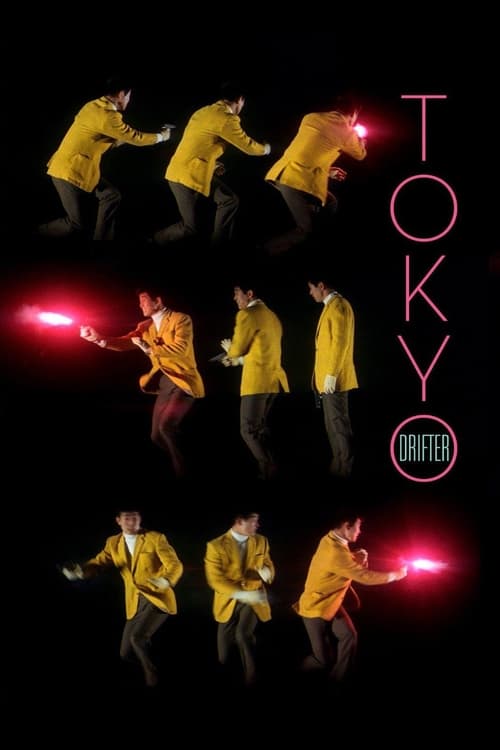
Tokyo Drifter
1966 · Seijun Suzuki
When you want something cool and visually intoxicating rather than emotionally heavy — a midnight movie for a night when you're craving style, swagger, and weirdness. Short enough to double-feature.
What it's about
When his yakuza boss dissolves the gang, loyal enforcer 'Phoenix Tetsu' refuses a rival kingpin's offer to switch sides — so the rival sends an unstoppable hitman called the Viper to kill him. Tetsu takes to the road as a drifter, dodging assassination attempts across Japan while wondering which of his old allies he can still trust.
The experience
Fast, strange, and gorgeous — a lean 83 minutes that starts as a cool crime picture and keeps mutating into something wilder, with candy-colored sets, a whistled theme song, and shootouts staged like pop-art theater. It's disorienting in a way that feels like a shot of pure style.
The craft
Seijun Suzuki takes a standard studio yakuza assignment and detonates it from the inside: rooms flood with single saturated colors, gunfights turn abstract, and the plot yields to spectacle at every opportunity. The production design and use of color are the point — this one genuinely sings on a good screen, and the recurring theme song will live in your head for days.
Why it matters
Suzuki's studio rebellion made him a cult legend, and the film's pop-art audacity echoed through decades of stylish crime cinema in Japan and far beyond it.
Snapshot
Tokyo Drifter is a genre film that stopped being a genre film halfway through its own making — and kept going anyway, at speed. Directed by Seijun Suzuki for Nikkatsu Corporation in 1966, it follows ex-yakuza enforcer Tetsuya "Phoenix Tetsu" Hondo through a gauntlet of assassination attempts, loyalty tests, and increasingly abstract set pieces, culminating in one of the most tonally disorienting climaxes in postwar Japanese cinema. On paper it is a ninkyō eiga — a chivalry-yakuza picture in the tradition that Toei Studio had made enormously profitable — but Suzuki systematically dismantles that form from within, replacing narrative causality with spectacle, psychological realism with color-coded theatricality, and genre satisfaction with something closer to an elegy for genre itself. The film runs a lean 83 minutes, cost very little, and was dismissed on release by the studio executives who commissioned it. It is now regarded as one of the high-water marks of 1960s Japanese cinema and a foundational text for any account of how popular genre filmmaking can achieve the condition of avant-garde art without abandoning the pleasures of action, music, and a beautifully tailored suit.
Industry & production
Nikkatsu, Japan's oldest film studio, reinvented itself in the late 1950s as an action-genre factory after a long period of financial difficulty. Its "borderless action" (mukokuseki akushon) model produced youth-oriented crime and thriller pictures at a pace that left directors little room for reflection. Suzuki had been a Nikkatsu contract director since 1954, turning out roughly three or four pictures a year under tight schedules and tight budgets. By the mid-1960s he had acquired a reputation inside the studio as a director whose pictures looked strange and cost extra time in post-production arguments with management, but who reliably delivered prints on schedule.
Tokyo Drifter was produced under these standard pressures: the story had already been serialized and the screenplay by Yasunori Kawauchi — who also wrote many of Suzuki's other Nikkatsu scripts — arrived as a fairly conventional yakuza-loyalty narrative. What happened during production is less clearly documented in English-language scholarship, but accounts consistently note that Nikkatsu cut the budget mid-production, and that Suzuki responded to this constraint by making creative choices that turned limitation into provocation. The film's unusual deployment of black-and-white and highly artificial color — the first sequence operates in near-monochromatic tones before the film erupts into lurid primary palettes — is broadly attributed to this production history, though the precise sequence of decisions is difficult to reconstruct from existing record. What is clear is that the resulting film looked nothing like what the studio had ordered, which was a straightforward action vehicle for rising star Tetsuya Watari.
Suzuki's relationship with Nikkatsu deteriorated through this period and broke completely in 1968, when the studio fired him following Branded to Kill — reportedly because that film's radical formalism had exhausted executive patience entirely. Suzuki sued, won a settlement, and spent a decade unable to direct theatrical features. The firing became a cause célèbre among Japanese cinephiles and retrospectively reframed his late-Nikkatsu work as a sustained act of creative resistance conducted within the confines of the studio system.
Technology
Tokyo Drifter was shot in NikkatsuScope, the studio's proprietary anamorphic widescreen format (a 2.35:1 aspect ratio derived from licensing arrangements with CinemaScope). The widescreen frame is not incidental to Suzuki's practice: he treats its horizontal expanse as a stage, placing figures at extreme edges, allowing dead space in the center, and organizing compositions so that spatial relationships carry dramatic weight that the dialogue refuses to supply. The film was shot on color negative, but its opening passages are processed or lit to read as essentially gray — a deliberate withholding of the film's chromatic register that makes the subsequent explosion of artificial color feel earned rather than arbitrary. The specific color timing and laboratory decisions behind these passages are not well documented in available English-language sources.
Technique
Cinematography
Cinematographer Shigeyoshi Mine, who worked with Suzuki on several Nikkatsu productions, photographs Tokyo Drifter in a manner that treats naturalism as a convention to be acknowledged and then discarded. Compositions are frequently frontal and theatrical — figures pose rather than occupy space, and the camera often holds a distance that prevents intimacy. Low angles inflate the frame's vertical dimension within its horizontal constraint, giving characters a monumental flatness. When the film shifts location to the countryside pursuit sequences, Mine opens up to wider environmental shots, but these feel no more "realistic" than the studio interiors; the countryside operates as another stage rather than a landscape with meteorological continuity. The use of available-light location shooting that characterized the French New Wave is not Mine's approach here: everything is controlled, lit for effect, and designed to feel constructed.
Editing
The editing rhythm is one of the most subversive elements of the film. Suzuki frequently cuts away from action before its resolution, or cuts into action after it has already concluded, so that the viewer is denied the conventional grammar of screen violence — the build, the collision, the aftermath. Scenes end on unexpectedly arbitrary beats. Musical sequences are intercut with action in ways that suspend rather than heighten tension. The effect is that the film seems to be continuously arriving slightly out of phase with itself, as though the editor (the specific credit is not consistently documented in sources available to this account) were cutting to the rhythm of a different picture.
Mise-en-scène / staging
This is where Tokyo Drifter stakes its most aggressive claims. The studio sets are overtly artificial — walls painted in block primary colors, floors that do not extend convincingly beyond the frame, rear-projection backgrounds deployed without any attempt at seamlessness. Rather than camouflaging these theatrical elements, Suzuki foregrounds them. The climactic sequence in a white nightclub — surfaces drained of all color, figures reduced to silhouettes against an enveloping blankness — functions as the film's ultimate statement: stripped of genre furniture, what remains is the figure of loyalty in a void. The staging of action throughout favors tableau over continuity: characters enter and exit the frame rather than moving through space, and shootouts are choreographed for geometric rather than physical clarity. The influence of theatrical Kabuki conventions — the posed, confrontational blocking; the use of color as character signature rather than environmental description — is broadly noted in commentary on Suzuki's style, though how consciously programmatic this influence was in his own account of his practice is not clearly established.
Sound
The sound design participates in the film's general illusionism. Foley effects are sometimes hyperbolically present, sometimes curiously absent, and the relationship between on-screen action and sound is inconsistently anchored in ways that feel deliberate. The score by Hajime Okumura moves between jazz idioms, orchestral melodrama, and the film's central musical number with a pragmatism that does not attempt unified atmosphere. The title song — "Tokyo Drifter," performed by Watari as his character Tetsu within the diegesis — operates as a ballad of self-narration, the wandering hero singing his own condition into existence. This device has precedents in the Japanese itinerant-hero tradition and in American western balladry, and Suzuki finds in it a way to literalize his film's reflexive impulse: the genre hero who knows he is a genre hero.
Performance
Tetsuya Watari's performance as Tetsu is calibrated to the film's broader logic. He is cool, minimal, and decorative — a figure rather than a psychology. His emotional range is narrow by design: loyalty, resolve, and a melancholy that surfaces only in the musical sequences. This is not a failure of acting but a realization of what the film requires. Against him, Ryuji Kita's Kurata (the dissolving boss) and the various antagonists occupy conventional genre positions without irony. The film is not interested in the inner lives of its characters; it is interested in what their positions signify within the genre system they inhabit, and Watari projects that positional clarity with considerable physical elegance.
Narrative & dramatic mode
The plot of Tokyo Drifter is a loyalty narrative of severe simplicity: Tetsu declines to be bought away from his retiring boss, is hunted as a consequence, wanders through the countryside pursued by the Viper (Tatsuzo), and eventually confronts the full corruption of the world he served loyally. What Suzuki does with this material is not so much to complicate it as to hollow it out. The loyalty that drives the narrative is revealed, by the film's end, to be structurally unrealizable — the world to which Tetsu's loyalty refers no longer exists, and his virtue is thus both absolute and pointless. This deflationary movement is characteristic of Suzuki's approach to genre: he follows the form's emotional logic to its conclusion and arrives at a terminus that the form did not anticipate.
The narrative is episodic in structure, and the episodes are not always causally connected in transparent ways. This looseness is productive rather than careless: it allows the film to pursue mood and visual effect without the genre machinery requiring forward momentum at all times.
Genre & cycle
Tokyo Drifter participates in and critically distances itself from the ninkyō eiga cycle that Toei Studio had built around stars like Koji Tsuruta and Ken Takakura. The ninkyo eiga — "chivalry film" — was built on the tension between traditional codes of loyalty (giri) and personal feeling (ninjō), typically resolved through sacrifice: the hero upholds the code and is destroyed by it, which the audience reads as dignity. Suzuki maintains the genre's surface conventions while evacuating their moral weight. Tetsu's loyalty is formally identical to the chivalric ideal but the film refuses the tragic grandeur that Toei's pictures offered. The resolution is not ennobling sacrifice but alienated departure — Tetsu drifts away with nowhere to go, which is neither triumph nor tragedy but something closer to absurdist resignation.
The film also draws heavily on the American western, particularly in its pursuit structure and in the visual grammar of its showdowns. The influence of Hollywood crime films and, more broadly, of French New Wave genre deconstruction (especially Godard) is apparent in the editing choices, the reflexive color use, and the willingness to interrupt action with musical interludes that break narrative immersion rather than reinforcing it.
Authorship & method
Seijun Suzuki (born Seitaro Suzuki, 1923–2017) is the dominant authorial presence in Tokyo Drifter, but his authority was exercised in conditions of production that make the auteur designation more complicated than it might seem. He was working on assignment, with a script he did not originate, on a schedule and budget that left limited room for reflection. What he brought to these constraints was a systematic refusal of naturalism and a willingness to let formal decisions override narrative ones. His method, as he described it in interviews over subsequent decades, was something like: to make visible the illogic that genre conceals. This is an anti-illusionist practice conducted within the commercial illusionist apparatus, which explains why it so thoroughly baffled studio executives.
Screenwriter Yasunori Kawauchi provided the structural material; Shigeyoshi Mine translated Suzuki's visual instincts into cinematographic decisions. Hajime Okumura's score, particularly the title song, became a vehicle for the film's thematic investments in a way that suggests genuine creative collaboration rather than simply functional music delivery. The film's style is inseparable from Watari's star image: his particular brand of cool inexpressiveness was a material condition that Suzuki worked with rather than against.
Movement / national cinema
Tokyo Drifter is a product of the Japanese studio system at a moment when that system was under pressure from multiple directions: declining attendance, the rise of television, and the challenge of a politically and aesthetically radical New Wave (Nuberu Bagu) associated with directors like Nagisa Oshima, Yoshishige Yoshida, and Masahiro Shinoda. Suzuki's work is sometimes grouped with the New Wave, but the grouping is misleading. The New Wave directors largely worked outside or at the margins of the studio system and drew on European art cinema and leftist political critique. Suzuki was a studio contract director whose radicalism was not ideologically programmatic but formal and temperamental. His films do not argue with Japanese society in the mode of Oshima's Night and Fog in Japan; they subvert genre conventions from within, with pleasure rather than anger as the dominant mode.
The film's mukokuseki ("borderless") aesthetic — its blend of American generic elements, French formal innovations, and Japanese genre conventions — is characteristic of Nikkatsu's house style, but Suzuki pushes this hybridity past the studio's functional intentions into something that refuses stable national or generic location.
Era / period
1966 sits at the height of Japan's high-growth economic era (kōdo keizai seichō), two years after the Tokyo Olympics that announced Japan's reentry into the international community. The yakuza genre's persistent popularity in this period has been read as a form of nostalgic compensation: a premodern code of honor (giri/ninjō) reactivated in a society undergoing rapid modernization and the dissolution of traditional social structures. Suzuki's films participate in this cultural moment but respond to it with something like diagnosis rather than nostalgia: the codes are honored, shown to be beautiful, and revealed to be hollow. The drifting hero of Tokyo Drifter has no home to return to because the social world that would make home possible has already ceased to exist — which is a statement about 1966 Japan as much as about genre convention.
Themes
Loyalty in Tokyo Drifter is not a virtue that generates story; it is a structure that the story empties out. Tetsu is loyal beyond rational calculation — he refuses better material offers repeatedly — and by the film's end this loyalty has cost him everything without producing anything. The film does not condemn the code; it mourns its inapplicability to a world organized by transactional power rather than honor.
The theme of betrayal is symmetrical: just as Tetsu cannot be bought, nearly everyone around him can be. The gradual revelation that his associates have compromised their loyalty is not staged as dramatic shock but as a kind of wearied confirmation, which aligns with the film's broader emotional temperature of melancholy beneath the stylized surfaces.
The wandering or drifting motif — rendered in the title, the song, the geographical structure of the pursuit — connects to the ronin tradition: the masterless samurai who moves through a world that no longer has a place for his particular form of virtue. Suzuki's treatment of this figure is more existentialist than tragic. Tetsu is not destroyed; he simply continues to drift, which is the film's cruelly apt final image of what loyalty without a world looks like.
Reception, canon & influence
Tokyo Drifter was not a significant success on its initial release, and Nikkatsu's displeasure with Suzuki's direction of the picture was part of the accumulating institutional friction that culminated in his dismissal in 1968. Mainstream Japanese critical reception in the 1960s was not sympathetic to films that appeared to flagrantly disregard the genre contracts under which they were sold. The film circulated in Japan as an oddity, valued by a cult of Suzuki admirers but not recognized as a major achievement.
The backward influences on the film are legible if not always precisely documented: the color design owes something to Jacques Demy as well as to American pop art; the genre deconstruction is in dialogue with Godard's early crime pictures (Breathless, 1960; Band of Outsiders, 1964); the action cinema of early 1960s Hollywood gangster and western films provided the genre templates being disassembled. Within Japanese cinema, the chambara (sword-fight) film tradition and Kabuki staging conventions are present, though Suzuki's explicit debts to Japanese theatrical form are less consistently documented than his affinities with Western art cinema.
The film's canonical rehabilitation began seriously in the 1990s, when Western critics and festival curators rediscovered Suzuki's Nikkatsu period. Retrospectives at major festivals brought his work to international art-cinema audiences who received it as a lost precursor of postmodern genre cinema. The Criterion Collection's releases of his Nikkatsu films — beginning in the 2000s — established an English-language critical archive and positioned him firmly in the world-cinema canon. Directors including Jim Jarmusch and Quentin Tarantino have cited Suzuki as an influence, and his impact on the stylized crime cinema of the 1990s and 2000s — the hyperchromatic, reflexively generic, music-saturated picture — is widely noted, though direct lines of influence are difficult to trace with precision given the mediated conditions of cross-cultural transmission. Wong Kar-wai's use of color as emotional atmosphere rather than environmental description, and Park Chan-wook's theatrical staging of genre violence, share formal concerns with Suzuki without necessarily deriving from him.
What Tokyo Drifter inaugurated, or at minimum exemplified with unusual purity, is a method of inhabiting genre from inside while systematically unraveling its premises — using the commercial form's pleasures (star presence, action, music, color) as the medium in which critique is conducted rather than as the object of critique. This is distinct from parody, which maintains the original genre's framework while inflating it for comic effect, and from the art-cinema rejection of genre entirely. Suzuki found a third position, and Tokyo Drifter remains its clearest expression.
A Deleuzian reading
A man in a pale blue suit stands in a white room.
The full Deleuzian reading of Tokyo Drifter →
Reception
In 1966 Nikkatsu saw it as a disposable B-picture gone off the rails — the studio had already slashed Suzuki's budget to rein him in, and a year later fired him outright for making 'incomprehensible' films. Three decades on, a Criterion release and champions like Jim Jarmusch turned it into one of the most beloved cult objects in Japanese cinema.
How Tokyo Drifter was received, from release to now →
Influences: the films it descends from and the films it influenced
- Gate of Hell (1953) — As Japan's first major color film, it established Kabuki-derived theatrical blocking and frontal staging within expressive Eastmancolor cinematography — using bold flat color planes in interior sets as emotional rather than environmental description, the chromatic design logic Suzuki radicalizes into primary-color set abstraction.
- Rio Bravo (1959) — Hawks's extended diegetic song sequence — 'My Rifle, My Pony and Me' halting the genre film mid-narrative for characters to perform — establishes the structural model for Suzuki's use of the title ballad as a genre-interrupting event rather than background accompaniment.
- Breathless (1960) — Godard's jump-cut editing, which treats continuity as material to cite and discard rather than maintain, is the direct technical ancestor of Suzuki's elliptical cutting; both directors use the crime film's causal chain as raw material for formal deconstruction rather than as governing narrative logic.
- Band of Outsiders (1964) — The choreographed Madison dance sequence — genre characters spontaneously performing a pop routine that halts narrative causality — is the direct structural template for Suzuki's interpolation of diegetic musical performance into crime-genre action, treating the ballad as formal punctuation rather than emotional accompaniment.
- The Umbrellas of Cherbourg (1964) — Demy's radical chromatic design — walls, costumes, and furniture color-coordinated in non-naturalistic primaries and secondaries to code emotional states rather than describe physical space — is the source Suzuki draws on for his artificial primary-color set design as emotional notation rather than location.
- Cruel Story of Youth (1960) — Anti-naturalist saturated color and abrupt spatial discontinuity within the Nikkatsu scope frame, with the title song surfacing diegetically as ironic commentary on the violence it accompanies — Ōshima's ironic pop cue taken to a full formal system.
- Fallen Angels (1995) — Wong uses a hitman protagonist to establish the same hollow genre archetype Suzuki deployed — the killer whose professional code replaces psychological interiority — while scoring action sequences with music that functions structurally rather than atmospherically, and treating Hong Kong neon color as emotional saturation rather than environmental description.
- Dead or Alive (1999) — Miike inherits Suzuki's genre-hollowing directly, deploying hyperbolized foley effects as theatrical punctuation rather than realism, and building the yakuza milieu from artificial chromatic set design that treats criminal space as staged spectacle — the same anti-naturalist method Suzuki used to denaturalize the ninkyo-eiga world.
- Ghost Dog: The Way of the Samurai (1999) — Jarmusch — who explicitly cited Suzuki — uses the RZA's score as the structural skeleton for hitman-genre action, music intercutting violence in the same manner Suzuki's title ballad interrupts genre narrative, while the samurai code functions as the decorative-minimalist performance framework that hollows out the assassin archetype.
- Ichi the Killer (2001) — Miike deploys hyperbolized foley — exaggerated sounds of impact and flesh — as theatrical punctuation that calls attention to genre mechanics rather than creating immersion, while the artificial primary-color set design treats the yakuza world as stageable chromatic spectacle in Suzuki's anti-naturalist mode.
- Kill Bill: Volume 1 (2003) — Tarantino — who explicitly cited Suzuki — structures the Crazy 88 sequence through musical-action intercutting with 'Battle Without Honor or Humanity' and deploys hyperbolized foley design as theatrical punctuation, extending Suzuki's technique of using music to suspend rather than accompany genre violence.
- Oldboy (2003) — The corridor fight sequence deploys a static frontal proscenium framing — the camera holds position while choreographed confrontation unfolds laterally across it — treating genre violence as theatrical tableau rather than kinetic event, sharing Suzuki's kabuki-influenced blocking strategy of spatial composition over camera movement.
- Lady Vengeance (2005) — Park's deliberate chromatic progression — a warm cream-and-yellow palette desaturating toward cold blue as revenge unfolds — uses color change as generic annotation rather than environmental description, deploying the same chromatic-withholding logic Suzuki pioneered as a marker of tonal transformation rather than naturalistic light or time of day.
- Outrage (2010) — Suzuki's practice of treating yakuza genre conventions as formal objects—loyalty codes rendered absurd, violence staged for aesthetic shock rather than dramatic weight—licenses Kitano's own detachment from genre sincerity and his refusal to honor the yakuza film's usual codes of sacrifice.
- House (1977) — Japanese precedent for pop-art theatrical sets and abrupt anti-realist color swaps that treat the frame as a graphic-design surface.
- Helter Skelter (2012) — Suzuki's pop-art flattening of décor into blocks of artificial saturated color — style as anti-realist design — is the Japanese lineage of hyper-stylized color Ninagawa extends.
- Lady Snowblood (1973) — Nikkatsu pop-art formalism—abstract color-field backdrops, anti-realist negative space and stylization over verisimilitude—shaped the studio-exploitation aesthetic Fujita stylizes.
- Female Prisoner #701: Scorpion (1972) — The founding case of a contract director accepting a program-picture assignment's content and rebuilding its form — sets stripped mid-scene to monochrome voids, color changing between cuts on no motivation — which is precisely Ito's method inside Toei six years later.
- Pale Flower (1964) — Shinoda's yakuza film uses jazz-scored elliptical editing to construct a world of pure sensation from which causal narrative has been evacuated — the same genre-hollowing strategy Suzuki deploys — locating the Japanese New Wave's deconstruction project within the same ninkyo-eiga tradition under comparable studio-system production constraints.
- Pierrot le fou (1965) — Godard's bold primary-color set and costume design used as emotional coding, his embedding of diegetic song sequences as formal interruption, and his actors' theatrical remove from their own genre roles represent contemporaneous development of the same formal strategies Suzuki was pursuing within the Nikkatsu genre system.
- Branded to Kill (1967) — Made in continuous production with Tokyo Drifter under the same Nikkatsu conditions, it pushes the chromatic-withholding technique further — stripping the ninkyo-eiga world toward monochrome at moments of genre intensity — and radicalizes episodic non-causality toward abstraction, extending every formal strategy of Tokyo Drifter to its logical limit.
Similar films
- Branded to Kill (1967) — influence & lineage
- Pale Flower (1964) — influence & lineage
- Ghost Dog: The Way of the Samurai (1999) — influence & lineage
- Ichi the Killer (2001) — influence & lineage
- Cruel Story of Youth (1960) — shared sensibility
- Yojimbo (1961) — shared sensibility
- Stray Dog (1949) — shared sensibility
- Bullet Ballet (1998) — shared sensibility
All the films related to Tokyo Drifter →