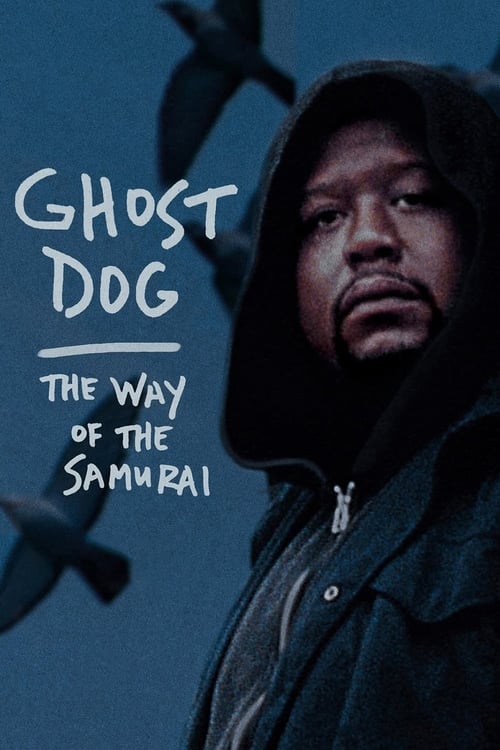
Ghost Dog: The Way of the Samurai
1999 · Jim Jarmusch
For a mellow night when you want cool over adrenaline — something stylish to sink into, headphones on, no rush. Comfort viewing for people who like their crime films strange.
What it's about
Ghost Dog is a solitary Black hitman living on a New Jersey rooftop with his carrier pigeons, who has bound his life to the code of the samurai and serves a small-time mobster as his feudal master. When a contract killing goes wrong in the wrong way, the aging mafia decides he has to go — and the man who lives by an obsolete code has to answer for it.
The experience
Deadpan, unhurried, and quietly funny, with sudden bursts of violence that land harder for the calm around them. It plays like a gangster movie remembered as a fable — you come out feeling oddly peaceful and a little mournful.
Performances
Forest Whitaker carries the film almost silently, giving a killer genuine gravity and gentleness — you believe completely in this impossible man.
The craft
Jim Jarmusch scores a hitman story to the RZA's woozy hip-hop beats and paces it like meditation, punctuating the action with passages from the samurai text his hero lives by. Robby Müller's photography gives run-down urban streets a dreamlike glow. The soundtrack alone justifies good speakers.
Why it matters
A cult landmark of the late-'90s indie scene, its fusion of hip-hop and samurai cinema echoed through crime films and music culture for years after, and it remains one of Jarmusch's most beloved films.
Snapshot
Ghost Dog: The Way of the Samurai is Jim Jarmusch's deadpan collision of two outwardly incompatible value systems: the medieval Japanese warrior code of the Hagakure and the decaying machinery of an American urban mafia. Forest Whitaker plays Ghost Dog, a solitary Black hitman who lives on a rooftop with a flock of carrier pigeons, communicates with his Mob "master" by bird, and conducts his contract killings as acts of feudal service to a retainer who barely remembers he exists. When a hit goes visibly wrong, the aging mobsters mark him for death, and the film becomes an elegy disguised as a gangster picture — a meditation on obsolete codes, mistranslation, and the quiet dignity of men out of step with their time. Scored by the RZA of the Wu-Tang Clan and shot by the great Dutch cinematographer Robby Müller, it is among Jarmusch's most fully realized works: a genre exercise that is really an essay on how cultures borrow, misread, and honor one another.
Industry & production
The film was produced outside the Hollywood studio system, characteristic of Jarmusch's career-long insistence on financial and creative independence. It was assembled as an international co-production drawing on French, German, Japanese, and American sources — among them Pandora Film, JVC, Bac Films, and Jarmusch's own production entity — a financing model Jarmusch had used since Dead Man to retain final cut and ownership of his negatives. Artisan Entertainment distributed it in the United States. The picture premiered in competition at the Cannes Film Festival in 1999 before a wider release that rolled out into 2000.
Jarmusch built the project, as he typically did, around a specific performer: he has said in interviews that he wrote the role for Forest Whitaker, conceiving the character and the film's tone with Whitaker's particular blend of mass and gentleness in mind. The production was modest in scale, shot largely in and around Jersey City and the New York metropolitan area, using real urban locations rather than constructed sets. Within the independent-film economy of the late 1990s — a moment when the "indie" label had been partly absorbed by studio specialty divisions — Ghost Dog stands as a defiantly authorial, non-formulaic product, neither a Miramax-style prestige item nor a genre cash-in.
Technology
Technically the film is conventional for its moment: 35mm photography, optical and practical effects rather than digital manipulation, and a traditional post-production chain. What is notable is less the hardware than the deliberate refusal of spectacle. Jarmusch and Müller worked with available and naturalistic light, and the violence is staged without the kinetic digital enhancement that defined the era's action cinema. One pointed technological motif lives inside the story rather than the production: Ghost Dog's anachronistic use of carrier pigeons as his communication network, set against the mobsters' telephones and the surrounding apparatus of modern surveillance and weaponry. The film quietly contrasts an old, organic, almost monastic technology of messaging with the disposable electronics of the world around it — a thematic rather than a production-level use of "technology."
Technique
Cinematography
Robby Müller — Wim Wenders's longtime collaborator and the cinematographer of Jarmusch's Down by Law, Mystery Train, and Dead Man — gives the film a cool, desaturated, nocturnal palette. Much of the action unfolds at night or in overcast gray, the city rendered in muted blues and industrial browns. Müller favors patient, often static or slowly tracking compositions that grant Ghost Dog a stillness commensurate with his discipline; the camera observes him with the same unhurried attention he brings to his rituals. There is a recurring formal device of framing the protagonist as a small, contained figure within larger urban geometry — rooftops, empty streets, the interiors of stolen cars — emphasizing isolation and self-containment. Müller's naturalism resists glamour: the gangsters' world looks shabby and fluorescent-lit, while Ghost Dog's rooftop possesses an austere, almost spiritual clarity.
Editing
Jay Rabinowitz, who cut several Jarmusch features, structures the film in a measured, contemplative rhythm punctuated by sudden, efficient violence. The most distinctive editorial gesture is the use of intertitle cards quoting the Hagakure (Yamamoto Tsunetomo's eighteenth-century compilation of samurai precepts) to segment the narrative into chapters. These quotations function as both commentary and structuring principle, slowing the film into a series of contemplative beats and inviting the viewer to read the surrounding action against the maxim just stated. Rabinowitz also threads in cutaway gags — bursts of cartoon violence on televisions glimpsed in the background — that rhyme ironically with the human killings, a montage strategy that lets the editing carry much of the film's mordant wit.
Mise-en-scène / staging
The film's design system is built on juxtaposition. Ghost Dog's rooftop aerie — pigeons, books, a single bed, his weapons maintained like ceremonial objects — reads as a contemporary dojo, an island of order. The mobsters, by contrast, occupy a cramped, dingy social club furnished with the iconography of a dying institution: men too old and too broke to embody the myth they inherited. Jarmusch stages the two worlds as mirror images of decline. Costuming is similarly legible: Ghost Dog's hooded streetwear doubles as both contemporary urban camouflage and a kind of warrior's robe, while his drawing of a pistol is repeatedly choreographed and framed as if it were the unsheathing of a sword. Recurrent objects — a copy of Rashomon, an ice-cream cart, a chessboard, caged birds — accumulate symbolic weight through repetition.
Sound
RZA's score is central to the film's identity. Built from hip-hop production — looped beats, dusty samples, minimalist atmospheres — it forges the equation at the film's heart: the parallel between bushido and the disciplined, code-bound ethos of hip-hop culture. The music does not merely accompany the images; it argues for a kinship between samurai asceticism and contemporary Black urban experience. Beyond the score, the sound design honors silence and ambient texture — pigeons, wind, traffic, the mechanical clack of weapons — and Jarmusch repeatedly uses the absence of shared language as a sonic and dramatic motif, most memorably in the friendship between Ghost Dog and the Haitian ice-cream vendor, who speak to one another in English and French respectively and never literally understand a word.
Performance
Whitaker anchors the film with a performance of monumental calm. He plays Ghost Dog as grave, courteous, and almost beatific, his physical bulk transmuted into a sense of rootedness rather than menace; the killing is dispatched with the same economy as his meals or his reading. The supporting ensemble plays in a register of weary comedy: the mobsters — including Henry Silva and John Tormey as Louie, the retainer whose life Ghost Dog once owed — are rendered as decrepit, bickering relics, their gangster bravado undercut at every turn. Isaach De Bankolé, as the ice-cream man Raymond, provides the film's warmth, and the young girl Pearline functions as a figure of inheritance, the one to whom the code might pass. The performances are uniformly pitched at Jarmusch's signature deadpan, where solemnity and absurdity coexist without ironic wink.
Narrative & dramatic mode
The narrative mode is elegiac and episodic rather than propulsive. While the plot follows the skeleton of a thriller — a hit, a betrayal, a hunted man, a reckoning — Jarmusch consistently drains it of conventional suspense in favor of digression, ritual, and philosophical reflection. The Hagakure intertitles convert the story into a series of illustrated precepts, so that each plot turn becomes a demonstration of a principle about duty, death, and loyalty. Dramatic irony pervades the film: Ghost Dog serves a master who has forgotten him, upholds a code his enemies cannot read, and pursues a death he has already accepted as the warrior's proper end. The tone is one of melancholy comedy, and the structure circles toward a resolution that is less a victory than a fulfillment of obligation — the consummation of a code rather than the triumph of a hero.
Genre & cycle
Ghost Dog sits at the intersection of the gangster film, the lone-assassin thriller, and the samurai picture, deliberately hybridizing all three. It belongs to a lineage of "hitman with a code" films and to the late-1990s vogue for genre pastiche, but Jarmusch's treatment is closer to deconstruction than homage: he uses the conventions to stage a cross-cultural argument rather than to deliver genre satisfactions. The film can also be read within the cycle of postmodern, sample-based filmmaking contemporaneous with Quentin Tarantino's work — a sensibility that treats prior cinema and literature as a library to be quoted — though Jarmusch's borrowings are gentler, more melancholic, and more anthropological in spirit than parodic.
Authorship & method
The film is a near-complete expression of Jarmusch's authorial method. His career — Stranger Than Paradise, Down by Law, Mystery Train, Night on Earth, Dead Man — is built on outsiders, deadpan humor, cross-cultural encounter, and the poetry of marginal American spaces, and Ghost Dog gathers all of these into one work. Jarmusch wrote as well as directed, building the script around layered intertextual sources (the Hagakure, Melville's cinema, Kurosawa's Rashomon) and around the personality of his lead actor.
His key collaborators are essential to the result. Cinematographer Robby Müller supplies the cool, humane naturalism that had defined their earlier films together. Editor Jay Rabinowitz organizes the contemplative rhythm and the intertitle architecture. The RZA's score is arguably the film's boldest authorial signature, a sonic thesis that binds the project's disparate worlds. The collaborative ethos — Jarmusch's preference for a recurring "family" of artists and his ceding of a whole expressive register to a musician from outside cinema — is itself characteristic of his method.
Movement / national cinema
Jarmusch is a foundational figure of American independent cinema, and Ghost Dog exemplifies that tradition's values: authorial control, low budgets, location shooting, and an aesthetic descended in part from European art cinema. The film is also self-consciously transnational. Its financing was international, and its imaginative geography spans Japan (the Hagakure, the samurai film), France (Jean-Pierre Melville's Le Samouraï, the French-speaking Haitian character), and the Caribbean, all grounded in a depressed American postindustrial cityscape. It is an American film in conversation with world cinema, and one whose subject is precisely the migration of ideas across national and cultural borders.
Era / period
Released at the turn of the millennium, Ghost Dog belongs to a moment when American independent film had matured and partly merged with studio specialty divisions, and when hip-hop had become a dominant cultural force capable of reframing older traditions. The film's fusion of bushido and hip-hop is legible as a product of its late-1990s context, when sampling — musical, cinematic, philosophical — was a defining creative logic. It also registers a fin-de-siècle mood of belatedness: its recurring subject is the survival of old codes into a disenchanted present, an anxiety well suited to the end of a century.
Themes
The film's central theme is the persistence and obsolescence of codes — bushido, omertà, the disciplines of hip-hop — and what it means to live by a system of honor in a world that no longer recognizes it. Around this cluster gather its other concerns: mistranslation and the possibility of communion without shared language; friendship across the lines of race, nationality, and tongue; the nearness of death and its acceptance as a condition of meaningful life; and cultural inheritance, dramatized through books that pass from hand to hand (Rashomon, the Hagakure) and through the figure of the child who may carry the code forward. The recurring cartoon violence and the dilapidation of the mob underscore a vision of American culture as both brutal and exhausted, with Ghost Dog's borrowed discipline standing as a fragile, dignified alternative.
Reception, canon & influence
Critical reception was substantial and, on balance, admiring, though some reviewers found the film's pace languid or its cross-cultural conceit overly schematic; the precise contours of its commercial performance are not something I can responsibly quantify here. Over time its reputation has grown, and it is now widely regarded as one of Jarmusch's major works and a touchstone for the cinematic dialogue between hip-hop and the samurai tradition.
Its backward-looking influences are explicitly worn. The dominant cinematic model is Jean-Pierre Melville's Le Samouraï (1967), itself a French gangster film that imported a fictionalized bushido onto its lone, fastidious assassin — Jarmusch inherits Melville's iconography of the solitary professional, the ritualized preparation, and the bird as companion and omen. Kurosawa stands behind the film both through Rashomon, which appears as a physical object passed among characters and as a thematic emblem of perspective and storytelling, and through the broader samurai-film tradition. The literary spine is Yamamoto Tsunetomo's Hagakure, quoted throughout. The hard-boiled American crime film and, more diffusely, the Japanese assassin cinema of figures such as Seijun Suzuki inform its genre framework.
Looking forward, Ghost Dog helped consolidate the cultural pairing of hip-hop with martial and samurai mythology — a current already present in the Wu-Tang Clan's own iconography and one that the RZA would pursue further, notably in his later directorial work in the martial-arts genre. The film deepened Jarmusch's standing as a model of sustained independent authorship and became a frequently cited reference point for subsequent filmmakers interested in genre as a vehicle for cross-cultural meditation. Its enduring legacy lies less in any single imitator than in its demonstration that a gangster picture could double as a philosophical essay — that the way of the samurai could be walked, with full seriousness and full irony, on a tenement rooftop in New Jersey.
A Deleuzian reading
Watch the way he draws the gun.
The full Deleuzian reading of Ghost Dog: The Way of the Samurai →
Reception
A modest performer at the box office in 1999 with respectful-but-mixed reviews, it's since climbed into the front rank of Jarmusch's filmography — now routinely cited as one of his very best and a landmark of hip-hop-inflected cinema.
How Ghost Dog: The Way of the Samurai was received, from release to now →
Influences: the films it descends from and the films it influenced
- Le Samouraï (1967) — Supplies the template of the fastidious lone professional whose ritualized pre-kill preparation and caged-bird companion Jarmusch transposes wholesale, down to the assassin's blank fidelity to a private code.
- Rashomon (1950) — Cited diegetically as a book passed between characters, its bushido-perspective theme becomes the film's emblem for storytelling and the unreliability of point of view that Jarmusch threads through his episodic structure.
- Branded to Kill (1967) — Models the deadpan, absurdist Japanese hitman picture where stylized assassination set-pieces and a fetishized professionalism tip into surreal comedy — the ironic register Jarmusch's killing scenes inherit.
- Le Cercle Rouge (1970) — Extends Melville's cool, near-wordless choreography of the criminal craftsman, the procedural patience and minimal dialogue that shapes Ghost Dog's contemplative, untranslated rhythms.
- Yojimbo (1961) — Establishes the masterless swordsman moving between warring criminal factions with detached competence, the rōnin-among-gangsters armature Jarmusch literalizes by arming his samurai with a pistol-as-sword.
- Lone Wolf and Cub: Sword of Vengeance (1972) — Provides the Hagakure-quoting assassin who lives by a written death-cult code, the literary-bushido voice-over device Jarmusch adopts via on-screen Hagakure intertitles.
- Point Blank (1967) — Pioneers the fractured, ritualistic hard-boiled revenge thriller where a single-minded professional executes a methodical reckoning, the American crime-film spine beneath Ghost Dog's mythic minimalism.
- Stranger Than Paradise (1984) — Originates Jarmusch's deadpan-episodic grammar — static long takes, chapter intertitles, and outsider drift — the formal architecture Ghost Dog reuses for its elegiac structure.
- Down by Law (1986) — First pairs Jarmusch with Robby Müller's humane naturalistic light and the comedy of marginal men, the cinematographic and tonal DNA carried directly into Ghost Dog's New Jersey rooftops.
- Dead Man (1995) — Its predecessor in genre-as-philosophical-essay: a mortality-bound journey scored by an outside musician (Neil Young's guitar there, RZA's beats here) over Müller's elegiac frames, treating a pulp form with full metaphysical seriousness.
- Violent Cop (1989) — Jarmusch explicitly models Ghost Dog's affectless hitman performance on Kitano's method — long silences, communication through gaze and physical action, absence of explanatory dialogue — and stages the film's violence with the same deadpan non-amplification: sudden, undramatized, consequence-first.
- Army of Shadows (1969) — Jarmusch named Melville as Ghost Dog's primary formal source: the isolated professional bound by a code that will destroy him, extended silences functioning as dramatic content rather than gap, RZA's spare score structurally equivalent to Melville's orchestral passages — marking the weight of the moment without providing emotional instruction.
- Le Samouraï’s heir — The Limits of Control (2009) — Jarmusch's own later refinement of the silent ritual-assassin, stripping Ghost Dog's bushido professional down to a near-wordless figure performing repeated coded rites across static compositions.
- Kill Bill: Vol. 1 (2003) — Builds the same pop-collage of samurai-film grammar, untranslated language, and chapter intertitles, treating Eastern martial codes as a mythic vocabulary grafted onto an American revenge structure.
- The Man with the Iron Fists (2012) — RZA's directorial extension of the hip-hop/martial-arts synthesis he forged scoring Ghost Dog, making explicit the Wu-Tang-as-Shaolin mythology the earlier film's score thesis proposed.
- Drive (2011) — Revives the Melville-by-way-of-Ghost-Dog lone professional bound by silence and code, where a genre-binding score (here synth-pop) does the expressive work and violence erupts from ritual calm.
- The American (2010) — A direct descendant of the meticulous-craftsman assassin, foregrounding the solitary professional's tool-rituals and ascetic routine in static, naturalistically lit compositions descended from the Melville-Jarmusch line.
- Coffee and Cigarettes (2003) — Carries forward Ghost Dog's RZA/GZA cross-pollination of cinema and hip-hop culture and its deadpan vignette form, with the Wu-Tang figures appearing as themselves in static two-shots.
- Ghost in the Shell (1995) — A parallel contemporaneous fusion of philosophical voice-over and the solitary armed operative moving through a melancholy urban landscape, sharing Ghost Dog's meditative-essay treatment of the killer-with-a-code.
- Sonatine (1993) — Jarmusch arrives at a formally parallel aesthetic through shared genealogy — both films derive the impassive criminal ritualist from Le Samouraï — substituting RZA's sparse, repetitive hip-hop score in place of Hisaishi's piano phrases; Ghost Dog is a sibling-in-influence rather than a direct stylistic descendant, both films discovering that Melville's model translates across cultural contexts when its essence (stillness, code, fatalism) is preserved.
Similar films
- Rashomon (1950) — influence & lineage · often watched together
- Dead Man (1995) — influence & lineage
- Branded to Kill (1967) — influence & lineage
- Le Samouraï (1967) — influence & lineage
- Yojimbo (1961) — influence & lineage
- Ghost in the Shell (1995) — influence & lineage
- Down by Law (1986) — influence & lineage
- Harakiri (1962) — often watched together
All the films related to Ghost Dog: The Way of the Samurai →