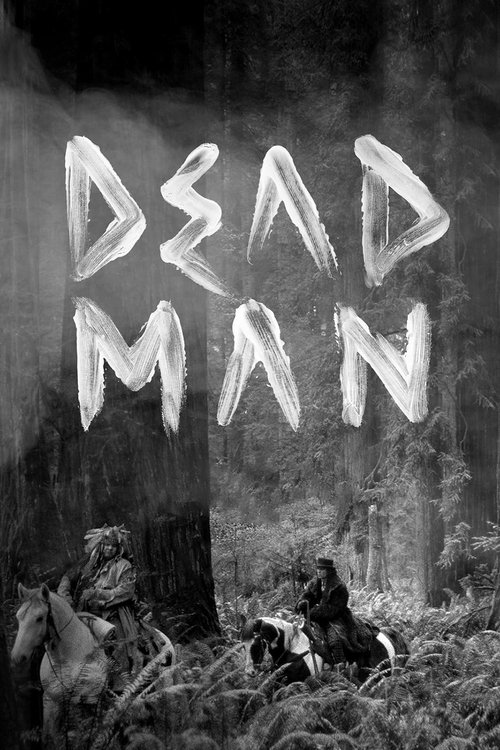
Dead Man
1995 · Jim Jarmusch
For a late night when you want to drift — something strange, deadpan, and death-haunted to sink into rather than a story to follow. A meditative challenge, not comfort food.
What it's about
A meek Cleveland accountant named William Blake rides the train west to the industrial hell-town of Machine, only to find the job he was promised has evaporated. A killing leaves him mortally wounded and on the run through the frontier, where a solitary, erudite Native American man called Nobody — convinced Blake is the reincarnated English poet — appoints himself guide for the dying man's last journey.
The experience
Hypnotic and funny in the driest possible way, it moves like a fever dream: slow fades, long silences, sudden violence, and Neil Young's raw electric guitar scraping over black-and-white landscapes. It's less watched than absorbed, and it lingers for days.
Performances
Johnny Depp gives one of his most restrained performances, letting bewilderment slowly harden into something stranger, while Gary Farmer's Nobody — wry, learned, and quietly furious — steals the film and gives it its soul.
The craft
Robby Müller's black-and-white cinematography turns the American West into an alien, primordial place, and Neil Young's improvised solo-guitar score is one of the most distinctive in modern film. Jarmusch structures the journey as a series of fades to black, like a life dimming out — it rewards a dark room and good sound.
Why it matters
Divisive at Cannes in 1995, it has since hardened into a canonical work of '90s American independent cinema and the definitive revisionist Western of its decade, deeply influential on how later films handle the frontier myth and Indigenous perspective.
Snapshot
Dead Man is Jim Jarmusch's black-and-white anti-Western, a hallucinatory death-journey that follows a meek Cleveland accountant named William Blake (Johnny Depp) west to the industrial hell-town of Machine, where a promised bookkeeping job has already evaporated. A killing leaves Blake mortally wounded and on the run; a solitary, erudite Native American man called Nobody (Gary Farmer) mistakes him for the reincarnated English poet and appoints himself guide, escorting the dying man toward the water and the passage out of this world. Premiering in competition at Cannes in 1995 and released in the United States by Miramax the following year, the film was divisive on arrival and has since hardened into a canonical work of 1990s American independent cinema — the picture that critic Jonathan Rosenbaum did the most to enshrine under the label "acid Western." It pairs Depp at the height of his stardom with Robert Mitchum in his final feature role, and rides on Neil Young's improvised solo-guitar score, one of the most distinctive in modern American film.
Industry & production
Dead Man sits at the collision point of American independent auteurism and the mid-1990s "indie boom" then being consolidated by Miramax. Jarmusch, by this stage, was among the most autonomous filmmakers in the country: he had long insisted on retaining final cut and ownership of his negatives, an arrangement almost unheard of at his budget level and central to understanding how a film this uncommercial got made on his own terms. Financing was assembled internationally, as was typical of his work, and the production was modestly budgeted by studio standards — reported figures cluster in the neighborhood of nine million dollars, though Jarmusch's productions rarely publish audited numbers and I would treat any single figure with caution.
The shoot ranged across western landscapes (locations in the American West, including desert and Pacific Northwest forest terrain), and the logistics of a period Western — trains, horses, frontier towns, a trading post — pushed Jarmusch well beyond the storefront minimalism of his earlier films. Distribution proved contentious: Miramax's Harvey Weinstein was reportedly uneasy with the film's length, pace, and non-commercial temperament, but Jarmusch's contractual control meant the film reached screens essentially as he intended. Its U.S. theatrical release was limited and belated relative to the Cannes premiere, and by common account it underperformed commercially in North America; I don't have reliable grosses to cite and won't invent them. The disappointment was real enough that Dead Man became a touchstone case in debates about how the studio-owned "indie" apparatus handled genuinely difficult work.
Technology
The film was shot on 35mm and finished in black and white — a deliberate, increasingly rare choice by 1995, when monochrome had become an aesthetic statement rather than a default. It carries a standard theatrical aspect ratio (1.85:1). The most notable technological dimension is aural rather than visual: Neil Young's score was generated by having the musician improvise on electric guitar (with some acoustic guitar and organ) while watching the assembled film projected in the studio, essentially performing the picture in real time. This method — closer to live silent-film accompaniment than to conventional cue-based scoring — is inseparable from the film's texture, and its rawness (feedback, decay, string noise) is a technological signature as much as a compositional one.
Technique
Cinematography
Robby Müller, the Dutch cinematographer and one of Jarmusch's most important collaborators (as well as Wim Wenders'), shot Dead Man, and it stands among his finest achievements. The black-and-white photography is high in contrast and unusually attentive to gradation — bright skies and inky forests, faces isolated in pools of light. Müller favors a restrained, observational camera that lets landscape and figure hold the frame, punctuated by the film's most conspicuous formal device (see below). The imagery consciously evokes both classical Western iconography and early photography, lending the frontier a spectral, already-historical quality — as if we are watching a world being remembered rather than lived.
Editing
Jay Rabinowitz, a longtime Jarmusch editor, cut the film, and its defining structural gesture is the fade to black between scenes. Rather than dissolving or cutting directly, Dead Man repeatedly darkens completely and then fades up, segmenting the narrative into discrete tableaux separated by small deaths. This rhythm — episodic, punctuated, unhurried — turns the journey into a series of stations and reinforces the sense that Blake is passing incrementally out of the world. The pacing is deliberately slow and accretive, an editorial stance that many first viewers found alienating and that admirers read as the film's whole point.
Mise-en-scène / staging
Jarmusch stages the two poles of the film in sharp opposition. The town of Machine is a mire of mud, industry, and menace — animal skulls, coffins, a metalworks belching smoke — a frontier stripped of romance and rendered as proto-industrial squalor. Against it stands the open landscape and the forest, spaces of silence and gradual dissolution. Costuming charts Blake's transformation: the checkered "clown" suit of the tenderfoot accountant gradually gives way, under Nobody's tutelage, to face paint and the trappings of a man being prepared for death. Props carry symbolic freight (Blake's eyeglasses, the poet's namesake, the gun that miscasts him as a killer), and Jarmusch's framing is patient and frontal, closer to tableau than to conventional Western coverage.
Sound
Beyond Young's score, the film's sound design leans on natural ambience — wind, water, the crackle of fire, the mechanical din of Machine — and on long passages with sparse dialogue. Young's guitar enters not as underscore smoothing the action but as an almost bodily presence, swelling and receding, so that music and image feel co-authored. The contrast between industrial noise and wilderness quiet is itself a thematic instrument.
Performance
Depp plays Blake in a register of bewildered passivity, a naïf drawn helplessly through violence he barely understands; it is a deliberately reactive performance that deepens as the character approaches death. Gary Farmer's Nobody is the film's moral and comic center — sardonic, learned, quoting Blake's poetry, delivering the recurring rebuke "stupid fucking white man" (a line and persona Farmer would echo in Jarmusch's later Ghost Dog). The supporting cast is a gallery of vivid grotesques: Robert Mitchum as the tyrannical industrialist John Dickinson in his last screen role; Lance Henriksen as the cannibal bounty hunter Cole Wilson; Michael Wincott as the garrulous Conway Twill; Crispin Glover as the spectral train fireman; Iggy Pop and Billy Bob Thornton among the deranged trappers; with John Hurt, Gabriel Byrne, Alfred Molina, and Mili Avital in smaller roles.
Narrative & dramatic mode
The film's dramatic mode is that of the mythic journey — a death-passage structured as a westward and then oceanward pilgrimage. It borrows the road-movie/quest armature Jarmusch had used before but inflects it toward allegory and vision: as Blake weakens, the narrative loosens its grip on realism and drifts toward the oneiric. The fade-to-black structure keeps the storytelling elliptical and stational rather than causal. Dialogue is often deadpan and absurdist even amid violence, sustaining Jarmusch's characteristic tonal doubleness — the film is at once solemn elegy and dry black comedy. The Henri Michaux epigraph that opens the film — to the effect that it is preferable not to travel with a dead man — frames the whole as a meditation on companionship, mortality, and passage rather than a plot to be resolved.
Genre & cycle
Dead Man is a revisionist Western that pushes past revisionism into something stranger. Rosenbaum's term "acid Western" — evoking a psychedelic, countercultural inversion of the genre's frontier myth — has stuck to it more firmly than to any other film, and the picture is now routinely cited as the form's fullest realization. It dismantles the classical Western's iconography: the West here is not a space of regeneration but of industry, disease, and casual slaughter; the gunfighter is an accountant who never wanted a gun; the "Indian companion" is the film's most articulate and modern consciousness rather than a silent sidekick. It belongs to a lineage of anti-mythic Westerns (from the elegiac and revisionist cycles of the 1960s–70s) while standing apart from the more conventional 1990s Western revival around it.
Authorship & method
Dead Man is unmistakably a Jarmusch film — episodic, deadpan, preoccupied with outsiders and cultural crossings — yet it marks a departure toward the elegiac and the mythic, away from the urban minimalism of Stranger Than Paradise, Down by Law, and Mystery Train. Jarmusch wrote as well as directed, and his method here foregrounds collaboration with a stable of trusted artists. Robby Müller's monochrome cinematography and Jay Rabinowitz's fade-structured editing are constitutive of the film's identity, not decorative. Neil Young's improvised score is perhaps the clearest instance of Jarmusch treating a collaborator as co-author: rather than commissioning cues to a temp track, he handed the finished film to a musician and let the performance become the soundtrack. The casting method — assembling admired actors and musician-friends into cameo-scaled roles — is likewise a Jarmusch hallmark, turning the ensemble into a kind of curated community.
Movement / national cinema
The film is a product of American independent cinema, and specifically of the downtown New York sensibility from which Jarmusch emerged — a milieu adjacent to No Wave music and post-punk art film, more attuned to European art cinema and to American underground traditions than to Hollywood. Jarmusch's affinities are transnational (his crews and financiers were often European, his cinephilia catholic), which places Dead Man at an interesting angle to "national cinema": it is an American subject — the frontier, the founding myth — filtered through a distinctly cosmopolitan, art-cinema lens. It also participates, pointedly, in the emergence of more self-aware and critical representations of Native American experience in 1990s American film, giving Gary Farmer's Nobody an intelligence and irony largely denied Indigenous characters in the classical Western.
Era / period
Made in the mid-1990s at the crest of the American indie wave, Dead Man both benefits from and resists that moment. The era's appetite for auteur-driven independent film made its financing and distribution conceivable; its temperament — slow, monochrome, uningratiating — cut against the same era's drift toward marketable "indie" product. Set in the late nineteenth-century American West (its industrial imagery evoking the closing frontier and the machine age encroaching on wilderness), the film uses period to diagnose modernity's origins: Machine is the frontier already becoming the factory. The choice of black and white further distances the film from its production moment, situating it in a memorial, almost archival past.
Themes
Death is the governing subject — not as event but as process, a gradual crossing that the film treats with equal parts solemnity and absurdity. Bound up with it is the theme of poetry and identity: Nobody's insistence that the accountant is the poet William Blake makes literary reincarnation a literal plot engine and threads Blake's own visionary verse through the dialogue. Colonialism and the violence of American expansion run throughout — the West as a landscape of extermination, disease, and commerce rather than freedom — and the film consciously inverts the genre's racial hierarchy by making its Native character the source of wisdom and modern consciousness. Industrialization and dehumanization (the town literally named Machine, Dickinson's metalworks) set the mechanical against the spiritual. And beneath it all lies a meditation on companionship and passage: the guide and the dying man, the reluctant intimacy of accompanying someone to the threshold.
Reception, canon & influence
Critical reception on release was sharply split. The film had prominent detractors — Roger Ebert was famously unpersuaded — who found it slow, opaque, and self-indulgent, and it did not perform well commercially in the United States. But it also had an unusually committed champion in Jonathan Rosenbaum, who not only defended it but wrote a book-length study for the BFI Modern Classics series, doing much to establish both the film's critical standing and the "acid Western" framework through which it is now read. Over the decades since, the consensus has shifted decisively toward admiration, and Dead Man is today widely regarded as one of Jarmusch's major works and among the essential American films of the 1990s.
Looking backward, the film draws on the poetry of William Blake, on Native American culture and the ethics of Indigenous representation, on the revisionist and elegiac Western traditions, on the road movie, and on Jarmusch's own art-cinema lineage; the Michaux epigraph signals its literary, European inflection. Looking forward, its influence runs along several lines. It cemented "acid Western" as a working critical category and became the reference point for subsequent psychedelic and revisionist frontier films. Neil Young's score influenced how filmmakers think about improvised, performance-based scoring. Within Jarmusch's own filmography, it prefigures Ghost Dog: The Way of the Samurai, which reprises the meditative-death-code register and brings Gary Farmer back as a comic echo of Nobody. Its rehabilitation of Depp as an art-film actor and its stature as Robert Mitchum's valediction have both fed its enduring reputation. Where the documentary record is thin — precise budget and box-office figures, the exact contours of the Miramax dispute — I have flagged the uncertainty rather than fill it, but the arc of the film's afterlife is not in doubt: a commercial disappointment that became a canonical film.
A Deleuzian reading
A man in a checkered suit sits by a train window going west.
The full Deleuzian reading of Dead Man →
Reception
Booed-adjacent at Cannes and a box-office flop in 1995 — Roger Ebert famously trashed it — while Jonathan Rosenbaum hailed it as an 'acid western' masterpiece; Rosenbaum won. It's now widely regarded as Jarmusch's peak and one of the great American films of the '90s.
How Dead Man was received, from release to now →
How to watch Dead Man: what to notice on a first viewing
- Watch for the screen going completely black between scenes. Jarmusch and editor Jay Rabinowitz fade to full black after almost every scene, then fade back up somewhere new. The story becomes a series of arrivals rather than a chain of cause and effect.
- Notice faces sitting in isolated pools of light. Robby Müller's high-contrast black-and-white photography keeps skies bright and forests nearly solid black, faces glowing out of the dark. The frontier looks already historical, like a world being remembered rather than lived.
- Listen for Neil Young's electric guitar swelling and receding under scenes. The guitar was improvised live to the finished film rather than composed to cues, so it rises and falls with the picture instead of underlining moments. Music and image share the scene as equals instead of one serving the other.
- Look at the mud, smoke, and animal skulls in Machine. Jarmusch stages the town as squalid industrial menace, then cuts to open forest and water as Blake travels further from it. The two spaces map the difference between the world Blake is dying out of and the one he is dying into.
The whole guide to watching Dead Man, with the keys for a rewatch →
Influences: the films it descends from and the films it influenced
- The Night of the Hunter (1955) — Lights Robert Mitchum's face in the same expressionist chiaroscuro Müller reprises, and stages its journey as a Blakean folk-fable — the exact register of mythic, elliptical menace Dead Man borrows down to casting Mitchum himself.
- McCabe & Mrs. Miller (1971) — Lays a musician's pre-existing songs (Leonard Cohen) over a finished cut rather than scoring to picture — the same 'hand the film to a performer' method Jarmusch used with Neil Young — inside a mud-and-machine revisionist frontier.
- Pat Garrett and Billy the Kid (1973) — Treats a musician (Bob Dylan) as both cameo player and composer-performer for an elegiac, death-drenched Western, prefiguring Dead Man's fusion of musician-friends-as-cast and performance-based scoring.
- El Topo (1970) — Establishes the 'acid Western' — a hallucinatory frontier structured as a mystical death-quest guided by spirit-mentor figures — the template Rosenbaum used to read Nobody's shepherding of William Blake.
- Greaser's Palace (1972) — Pioneers the deadpan-surreal acid-Western allegory of a messianic wanderer moving through an absurdist frontier, the countercultural strain of parody-mysticism Dead Man inherits and refines.
- The Shooting (1966) — Strips the Western to an existential, elliptical death-journey with reactive, near-passive protagonists and withheld motive — the minimalist mythic-quest grammar Jarmusch adopts over conventional plot.
- Stranger Than Paradise (1984) — Jarmusch's own invention of the fade-to-black blackout as a structural editing device carving the film into discrete episodic panels — the exact fade-structure Rabinowitz deploys across Dead Man.
- Down by Law (1986) — First pairs Jarmusch with Robby Müller's high-contrast monochrome and deadpan outsider-ensemble method, the cinematographic and casting partnership Dead Man deepens into elegy.
- Kings of the Road (1976) — Müller's black-and-white road-movie grammar — figures dwarfed by monochrome landscape on a westward drift — is the visual language he carries directly into Dead Man's train-and-wilderness passage.
- Little Big Man (1970) — Reframes the frontier from an Indigenous vantage and satirizes colonial genocide, the revisionist ethics of Native representation Jarmusch extends via Nobody and the trading-post massacre imagery.
- Pat Garrett & Billy the Kid (1973) — A doomed journey toward death scored by a solo singer-songwriter (Neil Young), carrying forward elegy-not-suspense and the integration of contemporary musicianship into Western scoring.
- Two-Lane Blacktop (1971) — A journey film of elliptical episodes and withheld affect, using diegetic sparseness and an anti-heroic non-arrival ending — the contemplative drift toward dissolution Two-Lane pioneered, in Western dress.
- Ghost Dog: The Way of the Samurai (1999) — Directly reprises the meditative death-code protagonist, brings Gary Farmer back as a comic echo of Nobody, and hands the finished film to RZA for a beat-driven improvised score exactly as Young scored Dead Man.
- The Assassination of Jesse James by the Coward Robert Ford (2007) — Extends the slow, elegiac mythic-death Western with Nick Cave and Warren Ellis's ambient score built as sustained performance rather than cued composition, echoing Young's improvised guitar drone.
- The Proposition (2005) — Fuses colonial-frontier violence with Nick Cave's spare, dread-laden performed score, carrying forward Dead Man's braid of settler brutality and musician-authored soundscape.
- Meek's Cutoff (2010) — Builds a frontier out of natural ambience and elliptical, near-eventless duration with an Indigenous guide whose knowledge the whites can't read — the reactive-passivity and machine-vs-wilderness ethic Dead Man models.
- Slow West (2015) — Revives the acid-Western's deadpan-surreal mythic journey — a naive traveler shepherded across a lethal, dreamlike frontier toward inevitable death — explicitly downstream of Dead Man's tonal template.
- Embrace of the Serpent (2015) — Black-and-white spiritual death-journey in which an indigenous companion (Nobody) reorients the whole cosmology, decentering the white protagonist — the colonial-inversion and indigenous-guide framework Embrace inherits.
- Only Lovers Left Alive (2013) — The immediate stylistic antecedent: a contemplative nocturnal drift scored by a musician (Neil Young) improvising drone to the image — the model for the van Wissem/SQÜRL method.
- Birds of Passage (2018) — The genre Western reframed through indigenous cosmology and spirit-guidance, using fade-to-black interludes as formal chapter dividers — the same tactic of letting a native worldview overwrite the settler-genre's causality.
- Ravenous (1999) — A deadpan revisionist western that reads westward expansion as a slow death and lets an anachronistic rock musician's score (Neil Young's improvised guitar) set the tone, much like Albarn's pop sensibility in Ravenous.
- November (2017) — Robby Müller's high-contrast monochrome, combined with deadpan absurdist dialogue in a mythic setting, anticipates November's mix of sublime black-and-white images with dry, comic episodes about peasant life.
- First Cow (2019) — Sustains the elegiac Pacific-Northwest frontier through natural sound and machine-vs-wilderness intimacy, extending Dead Man's anti-heroic, process-of-death register into quiet economic tragedy.
- Dancer in the Dark (2000) — Another Müller collaboration whose stark, grained handling of light demonstrates the cinematographer's range that von Trier exploits in the muted, desaturated palette of Selma's world.
Similar films
- Ghost Dog: The Way of the Samurai (1999) — influence & lineage
- Stranger Than Paradise (1984) — influence & lineage
- Down by Law (1986) — influence & lineage
- Lone Star (1996) — shared sensibility
- No Country for Old Men (2007) — shared sensibility
- Stagecoach (1939) — shared sensibility
- The Man Who Wasn't There (2001) — shared sensibility
- Faust (1994) — shared sensibility