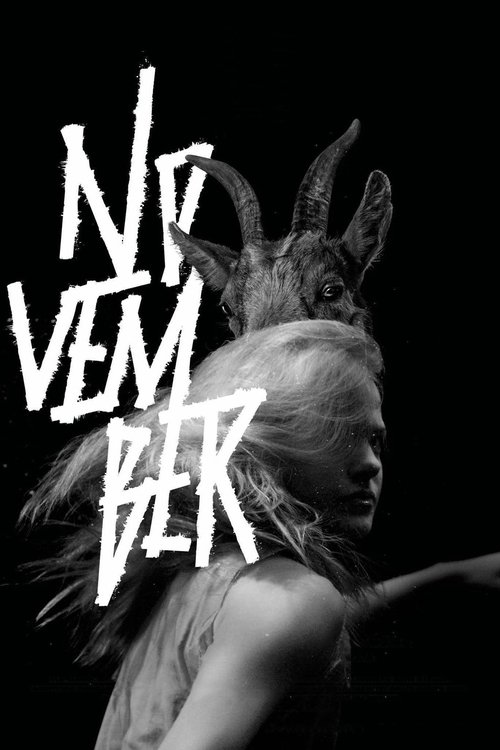
November
2017 · Rainer Sarnet
For when you want something genuinely unlike anything you've seen — a slow, moonlit fairy tale with dirt under its nails. A challenge more than a comfort, best saved for a night you're willing to surrender to a strange rhythm.
What it's about
In a starving nineteenth-century Estonian village, peasants survive the winter by any means available: stealing from the Baltic German manor, bargaining with the Devil at a crossroads, and building kratts — servant creatures assembled from scythes, bones and buckets and animated with a bought soul. Amid all this scheming, a farm girl named Liina loves a village boy, Hans, who only has eyes for the baron's sleepwalking daughter. It's a love triangle tangled up in witchcraft, werewolves and visits from the walking Plague.
The experience
Strange, deadpan and gorgeous — it swings between grotesque folk comedy and genuine ache, with images so stark they feel like woodcuts come to life. The pace is unhurried and dreamlike, but the weirdness keeps you leaning in, and the love story sneaks up on you.
Performances
Rea Lest gives Liina a fierce, wordless longing that anchors all the absurdity, and Jörgen Liik makes Hans's lovesick haze oddly touching.
The craft
The black-and-white cinematography is the star: frost, marsh and candlelight rendered in silvery high contrast, every frame composed like a folk engraving. Adapted from one of Estonia's best-loved modern novels, it treats its pagan logic matter-of-factly, which makes the magic feel lived-in rather than decorative. It absolutely rewards the biggest, darkest screen you can find.
Why it matters
It became the rare Estonian film to break out internationally, serving as the country's Oscar submission and introducing world audiences to a distinctly Baltic strain of folk fantasy.
Snapshot
November (Estonian: November) is a black-and-white folk fantasy set in a nineteenth-century Estonian village. Rainer Sarnet wrote and directed it, adapting Andrus Kivirähk's 2000 novel Rehepapp ehk November (The Old Barny, or November), one of the best-selling Estonian novels of the post-Soviet era. In a marshy, half-starved hamlet beneath a Baltic German manor, peasants steal from the manor, from each other and from the dead. They make deals with the Devil at a crossroads, trick the Plague when it comes walking down the road, and send out "kratts": servant creatures built from scythes, skulls, buckets and animal bones and brought to life with a soul bought for three drops of blood. At the centre is Liina (Rea Lest), a farm girl who loves the young villager Hans (Jörgen Liik). Hans is infatuated with the baron's sleepwalking daughter (Katariina Unt). Liina can also become a wolf.
The film premiered at the Tribeca Film Festival in 2017, where Mart Taniel won the festival's cinematography award in the international narrative competition. It was Estonia's submission for the Academy Award for Best Foreign Language Film for that year and was not nominated. It played widely on the festival circuit and was released in the United States by Oscilloscope Laboratories. It is probably the best-known Estonian feature of its decade outside Estonia, and it is often cited in discussions of the 2010s folk-horror revival. Its tone sets it apart from that revival: it is earthy, grotesque, funny and romantic all at once, and it moves through dread and absurdity with the same matter-of-fact poise.
Industry & production
The film was produced by Katrin Kissa for the Tallinn company Homeless Bob Production, with European co-production partners. Most accounts name Poland's Opus Film, the company behind Paweł Pawlikowski's Ida, and a Dutch partner, PRPL. The Estonian Film Institute and Estonian cultural funding bodies backed it. Detailed public figures on the budget are scarce. By international standards it was a modest European art-film production, but it was ambitious for Estonia because it needed period settings, animal performers, a large cast of villagers and many practical creature effects.
The co-production structure brought in more than money. The score came from the Polish composer Jacaszek, and some post-production went through the partner countries. This was the standard route for small-nation art cinema in the 2010s, where combining state and European funds made larger-scale projects possible.
The project came with a recognised literary brand. Kivirähk's novel was a bestseller and had already been adapted for the stage, so the film could expect a domestic audience. It performed well at the Estonian box office on release, though this dossier does not give precise admissions figures. Oscilloscope's US release in 2018 gave it an unusually wide reach for an Estonian film.
Technology
November was shot digitally and finished in high-contrast monochrome. The black-and-white image is not a nostalgic veneer. It does real work in the film. Deep blacks, blown-out snow and silvery mist make the photography read sometimes like nineteenth-century glass-plate images and sometimes like expressionist woodcuts.
The kratts are mostly built practically. They are physical assemblages of farm tools, wood, bone and hide, moved by puppetry, rigging and digital clean-up rather than computer-generated as creatures. Their clattering, jointed movement is part of the film's craft appeal. They feel as handmade as the peasants who build them, which fits a story where everything is improvised from what is lying around. Digital compositing is used with restraint for transformations, the ghostly dead and the Plague's changes of shape. The tactile, practical look dominates.
Technique
Cinematography
Mart Taniel's photography is the most celebrated part of the film and is what won the Tribeca prize. He gets a wide tonal range from the monochrome: frost-glazed fields, smoke-dark interiors lit by single sources, and moonlit night exteriors where figures come out of fog. Many compositions are formal tableaux. Villagers are lined up in a frontal plane, the dead process through birch woods in white shrouds, and Liina stands alone against an empty sky.
The camera is usually measured rather than kinetic. It favours held frames and slow movement, which lets the strangeness of the images settle in. Critics regularly reached for painterly and photographic comparisons, including Romantic landscape painting, early ethnographic photography and the high-contrast black-and-white of Eastern European art cinema. The images are also often funny. Taniel frames absurdities, such as a kratt made from a snowman or a peasant posing in stolen finery, with the same gravity as the sublime images, and the deadpan gravity is part of the joke.
Editing
The film is built episodically, following the novel's loose, anecdotal structure. It cuts between the love triangle, the village's schemes against the manor, the scheming among villagers, and set pieces such as All Souls' Day, when the dead come home, are fed and are bathed in the sauna. The rhythm is unhurried, with long passages of atmosphere broken by sudden jolts of slapstick or violence. Credit information for the editor is not reliably recorded in widely available sources, so this dossier does not name one.
Mise-en-scène / staging
Sarnet's village is a world of mud, frost, rags, smoke and clutter, and wealth is measured in stolen objects. The production design sets the peasants' improvised material culture (hoarded tools, ill-fitting stolen clothes, kratts welded from junk) against the manor's German refinement of lace, mirrors and books. The class divide shows in what things are made of. The staging often uses folk-ritual tableaux: the crossroads at midnight, the processions of the dead, the Plague's arrival as first a goat and then a woman. The supernatural is presented without any break in style. A wolf, a ghost and a bargaining Devil share the frame with ordinary peasants on equal footing, which is the film's version of the folk worldview its source records.
Sound
The soundscape is dense with practical detail: creaking wood, chains, wind, livestock and the metallic grind of the kratts. Jacaszek's score, built from electronic textures, processed acoustic sources and choral or liturgical shading, gives the film a hovering, half-sacred atmosphere. It works against the coarseness on screen and makes room for the yearning romance. Dialogue is mostly in Estonian, with German spoken at the manor. The language divide marks the colonial and class hierarchy of Baltic German rule.
Performance
Rea Lest plays Liina with ferocity and longing, and her face carries most of the film's emotional weight. Jörgen Liik's Hans is lovesick and passive, a young man undone by an unreachable ideal. Arvo Kukumägi, a veteran of Estonian stage and screen, plays the old farm hand of the novel's title, the "rehepapp," with sly folk cunning. The German actor Dieter Laser (known internationally from The Human Centipede) plays the baron. Katariina Unt plays his sleepwalking daughter, an ethereal, almost somnambulant figure who stands for the romantic Other.
The ensemble works in an unusual register. The villagers are played straight, even naturalistically, while doing absurd and monstrous things. This deadpan approach suits the source's satirical folk voice and avoids both whimsy and camp.
Narrative & dramatic mode
The film is an ensemble fable organised around an unrequited love triangle, and it moves through frank episodes rather than a tight plot. Its mode mixes folk tale, satire, horror and romantic tragedy. Kivirähk's novel was known, and in Estonia sometimes argued over, for refusing to romanticise the Estonian peasantry. His villagers are thieves, liars and opportunists, ready to cheat God, the Devil and each other. Sarnet keeps this anti-pastoral satire but gives more weight to the lovers' melancholy. The result is that greed and grotesquerie sit alongside sincere, aching desire, and the film's emotional climax is earnest rather than ironic.
Magic works as everyday economy. A kratt is a labour-saving device, the Devil is a business partner to be outwitted, and the dead are household guests. Desire, by contrast, cannot be bought or forced, and that is where the film locates its tragedy. Love spells, sacrifices and bargains all fail to produce the one thing Liina and Hans want.
Genre & cycle
November is usually discussed in three overlapping contexts:
- Folk horror. It was released in the same years as Robert Eggers' The Witch (2015) and other films that revived the folk-horror tradition associated with British films of the late 1960s and early 1970s. It shares their interest in pre-modern belief, rural isolation and the uncanny landscape. It is less frightening and more comic than most entries in the cycle, and many critics placed it as much in dark fantasy or the grotesque.
- Eastern European historical art cinema. It is regularly compared with František Vláčil's Marketa Lazarová (1967), Andrei Tarkovsky's Andrei Rublev (1966) and Aleksei German's Hard to Be a God (2013), all black-and-white films that render a pre-modern world as muddy, physical and morally unsettled.
- Magical realism and literary fantasy. Its tone, where the miraculous is treated as ordinary, links it to magical-realist literature, and some reviewers compared its handmade oddity to the films of Guy Maddin.
Authorship & method
Rainer Sarnet (b. 1969) is an Estonian director drawn to literary adaptation and to stylised, theatrical film-making. His earlier features include Kuhu põgenevad hinged (Where Souls Go, 2007) and Idiot (2011), a stylised modern-dress adaptation of Dostoevsky. November was his international breakthrough. His next feature, Nähtamatu võitlus (The Invisible Fight, 2023), a kung-fu comedy about Orthodox monks in Soviet-era Estonia, premiered at Locarno. It confirmed a sensibility that mixes genre, religious motifs and deadpan absurdism.
Sarnet wrote the screenplay himself from Kivirähk's novel. His method on November, as shown by the finished film and described in interviews around its release, was to keep the novel's anecdotal folk material while pushing the romantic and visual registers much further than the satirical source does.
Key collaborators:
- Andrus Kivirähk (source novelist). He is one of the most popular Estonian writers of his generation and is also known internationally for Mees, kes teadis ussisõnu (The Man Who Spoke Snakish). His work often revisits Estonian national myths with irony.
- Mart Taniel (cinematographer). His monochrome work on the film is its most praised feature and won the Tribeca cinematography award.
- Jacaszek (Michał Jacaszek, composer). He is a Polish musician known for ambient and electro-acoustic work that blends early-music and liturgical textures with electronics.
- Katrin Kissa (producer, Homeless Bob Production).
Full credits for editing, production design and creature fabrication are not reliably confirmed here. Readers should check the film's official credits for those roles.
Movement / national cinema
Estonian cinema is a small national cinema. During the Soviet period it produced cult works such as Kaljo Kiisk's Hullumeelsus (Madness, 1968) and the famous comedy Viimne reliikvia (The Last Relic, 1969), alongside a strong tradition of animation (Priit Pärn, Tallinnfilm/Joonisfilm). After independence in 1991, production fell sharply and then gradually recovered with the support of the Estonian Film Institute (founded 1997) and European co-production.
The 2010s brought international visibility. Zaza Urushadze's Estonian–Georgian Mandariinid (Tangerines, 2013) was nominated for an Oscar, and Klaus Härö's Finnish–Estonian Miekkailija (The Fencer, 2015) was nominated for a Golden Globe. Both are historical dramas in a classical style. November offered a different kind of Estonian cinema. It was visually bold, steeped in folklore, ironic about national self-mythology, and drew on Estonian literature and folk belief: kratts, werewolves, the visiting dead on All Souls' Day (hingedeaeg, "the time of souls"), and the long history of serfdom under Baltic German landowners. It was part of the run of national productions leading up to the Republic of Estonia's centenary in 2018, though it was not formally one of the centenary-programme films.
Era / period
The film is set in an unspecified nineteenth century, before the abolition of serfdom took full practical effect and while the Baltic German nobility still dominated rural Estonia. The setting matters. The peasants' compulsive theft is shown as both a moral failing and a rational response to dispossession, and the German-speaking manor is both an object of envy and the village's main colonial adversary.
As a 2017 film, November belongs to a period when international art cinema took a renewed interest in black-and-white photography (Ida, Hard to Be a God, Cold War, The Lighthouse) and in pre-modern, folkloric subject matter. Distributors such as A24 and Oscilloscope were also building niche audiences for "elevated" genre films. November fitted this market, and its US release benefited from it.
Themes
- Souls as currency. The film's governing metaphor is that a soul can be bought for three drops of blood and put into a pile of junk. Spiritual value becomes a commodity in a world of scarcity. The peasants trade, steal and haggle over souls the way they trade over grain.
- Greed and theft as a way of life. Following Kivirähk, the film dismantles the image of the virtuous, hard-working Estonian peasant. Everyone steals. The satire is also compassionate, because theft is how people survive under feudal domination.
- Unattainable desire. Liina loves Hans, Hans loves the baron's daughter, and the baron's daughter barely registers that anyone is there. Love stands outside the barter economy, and the film's most serious emotion comes from this mismatch.
- Class and colonial hierarchy. The divide between Estonian village and German manor (language, dress, material wealth) shapes every relationship. Desire crossing class lines (Hans for the baron's daughter) is shown as both romantic and impossible.
- The porous border between the living and the dead. The All Souls' Day sequence, in which the dead return to eat, bathe and sit among the living as birds or shrouded figures, is often singled out as the film's most beautiful passage. It presents death as a familiar neighbour rather than a remote horror.
- Metamorphosis. Werewolves, the shape-shifting Plague and kratts built from scrap all point to a world where identity and matter are unstable and can be bargained over.
- National self-image. Through its source, the film takes part in an Estonian conversation about how the nation imagines its rural ancestors, with the romantic folk heritage and the ironic critique of that heritage both present at once.
Reception, canon & influence
Critical reception. November was received very well internationally, with reviewers especially praising Taniel's cinematography, the film's tonal originality and the inventiveness of the kratts. Many noted how hard it is to classify, calling it variously a folk horror, a dark fairy tale, a romance and a satire. A minority found its episodic structure meandering or its mythology hard to follow without knowledge of Estonian folklore. Beyond the Tribeca award, it played at many festivals, including genre-oriented ones. Its selection as Estonia's Oscar submission confirmed its domestic standing. Since release it has built a lasting cult reputation, helped by home-video and streaming availability through its US distributor.
Influences on the film (backward).
- Literary: Kivirähk's novel is the direct source. Behind it lie Estonian folk-belief collections and nineteenth-century national-romantic literature, which Kivirähk was in part parodying.
- Cinematic: The most frequent critical reference point is Vláčil's Marketa Lazarová, for its medieval world of brutal, poetic black and white. Comparisons with Tarkovsky's Andrei Rublev, Aleksei German's late work, Bergman's medieval films (The Seventh Seal, The Virgin Spring) and Sergei Parajanov's folkloric tableaux are also common, as is the tradition of Eastern European black-and-white art cinema generally. These are critics' comparisons. This dossier does not attribute specific stated influences to Sarnet beyond what the film plainly shows.
- Genre: The contemporary folk-horror revival, especially The Witch, is a context critics regularly invoked, though November developed from its own literary source and was not presented as a response to it.
Legacy (forward). It is too early to trace a clear line of descendants from November, and claims of direct influence should be made cautiously. Its demonstrable legacy works on several levels:
- It is a reference point in discussions of 2010s folk horror and of Northern and Eastern European folkloric fantasy. It is often recommended alongside The Witch, Hard to Be a God and later folk-inflected genre films.
- It raised the international profile of Estonian cinema beyond the historical-drama model and showed that a strongly local, folklore-based and stylistically uncompromising film could travel.
- Within Sarnet's own career, it established the mix of genre play, religious and folk motifs and deadpan comedy that he carried into The Invisible Fight (2023).
- Taniel's monochrome work is regularly cited among the decade's notable black-and-white cinematography.
Taken together, November is best understood as a hinge work. It brings the tradition of Eastern European black-and-white historical art cinema into the 2010s market for elevated genre film, and it uses a national bestseller to question, with both affection and mockery, the folk past that small nations tell themselves about.
Influences: the films it descends from and the films it influenced
- Häxan (1922) — It stages folk belief as a series of tableaux, with practical costume-and-makeup demons treated as matter-of-fact physical presences. November's devil at the crossroads and its plague figure carry on this physical, non-optical way of showing the supernatural.
- The Seventh Seal (1957) — It turns a metaphysical force, Death, into an actor who bargains in deadpan conversation inside high-contrast frames. November does the same when its Plague arrives as a woman and a goat and is haggled with face to face.
- The Virgin Spring (1960) — Sven Nykvist's austere monochrome lets pagan rite and Christian observance sit side by side in one medieval peasant household. November builds its folk-ritual tableaux on that same coexistence.
- Shadows of Forgotten Ancestors (1965) — Its ethnographic staging of Hutsul sorcery, love magic and funeral rites as stylised ritual set pieces is a model for November's spell-casting, its love-potion scenes and its All Souls' Day sequence.
- Andrei Rublev (1966) — Its chaptered, episodic monochrome chronicle includes a pagan Kupala-night sequence of naked villagers in the forest. That is the template for November's anecdotal structure and its nocturnal pagan rituals filmed in the woods.
- Marketa Lazarová (1967) — November takes the most from it: wide black-and-white images of a muddy, wolf-haunted pagan and Christian borderland, and a romance told through elliptical, poetic tableaux.
- Viy (1967) — Aleksandr Ptushko's handmade in-camera creature effects bring Slavic folk demons to life with physical rigs. This is the Soviet-bloc precedent for November's puppeteered, practically built kratts.
- Alice (1988) — Švankmajer animates creatures assembled from skulls, junk and household objects. That object-assemblage idea of life, made from scraps, shapes how November's kratts are built from tools, bones and farm debris.
- The Juniper Tree (1990) — It is an austere black-and-white Northern European witch tale in which a folktale is played with flat, naturalistic restraint against a stark landscape. November later takes that minimal monochrome folk register into the arthouse festival circuit.
- Dead Man (1995) — Robby Müller's high-contrast monochrome, combined with deadpan absurdist dialogue in a mythic setting, anticipates November's mix of sublime black-and-white images with dry, comic episodes about peasant life.
- Valerie and Her Week of Wonders (1970) — Shoots folk-baroque material in deliberately blown-out monochrome with practical, non-digital marvels — puppet-like household creatures, in-camera apparitions — reviving Valerie's premise that peasant magic should look handmade rather than rendered.
- The Lighthouse (2019) — Jarin Blaschke's high-contrast monochrome combines folkloric creatures (the mermaid and the gulls' superstition) with deadpan grotesque comedy. It carries forward November's balance of black-and-white sublimity and absurdist humour.
- The Painted Bird (2019) — It is shot on 35mm black-and-white widescreen in episodic, vignette-by-vignette chapters about superstitious Eastern European peasants. The way it continues the Marketa Lazarová tradition parallels November's episodic, anecdotal form.
- Lamb (2021) — Its Nordic folk creature is realised through practical puppetry plus digital touch-ups and is presented in a deadpan, naturalistic farm setting. This carries on November's strategy of treating the uncanny with flat, everyday matter-of-factness.
- You Won't Be Alone (2022) — It is a Balkan folk-witch tale structured as a series of shape-shifting episodes in peasant villages. Like November, it uses folklore to look tenderly and critically at a small nation's pre-modern rural past.
- The Invisible Fight (2023) — Sarnet's own follow-up keeps November's method of colliding a genre framework with religious and folk motifs, played as deadpan absurdist ensemble comedy. This time the frame is kung fu and Orthodox monasticism.
- Hard to Be a God (2013) — Its dense monochrome world of mud and filth stresses physical degradation and the brute materiality of a pre-modern society. November shares this way of building a world from grime, rags and bodily squalor.
- The Witch (2015) — It is the touchstone of the folk-horror revival, built on period-accurate dialect, folklore taken literally, and a devil-bargain arc. November uses the same mechanics in its crossroads pact and its soul trading.
- Hagazussa (2017) — A contemporaneous Central European folk horror, it has a tableau-like pace, long static compositions and a drone-heavy soundscape. It extends the same slow, ritual staging of an isolated peasant world.
Similar films
- Lamb (2021) — influence & lineage
- Marketa Lazarová (1967) — influence & lineage
- Shadows of Forgotten Ancestors (1965) — influence & lineage
- The Peasants (2023) — shared sensibility
- Werckmeister Harmonies (2001) — shared sensibility
- Satantango (1994) — shared sensibility
- Nosferatu (2024) — shared sensibility
- The Girl with the Needle (2024) — shared sensibility