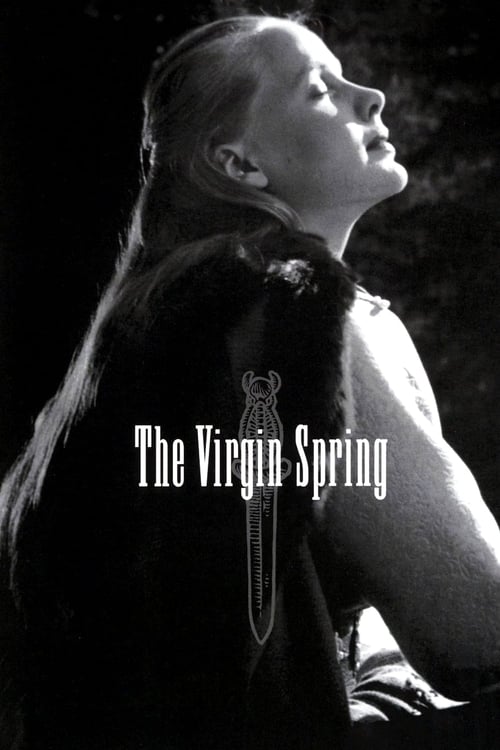
The Virgin Spring
1960 · Ingmar Bergman
For a serious, contemplative night when you want a film to chew on for days — moral weight over entertainment. Be warned it contains a genuinely harrowing assault; this is a demanding watch that earns its darkness.
What it's about
In medieval Sweden, a devout landowner and his wife send their cherished daughter through the forest to deliver candles to a distant church, accompanied by a resentful foster sister who prays to the old gods. The journey ends in an act of terrible violence — and when the strangers responsible unknowingly seek shelter at the family's own farm, her father must decide what his faith demands and what his grief will allow.
The experience
Spare, hushed, and devastating — long stretches of ritual calm broken by brutality the film refuses to soften. It leaves you wrung out and wrestling with questions about justice, faith, and whether vengeance can ever be clean.
Performances
Max von Sydow anchors the film as the father, holding volcanic grief behind a granite face — his wordless preparation for what he's about to do is among the most powerful sequences Bergman ever staged.
The craft
Adapted from a thirteenth-century ballad, it began Ingmar Bergman's great partnership with cinematographer Sven Nykvist, whose stark natural light gives forest, farmhouse, and firelight the gravity of a woodcut. Every frame feels carved rather than composed.
Why it matters
It won the Academy Award for Best Foreign Language Film and later became the acknowledged template for the American revenge-horror picture, its story migrating from art house to grindhouse.
Snapshot
A devout Swedish landowner's daughter is raped and murdered by itinerant goat herders while traveling through a forest to deliver candles to a distant church; when the killers unknowingly seek shelter at her father's farm, he enacts a merciless revenge — and discovers, at the site of her death, a miraculous spring. Adapted from a thirteenth-century Swedish ballad, Töres döttrar i Wänge ("Töre's daughters in Wänge"), The Virgin Spring is a meditation on theodicy, pagan guilt, and the cost of faith's preservation. It won the Academy Award for Best Foreign Language Film in 1961, marked Ingmar Bergman's first sustained collaboration with cinematographer Sven Nykvist, and — by Wes Craven's own admission — provided the direct template for the American exploitation film The Last House on the Left (1972). Spare, brutal, and strikingly beautiful, it occupies an unusual position in the Bergman canon: more narratively elemental than his metaphysical chamber films of the same period, yet equally preoccupied with the silence of God.
Industry & production
The Virgin Spring was produced by Svensk Filmindustri (SF), the state-adjacent studio that had been Bergman's institutional home since the late 1940s. By 1959, when principal photography took place, Bergman was SF's most commercially and critically valuable asset internationally; the success of The Seventh Seal (1957) and Wild Strawberries (1957) had transformed him into the prestige export of European art cinema. SF granted him considerable autonomy, and the production moved through its schedule without reported major disruptions. Specific budget figures are not part of the reliable public record for this production. The screenplay was commissioned from novelist and playwright Ulla Isaksson, who had written the script for Bergman's Brink of Life (Nära livet, 1958); their collaboration on that film, which had won Best Director at Cannes, made her an established and trusted figure in his orbit. Isaksson worked closely with the medieval source ballad, compressing and reshaping it into a tight dramatic arc while retaining its folkloric directness. Filming took place in Sweden, with production design drawing on actual medieval-period landscapes and architectural settings to achieve period authenticity on what was, by any measure, a modest Scandinavian art-film budget.
Technology
The film was photographed in black and white, formatted for the Academy ratio (approximately 1.37:1), and recorded with the synchronous-sound technology standard to Swedish studio production of the period. There is no documented use of exceptional or experimental equipment on this production. The technical interest of The Virgin Spring lies not in novel apparatus but in how Sven Nykvist deployed available and carefully controlled natural light — a departure from the more architecturally constructed, shadow-heavy chiaroscuro of Gunnar Fischer, who had photographed the majority of Bergman's major works through the late 1950s. The shift from Fischer to Nykvist represented a change in photographic philosophy as much as personnel, moving toward what Nykvist would describe in later interviews as a pursuit of "simple, honest light." The optical quality of the image — soft without being diffuse, high in contrast but never expressionistically exaggerated — was achieved through precise placement of sources and reflectors rather than filtration or processing innovations.
Technique
Cinematography
Nykvist's photography of The Virgin Spring established several qualities that would define the Bergman-Nykvist partnership for the next two decades. The forest sequences are lit to suggest actual dappled Scandinavian daylight — cool, high, and directional — which gives the landscape an indifferent beauty that intensifies the horror of the violence committed within it. Nykvist favours faces held in close or medium-close framings that read as candid observation rather than formal portraiture; the long, still takes on Max von Sydow's face during the vengeance sequence allow small muscular changes to carry enormous moral weight. The farmhouse interiors use firelight and high windows as anchor sources, grounding every domestic scene in a plausibly medieval luminosity that avoids both the theatrical expressionism of German silent cinema and the flatness of studio-bound period drama. The rape sequence is filmed in a manner that has been discussed by scholars as deliberately withholding: the camera does not linger on the act's mechanics but holds, at certain moments, on Ingeri's hidden, watching face — making complicity and witness the film's visual subject.
Editing
Oscar Rosander, who had edited many earlier Bergman productions, cut The Virgin Spring with a restraint that matches the film's tonal severity. Transitions between sequences are largely straight cuts; dissolves are rare and appear only in passages that carry a dreamlike or premonitory register. The editing rhythm in the first half of the film is deliberately unhurried, allocating considerable time to the rituals of the household and the journey through the forest, which creates a painful dramatic irony: the audience understands what is coming before it arrives, and the pace refuses to rush them past that knowledge. The murder scene itself is cut with more compression than the surrounding material — an editorial choice that makes the violence feel both sudden and inevitable rather than prolonged.
Mise-en-scène / staging
Bergman's staging in The Virgin Spring is rigorously spatial. The opening sequences establish the farm as a closed, hierarchical world — the movement of bodies through the frame consistently encodes social position. The contrast between the virginal Karin (Birgitta Pettersson), dressed for the church journey in embroidered finery, and her foster-sister Ingeri (Gunnel Lindblom), dressed plainly and associated from the first shots with hearth fire and pagan incantation, is constructed through costuming, blocking, and light placement that operates almost as iconographic vocabulary. The goat herders are introduced at a distance and allowed to approach the frame across real geographic space — no abrupt cutting manufactures their menace; it accumulates through proximity. The late scene of Töre's preparation for revenge — stripping, then the elaborate ritual of cutting a birch sapling and steaming himself — is staged in extended real time, a private ceremony the camera attends without commentary, drawing on Bergman's deep understanding of how ritual duration communicates internal transformation.
Sound
The film's sound design is notable for its periods of near-silence. Erik Nordgren's score is spare and largely confined to passages of liturgical or folk-derived music that anchor specific thematic moments — the journey to the church, and the final discovery of the spring. Long stretches of the film proceed with only ambient sound: wind through trees, the creak of the farmhouse, water. This acoustic restraint amplifies the psychological pressure of scenes that carry the film's heaviest dramatic burden. Nordgren had scored several of Bergman's earlier films and understood the director's preference for music that did not underline or emotionalise but that occasionally punctured silence with something cold and precise.
Performance
Max von Sydow's performance as Töre is, by wide critical consensus, among the pivotal work of his early career. He plays a man of profound and sincere Christian faith whose grief converts, by degrees, into something that his faith should prohibit but his nature cannot contain; von Sydow finds this contradiction without theatrical announcement, allowing the transition to register through stillness and physical economy. Birgitta Pettersson brings a quality of uncomplicated luminosity to Karin — the character's lack of psychological complexity is precisely the point; her death must feel like the destruction of something undefended. Gunnel Lindblom, as Ingeri, carries the film's most oblique dramatic burden: a character whose resentment curses the journey and whose witness implicates her in the outcome. Her performance, largely conducted in close-up reaction, is a study in the costs of envy and inaction. Birgitta Valberg as Märeta, the mother, functions as the film's moral voice without becoming a simple moral counterweight to Töre's vengeance.
Narrative & dramatic mode
The Virgin Spring is structured as a ballad rendered in filmic time: a two-part movement of violation and response, with a brief miraculous coda that refuses to resolve the theological question the preceding action has raised. The narrative is elemental and architecturally symmetrical — the journey out, the crime, the inadvertent return of the criminals to the victim's home, the revenge, the discovery of the spring. Bergman and Isaksson make no effort to complicate this structure with psychological subplots or tonal relief. The result is a film with the formal gravity of an Old Testament parable, which is precisely the register in which its theology operates: Töre's cry to God after the killing — a direct address demanding to know how to live with what he has done and what God allowed — is the film's central speech, and it is staged as a question that the spring answers miraculously but not fully. The dramatic mode is tragedy in its strictest sense: the protagonist's virtue and his crime are the same quality expressed in different circumstances.
Genre & cycle
The film sits within the European medieval drama, a form that flourished in the art cinema of the late 1950s as a vehicle for examining the relationship between faith, violence, and history at a remove from contemporary realism. Bergman had recently worked in this register with The Seventh Seal; The Virgin Spring strips the allegory further, removing the chess-match abstraction and the ensemble breadth to concentrate on a single family's catastrophe. It belongs also, and more uncomfortably, to what critics would later theorize as the rape-revenge cycle — a mode that recurs across exploitation and art cinema alike. Its direct descendant in exploitation cinema, Craven's The Last House on the Left, transplants the essential structure into contemporary American horror, a generic migration that Bergman did not endorse and that has generated considerable critical discussion about the uses and abuses of his source material. Within Swedish cinema, the film participates in a long engagement with medieval legend and religious history that extends from Victor Sjöström's silent adaptations of Selma Lagerlöf through to later Scandinavian art cinema.
Authorship & method
Bergman's method on The Virgin Spring reflects the austerity he was moving toward throughout the early 1960s. His public statements about the project — available in various interview collections — suggest a director who felt the ballad demanded fidelity over elaboration, and who was drawn to it partly because its ethical problem (how does a Christian father respond to the slaughter of his innocent daughter?) was intractable in a way that interested him more than resolvable questions. The collaboration with Ulla Isaksson gave the script a literary cleanness that Bergman's own screenplays of the period sometimes deliberately avoid; Isaksson's prose sensibility kept the dialogue spare and the dramatic logic legible.
Sven Nykvist's entry into the sustained Bergman collaboration is the other defining authorial fact of this film. Nykvist had operated camera for Bergman as early as Sawdust and Tinsel (Gycklarnas afton, 1953) and had photographed the low-budget The Virgin Spring after Gunnar Fischer — the DP of The Seventh Seal and Wild Strawberries — was unavailable or moved on. Their working relationship on The Virgin Spring established a visual grammar that Nykvist refined across Through a Glass Darkly (1961), Winter Light (1963), The Silence (1963), Persona (1966), and beyond: the close face as primary cinematographic unit, the rejection of baroque shadow-play in favour of honest northern light, the camera as witness rather than narrator. Oscar Rosander's long editorial partnership with Bergman continued here without dramatic innovation, which is itself a statement: the film's editing serves the material with craft rather than asserting an editorial voice.
Movement / national cinema
The Virgin Spring belongs to Swedish cinema's international phase — the moment, stretching roughly from the mid-1950s through the 1960s, in which Swedish films achieved consistent global distribution and critical attention primarily through the Bergman brand. SF's investment in Bergman gave Swedish cinema a visibility disproportionate to its industrial scale. The film draws on distinctly Swedish cultural material — the medieval ballad tradition, the specific relationship between Lutheranism and older Norse spiritual substrates — while translating that material into the universal idiom of European art cinema's theological inquiry. Its Swedish-ness is not superficial geography but thematic: the tension between Karin's Christianity and Ingeri's residual paganism, and Töre's violent act that cannot be resolved by either faith, is legible as a compressed history of Sweden's own religious and cultural syncretism.
Era / period
The film was made and released at the moment when European art cinema was consolidating its international critical apparatus — Cahiers du Cinéma, the major film festivals at Cannes, Venice, and Berlin, and the emerging network of arthouse distributors (in the United States, Janus Films was the primary conduit for Bergman's work) — and when the question of cinema as a vehicle for metaphysical and moral inquiry was being debated with unusual seriousness in the European press. Bergman's reputation by 1960 was such that a new film from him was a critical event across multiple national contexts. The Academy Award for Best Foreign Language Film placed the film within Hollywood's own prestige economy, signaling a mainstream legitimacy that co-existed with its art-cinema reception.
Themes
The film's central theological concern is theodicy: if God exists and is good, what account can be given of the rape and murder of an innocent Christian girl carrying candles to his church? Bergman stages this question through the figure of Töre, whose rage and vengeance are not presented as apostasy but as a confrontation with faith's limits that eventually breaks through to a kind of anguished recommitment — the vow to build a church at the site of his daughter's death is not triumphant resolution but exhausted faith's last gesture. The film also pursues a subsidiary but persistent examination of pagan survivals within Christian Scandinavia: Ingeri's invocation of Odin at the film's opening and her ambiguous curse establish a spiritual frame in which the Christian God and older powers exist in unresolved tension. The violence done to Karin is, in one reading, the answer that paganism gives to Christianity's pretensions to protect the innocent. The miraculous spring at the film's close — water appearing where Karin's body lay — is the only supernatural intervention; it confirms nothing about the justice of what happened, only that the ground remembers.
Reception, canon & influence
The Virgin Spring received strong reviews at the time of its release, though critical response was somewhat more divided than the hagiographic reception of The Seventh Seal and Wild Strawberries. Some critics found its brutality uncharacteristic and disturbing — Pauline Kael, characteristically contrarian about Bergman's prestige, was among those who expressed reservations — while others saw in its formal simplicity a discipline that the more elaborate metaphysical films lacked. The Academy Award for Best Foreign Language Film (1961) represented institutional endorsement of a different kind than the auteurist celebrations of French criticism. At Cannes, the film was not among Bergman's prize-winning entries, though the festival remained central to his distribution ecosystem.
The backward influences on The Virgin Spring are clear: the medieval ballad Töres döttrar i Wänge, a variant of the widespread European folk narrative known as the "Maiden's Lament" type; the Swedish silent cinema's tradition of landscape-rooted moral drama, particularly the work of Victor Sjöström; and Bergman's own previous medieval film, The Seventh Seal, which had demonstrated that the middle ages could function as a space for serious theological investigation rather than costume spectacle. The film also reflects Bergman's familiarity with Dreyer — the austerity of The Passion of Joan of Arc (1928) and the sacred-body theology of Ordet (1955) are legible as spiritual antecedents.
The film's forward legacy is bifurcated in ways that have made it an unusual canonical object. Within art cinema, it remained part of the Bergman retrospective as a transitional work — not the most discussed of his films but consistently cited in accounts of his 1960s period and of the Nykvist collaboration. In genre and exploitation cinema, its influence was transformative: Wes Craven's The Last House on the Left (1972) lifted the narrative structure directly (killers who unknowingly seek shelter with the victim's family; parental revenge), transposing it into a contemporary American setting with a rawness that Bergman's formal control deliberately avoided. Craven acknowledged Bergman's film as his source. This lineage has extended into subsequent rape-revenge films across several national cinemas, making The Virgin Spring an unlikely ur-text for one of exploitation cinema's most persistently controversial cycles. The critical conversation about this inheritance — what it means for art cinema's serious theological intentions to have generated a genre of graphic victimization — has not been fully resolved and represents one of the genuinely interesting problems in the film's reception history.
A Deleuzian reading
Watch where the camera goes during the worst minute of the film.
The full Deleuzian reading of The Virgin Spring →
Reception
Feted on release — a Cannes special mention and the Best Foreign Language Film Oscar — it was later disowned by Bergman himself, who dismissed it as an 'aberration'; today fans have re-embraced it as one of his most stark and powerful films, over its maker's objections.
How The Virgin Spring was received, from release to now →
Influences: the films it descends from and the films it influenced
- The Passion of Joan of Arc (1928) — Dreyer's systematic reduction of the drama to the extreme close-up of a human face under duress — the face as moral landscape rather than expressive instrument — is the direct photographic ancestor of Nykvist's close face-framing in Virgin Spring.
- Day of Wrath (1943) — Dreyer's staging of a devout Scandinavian community's collision with an accused pagan woman uses ritual-duration long takes and iconographic domestic blocking as a template Bergman directly inherits for the farm sequences.
- Rashomon (1950) — Kurosawa's structuring of a forest rape as a problem of witness and unstable testimony — using natural forest light as moral atmosphere — establishes the narrative grammar that Bergman deploys more directly in the Ingeri complicity sequences.
- Sawdust and Tinsel (1953) — Bergman's pre-Nykvist exploration of shame-as-spectatorship — the opening sequence stages an audience watching a woman's humiliation — directly anticipates Ingeri's role as hidden witness whose observation becomes the film's moral center.
- Ordet (1955) — Dreyer's use of staging/ritual-duration as theological argument — the long static take as formal enactment of faith's endurance — is the immediate precedent for Bergman's pacing of the vengeance sequence and the miracle's arrival.
- The Seventh Seal (1957) — Bergman establishes the medieval Swedish landscape as a space for theodicy and iconographic blocking immediately before Virgin Spring, with von Sydow's physical economy and the film's ballad-episodic structure providing the direct template.
- Brink of Life (1958) — Ulla Isaksson's screenplay method — condensing a literary source into an elemental chamber drama structured entirely by suffering and moral witness — was established in this Bergman collaboration and carried directly into the Virgin Spring script.
- Winter Light (1963) — The Bergman-Nykvist collaboration's direct extension of Virgin Spring's theological near-silence: the film strips away all ambient sound to make the absence of God's answer a formal property of the image, compressing the earlier film's method into a single sustained register.
- The Last House on the Left (1972) — Craven's explicit transposition of Virgin Spring's rape-revenge-miracle structure into American exploitation retains the ballad's three-act moral arc — violation, unknowing shelter, retributive killing — while relocating its geography to contemporary New England.
- Cries and Whispers (1972) — The Bergman-Nykvist face-framing and physical economy in performance reach their apex: Nykvist's extreme close-ups of women's faces in extremis extend the photographic grammar first sustained in Virgin Spring across an entire chamber film.
- The Wicker Man (1973) — Hardy extends Virgin Spring's faith/paganism structural opposition into folk-horror, deploying ritual-duration staging of pagan ceremonies as an iconographic system that methodically displaces the Christian protagonist's assumptions in the same pattern as Bergman's confrontation between Töre's faith and the goatherds' world.
- The Piano (1993) — Campion's use of natural period light, deliberate pacing, and physical economy in performance for a story of female violation and constrained agency in an isolated landscape extends Virgin Spring's visual and ethical grammar into 1990s art cinema.
- Caché (2005) — Haneke inherits Virgin Spring's complicity-and-witness structure — specifically the ethical weight placed on the hidden observer who sees and does not act — making the concealed watcher's moral position the film's formal and thematic center through a static surveillance aesthetic.
- The Girl with the Dragon Tattoo (2009) — Establishes the Swedish rape-revenge template the film secularizes — a methodical vengeance mounted after a young woman's rape, staged with grave stillness rather than exploitation-genre kineticism.
- Marketa Lazarová (1967) — Grave medieval materiality in which love and faith are entangled with abrupt eruptions of violence, shot in Nykvist's severe monochrome.
- The Emigrants (1971) — Supplies the acting grammar and Nordic austerity Troell inherits — Max von Sydow's interior stillness and the Sven Nykvist-school faith in unadorned natural light on faces, which Troell adopts and pushes toward documentary rather than allegory.
- L'Avventura (1960) — Antonioni's contemporaneous European art cinema use of prolonged duration, near-silence, and landscape as moral register deploys a formally analogous grammar of deliberate pacing and physical economy in performance within the same era.
- Rocco and His Brothers (1960) — Visconti's contemporaneous staging of rape as a rupture that generates a fatal revenge arc — shot in high-contrast black-and-white with careful face-framing and physical directness — inhabits the same craft territory within European art cinema of 1960.
- The Nightingale (2018) — ancestor — the austere, morally interrogative rape-revenge structure staged in cold natural light, where the assault is withheld from spectacle and vengeance brings no catharsis, the anti-exploitation lineage Kent extends.
Similar films
- Winter Light (1963) — influence & lineage · often watched together
- Cries and Whispers (1972) — influence & lineage · often watched together
- The Seventh Seal (1957) — influence & lineage
- Day of Wrath (1943) — influence & lineage
- Ordet (1955) — influence & lineage
- Wild Strawberries (1957) — often watched together
- Marketa Lazarová (1967) — often watched together
- Breaking the Waves (1996) — often watched together
All the films related to The Virgin Spring →