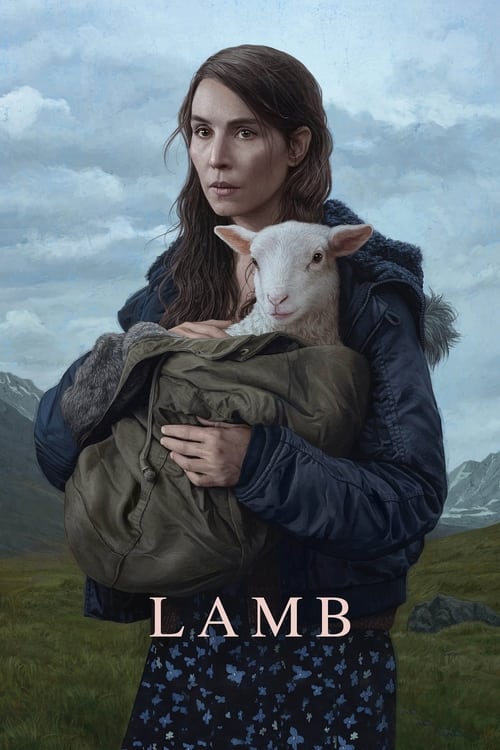
Lamb
2021 · Valdimar Jóhannsson
An Icelandic couple live with their herd of sheep on a beautiful but remote farm. When they discover a mysterious newborn on their land, they decide to keep it and raise it as their own. This unexpected development and the prospects of a new family brings them much joy before ultimately destroying them.
Snapshot
Lamb (Icelandic title Dýrið, "The Animal" or "The Beast") is Valdimar Jóhannsson's first feature. It is a slow, deadpan folk fable set on an isolated sheep farm in northern Iceland. María (Noomi Rapace) and Ingvar (Hilmir Snær Guðnason) are a childless couple. During lambing season one of their ewes gives birth to a creature with a lamb's head and a partly human body. They name it Ada, after a daughter we gradually learn they have lost, and raise it as their child. Ingvar's brother Pétur (Björn Hlynur Haraldsson), a dissolute former pop musician, arrives and unsettles the arrangement. The new family's happiness is then ended by a reckoning from the natural, or supernatural, order the couple has violated.
Jóhannsson co-wrote the film with the Icelandic poet and novelist Sjón. It premiered in the Un Certain Regard section at Cannes in 2021 and won a newly created Prize of Originality there. A24 released it in North America, and it was Iceland's submission for the Academy Award for Best International Feature Film. Viewers tend to remember it for one image, a lamb-headed child in a knitted sweater, but the film plays that image almost entirely straight. The result sits somewhere between grief drama, rural realism and horror.
Industry & production
Lamb is a European co-production of the kind now standard for Nordic art cinema. It was produced chiefly by the Icelandic company Go to Sheep with Swedish and Polish partners: Black Spark Film & TV in Sweden and Madants in Poland. Financing came from the national and regional support systems that underpin most Icelandic features, including the Icelandic Film Centre and Nordic and Swedish funding bodies. The Polish partnership brought in Polish crew in key post-production roles, including the editor.
Two executive producers are often cited, and both were material to the project:
- Noomi Rapace. The Swedish star took on an executive producer credit in addition to playing María. Her international profile, built on The Girl with the Dragon Tattoo (2009) and English-language work such as Prometheus (2012), gave a first-time Icelandic director's small film a recognisable lead for the festival and sales markets.
- Béla Tarr. The Hungarian filmmaker had taught Jóhannsson at his film.factory programme in Sarajevo. His involvement signals the film's place in a lineage of austere, durational European art cinema.
Jóhannsson came to directing from below the line. He had worked for years in special effects and technical departments on international productions shot in Iceland and elsewhere. That background is often cited to explain how confidently the film handles its central practical and digital illusion. Public accounts describe the development as long, with the project taking several years to move from concept to shoot. Detailed figures for budget and schedule are not reliably documented in the public record.
After Cannes, A24 bought North American rights. It was one of the company's few Nordic-language releases, and the distributor's brand helped position the film for the genre-curious arthouse audience it had cultivated with The Witch (2015), Hereditary (2018) and Midsommar (2019).
Technology
The film's main technical problem was Ada. The production built her from a composite of methods:
- real lambs for the newborn and infant stages;
- child performers in costume for the upright, walking Ada;
- puppetry and animatronic elements for some shots;
- digital compositing, which joined lamb heads to child bodies and smoothed the seams between techniques.
Peter Hjorth is credited with visual effects supervision. He is a Danish specialist known for his long collaboration with Lars von Trier and for Ali Abbasi's Border (2018). The design principle was restraint. Ada is never showcased as a spectacle; she is filmed in the same plain, observational way as everything else in the frame, and that ordinariness is what makes her believable. Much of the film's strangeness depends on the effects never calling attention to themselves.
The production also relied on large numbers of real animals: sheep, a sheepdog, a cat and horses. The animals are not just background. Their reaction shots, especially the opening sequence and repeated cutaways to the watching cat and dog, are central to the film's design. Which cameras and formats were used is not something the public record documents in detail.
Technique
Cinematography
Eli Arenson shoots the farm and the valley with a still, often locked-off camera in wide compositions. The human figures are dwarfed by mountainsides and banks of fog. The light changes from the darkness of the opening winter storm to the near-endless pale light of the Icelandic summer. That shift gives the film a seasonal arc that tracks the family's brief happiness.
The palette is muted: greys, moss greens, wet browns and the off-white of fleece and fog. Interiors are lit naturalistically and kept low-key. Arenson repeatedly frames the animals as watchers. Sheep stare into the lens from the fold, and the dog and cat track Ada's movements. Through these shots the film builds a sense of a non-human point of view that judges the human story without commenting on it.
The prologue makes this explicit. In a blizzard on what is implied to be Christmas night, a subjective camera moves through the darkness toward the barn while horses panic and the flock turns to look. It is an unseen presence's point of view, and the film withholds its source until the final minutes.
Editing
Agnieszka Glińska, a Polish editor, cuts the film at a patient, measured pace. Long takes and generous pauses let ordinary farm work play in near real time: lambing, mowing, tractor repair, meals. Much of the meaning sits in the cuts between human activity and animal observation.
The film is divided into three titled chapters:
1. The arrival of Ada. 2. Pétur's visit and his slow, reluctant acceptance of the child. 3. The violent resolution.
The chapter structure gives the film a storybook formality. Withholding is the editing's main strategy. Ada's full body is not shown for a considerable stretch after her birth, and when it finally appears the reveal comes almost offhandedly, through Pétur's shocked eyes, rather than as a shock cut.
Mise-en-scène / staging
The farm is a closed world: a turf-roofed or corrugated-iron complex of house, barn and outbuildings at the bottom of a steep valley, with no neighbours in sight. Staging keeps the couple bound to routine, with chores, the dinner table, the bath and the bed. The supernatural element is folded into domestic ritual. Ada is dressed in knitted sweaters, fed at the table and tucked into a cot moved from the couple's bedroom.
Props and spaces carry the backstory with little dialogue. The cot is taken out of storage. A child's grave is seen briefly. The orphaned mother ewe stands bleating beneath the window, a figure María increasingly treats as a rival, and María's violence toward her is staged with cold economy. The deadpan presentation of an impossible situation is the film's essential tonal device. Several critics described its comedy as arising from the characters' refusal to acknowledge the absurdity, not from any wink to the audience.
Sound
Þórarinn Guðnason's score is sparing. It works mostly in low drones, choral textures and sustained tones that thicken the atmosphere without dictating emotion. The film depends at least as much on its soundscape: wind, rain, the creak of the barn, and above all the vocalisations of animals. The ewe's persistent bleating outside the house works as a reproach.
Silence and near-silence dominate the domestic scenes, which makes the few bursts of popular music stand out. The most notable is a sequence in which the three adults watch an old music video of Pétur's band and drift into an awkward, half-drunk dance. It is the film's warmest and most human moment, and its sound sharply contrasts with the elemental drones around it.
Performance
Noomi Rapace plays María in Icelandic, with a guarded, inward performance. Her grief is held behind practicality, and it surfaces as a fierce, possessive maternal tenderness. Her stillness is the film's emotional centre. The few moments when it breaks, especially her ruthlessness toward the ewe and her final solitude, carry particular force.
Hilmir Snær Guðnason, a leading Icelandic stage and screen actor, plays Ingvar as gentle, quietly besotted with his new daughter and almost childlike in his acceptance. Björn Hlynur Haraldsson's Pétur is the film's point of scepticism and its source of dry humour. He is a washed-up figure whose initial disgust, and his attempt to get rid of Ada, give way to grudging affection. He is also sexually entangled in the past with María.
Ada is performed by several child actors and lambs, and in the shared performance she has a convincing, wordless presence. The animal performers are integral throughout. The dog and cat in particular function as silent characters.
Narrative & dramatic mode
Lamb is built like a folk tale or parable, and the chapter divisions underline this. It sets up a situation that contains its own punishment: a gift taken from nature, a debt deferred, a reckoning that arrives. Its dramatic mode is understatement. Explanation is almost entirely withheld:
- The film never addresses how Ada came to exist.
- The couple's earlier loss is conveyed through a grave and a name rather than dialogue.
- The final appearance of a ram-headed humanoid figure, implied to be Ada's father and the presence of the prologue, is presented with the same flat realism as everything before it.
The structure moves from domestic drama through a chamber triangle to a sudden, violent coda. The ending, in which Ingvar is shot, Ada is taken back into the hills and María is left alone, resolves the parable's moral logic without interpreting it. Some critics found the method hypnotic. Others felt the premise was stretched thin over its running time and that the payoff confirmed what the opening had already implied.
Genre & cycle
The film was marketed and widely received as horror, and it belongs to the "folk horror" revival of the 2010s and 2020s. That cycle includes The Witch, Midsommar, and Hagazussa (2017) and is characterised by rural settings, pre-modern belief and the return of repressed natural or pagan forces. Lamb sits at the cycle's quiet end: it has few conventional scares and relies on dread and incongruity.
It also belongs to an adjacent group of Nordic "strange realism" or folk-fantasy films that treat the uncanny matter-of-factly. Ali Abbasi's Swedish Border (2018) is the closest comparison, both tonally and in its shared VFX supervision. It is equally a domestic grief drama and a dark fairy tale. A24's distribution placed it alongside the so-called "elevated horror" of the period, a critical label that the film's art-cinema pacing both fits and complicates.
Authorship & method
Valdimar Jóhannsson made his feature debut with Lamb after years of technical work in film. His formation under Béla Tarr is visible in the long takes, the attention to weather and labour, and the treatment of animals as presences rather than props. Accounts of the project's genesis say the idea grew from a sketchbook of images Jóhannsson had gathered over years. The specifics of how it developed are not extensively documented.
Key collaborators:
- Sjón (co-writer). The internationally known Icelandic novelist and poet is a longtime lyricist for Björk. His fiction, including The Blue Fox and Moonstone, draws on Icelandic folklore, myth and metamorphosis. His mythic sensibility shapes the screenplay's fable-like economy. The following year he co-wrote Robert Eggers's The Northman (2022).
- Eli Arenson (cinematographer). He was responsible for the film's austere landscape compositions and naturalistic light.
- Agnieszka Glińska (editor). A Polish editor who came to the project through the Polish co-production; she shaped the film's patient rhythm and chapter structure.
- Þórarinn Guðnason (composer). An Icelandic musician who wrote the sparse, drone-based score.
- Peter Hjorth (VFX supervisor). He made Ada a seamless figure, building on his experience with naturalistic fantasy effects in Nordic art cinema.
Movement / national cinema
Lamb belongs to the remarkably productive small Icelandic film industry of the 2010s and 2020s. Supported by the Icelandic Film Centre and Nordic co-production funds, that industry produced a run of festival successes rooted in rural life and the landscape. The most pertinent comparison is Grímur Hákonarson's Rams (Hrútar, 2015). It also concerns sheep farmers in a remote valley and the intimate, almost familial bond between farmer and flock, and it won the Un Certain Regard prize at Cannes. Lamb can be read as a fantastical cousin to that realist film.
Other contemporaries include:
- Benedikt Erlingsson's Of Horses and Men (2013) and Woman at War (2018), which share a deadpan, animal-centred and landscape-driven sensibility;
- Hlynur Pálmason's A White, White Day (2019) and Godland (2022), which share the attention to weather, grief and duration.
The film draws on Icelandic folklore more by atmosphere than by citation: hidden beings in the landscape, the danger of the midwinter nights, and transformations between animal and human. It does not adapt any specific folktale.
Era / period
The film was made in the late 2010s and released in 2021, the first full year of festival circulation after the COVID-19 pandemic. Cannes 2021 was itself the return of the festival after its cancelled 2020 edition. The film is set in an unspecified present. Television and radio, a car, a tractor and a VHS-era music video place it in a modern world, but the farm remains almost sealed from it. That tension between contemporary life and archaic setting is characteristic of the period's folk horror.
Themes
- Grief and substitution. The couple's adoption of Ada is a displaced mourning for a dead daughter. The film quietly examines how grief can turn love into possession.
- Nature's claim and the limits of domestication. The farm is a site of human control over animals: breeding, slaughter and husbandry. Ada inverts that relationship. The ending suggests nature reclaiming what was taken, which can be read as an ecological parable about human appropriation of the non-human.
- Motherhood and theft. María's displacement and eventual killing of Ada's mother ewe makes her love inseparable from violence. The film refuses to soften this.
- The family as fragile construction. Pétur's visit exposes the instability beneath the couple's contentment, through jealousy, buried history and desire.
- The gaze of animals. The recurring shots of animals watching posit a moral witness outside human judgement.
- Religious and mythic undertones. The Christmas-night conception, the lamb as a Christian emblem and the ram-figure's pagan connotations layer sacred imagery without resolving it into allegory.
Reception, canon & influence
Critical reception. Lamb won the Prize of Originality in Un Certain Regard at Cannes, and the general critical response was positive. Critics praised Rapace's performance, the cinematography, the conviction of the effects and the nerve of committing so fully to an absurd premise. The main reservation, widely repeated, was that the film's slowness and its single central conceit made it feel over-extended, and that its ending was either too opaque or too predictable depending on the reviewer. It was Iceland's official Oscar submission for Best International Feature and reached the Academy's shortlist, but it was not nominated. It also picked up honours in the Nordic and genre-festival circuits. The film found a wide audience for an Icelandic-language picture. Ada's image circulated as an online meme, which drew viewers who might not otherwise have sought out Nordic art cinema.
Influences on the film (backward).
- Béla Tarr's durational cinema, through Jóhannsson's training: landscape, weather and the animal as presence (Sátántangó, The Turin Horse).
- Rosemary's Baby (1968), often cited for its mix of domestic intimacy, unnatural birth and parental devotion.
- Bergman's chamber dramas, for the triangulated household and the restrained intensity of Rapace's performance.
- Icelandic and broader Nordic folklore of transformation and hidden beings, filtered through Sjón's literary sensibility.
- The Nordic strange-realist cycle, especially Border.
- Icelandic rural cinema, notably Rams.
- The folk horror revival around A24, particularly The Witch and its goat Black Phillip, an animal that turns out to be more than an animal.
Legacy (forward). It is too early to judge the film's long-term canonical standing with confidence. Lamb is now commonly listed among the defining titles of A24's folk horror and "elevated horror" period. It consolidated a moment of international visibility for Icelandic cinema alongside Pálmason's Godland and Erlingsson's films. Sjón's next screenwriting credit, The Northman, extended his folkloric collaboration into a larger-scale Scandinavian epic. More broadly, Lamb stands as a model of the deadpan, low-key fantastical: an impossible premise staged with full documentary realism. Its specific influence on later films has not yet been established in the critical literature.
Influences: the films it descends from and the films it influenced
- Midsommar (2019) — A Nordic folk-horror descendant trading on slow long-take endurance, agrarian total environment, and a grieving couple's pact with rural-pagan forces — Midsommar's Scandinavian-landscape dread carried forward.
- Splice (2010) — A childless couple on a remote farm raise a human-animal hybrid as their daughter. The film keeps her partly out of frame for its first act, combines a child actor, puppetry and CG for her body, and stages calm, grotesque family scenes that match Splice's farmhouse section.
- Thelma (2017) — Lamb extends the Nordic supernatural-realism cycle Thelma helped bring into fashion, with a single, almost unmarked digital impossibility staged in long, quiet, landscape-bound takes.
- Noi the Albino (2003) — Icelandic landscape dread rendered in deadpan stillness around a single absurdist object/creature, resolving in an abrupt, arbitrary fatalism.
- The Love That Remains (2025) — Contemporary Icelandic realist-fantastical hybrid that, like Pálmason, plants a single uncanny element into patient, naturalistically-shot rural family life and stages humans as small figures against vast, weather-bound terrain.