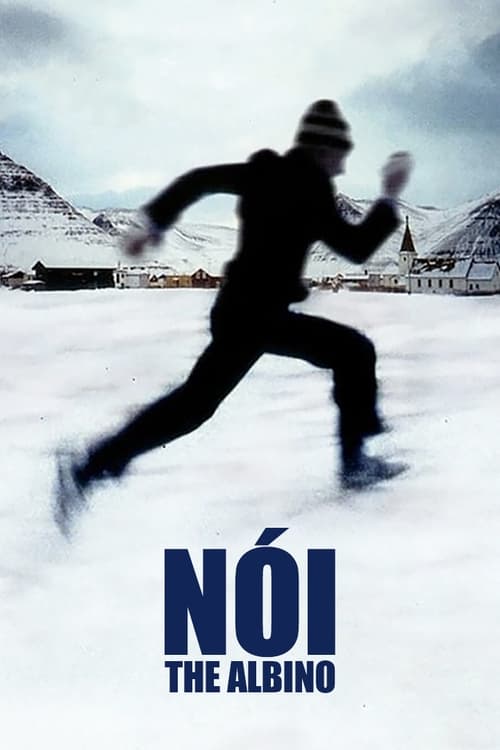
Noi the Albino
2003 · Dagur Kári
For a quiet night when you want something small, strange, and wintry — a film about feeling stuck that's oddly soothing to watch. Ideal when you're in the mood for droll over dramatic.
What it's about
Nói is a pale, shaven-headed seventeen-year-old drifting through life in a tiny Icelandic fjord village that winter seals off from the rest of the world. Possibly a genius, possibly just a truant, he cuts school, orbits his grandmother and his alcoholic father, and falls for Íris, the girl at the gas station till. His dream is simple — get out — but his fumbling attempts at escape keep going sideways.
The experience
Deadpan and quietly funny, with the hush of snow over everything — long pauses, absurd small-town rituals, and a melancholy that sneaks up on you. It's slow-burn in the gentlest way until it isn't.
Performances
Tómas Lemarquis is unforgettable in the title role — his pale, alien stillness makes Nói both a village oddball and someone you ache for, often without a word.
The craft
Dagur Kári frames the fjord as a beautiful white prison: washed-out, blue-tinged compositions, ominous mountains, and comic timing built from stillness. The landscape does as much storytelling as the dialogue, and it's gorgeous on a big screen.
Why it matters
An acclaimed debut that announced a distinctive Icelandic voice on the festival circuit and helped put the country's deadpan, landscape-steeped cinema on the international map.
Snapshot
Nói albínói — released internationally as Noi the Albino — is the debut feature of Icelandic-French director Dagur Kári, a deadpan coming-of-age tragicomedy set in an isolated fjord village in the Westfjords of Iceland. Its protagonist, Nói (Tómas Lemarquis), is a pale, shaven-headed seventeen-year-old of ambiguous gifts and chronic truancy, trapped between a stifling provincial existence and a vague, unrealizable dream of escape with Íris, a girl who works the till at the local petrol station. The film belongs to a recognizable northern-European lineage of muted, absurdist minimalism, and it announced a distinctive new voice: a director equally attentive to bleak comedy, regional landscape, and the existential weight of confinement. Its ending — an avalanche that obliterates the village while Nói survives by chance in a cellar — recasts what had seemed a slacker comedy as something closer to fable, and lends the whole film a retrospective gravity that has sustained its reputation.
Industry & production
Nói albínói was produced by the Reykjavík company Zik Zak Filmworks (Zik Zak Kvikmyndir), a key engine of the early-2000s Icelandic feature scene, as a European co-production drawing partners from Iceland, Germany, the United Kingdom, and Denmark. This multinational financing structure was characteristic of small-nation cinema in the period: Icelandic features, working in a language spoken by a few hundred thousand people, routinely assembled budgets from a patchwork of national film funds, public broadcasters, and pan-European mechanisms (the Icelandic Film Centre and schemes such as Eurimages and Nordic regional funds being the typical scaffolding). I do not have reliable figures for the production budget or its box-office returns, and will not invent them; what is clear is that the film was made economically, with a small cast and a concentrated number of locations.
The film was shot largely in and around Bolungarvík, a fishing town in the remote Westfjords, whose steep encircling mountains and winter isolation supply the film's defining visual and thematic conditions. The choice of a real, depopulating fjord town rather than a studio approximation is central to the film's authenticity and to its industrial logic — the landscape is the production value. Kári came to the project directly from the National Film School of Denmark, and several of his key collaborators were drawn from that Danish orbit, reflecting the deep Icelandic–Danish cultural and training ties that shaped his generation of filmmakers.
Technology
Nói albínói was made with conventional early-2000s photochemical or digital-intermediate-era tools; the precise capture format I cannot confirm and will not guess. What matters technically is not novelty but control of palette. The film is dominated by a desaturated register of cold blues, slate grays, and bleached whites, a scheme that may have been achieved or reinforced in grading. This near-monochrome treatment — snow, overcast sky, and gray rock collapsing into a single tonal field — is the film's signature technological gesture: a deliberate suppression of color that turns the fjord into the "white-walled prison" of the synopsis and renders the rare warm accents (lamplight, skin, blood) shocking by contrast. The approach situates the film alongside other northern minimalist works that use the digital and post-production toolkit less for spectacle than for atmospheric foreclosure.
Technique
Cinematography
The cinematography is credited to the Danish cinematographer Rasmus Videbæk, and it is among the film's most discussed elements. Videbæk favors static or near-static framings, symmetrical and frontal compositions, and a patient observational distance that holds characters within the oppressive geometry of low ceilings, window frames, and the looming mountain walls. Interiors are cramped and boxlike — the grandmother's house, the schoolroom, the basement — and the camera tends to pin figures against flat planes, emphasizing entrapment. Exteriors set the small human figure against vast white slopes, the recurring visual argument that the landscape is both beautiful and carceral. The restraint is purposeful: by refusing camera movement and coverage-driven cutting, the film makes each composition feel like a held breath, and the muted palette flattens depth so that escape seems spatially as well as narratively impossible.
Editing
The editing — credited to Daniel Dencik, working in the same Danish-trained milieu as the director — is unhurried and elliptical, built around the comic and melancholic rhythms of deadpan. Scenes are often constructed as discrete, almost tableau-like units, with cuts that withhold reaction or let a gag land in silence rather than underlining it. The pacing is deliberately becalmed for much of the film, lulling the viewer into the torpor of provincial winter, which makes the violent compression of the avalanche climax all the more rupturing. The structural gamble of the editing is tonal: it sustains low-key comedy long enough that the late turn toward catastrophe reorganizes everything that came before.
Mise-en-scène / staging
Kári's staging is meticulous and slightly stylized, full of repeated motifs and absurdist objects: the shotgun the grandmother fires to wake Nói, the fortune-teller and the séance-like premonitions, the stuffed and skeletal curiosities, the bunker-like cellar where Nói retreats. Production design leans into a worn, lived-in provincialism — the gas station, the bookshop-cum-curio-shop, the modest domestic interiors — without caricature. The compositions frequently isolate Nói within doorways and frames-within-frames, and the recurring imagery of holes, tunnels, and burrowing (Nói digging, hiding underground) prefigures the literal salvation of the ending. The mise-en-scène consistently externalizes the film's theme: a world that is small, closed, and quietly surreal.
Sound
The soundscape balances the muffled hush of snowbound interiors and wind against a spare, plaintive score. The music is by slowblow, the Icelandic duo of which Dagur Kári himself is a member alongside Orri Jónsson — meaning the director effectively scored his own film. The result is an unusually integrated marriage of image and sound: melancholic, lo-fi, folk-inflected textures that reinforce the film's mood of wistful suspension without sentimentalizing it. Dialogue is sparse and dry, often delivered in a flattened affect that lets silence and ambient sound carry emotional weight.
Performance
The film rests on Tómas Lemarquis's performance as Nói, a piece of casting inseparable from its meaning. Lemarquis's striking physical presence — pale, hairless, otherworldly — gives the character his "albino" nickname and his quality of not-belonging, a figure visibly alien to his surroundings. (The film leaves Nói's exact condition unexplained; the nickname functions more as social marking than diagnosis.) Lemarquis plays him with a contained, watchful stillness, an intelligence that registers as both gifted and inert, sympathetic without pleading the audience. The surrounding ensemble — the firm, exasperated grandmother; the absent, ineffectual father Kiddi; Íris at the gas station — is played in a low, naturalistic key consistent with the deadpan idiom, supporting rather than competing with the central figure.
Narrative & dramatic mode
Structurally the film operates in a picaresque, episodic register for most of its length: a series of loosely connected incidents — failed school, petty schemes, a robbery, a half-formed plan to flee — that map Nói's drift rather than a tightly causal plot. The dramatic mode is ironic and observational, comedy shading into pathos, with the protagonist as a passive center around whom small absurdities accrete. The synopsis's "clumsy attempts at escape spiral out of control" describes the engine of the second half, but the film's most radical narrative decision is its ending. The avalanche is not a consequence of Nói's actions; it is arbitrary, a stroke of fate that kills the community and spares him by the accident of where he happens to be. This shifts the film from character-driven comedy to something fable-like and fatalistic, raising the question the film leaves open: is survival a reprieve, a curse, or simply the indifferent verdict of chance?
Genre & cycle
Nói albínói sits at the intersection of the coming-of-age drama, the deadpan northern comedy, and the regional "trapped in a small town" film. It participates in an early-2000s cycle of small-nation arthouse features that found international festival traction by pairing local specificity with a recognizably minimalist, dryly comic aesthetic. Within Icelandic cinema it can be read alongside other works preoccupied with provincial isolation, generational stasis, and the pull between rootedness and emigration. It resists the redemptive arc typical of the coming-of-age genre: there is no graduation into adulthood, only the brute fact of having outlived one's world.
Authorship & method
The film is the work of a tightly knit Danish-trained creative core centered on Dagur Kári (born 1973), who directed and co-wrote it as his feature debut following his studies at the National Film School of Denmark. Kári's authorship here is unusually total: he directs, writes, and — as a member of slowblow with Orri Jónsson — co-authors the music, giving the film a singular tonal coherence in which visual deadpan and musical melancholy are clearly the product of one sensibility. His key collaborators reflect his training: cinematographer Rasmus Videbæk and editor Daniel Dencik, both working in the Danish industry, translate Kári's vision into the film's controlled compositional and rhythmic grammar. The method is one of restraint and precision — fixed frames, muted color, withheld emotion, comic understatement — deployed in service of a fundamentally bleak worldview. Kári would go on to develop these preoccupations across subsequent features, including the Danish-language Dark Horse (Voksne mennesker, 2005), the English-language The Good Heart (2009), and Virgin Mountain (Fúsi, 2015), the last of which returns to the figure of the gentle, socially marooned outsider that Nói first embodied.
Movement / national cinema
The film is a landmark of the modern Icelandic feature, part of a wave that, from the late 1990s onward, brought Icelandic cinema to wider international attention through co-production and festival circulation. It is equally legible within a broader Nordic and northern-European minimalist tradition. Critics have repeatedly invoked the dry, melancholic comedy of the Finnish director Aki Kaurismäki and the static, deadpan minimalism of Jim Jarmusch as touchstones — comparisons that situate Kári within a transnational lineage of slow, ironic, working-class-and-margins filmmaking rather than any narrowly national school. Yet the film's grounding in the Westfjords landscape, language, and social texture marks it as unmistakably Icelandic, and it has become one of the most internationally recognized Icelandic films of its era.
Era / period
Nói albínói is a product of the early 2000s, a moment when European co-production frameworks and a robust global festival circuit made it viable for filmmakers from very small national industries to reach international audiences with personal, uncommercial work. Its sensibility — ironic, minimalist, regionally rooted, suspicious of uplift — is characteristic of post-millennial arthouse cinema. The film's avalanche climax also resonates with a specific recent Icelandic memory: the catastrophic avalanches that struck Westfjords towns, including Súðavík and Flateyri, in 1995, killing dozens. While I would not claim a one-to-one correspondence, the film's ending unmistakably draws on a real and recent regional trauma of communities annihilated by the mountains that enclose them, giving its fable a documentary undertow.
Themes
The film's governing theme is entrapment — geographic, social, and existential. The fjord is literally walled by mountains and seasonally cut off, and this physical confinement stands for the foreclosed horizons of provincial youth, the inertia of family and place, and the difficulty of becoming. Against this, the film sets the dream of escape, embodied in Íris and in Nói's fantasies of elsewhere, dreams the film treats with tenderness and skepticism in equal measure. Running beneath is a preoccupation with fate and contingency: premonitions, fortune-telling, and finally an avalanche that renders human planning irrelevant. The recurring imagery of burrowing and the underground gives the theme its central irony — that the only escape available is downward, into the earth, and that survival is granted not by will but by accident. Nói's outsider physicality threads through all of this as a figure of irreducible difference, someone who cannot belong even before catastrophe removes the world he might have belonged to.
Reception, canon & influence
Nói albínói was warmly received internationally and traveled widely on the festival circuit, earning Dagur Kári recognition as a major new talent and winning a number of awards; it became, by consensus, one of the defining Icelandic films of its decade and a frequent reference point in discussions of contemporary Nordic cinema. (I am confident of its strong critical standing and award success in general terms but cannot reliably enumerate every specific prize, and so decline to list festival awards I cannot verify.) Critically, it was praised for its visual control, its tonal balance of comedy and dread, and Lemarquis's haunting central performance, with reviewers regularly reaching for Kaurismäki and Jarmusch as comparisons.
Its influences run backward into that same deadpan-minimalist tradition, into the broader Nordic art film, and into the lived geography and recent disaster history of the Westfjords. Its forward influence is most visible in Kári's own subsequent career and in the international profile it helped secure for Zik Zak Filmworks and the Icelandic feature industry, which in the following years produced an increasingly visible body of internationally distributed work. The film also launched Tómas Lemarquis, whose distinctive presence led to an international acting career. More diffusely, Nói albínói helped consolidate a template — the muted-palette, dryly comic, landscape-bound study of a marooned outsider — that recurs across later Icelandic and Nordic cinema. Its lasting power rests on the audacity of its ending, which transforms a small, funny, melancholy portrait of a stuck adolescent into a meditation on chance and survival that continues to reward and unsettle viewers.
A Deleuzian reading
A grandmother fires a shotgun into the morning air to wake the boy.
The full Deleuzian reading of Noi the Albino →
Reception
A festival-circuit darling in 2003 that became the international breakout of Iceland's new wave, it has since settled into quiet cult status — less name-checked than it once was, but still the film cinephiles hand you as the doorway into Icelandic cinema.
How Noi the Albino was received, from release to now →
Influences: the films it descends from and the films it influenced
- Stranger Than Paradise (1984) — Builds each scene as a single static long-take tableau punctuated by blackout cuts, married to an episodic picaresque of drifting deadpan outsiders — the exact grammar Nói inherits.
- The Match Factory Girl (1990) — Flattened, near-mute sparse dialogue and frontal stone-faced staging in which an unremarkable life is steered toward sudden arbitrary catastrophe.
- Ariel (1988) — The muted, desaturated palette and immobile working-class hero whose deadpan endurance of bad luck becomes both comic and bleak.
- Au Hasard Balthazar (1966) — Withheld 'model' (non-)performance and elliptical editing capped by an abrupt, arbitrary death that retroactively recasts the whole picture as a meditation on chance.
- Songs from the Second Floor (2000) — Wide symmetrical frontal tableaux held rigidly static while absurdist objects and deadpan figures populate the depth of frame.
- The 400 Blows (1959) — The marooned-adolescent picaresque that ends on an unresolved, fate-suspended image rather than a resolution — the coming-of-age template Nói darkens.
- Sherlock Jr. (1924) — The 'great stone face': comedy generated by an utterly immobile deadpan body placed within precise, frontally composed frames.
- Down by Law (1986) — Frames-within-frames (bars, doors, windows) and slow tableau staging of entrapped men whose escape is comically anticlimactic.
- Dark Horse (2005) — Kári's immediate follow-up extends the muted deadpan portrait of aimless young men, with director-co-scored slowblow melancholy and the same withheld-emotion grammar.
- Virgin Mountain (2015) — Returns directly to Nói's figure — the gentle, socially marooned outsider — rendered in static framing, sparse dialogue and deadpan tenderness.
- Of Horses and Men (2013) — Icelandic deadpan tableau anchored to landscape, structured as absurdist episodes whose dry comedy keeps tipping into arbitrary death.
- Rams (2015) — Landscape-bound entrapment, near-wordless sparse dialogue and the deadpan-into-tragedy tonal turn that consolidates Nói's Icelandic template.
- Volcano (2011) — Muted-palette, elliptical study of a marooned outsider stuck in place, with the same restraint and refusal of emotional underlining.
- A Pigeon Sat on a Branch Reflecting on Existence (2014) — Continues the symmetrical frontal absurdist tableau into ever-more-static deadpan compositions populated by pale, affectless figures.
- Submarine (2010) — Deadpan coming-of-age built on symmetrical frontal compositions and frames-within-frames, with a director-curated melancholy score as authorial signature.
- Force Majeure (2014) — Nordic static frontal composition in which an arbitrary catastrophe punctures comic restraint, exposing entrapment beneath deadpan surfaces.
- Lamb (2021) — Icelandic landscape dread rendered in deadpan stillness around a single absurdist object/creature, resolving in an abrupt, arbitrary fatalism.
Similar films
- Ariel (1988) — influence & lineage
- The Man Without a Past (2002) — same viewing thread
- Godland (2022) — same viewing thread
- Fallen Leaves (2023) — shared sensibility
- My Sunshine (2024) — shared sensibility
- Le Havre (2011) — shared sensibility
- The Love That Remains (2025) — shared sensibility
- Dry Leaf (2026) — shared sensibility
All the films related to Noi the Albino →
Watch it with: curated runs of related films
- Quiet Lives at the World's Edge — Watch these when you want a life pared down to essentials — someone walking out of society to start from zero, or simply living out their days at the margins.