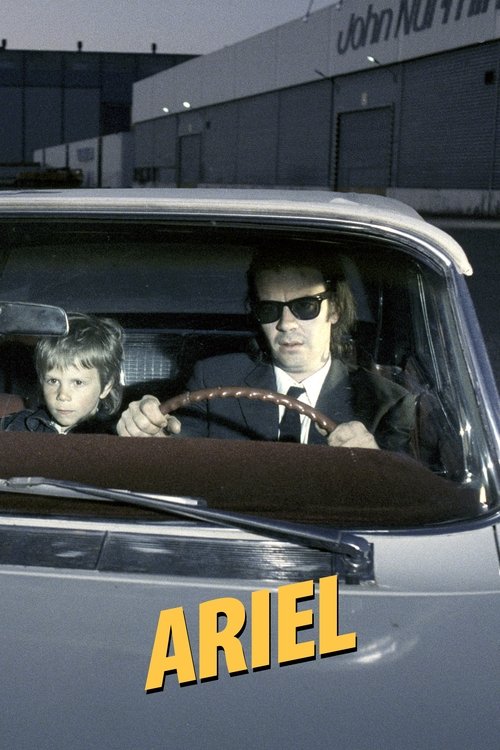
Ariel
1988 · Aki Kaurismäki
Un-retired to make Fallen Leaves, and the internet decided the deadpan Finn was its favorite romantic — a genuine late-career Letterboxd canonization event.
For when you're feeling beaten down by life and want a film that gets it — one that turns hard luck into dry comedy and leaves you rooting for the underdog. Comforting in a bleak, wry, very Finnish way.
What it's about
When the mine closes in northern Finland, a young worker inherits a white convertible under the grimmest circumstances and points it south toward Helsinki. There he's robbed of his savings, scrapes by on casual labor, falls for a traffic warden with a young son, and keeps getting shoved to the margins by bad luck and a rigged system. It's a working-class drifter's tale — job, love, jail, and a stubborn dream of escape.
The experience
Deadpan to the bone: misfortunes land with a straight face, romance is conducted in about six words, and somehow it's funny and quietly heartbreaking at once. It's lean and fast — barely over seventy minutes — with a strange warmth glowing under all that Finnish frost.
Performances
Turo Pajala plays the drifting miner with a stone face that somehow lets you read everything underneath, and Susanna Haavisto matches him with unsentimental tenderness.
The craft
Kaurismäki strips every scene to its essentials — flat compositions, minimal dialogue, jukebox tangos on the soundtrack — so each small gesture carries real weight. The economy is the style: no scene overstays, no emotion is underlined, and the humor lives entirely in timing and framing.
Why it matters
The middle panel of Kaurismäki's Proletariat Trilogy, it helped establish him as Finland's essential filmmaker and a touchstone for deadpan, working-class minimalism in world cinema.
Snapshot
Ariel is the second panel of Aki Kaurismäki's so-called "Proletariat Trilogy" — bracketed by Shadows in Paradise (1986) and The Match Factory Girl (1990) — and it remains one of the purest distillations of his method: a lean, deadpan working-class fable told in roughly seventy-odd minutes with almost no fat on it. The premise is bleakly simple. A northern Finnish miner, Taisto Kasurinen (Turo Pajala), loses his job when the pit closes; his father, in a café washroom, hands him the keys to a white convertible and then shoots himself. Taisto points the car south toward Helsinki, is promptly robbed of his savings, drifts into casual labor, falls in with a traffic warden named Irmeli (Susanna Haavisto) and her young son, lands in prison after violence he did not fully choose, breaks out with his fellow inmate Mikkonen (Matti Pellonpää), and finally boards a freighter — the Ariel of the title — bound for Mexico and an unnamed better life. The film is at once a crime picture, a romance, a hard-times social drama, and a laconic comedy, and it refuses to let any one of those modes dominate. Its power lies in compression and tone: catastrophe delivered flatly, tenderness delivered without a single sentimental cue, and an ending that reaches, against all the evidence the film has assembled, for hope.
Industry & production
Ariel was produced through Villealfa Filmproductions, the company Aki Kaurismäki founded (its name a nod to Godard's Alphaville), which anchored the fiercely independent, low-budget mode of production that defined the Kaurismäki brothers' operation in the 1980s. Working outside the more institutional channels of Finnish state-supported cinema — though Finnish film financing of the period typically ran through the Finnish Film Foundation, and the specifics of Ariel's financing are not something I can document precisely here — Kaurismäki cultivated a repertory-company economy: the same small crew, the same recurring actors, short shooting schedules, real locations, minimal coverage, and a refusal of the overheads that inflate most feature budgets. I will not invent a budget or box-office figure; the reliable public record on Ariel's exact costs and grosses is thin, and what matters historically is the deliberateness of its poverty of means. That economy was not merely a constraint but an aesthetic and ethical position — a cinema made cheaply about people living cheaply, without the gloss that would betray them. The film traveled the festival circuit and was central to establishing Kaurismäki as a major international art-cinema name in the late 1980s; its later canonization was consolidated when the Criterion Collection gathered the three working-class films together (Eclipse Series 12, Aki Kaurismäki's Proletariat Trilogy), which is how many English-language viewers first encountered it.
Technology
There is nothing technologically novel about Ariel, and that is the point. It was shot on 35mm color film in the standard manner of the period, using available and simply augmented light, practical locations, and a modest complement of equipment. Kaurismäki's practice runs deliberately counter to the era's drift toward technical spectacle: no elaborate crane or Steadicam vocabulary, no optical trickery, no reliance on the emerging video and effects technologies of the late 1980s. The camera is most often locked down on a tripod. The technological "signature," insofar as there is one, is a preference for the durable, analog, and slightly anachronistic — jukeboxes, radios, old cars, the material culture of a Finland that already looks a decade or two out of date. This retro-materialism, achieved through production design and location rather than any camera technology, is itself a stylistic statement, and it recurs across Kaurismäki's filmography.
Technique
Cinematography
The images are the work of Timo Salminen, Kaurismäki's near-constant director of photography and one of the essential collaborators of the whole body of work. Salminen's camera in Ariel is patient and frontal. Compositions are frequently static, planimetric, and centered; characters are framed cleanly against walls, in cars, across café and prison tables, with a stillness that lets small gestures carry disproportionate weight. The palette leans toward saturated, unfashionable color — deep blues, reds, and greens pooling in otherwise drab interiors — a controlled, almost painterly use of hue that would become a hallmark of the later films and that here contrasts pointedly with the gray social reality on screen. Salminen tends to hold shots, avoid unmotivated movement, and let the frame do the work of a cut, so that the cinematography and the editing are really a single economy of means.
Editing
The cutting is spare and elliptical. Kaurismäki habitually removes the connective tissue that conventional narrative cinema uses to smooth transitions: establishing beats, reaction shots, and explanatory coverage are stripped away, so that consequences arrive abruptly and time compresses without warning. The father's suicide, the robbery, the slide into prison — these land as near-jump-cuts in the life of the film, elided rather than dramatized. (I won't assert the editing credit with false precision; the cutting is very much of a piece with Kaurismäki's authorial control of his early features.) The result is a rhythm that feels both curt and unhurried: individual shots breathe, but the story as a whole is told at a clip, refusing to linger on catastrophe.
Mise-en-scène / staging
Kaurismäki stages in tableau. Actors are arranged frontally, often held at a slight remove, moving little and speaking less; the blocking has the flatness of a comic strip or a devotional painting. Production design supplies the anachronistic, working-class texture — worn cafés, rented rooms, factory yards, the interiors of cars — rendered with a deadpan attention that makes ordinary objects quietly expressive. The white convertible whose roof will not close is the film's great staging joke and its central image: a fool's chariot of freedom that leaves its driver exposed to the Finnish weather, a piece of Americana entirely wrong for the climate, and a perfect visual condensation of the whole film's mixture of absurdity, aspiration, and hard luck.
Sound
Sound in Ariel is dominated by its music. Dialogue is sparse and delivered flatly, ambient sound is functional, and into the resulting quiet Kaurismäki drops needle-drops and source music — Finnish tango and schlager, rock and rockabilly, older popular recordings — that carry the emotional register the actors withhold. Music becomes the film's licensed sentiment, the place where feeling is allowed to be large because everywhere else it is kept small. The film famously closes on a Finnish-language rendition of "Over the Rainbow," an ironic and genuinely moving gesture that gilds the freighter's departure with a borrowed Hollywood longing. (I'd rather not misattribute the specific performing artist of that closing cover, as I can't verify it with confidence here; the choice of the song itself is the salient authorial fact.)
Performance
The performances are governed by Kaurismäki's celebrated deadpan. Faces are held nearly impassive; lines are spoken with minimal inflection; grief, love, and fear are indicated by the smallest of adjustments rather than dramatized. Turo Pajala's Taisto is a study in stoic endurance, a man to whom things happen and who meets them with unbroken understatement. Susanna Haavisto brings a wary, plainspoken warmth to Irmeli. And Matti Pellonpää — the great recurring face of Kaurismäki's cinema — lends Mikkonen the rumpled, hangdog gravity that would make him the director's on-screen alter ego across many films. The affect is Bressonian in its refusal of demonstration, yet it repeatedly tips into dry comedy precisely because the flatness is held so consistently against such extreme circumstances.
Narrative & dramatic mode
Structurally, Ariel is a picaresque of downward mobility that keeps threatening to become a genre picture and then declining to. It moves episodically — mine to road to city to workplace to prison to escape to harbor — with each segment introduced abruptly and closed just as fast. The dramatic mode is anti-melodramatic melodrama: the raw materials are pure tearjerker (unemployment, a father's suicide, a robbed inheritance, a single mother, a wrongful imprisonment, a last-minute flight), but Kaurismäki processes them through radical understatement and elliptical cutting so that the pathos is implied rather than milked. The film trusts the viewer to supply the feeling the surface withholds. Its ironies are structural: a getaway car that cannot protect its driver, a prison break staged with matter-of-fact absurdity, and a rainbow-song send-off to a Mexico we will never see and have every reason to doubt.
Genre & cycle
The film sits at a crossroads of genres it treats as raw material rather than rulebook. It is a crime film (robbery, a beating, incarceration, a jailbreak), a romance (Taisto and Irmeli's laconic courtship), a social-realist drama of unemployment and precarity, and a deadpan comedy, all at once. Kaurismäki works in the tradition of European art cinema that absorbs and refunctions Hollywood genre — noir, the road movie, the prison-break picture, the melodrama — draining them of their generic excess while keeping their skeletons. Within his own output, Ariel belongs to the tight cycle of the Proletariat Trilogy, three films unified by their focus on working-class Finns crushed and occasionally redeemed by economic circumstance, and it stands as the trilogy's most mobile and escape-minded entry, framed by the more static Shadows in Paradise and the more pitiless The Match Factory Girl.
Authorship & method
Ariel is a thoroughly authored film, the product of Kaurismäki's repertory method: a stable team executing a highly consistent, recognizable style. The essential collaborators are the cinematographer Timo Salminen, whose static frontal framing and saturated color are inseparable from the Kaurismäki look, and the ensemble of recurring actors, chief among them Matti Pellonpää, whose presence threads through the director's work. Kaurismäki writes his own screenplays and exercises unusually tight control over cutting and tone, and his method — short schedules, real locations, few takes, minimal coverage, strong reliance on curated source music — produces films of remarkable stylistic uniformity across decades. The authorship is also declaratively cinephilic: the very name of the production company (Villealfa, from Godard's Alphaville) advertises a director who thinks through the history of cinema, and Ariel wears its debts openly while remaining unmistakably his own.
Movement / national cinema
As Finnish national cinema, Ariel is a landmark. Aki Kaurismäki, working alongside his brother Mika, effectively put Finnish film on the international art-cinema map in the 1980s, and the Proletariat Trilogy is central to that achievement. The film offers a vision of Finland far from any tourist image — a country of closing mines, gray cities, cheap rooms, and stubborn survivors — and it does so in a register that is distinctively national (the tango culture, the melancholy, the terseness often read as a Finnish temperament) while remaining legible worldwide. In the broader map of European cinema, Kaurismäki belongs to a minimalist, deadpan lineage rather than to any organized movement; he is closer to a one-man school, though his sensibility rhymes with strands of European modernism and with the international deadpan of contemporaries abroad.
Era / period
Ariel is a product of the late 1980s and legible against that moment: a period when Western economies were reshaping around deindustrialisation, when mines and factories were closing and the working communities built around them were being hollowed out. The film's inciting event — a pit shutting, throwing men out of work — is squarely of its era, and its journey from a depleted north to an indifferent capital traces the geography of that economic dislocation. At the same time, Kaurismäki deliberately blurs the period: the cars, jukeboxes, clothes, and music evoke earlier decades, giving the film a timeless, out-of-joint quality. It is simultaneously a document of 1980s precarity and a fable set in a Finland that seems to exist a little outside history.
Themes
The governing themes are work and its loss, dignity under economic pressure, and solidarity among the down-and-out. The film is preoccupied with money — the inheritance stolen, wages scraped, the constant arithmetic of survival — and with the way capitalism disposes of people once their labor is no longer wanted. Against that, it sets loyalty and small kindnesses: the courtship with Irmeli, the bond with Mikkonen, the pooled resolve to escape. Escape and its dubious promise form the counter-theme, crystallized in the ship and the borrowed rainbow — a longing for elsewhere that the film treats with equal parts sincerity and irony. Underlying it all is a stubborn, unsentimental humanism: Kaurismäki grants his characters an unglamorous dignity, letting them keep their reticence and their jokes even as the world grinds them down.
Reception, canon & influence
Critically, Ariel was received as a breakthrough that confirmed Kaurismäki as a major international director, and it has since settled firmly into the art-cinema canon, most durably through its inclusion in the Criterion Eclipse edition of the Proletariat Trilogy, which framed it for later generations of viewers and critics. I won't cite specific awards, grosses, or review quotations I cannot verify; the secure historical claim is that the film consolidated his reputation abroad and is now treated as essential Kaurismäki.
Its influences run backward to a cluster of touchstones critics regularly and plausibly attach to his work: the ascetic economy and impassive performance of Robert Bresson; the frontal stillness often compared to Yasujirō Ozu; the refunctioned genre grammar of classic Hollywood and film noir and of Jean-Pierre Melville; the melodramatic color of Douglas Sirk; and the cinephile modernism of Jean-Luc Godard, whose Alphaville named Kaurismäki's own company. Forward, its legacy lies in the international vogue for deadpan minimalism — the flat affect, static framing, and dry comic melancholy that link Kaurismäki, in the critical imagination, to figures such as Jim Jarmusch — and in the template it set for Kaurismäki's own subsequent career, which would later reach its widest recognition with films like The Man Without a Past (2002). Ariel is where that mature style arrives fully formed, and its long afterlife rests on how completely it fuses social compassion with formal restraint.
A Deleuzian reading
The roof will not close.
The full Deleuzian reading of Ariel →
Reception
A modest release at home in 1988, it became Kaurismäki's international breakthrough when it reached the US in 1990 and won the National Society of Film Critics' Best Foreign Language Film — the moment American critics discovered Finnish deadpan. Now it's a Criterion Eclipse staple and a fixture of every 'start here with Kaurismäki' list.
How Ariel was received, from release to now →
How to watch Ariel: what to notice on a first viewing
- Notice how still and centered the camera stays in each shot. Salminen frames people flatly and frontally against walls, cars, and cafe tables, rarely moving the camera, so small gestures carry unusual weight. With the camera doing so little, the smallest shift in someone's face becomes the whole event.
- Notice a single deep blue, red, or green filling a drab room. Salminen pools unfashionable, saturated color into otherwise gray, working-class interiors, a controlled use of hue that stands out against the hard circumstances on screen. The color is carrying a feeling the flat faces and flat voices refuse to show you.
- Watch how little Taisto's face changes after bad news. Turo Pajala plays catastrophe after catastrophe with almost no visible reaction, lines delivered flatly and grief indicated only by the smallest adjustment. The less he shows, the more you find yourself supplying the feeling he is withholding.
- Listen for the music arriving right when the dialogue goes quiet. Tango, schlager, and rockabilly needle-drops fill the silences the actors leave, carrying an emotional register the flat performances never voice directly. The soundtrack is where this film is allowed to feel large, since everywhere else it stays small.
- Notice the convertible's roof will not fully close. Taisto drives a white American convertible south through the Finnish cold with the weather sitting directly on him, a piece of Americana entirely wrong for the climate. A car built for freedom leaves its driver exposed instead, which is the whole film in one object.
The whole guide to watching Ariel, with the keys for a rewatch →
Influences: the films it descends from and the films it influenced
- Pickpocket (1959) — Bresson's 'model' technique — emotion drained from the face, feeling displaced onto hands, objects and the exact gesture of a paid transaction — is the direct source of Ariel's impassive performances and its economy of expressive means.
- Tokyo Story (1953) — The frontal, eye-level static setup with characters addressing the lens along the axis — the compositional grammar Salminen adopts — descends from Ozu's tatami-height frontality and refusal of camera movement.
- Le Samouraï (1967) — Melville's refunctioning of Hollywood noir into a laconic, ritualized code of professional gesture and minimal dialogue is the model for Ariel's stripped-down crime-genre grammar and taciturn men in trench coats.
- All That Heaven Allows (1955) — Sirk's use of heightened, unnaturalistic saturated color as an emotional register beneath a repressed surface is the melodramatic color logic Salminen and Kaurismäki apply to working-class interiors.
- Alphaville (1965) — Godard's cinephile modernism — genre iconography quoted and re-tuned self-consciously — is so foundational that Kaurismäki named his company Villealfa after this film; the debt is a declared method of thinking through film history.
- Le Quai des brumes (1938) — French poetic realism's fatalist template — a doomed working-class couple, the dream of escape by sea from a dead-end port — is the narrative-atmospheric mold Ariel reworks, down to the outbound-boat ending.
- They Live by Night (1948) — Ray's tender noir of a criminal couple fleeing on the road supplies the picaresque road-movie chassis and the sympathy-for-the-marginal that Ariel grafts onto its social realism.
- The Wizard of Oz (1939) — Ariel's diegetic cover of 'Over the Rainbow' is a direct needle-drop citation of this film's yearning anthem, deployed as source music to voice the escape motif without narrating it.
- Shadows in Paradise (1986) — The immediately preceding Proletariat Trilogy entry establishes the same repertory method — Salminen's static frontal color framing, Pellonpää's deadpan, curated source music — that Ariel brings to full maturity.
- Alice in the Cities (1974) — Inherits the mood-driven working-class drift and economy of gesture, deploying the same American-rock-on-the-radio juxtaposition against bleak transit spaces to score a wordless emotional life.
- The Man Without a Past (2002) — The film that widened Kaurismäki's recognition simply scales up Ariel's exact recipe — real locations, few takes, minimal coverage, tableau staging and jukebox source music around a down-and-out protagonist.
- Songs from the Second Floor (2000) — Andersson radicalizes the planimetric static frontal tableau into locked-off, deep-staged deadpan compositions — the same anti-camera-movement aesthetic Salminen deploys, taken to a theatrical extreme.
- The Royal Tenenbaums (2001) — Anderson's flat frontal 'planimetric' framing, centered symmetry and melancholic deadpan delivery extend the same head-on staging logic into ornate maximalism.
- Divine Intervention (2002) — Suleiman builds his film from static frontal tableaux and a mute, impassive protagonist observing dead-end social reality — deadpan minimalism as political observation, a direct heir to the Kaurismäki frame.
- Noi the Albino (2003) — The muted, desaturated palette and immobile working-class hero whose deadpan endurance of bad luck becomes both comic and bleak.
- The Match Factory Girl (1990) — Completing the trilogy, it pushes the same elliptical cutting and near-silent deadpan performance to an even more ascetic extreme, extending Ariel's Bressonian economy of shots.
- Stranger Than Paradise (1984) — Jarmusch's fixed-frame long takes, elliptical black-out cutting between vignettes and affectless drifting characters are the parallel American strain of deadpan minimalism critics twin with Kaurismäki.
- Down by Law (1986) — Its picaresque of laconic misfits drifting toward escape, shot in composed static frames with black-out transitions and a musician's ear for source songs, runs in exact stylistic parallel to Ariel the same year.
- Night on Earth (1991) — Matti Pellonpää's flat frontal delivery, held in static medium shots that let a devastating line land without an emphasizing cut, is the performance register Jarmusch imports by casting him — the Helsinki segment is essentially shot in Kaurismäki's grammar.
Similar films
- Shadows in Paradise (1986) — influence & lineage
- The Man Without a Past (2002) — influence & lineage
- Stranger Than Paradise (1984) — influence & lineage
- Fallen Leaves (2023) — shared sensibility
- The Other Side of Hope (2017) — shared sensibility
- Le Havre (2011) — shared sensibility
- Noi the Albino (2003) — shared sensibility
- 101 Reykjavik (2000) — shared sensibility