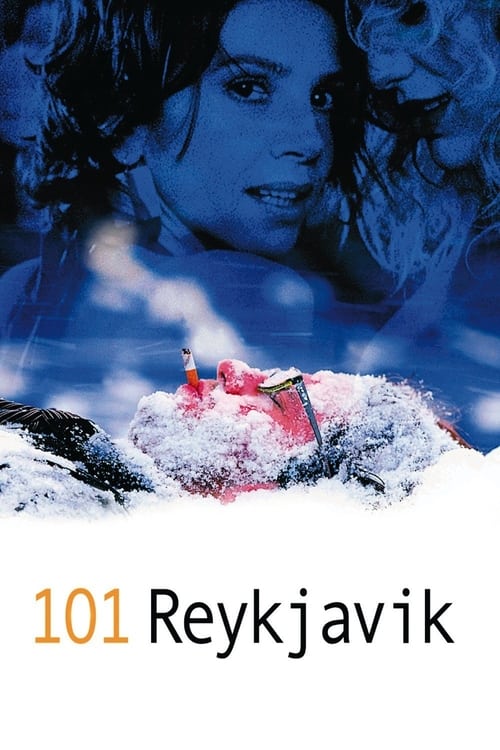
101 Reykjavik
2000 · Baltasar Kormákur
For when you want something wry, boozy, and off the beaten path — a slacker comedy with actual teeth, best on a night you're up for European oddball charm rather than tidy feel-good.
What it's about
Hlynur is thirty, unemployed by choice, and still living with his mother in downtown Reykjavík — a life of pubs, hangovers, and going nowhere, narrated with a shrug. Then his mother's friend Lola, a magnetic Spanish flamenco teacher, moves into the flat, and one reckless New Year's night tangles the household into a knot of desire, secrets, and an unplanned pregnancy that even Hlynur can't shrug off.
The experience
Deadpan and scuzzy-funny, with a dark undertow — the comedy of a man watching his own inertia like weather. It ambles like its hero, then keeps landing jabs of real sadness and absurdity.
Performances
Victoria Abril is the film's live wire as Lola, all warmth and disruption, while Hilmir Snær Guðnason makes Hlynur's passivity weirdly compelling — a charming void you can't stop watching.
The craft
Kormákur shoots downtown Reykjavík as both cocoon and cage — overcast, bar-lit, snowbound — and lets a droll voiceover set the film's curdled comic tone. The mix of Icelandic chill and flamenco heat gives it a texture unlike standard-issue slacker comedies of its era.
Why it matters
The film that put modern Icelandic cinema on the international festival map at the turn of the millennium and launched Baltasar Kormákur's career from Reykjavík to Hollywood.
Snapshot
101 Reykjavík is the feature debut of Baltasar Kormákur, adapted from Hallgrímur Helgason's 1996 novel of the same name, and it remains one of the films that announced a recognizably modern Icelandic cinema to international festival audiences at the turn of the millennium. Its title is geographic and pointed: 101 is the postal code of downtown Reykjavík, the small, bar-dense, perpetually overcast core of a capital that the film treats as both womb and trap. The protagonist, Hlynur, is a thirty-year-old who has never left it — a man who lives with his mother, draws unemployment, masturbates to internet pornography, cycles through the same handful of pubs, and narrates his own inertia with a deadpan that curdles between charm and despair. The film's engine is a domestic detonation: his mother's flamenco-teaching friend Lola, a Spanish woman, moves into the apartment, sleeps with Hlynur on a drunken New Year's, then reveals herself to be his mother's lover — and pregnant by him. The premise reads as farce and is played, much of the time, as something colder and sadder. The dossier that follows treats 101 Reykjavík as a transitional object: a national cinema's coming-of-age told through a story about a man who refuses to grow up.
Industry & production
The film is a multi-country European co-production, the kind of patchwork financing that defined small-nation art cinema in the late 1990s. It was produced through Kormákur's own Icelandic outfit (Blueeyes Productions) in partnership with Danish, French, German and Norwegian backers; the involvement of Lars von Trier's Zentropa on the Danish side is the most frequently cited of these relationships and situates the film within the Nordic production ecology that Dogme 95 had recently energized. Icelandic public film funding and European co-production subsidy structures of the period made exactly this scale of picture possible: a culturally specific, language-rooted story underwritten by pooled continental money and aimed at the festival circuit as its primary marketplace.
Casting was itself a co-production gesture. The decision to bring in Victoria Abril — a Spanish star known internationally from Pedro Almodóvar's Tie Me Up! Tie Me Down! and a body of French and Spanish work — as Lola gave the film a recognizable European name and an outsider's charge against the homogeneity of the Reykjavík milieu. The Icelandic leads, by contrast, were drawn from the country's small and theater-trained acting pool, with Hilmir Snær Guðnason as Hlynur. The grounding synopsis's "flamenco-dancing friend" is accurate to Lola's function in the story, though her role in the drama is far more disruptive than that phrasing suggests.
On the festival circuit the film traveled widely and was generally received as a discovery, screening at Toronto and across the European festivals; precise award citations vary by source and I won't assert specific prizes I can't verify. What is not in dispute is its reputational effect: it made Kormákur a name and became, for a stretch, the most visible Icelandic film of its moment abroad.
Technology
101 Reykjavík was shot and finished on conventional turn-of-the-millennium 35mm photochemical infrastructure rather than the consumer digital video that its near-contemporary Dogme films embraced; its look is film-grained and composed rather than handheld-video raw. That said, the film is unusually alert to diegetic technology as a subject. Hlynur's relationship to the world is heavily mediated by screens: television flickers constantly in the apartment, and his sexuality and curiosity are routed through early-internet pornography and web browsing. The film arrives at the precise moment when the domestic internet was becoming an ambient fact of Western life, and it registers that shift as a symptom of its protagonist's withdrawal — desire and information consumed privately, at a remove, in a darkened room. The technology that matters most in 101 Reykjavík is therefore not the camera but the screen, deployed as a character note.
Technique
Cinematography
The photography (by Peter Steuger) builds the film's emotional climate out of Reykjavík's light, or its absence. The dominant register is wintry: low northern sun, long blue dusks, the sodium and neon of bars against snow and wet pavement. Interiors are close and lamplit, emphasizing the smallness of the shared apartment and the proximity that the plot will weaponize. The film alternates this naturalism with bursts of stylization — fantasy and dream inserts, and at least one celebrated visual conceit in which Hlynur imagines himself adrift in arctic water, a literalization of his drift through life. Reykjavík itself is shot less as a tourist's city than as a closed circuit: the same streets, the same harbor, the same downtown grid, framed to feel both intimate and inescapable.
Editing
The cutting serves a first-person consciousness. Hlynur's voiceover threads the film, and the editing moves with his associative, ironic, self-cancelling narration — leaning on juxtaposition for comic and bleak effect, dropping into fantasy and back out, compressing the repetitive rhythm of his days (bar, bed, mother's living room, repeat) into a sense of looping stasis. The structure is episodic and seasonal, organized loosely around the turning of a Reykjavík year, with the New Year's Eve transgression as its pivot. The film's tonal control is largely an editorial achievement: holding comedy and depression in the same frame without letting either fully win.
Mise-en-scène / staging
The apartment is the film's principal stage and its central metaphor — a place where mother, son, and the interloper Lola are forced into a triangle that is at once domestic and erotically scrambled. Staging repeatedly puts the three bodies in proximities that should be ordinary (kitchen, sofa, hallway) and renders them charged. The downtown bar is the second key space, a social arena where Hlynur performs a sociability he doesn't feel. Production design keeps to a lived-in Icelandic ordinariness — cluttered, warm, slightly shabby interiors against the cold outside — so that Lola's flamenco color and southern-European heat read as a genuine intrusion of the foreign into a sealed room.
Sound
Sound is one of the film's signal pleasures, owing to a score composed by Damon Albarn (of Blur and Gorillaz) in collaboration with Einar Örn Benediktsson, the former Sugarcubes vocalist and a fixture of Iceland's experimental music world. The pairing of a British art-pop figure with an Icelandic avant-gardist produced music that is melancholy, propulsive, and modern, knitting the film to the indie-rock sensibility of its era and to Reykjavík's outsized reputation as a music city. The soundtrack famously gives the Kinks' "Lola" a fresh charge given the character's name and the gender play of the plot. Beyond the score, the film's sound design leans on the ambient hum of bar talk, television, and weather — the acoustic texture of a life lived indoors.
Performance
Hilmir Snær Guðnason's Hlynur is the film's load-bearing performance: a study in passivity that has to remain watchable while doing as little as possible. He plays the character's irony as a defense and lets the depression leak through it, so that the slacker comedy keeps tipping toward something clinical. Victoria Abril's Lola supplies the opposite energy — appetite, decisiveness, sexual and emotional adulthood — and the contrast is the film's whole motor. Hanna María Karlsdóttir, as the mother, has the quietly difficult task of a woman discovering her own late-life desire while her son corrodes; the film's most humane current runs through her. The supporting playing is recognizably theater-bred, precise and unshowy.
Narrative & dramatic mode
The film's mode is first-person ironic confession — closer to the comic-depressive literary monologue than to conventional screen comedy. Helgason's novel is built on Hlynur's voice, and Kormámur preserves it through voiceover, so that everything is filtered through a narrator who is unreliable mostly in the sense that he refuses to take his own life seriously. The dramatic engine is transgression-and-consequence: a drunken act collapses the boundaries between mother, lover, and son, and forces a man who has organized his existence around avoidance into a situation he cannot narrate his way out of. Tonally it lives on a knife-edge between comedy of arrested development and study of clinical inertia — what looks like a sex farce is also a portrait of a man circling depression and, at one point, self-erasure. The film resists a tidy redemptive arc; its movement is less toward growth than toward a grudging, unfinished accommodation with adulthood.
Genre & cycle
101 Reykjavík sits inside the international turn-of-the-millennium cycle of slacker and arrested-development films — stories of young men who will not leave home, will not commit, and narrate their paralysis with knowing irony. It belongs equally to the European comedy-of-discomfort tradition, where sexual farce is played without the safety net of farce's usual lightness. Its specific contribution to the cycle is the collision of that English-language slacker sensibility (reinforced by the Albarn score) with a sharply local Icelandic setting, and the daring of its central taboo — the overlapping of maternal, homosexual, and accidental-paternal desire within one apartment.
Authorship & method
This is Baltasar Kormákur's origin point as a filmmaker. Already an established stage and screen actor in Iceland, he made 101 Reykjavík as his directorial debut and adapted Helgason's novel himself, choosing for his first film a property that was already a totem of contemporary Icelandic letters. The method on display — strong literary source, first-person voice preserved, a closed domestic chamber drama dressed as comedy, an international score — would inform the more controlled work that followed. Among his collaborators, the most consequential creative partnership is the musical one with Damon Albarn and Einar Örn, whose contribution is inseparable from the film's identity. The source author Hallgrímur Helgason is the other essential authorial presence: the sensibility — the irony, the bleakness, the downtown Reykjavík specificity — is his as much as Kormákur's. Cinematographer Peter Steuger gives the film its photographic temperature. The detailed division of labor among editor and other department heads is less thoroughly documented in English-language sources, and I won't overstate attributions I can't confirm.
Kormákur would go on to a notably bifurcated career: further Icelandic literary adaptations and chamber dramas (The Sea, Jar City), then a move into Hollywood genre filmmaking (Contraband, 2 Guns, Everest) and large-scale Icelandic survival cinema (The Deep). 101 Reykjavík is the seed of that trajectory — the moment a working actor became a director with an international profile.
Movement / national cinema
The film's largest significance is as a landmark of contemporary Icelandic national cinema. Iceland's film industry is tiny by any measure — small population, limited domestic market, dependent on state funding and European co-production — and for most of the twentieth century it barely registered abroad. 101 Reykjavík was among the films that changed that, presenting an Icelandic story that was urban, contemporary, irreverent, and exportable rather than folkloric or landscape-bound. It also helped consolidate an international image of Reykjavík as a hip, music-saturated micro-metropolis — an image already circulating through Björk and the Sugarcubes, and one the film both draws on and reinforces. In the broader Nordic frame, it sits adjacent to the Danish Dogme moment without being of it: it shares the era's appetite for uncomfortable domestic truth-telling but keeps a composed, scored, photochemical aesthetic the Dogme rules forbade.
Era / period
The film is precisely of its year, 2000: a turn-of-the-millennium artifact in which the early domestic internet, indie-rock cosmopolitanism, and a particular strain of ironic male anomie all converge. It captures a pre-9/11, pre-social-media European youth culture — globalized in its music and its references, local in its geography — and a specifically Icelandic pre-crash moment, before the 2008 financial collapse that would reshape the country's self-image. Watched now, it has the quality of a time capsule of late-1990s downtown Reykjavík.
Themes
The governing theme is arrested development — the refusal or inability to cross into adulthood, dramatized through a man who cannot leave his mother's home, hold work, or commit to the woman who is carrying his child. Around that core the film organizes a cluster of concerns: maternal attachment and the failure to separate from it; the fluidity and embarrassment of desire, staged through a plot that scrambles heterosexual, homosexual, and accidental-paternal lines within a single household; the smallness of island life, the sense of a closed world from which there is no obvious exit; and depression as a quiet undertow beneath the comic surface, surfacing in Hlynur's flirtations with self-erasure. Against all of this the film sets Lola — foreignness, heat, appetite, adulthood — as the disruptive force that the protagonist's sealed world cannot absorb without breaking.
Reception, canon & influence
Internationally, 101 Reykjavík was received as a discovery and a calling card, the film that put Kormákur and a certain idea of contemporary Iceland on the festival map; it traveled the circuit and earned the kind of critical attention that small-nation debuts rarely command. (Specific award citations differ across sources, and I've avoided naming prizes I can't verify.) Looking backward, the film draws on Helgason's already-celebrated novel as its primary influence, on the European tradition of uncomfortable sexual comedy, on the Almodóvarian charge that Victoria Abril carries with her, and on the indie/art-rock culture that the Albarn–Einar Örn score makes audible. Looking forward, its legacy is twofold. It launched Baltasar Kormákur, whose subsequent oscillation between Icelandic literary cinema and Hollywood genre work is one of the more striking small-nation-to-global careers of the century's first decades. And it helped open the door for the wave of Icelandic features that followed, contributing to the international legibility of an Icelandic cinema that would later produce festival successes of its own. Its long-tail cultural footprint also rests heavily on its music: the Albarn score gave the film an afterlife among listeners who came to it through the soundtrack as much as the screen. The honest summary is that 101 Reykjavík is remembered less as a perfected film than as a pivotal one — a debut whose importance lies in what it announced.
A Deleuzian reading
There's a moment when Hlynur pictures himself floating in arctic water — face up, going nowhere, the cold holding him like a hand.
The full Deleuzian reading of 101 Reykjavik →
Reception
A festival hit on release — it took the Discovery Award at Toronto 2000 and helped announce Icelandic cinema to the world — and it's now remembered less as a standalone classic than as the film that launched Baltasar Kormákur's career before his Hollywood turn (Everest, 2 Guns).
How 101 Reykjavik was received, from release to now →
Influences: the films it descends from and the films it influenced
- Tie Me Up! Tie Me Down! (1990) — Victoria Abril imports her Almodóvarian transgressive-erotic comic persona — the volatile sexual frankness and melodramatic charge — directly into the Lola role, the casting carrying a whole tradition of uncomfortable sexual comedy with it.
- Trainspotting (1996) — Establishes the template of ironic first-person slacker voiceover laid over a pop needle-drop soundtrack to narrate a young man's dissolution, the exact voice-plus-music architecture 101 adopts.
- The Graduate (1967) — Founds the comedy of discomfort built on a passive arrested young man seduced by an older woman, with a pop song cycle functioning as quasi-narration over his drift.
- Festen (1998) — The Dogme-95 handheld natural-light naturalism and claustrophobic family-chamber staging that 101's 'Dogme-adjacent' closed apartment drama works in the slipstream of.
- Annie Hall (1977) — Models the confessional first-person voiceover and direct address organizing a neurotic comedy of fluid desire and self-deprecating arrested romance.
- Slacker (1990) — Codifies the arrested-development slacker as a legitimate cinematic subject and the episodic, plot-resistant drift structure that 101's seasonal episodes inherit.
- Children of Nature (1991) — The Oscar-nominated breakthrough that built the international legibility of Icelandic national cinema as a festival category, the door 101 walked through.
- Cold Fever (1995) — Sets the photographic temperature of wintry Icelandic natural light and deadpan landscape framing that Peter Steuger's cinematography continues.
- The Sea (2002) — Kormákur directly extends his own method — Icelandic literary adaptation staged as a closed-domestic chamber drama with a preserved authorial voice.
- Jar City (2006) — Continues the Kormákur formula of adapting a totemic Icelandic novel while keeping its first-person sensibility, now bent toward genre, with the same wintry-natural-light temperature.
- Nói the Albino (2003) — Extends the deadpan portrait of arrested provincial Icelandic youth in cold natural light — part of the post-101 Icelandic wave whose international legibility 101 helped secure.
- Reykjavík-Rotterdam (2008) — Downtown-Reykjavík genre cinema produced by and starring Kormákur, extending the '101' scene's specific urban milieu into thriller form.
- Of Horses and Men (2013) — Carries forward the episodic-vignette comedy of rural Icelandic discomfort and bleak irony as a national-cinema idiom on the festival circuit 101 opened.
- Rams (2015) — A later Icelandic-national-cinema festival success occupying the international art-house lane that 101 Reykjavík's breakthrough helped make legible for small-nation features.
- Ravenous (1999) — Damon Albarn's idiosyncratic, non-orchestral film scoring as a craft signature — the same art-rock composer's-ear that makes the Albarn–Einar Örn score inseparable from 101's identity.
- High Fidelity (2000) — Contemporary sibling in direct first-person confession of an arrested man-child whose pop-music taste is used as the structuring device for self-narration.
Similar films
- The Man Without a Past (2002) — shared sensibility
- Noi the Albino (2003) — shared sensibility
- Rotting in the Sun (2023) — shared sensibility
- Amores Perros (2000) — shared sensibility
- Touch (2024) — shared sensibility
- Fallen Leaves (2023) — shared sensibility
- Y Tu Mamá También (2001) — shared sensibility
- The Love That Remains (2025) — shared sensibility