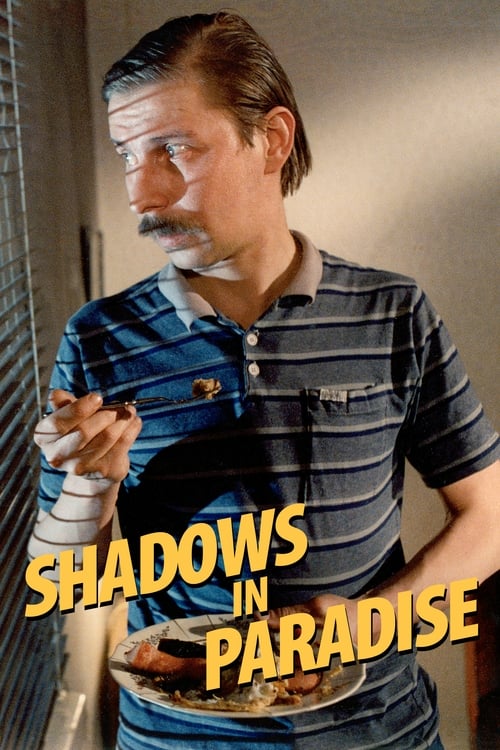
Shadows in Paradise
1986 · Aki Kaurismäki
Un-retired to make Fallen Leaves, and the internet decided the deadpan Finn was its favorite romantic — a genuine late-career Letterboxd canonization event.
For when you're feeling low-key and a little melancholy and want a film that finds dignity and dry humor in ordinary life — a small, warm thing rather than a big loud one.
What it's about
Nikander collects garbage in Helsinki and dreams, modestly, of going into business for himself — until his would-be partner dies and the plan dies with him. Then he meets Ilona, a supermarket cashier who's just lost her job, and two solitary working people begin a halting, almost wordless courtship, feeling their way toward each other with no grand gestures and very little luck.
The experience
Deadpan and tender at once — long silences, blank faces, and rock 'n' roll on the jukebox, with real feeling running underneath the stillness. It's quietly funny in a way that makes you smile more than laugh, and oddly consoling.
Performances
Matti Pellonpää and Kati Outinen do remarkable work with almost nothing — faces held nearly still, feelings conveyed in a glance or a pause — a minimalist double act that makes reticence itself romantic.
The craft
This is where Aki Kaurismäki's signature style clicked into place: precise, stripped-down frames, deadpan timing, and a soundtrack of rock 'n' roll and tango that says everything the characters won't. Every shot is composed with a dry wit that turns supermarkets and garbage trucks into something quietly beautiful.
Why it matters
The opening chapter of Kaurismäki's Proletariat Trilogy and the arrival of one of European cinema's most distinctive voices — his deadpan, working-class romanticism has influenced offbeat comedies ever since.
Snapshot
Shadows in Paradise (Finnish: Varjoja paratiisissa) is Aki Kaurismäki's third feature and the film in which his mature style arrived fully formed: deadpan, minimalist, tender toward the working poor, and steeped in an anachronistic love of rock 'n' roll, tango, and mid-century Americana. It follows Nikander (Matti Pellonpää), a Helsinki garbage collector whose modest dream of going into business for himself collapses when his older partner dies of a heart attack, and Ilona (Kati Outinen), a supermarket cashier who loses her job. Their courtship is halting, undemonstrative, and quietly comic — two solitary people negotiating affection with almost no visible expression and very few words. The film is the opening chapter of what became known as Kaurismäki's "Proletariat Trilogy" (with Ariel, 1988, and The Match Factory Girl, 1990), and it inaugurated the director's decades-long partnerships with Pellonpää, Outinen, and cinematographer Timo Salminen. Compact — running roughly 74 minutes — it is a small film that established a very large sensibility.
Industry & production
Shadows in Paradise was produced through Villealfa Filmproductions, the independent company Aki Kaurismäki ran with his brother Mika, its name a homage to Jean-Luc Godard's Alphaville. The Villealfa model — low budgets, small crews, fast shoots, creative autonomy — was central to the film's aesthetic and to the wider phenomenon of the 1980s Finnish film revival. Working outside the orbit of the large, subsidy-dependent productions that had dominated Finnish cinema, the Kaurismäkis made films quickly and cheaply, which allowed them to take formal and tonal risks that a more conventional industry structure would likely have discouraged.
By 1986 Aki Kaurismäki had already directed Crime and Punishment (1983), a Dostoevsky adaptation transposed to Helsinki, and the anarchic Calamari Union (1985). Shadows in Paradise marked a consolidation: where the earlier films experimented, this one distilled. The precise budget and box-office performance are not well documented in readily verifiable English-language sources, and I will not invent figures; what is clear is that the film was made on modest means and that its commercial ambitions were secondary to Kaurismäki's growing festival and art-house reputation. Its lasting industrial significance lies less in its returns than in its role as proof of concept for a sustainable auteur cinema operating on the margins of a small national industry — and in cementing the repertory company of actors and technicians Kaurismäki would reuse for the next thirty years.
Technology
The film was shot on 35mm color stock, and its technology is essentially conventional for mid-1980s European production — the interest lies in how deliberately un-modern Kaurismäki makes it look. Rather than exploiting the visual conventions of contemporary 1980s cinema, he and cinematographer Timo Salminen use saturated, carefully controlled color and old-fashioned framing to evoke an indeterminate mid-century world. The mise-en-scène is dense with obsolete technology as set dressing: jukeboxes, rotary telephones, older-model automobiles, radios, and record players. This anachronism is a design choice rather than a budgetary accident; it detaches the film from a specific historical moment and places it in the timeless, slightly melancholic pop-cultural past that Kaurismäki prefers. Sound is recorded and mixed plainly, without ostentation, and music is delivered largely through diegetic sources — bars, jukeboxes, radios — which reinforces the sense of a world assembled from second-hand cultural artifacts.
Technique
Cinematography
Timo Salminen's photography is the visual signature of the film and the beginning of one of the most important director–cinematographer partnerships in modern European cinema. The camera is predominantly static; Salminen favors fixed frames, frontal or near-frontal compositions, and a restrained visual grammar that lets the actors and the décor do the work. Color is used expressively — blocks of deep blue, red, green, and yellow anchor otherwise drab working-class interiors, lending dignity and a faintly melancholic beauty to supermarkets, rented rooms, and dockside bars. The lighting is clean and deliberate rather than naturalistic. There is almost no showy camera movement; when the frame does move, it registers. This economy of means, in which a cut or a small reframing carries unusual weight, became a defining feature of Kaurismäki's cinema.
Editing
The film's editing is spare and elliptical. Scenes are pared to essentials, transitions are often abrupt, and narrative connective tissue is frequently omitted, so that the audience infers events that are never shown. The cutting rhythm is patient — shots are held long enough to let deadpan reactions land — but the overall structure is compressed, which is how a story of this emotional range fits into roughly 74 minutes. The effect is both comic and poignant: information is withheld and delivered flatly, and the ellipses create a distinctive tempo that is neither the loose realism of documentary nor the propulsion of conventional narrative. (The film was edited by Raija Talvio.)
Mise-en-scène / staging
Staging is central to Kaurismäki's method, and Shadows in Paradise codifies it. Actors are frequently arranged frontally, side by side or facing the camera, and blocked with a deliberate stillness that borders on the tableau. Interiors are meticulously composed — every prop, color, and surface is chosen — yet the overall impression is of unglamorous, lived-in working-class Helsinki. The gap between the precision of the design and the shabbiness of the depicted world is where much of the film's tenderness and dry humor resides. Characters occupy their spaces with an almost ceremonial economy of movement, and the settings — garbage truck, supermarket, cheap apartments, harbor — are photographed with a gravity that treats proletarian life as worthy of formal beauty.
Sound
The soundtrack is a Kaurismäki hallmark: a curated jukebox of rock 'n' roll, rockabilly, and Finnish and continental tango, most of it motivated diegetically. Music functions as emotional counterpoint to the characters' expressive reticence — the songs articulate longing and romance that the near-mute protagonists cannot voice. Dialogue is sparse, delivered flatly, and often exchanged with long pauses; silence is a structural element. The specific music credits are not something I can enumerate reliably from memory, and I will not fabricate them, but the general texture — vintage pop and tango standing in for interior feeling — is unmistakable and consistent with the director's lifelong practice.
Performance
The acting is the film's most immediately striking feature. Matti Pellonpää, as Nikander, and Kati Outinen, as Ilona, perform in a register of extreme restraint — impassive faces, minimal gesture, monotone delivery — that recalls the anti-expressive "models" of Robert Bresson more than any naturalistic school. Emotion is conveyed through the smallest inflections: a glance, a hesitation, the way a cigarette is held. This deadpan does double duty as comedy and as pathos; the flatness is funny, but it also reads as the emotional armor of people who have learned not to expect much. Shadows in Paradise launched both actors as Kaurismäki's central players — Pellonpää would become the melancholic face of his 1980s and early-'90s work until the actor's death in 1995, and Outinen would remain a defining presence across the director's career.
Narrative & dramatic mode
The narrative is a minor-key romance built on reversal and understatement. Nikander's entrepreneurial hope is extinguished at the outset by his partner's sudden death, and the film thereafter tracks the fitful, easily derailed formation of a bond between two people with little social capital and even less fluency in expressing desire. The dramatic mode is anti-melodramatic melodrama: the raw materials are those of the "woman's picture" and the working-class romance — job loss, misunderstanding, jealousy, small betrayals, tentative reconciliation — but they are filtered through a deadpan flatness that suppresses overt sentiment while quietly honoring it. Plot points arrive obliquely, often already accomplished by the time we see their aftermath. The result is a story that feels both slight and unexpectedly moving, its emotional stakes carried by tone and gesture rather than by incident or speech.
Genre & cycle
Nominally a comedy-drama-romance, Shadows in Paradise belongs most precisely to Kaurismäki's own cycle: the "Proletariat Trilogy" (or "Working-Class Trilogy") that it inaugurates, completed by Ariel and The Match Factory Girl. Across the three films Kaurismäki attends to Finland's low-wage, precarious workers — collectors, miners, factory hands, cashiers — with a mixture of dry comedy, social observation, and romantic longing. The film also participates in a broader lineage of humanist working-class cinema and of the deadpan comedy of stone-faced protagonists. It is a romance that refuses romantic effusion, a comedy whose humor derives from affectlessness, and a social film that never lectures — a hybrid that Kaurismäki would refine but essentially not abandon for the rest of his career.
Authorship & method
Shadows in Paradise is a fully authored work, written and directed by Aki Kaurismäki, and it announces the collaborative "company" method that underwrites his authorship. The key collaborators established or consolidated here recur for decades: cinematographer Timo Salminen, whose static, color-blocked images are inseparable from Kaurismäki's vision; actors Matti Pellonpää and Kati Outinen, the melancholic leads who become the recurring faces of his cinema; and editor Raija Talvio. Kaurismäki himself functions as writer-director and, through Villealfa, as producer, controlling the work end to end. His method is one of economy and repetition — a stable ensemble, a consistent formal grammar, fast and inexpensive shooting — and of deliberate citation: the deadpan performance owes to Bresson, the compositional stillness and working-class melancholy evoke Ozu, and the fatalistic romanticism and genre affection recall Jean-Pierre Melville and the American and European B-movies Kaurismäki loves. Rather than a score composed for the film, his method favors compiled vintage music as an authorial voice in its own right.
Movement / national cinema
The film is a foundational document of the 1980s revival of Finnish cinema — sometimes called the "new" Finnish cinema — driven above all by Aki and Mika Kaurismäki and their Villealfa company. Before this generation, Finnish film had limited international visibility; the Kaurismäkis, working cheaply and independently, put Finland on the world art-house map and created an exportable national style. Aki's contribution specifically was a recognizable auteur idiom — deadpan, retro, proletarian, formally rigorous — that became, for international audiences, almost synonymous with Finnish cinema itself. Shadows in Paradise is where that national-cinematic identity crystallizes, and it opened the way for the festival successes that followed throughout the late 1980s and 1990s.
Era / period
Made and set in mid-1980s Helsinki, the film nonetheless resists its period. Kaurismäki systematically strips out markers of the contemporary and replaces them with a composite mid-century pastness — 1950s and '60s cars, jukeboxes, fashions, and music — so that the film seems to float outside history. This deliberate anachronism is thematically loaded: it universalizes the characters' predicament and lends their world a nostalgic, elegiac quality even as the underlying subject is the decidedly present-tense precarity of low-wage labor in an advanced welfare state. The period, in other words, is double — the actual 1980s and an imaginary vintage past superimposed upon it — and the tension between them is one of the film's quiet pleasures.
Themes
The film's central themes are loneliness and the difficult labor of connection; the dignity of the working poor; economic precarity and the fragility of modest ambition; and the redemptive power of small gestures. Kaurismäki treats his characters' isolation with great seriousness but never with pity — their reticence is both a wound and a form of integrity. Solidarity among the marginalized, romance as a fragile refuge, and the possibility of escape (literal and figurative) recur throughout. Underlying it all is a compassionate, faintly melancholic humanism: the conviction that ordinary, inarticulate people leading unglamorous lives are worthy subjects of formal beauty and genuine feeling. The pop and tango soundtrack functions thematically too, voicing the longing the characters cannot express and suggesting that even the most affectless lives are shot through with romantic yearning.
Reception, canon & influence
Shadows in Paradise was received as a breakthrough in Kaurismäki's development and, together with the trilogy it opened, helped build his international critical standing over the following years. It has since been treated as a canonical entry point to his work; the Criterion Collection gathered the three "Proletariat Trilogy" films for home-video release (Eclipse Series), which consolidated the film's status among English-language cinephiles and confirmed its place in the arthouse canon. I do not have reliable contemporaneous review quotations or award records to cite here, and I will not invent them; the durable critical consensus, however, positions the film as the moment Kaurismäki's voice fully emerged.
Influences on the film (backward): the anti-expressive performance style and formal austerity of Robert Bresson; the static, frontal compositions and working-class melancholy associated with Yasujirō Ozu; the fatalism and genre romanticism of Jean-Pierre Melville; the emotional structures of classical melodrama, including the Sirkian "woman's picture"; the tradition of Italian neorealism in its attention to ordinary labor; and the American rock 'n' roll and B-movie culture, plus continental and Finnish tango, that supply the film's musical and iconographic vocabulary.
Legacy (forward): most immediately, the film established the template for the rest of Kaurismäki's career — the ensemble of Pellonpää, Outinen, and Salminen; the deadpan romance; the retro mise-en-scène; the jukebox soundtrack — carried forward through Ariel, The Match Factory Girl, The Man Without a Past (2002), Le Havre (2011), The Other Side of Hope (2017), and Fallen Leaves (2023), the last of which he has described in relation to this trilogy. More broadly, its deadpan minimalism and its dignified treatment of the working class contributed to an international vocabulary of restrained, tableau-driven comedy-drama, and its success helped legitimize a whole generation of small-nation independent auteurs. For a film of such modest scale, Shadows in Paradise proved extraordinarily generative: it is the seed from which one of Europe's most consistent and beloved bodies of work grew.
A Deleuzian reading
Two people sit side by side in a rented room, facing the camera instead of each other.
The full Deleuzian reading of Shadows in Paradise →
Reception
Barely seen outside Finland on release, it quietly launched what became Kaurismäki's 'Proletariat Trilogy' — and as his international stock soared over the following decades, it got reappraised as the moment his deadpan style fully clicked, now a steady Letterboxd favorite.
How Shadows in Paradise was received, from release to now →
How to watch Shadows in Paradise: what to notice on a first viewing
- Watch how still the camera stays through nearly every scene. Timo Salminen shoots in fixed, frontal frames and rarely moves the camera at all, so when it finally does, the movement carries real weight. The stillness makes every small gesture inside the frame feel deliberate.
- Notice a single strong color filling each drab room. Blocks of deep blue, red, or yellow sit inside otherwise ordinary working-class interiors, a supermarket, a rented room, a dockside bar. Color does the work of dignifying these spaces that the dialogue never does out loud.
- Watch Nikander's face right after something goes wrong for him. Matti Pellonpää plays him with almost no change in expression, so a setback and a small kindness get roughly the same flat weather on his face. The flatness is both a joke and an armor for a man who has learned not to expect much.
- Listen for the music always playing from a jukebox or radio. Nearly every song comes from a machine inside the scene, rock and roll, rockabilly, tango, and it says the things Nikander and Ilona never say out loud. The declaration of love in this film happens on a record, not on a face.
The whole guide to watching Shadows in Paradise, with the keys for a rewatch →
Influences: the films it descends from and the films it influenced
- Pickpocket (1959) — Source of the flattened, affectless 'model' performance Kaurismäki imposes on Pellonpää and Outinen — dialogue delivered without inflection or reactive facework, so emotion registers through gesture and object rather than expression.
- L'Argent (1983) — Late-Bresson elliptical cutting — the fragmenting of an action into hands, money, and doors that omits psychological connective tissue — models the abrupt scene-to-scene compression Kaurismäki uses to skip over transitions and reactions.
- An Autumn Afternoon (1962) — The static, frontal, eye-level camera holding on characters seated in blocked interiors — with color used as flat compositional blocks (a red kettle, a signboard) — is the Ozu grammar Salminen and Kaurismäki transpose to Helsinki.
- Tokyo Story (1953) — Tableau staging of ordinary domestic life shot at tatami height with no camera movement, dignifying working people through stillness rather than dramatic emphasis — the compositional patience Kaurismäki adopts for his supermarket and dockworker scenes.
- Le Samouraï (1967) — Melville's laconic, fate-bound loner in a color-drained frame and his refusal of expository dialogue supply the genre-romantic fatalism and minimalist noir iconography (trench coats, bars, cars) Kaurismäki reworks straight-faced.
- Bob le Flambeur (1956) — The affectionate B-movie underworld texture and low-budget location shooting of Melville's Paris demimonde is the template for Kaurismäki's romance of small-time crooks, bars, and marginal labor.
- All That Heaven Allows (1955) — Sirkian melodrama structure — lovers separated by class and circumstance, reunited by contrivance — is what Kaurismäki keeps as skeleton while stripping out the swelling music and heightened acting, an anti-melodrama built on melodrama's bones.
- Bicycle Thieves (1948) — Neorealist attention to the concrete rhythms of manual labor and unemployment — the job, the wage, the lost work — grounds Kaurismäki's proletarian settings in real economic detail rather than metaphor.
- Ariel (1988) — Directly extends the Proletariat Trilogy method — same repertory ensemble (Pellonpää), Salminen's color-blocked static frames, and the road-movie fatalism carrying forward Melville's genre romanticism into a Finnish register.
- The Match Factory Girl (1990) — Pushes the seed's elliptical compression and Bressonian deadpan to their extreme — Outinen's near-silent factory worker, minimal dialogue, and cutting that elides all psychological explanation — closing the trilogy the film opened.
- The Man Without a Past (2002) — Carries the same grammar into the Finland Trilogy: tableau blocking, diegetic jukebox and live-band music as counterpoint, and the dignified deadpan romance among society's discarded, now in fully saturated color-blocked frames.
- Fallen Leaves (2023) — Kaurismäki's explicit late return to the Shadows in Paradise template — supermarket-worker heroine, obstructed deadpan romance, jukebox/radio music, and the retro anachronistic mise-en-scène — a self-conscious recapitulation of the seed's formula.
- Kitchen Stories (2003) — Establishes the Nordic chamber two-hander built from terse, widely-spaced lines of dialogue and muted working-class interiors, the exact tonal economy Hamer adopts for Isak and Folke.
- Humanist Vampire Seeking Consenting Suicidal Person (2023) — A romance between two lonely, undemonstrative souls conducted in neon-lit bars over jukebox torch songs — the exact 'nocturnal-neon plus torch-song' courtship the film reprises.
- The Other Side of Hope (2017) — The founding text of his own method — Salminen's hard-key 35mm, the deadpan wage-labor romance, jukeboxes and in-frame bands doing all the work a score would do, and the establishment of the repertory company (Kati Outinen among them) that Hope still casts from.
- Stranger Than Paradise (1984) — Contemporaneous parallel invention of deadpan minimalist cinema — long static takes, blank affect, drab interiors, and terse jukebox-scored scenes — arriving from American independent cinema at the same moment as Kaurismäki's Finnish variant.
- Down by Law (1986) — Shares the year and the method: melancholic male losers filmed in stark held compositions with dryly comic underplaying and vintage-music cues functioning as authorial voice rather than emotional underscore.
- Songs from the Second Floor (2000) — Independent Nordic development of the same deadpan-tableau craft — rigidly frontal, static, color-controlled wide shots staging melancholy comedy of ordinary people — arriving at Kaurismäki's stillness through a theatrical-diorama route.
- A Pigeon Sat on a Branch Reflecting on Existence (2014) — Extends the shared tableau-blocking idiom to its purest form: single locked-off compositions, pale color palette, non-reactive performances, and absurdist working-class pathos held in unbroken static frames.
Similar films
- Ariel (1988) — influence & lineage
- Fallen Leaves (2023) — influence & lineage
- The Man Without a Past (2002) — influence & lineage
- Stranger Than Paradise (1984) — influence & lineage
- Songs from the Second Floor (2000) — influence & lineage
- Tokyo Story (1953) — influence & lineage
- Le Havre (2011) — shared sensibility
- The Other Side of Hope (2017) — shared sensibility