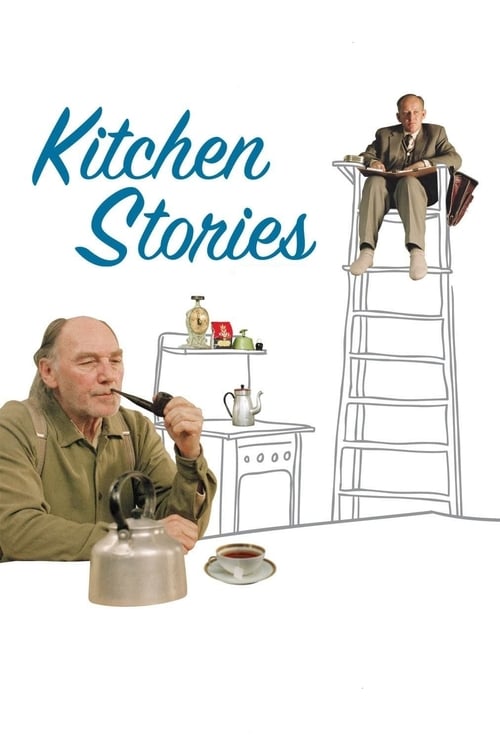
Kitchen Stories
2003 · Bent Hamer
For a mellow evening when you want to smile more than laugh out loud — cozy, wintry comfort viewing for anyone who likes their comedy understated and their sentiment earned.
What it's about
In the 1950s, a Swedish institute dispatches efficiency researchers to rural Norway to chart how single men use their kitchens. The rules are strict: the observer sits atop a tall umpire's chair in the corner, records every movement, and must never speak to his subject. The film follows one pairing — the dutiful researcher Folke and the stubborn old farmer Isak, who retaliates by simply refusing to use his kitchen — as silence slowly gives way to something like friendship.
The experience
Dry as a cracker and twice as satisfying — long deadpan silences, tiny visual jokes, and a warmth that creeps up on you so gradually you don't notice until it's got you. It's slow in the best way: unhurried, precise, quietly moving.
Performances
Tomas Norström and Joachim Calmeyer do wonders with almost no dialogue, playing an entire relationship — suspicion, stubbornness, thaw — in glances traded across a kitchen.
The craft
Bent Hamer builds comedy from geometry: the absurd umpire's chair, the mapped kitchen floor, two lonely men arranged in a frame like a diagram slowly going wrong. The muted colors, retro production design, and near-silent soundscape make the smallest gesture — a shared pipe, a cup of coffee — land like an event.
Why it matters
A signature work of Nordic deadpan that traveled far beyond Scandinavia, and a sly, humane rebuttal to the postwar dream of scientifically managed living.
Snapshot
Kitchen Stories (Norwegian: Salmer fra kjøkkenet, literally "Hymns from the Kitchen") is a deadpan tragicomedy by Norwegian director Bent Hamer, built from a premise so absurd it sounds invented but is rooted in postwar fact: a Swedish institute dispatches efficiency researchers into the homes of Norwegian bachelors to chart their kitchen movements. The researcher must perch on a raised umpire's chair in the corner, observe in silence, and never interact with his subject. The film follows one such pairing — the dutiful observer Folke Nilsson (Tomas Norström) and the stubborn old farmer Isak Bjørvik (Joachim Calmeyer) — as the wall of scientific protocol erodes into a wary, then tender, friendship. It is a small film about large things: surveillance and the impossibility of neutral observation, the loneliness of aging men, and the gentle comedy of national rivalry between Swedes and Norwegians. Premiering in the Un Certain Regard section at the 2003 Cannes Film Festival, it became Hamer's international breakthrough and remains the work most associated with his name.
Industry & production
The film is a Norwegian–Swedish co-production, a logical structure given that its very subject is the cultural friction between the two neighbors. Hamer's own production company, Bulbul Film, anchored the Norwegian side, with Swedish partners completing the co-production; the project drew on the standard Nordic public-funding architecture of the era, in which national film institutes and regional funds underwrite modestly budgeted auteur cinema. The budget was small by any international measure, consistent with a chamber piece that unfolds largely within a single farmhouse kitchen and its surrounding rural landscape.
The conceit is grounded in real institutional history. In the late 1940s and 1950s, Sweden's Hemmets Forskningsinstitut (the Home Research Institute, HFI) genuinely conducted time-and-motion studies of domestic kitchen work, mapping the paths housewives traced between stove, sink, and counter in pursuit of rationalized, ergonomic design — a domestic application of the Taylorist and Frank-and-Lillian-Gilbreth motion-study tradition. Hamer transposes this documented project into a comic fiction: the institute's decision to study single men, and to do so by planting an unmoving observer in the room, is the film's invented engine. The detail that the researchers travel in a convoy of identical caravans (trailers), and that they are forbidden from accepting so much as a cup of coffee from their subjects, dramatizes the pretense of laboratory sterility imported into a lived-in home.
The casting is central to the production's identity. Tomas Norström, a Swedish actor, and Joachim Calmeyer, a veteran Norwegian, embody the national divide not only thematically but linguistically — the comedy of two men who barely speak, and who when they do speak speak different (if mutually intelligible) Scandinavian languages, is woven into the film's fabric. The decision to cast older men in the leads, rather than reaching for younger marquee names, signals the film's interest in loneliness and the passage of time over conventional appeal.
Technology
Kitchen Stories is, technologically, a deliberately modest and analog film, and that modesty is expressive rather than incidental. Shot on film with naturalistic, available-feeling light, it eschews any visual flourish that would betray its early-2000s production date; the aim is to render the 1950s period world as solid, tactile, and unhurried. The film's most pointed "technology" is diegetic and thematic: the apparatus of observation itself. The towering umpire's chair, the clipboard and notation system, the forbidden two-way protocol, and Isak's counter-surveillance through a hole bored in the ceiling constitute a low-tech meditation on instruments of measurement and watching. The film is, in effect, about the impossibility of a clean technological interface between observer and observed — a cinematic dramatization of what social scientists call the observer effect (or, by analogy, the Hawthorne effect): the act of measuring inevitably alters the thing measured. Isak stops cooking once he is watched; the experiment destroys its own data.
Technique
Cinematography
The photography, by Philip Øgaard — a frequent Hamer collaborator — is composed, patient, and frontal, suited to a film whose subject is looking. The camera tends toward stillness and symmetry, framing the kitchen as a stage and the umpire's chair as a fixed vantage that the film both adopts and interrogates. Color is muted and wintry, a palette of pale Nordic light, dark wood interiors, and the cold blues and whites of the rural exterior, reinforcing both the period setting and the emotional reticence of the characters. The visual wit lies in geometry: the elevated observer looking down, the framed and bounded kitchen space, the recurring motif of one man watching another through apertures and across thresholds. Where many comedies cut for pace, Hamer and Øgaard let compositions hold, trusting the absurdity of the tableau — a man sitting motionless on a high chair in another man's kitchen — to generate its own quiet humor.
Editing
The cutting is unhurried and observational, matching the deadpan register: shots are held past the point of conventional comic timing so that awkwardness and stillness become the joke. The rhythm is patient, allowing silence and routine to accumulate meaning before the slow thaw between the two men registers. (Specific editorial credits for the film are not something I can confirm in detail here, and I will not invent an attribution.)
Mise-en-scène / staging
This is the film's richest technical dimension. The single dominant set — Isak's kitchen — is dressed with period precision and lived-in clutter, and the blocking is organized around the absurd spatial relationship the experiment imposes: the observer raised and removed, the subject going about (or pointedly not going about) his domestic business below. The umpire's chair is the master prop, a piece of sporting equipment relocated into a domestic interior, instantly comic and faintly menacing. Staging exploits levels and lines of sight throughout — the hole in the ceiling that lets Isak reverse the gaze is the structural pivot, converting a one-way study into mutual observation and, eventually, mutual recognition. The convoy of identical caravans parked in the snowy yard extends the visual rhetoric of standardization colliding with idiosyncratic rural life.
Sound
Dialogue is sparse by design; much of the film's first act proceeds in near-silence, governed by the no-talking rule, so that ambient kitchen sounds, the creak of the chair, and the scratch of pencil on clipboard carry the scene. When speech finally breaks the protocol, it lands with weight precisely because the soundscape has been so withholding. The musical scoring is restrained and used sparingly, in keeping with the film's overall economy; I won't assign a composer credit I cannot verify.
Performance
The film lives or dies on its two lead performances, and both are exercises in minimalism. Norström plays Folke as a man of rules slowly undone by ordinary human warmth — the comedy and pathos come from tiny fractures in his professional composure. Calmeyer's Isak is all flinty resistance giving way, grudgingly, to companionship; his stillness and sidelong glances do enormous work. The supporting register — notably the institute superior and the figure of Isak's neighbor, who resents the intimacy developing between the two men — sharpens the central relationship by surrounding it with suspicion and bureaucratic propriety.
Narrative & dramatic mode
Structurally the film is a two-hander built on a single sustained situation, evolving through small increments rather than plot mechanics. Its dramatic mode is the deadpan comedy of constraint: a rule is established (no contact), and the entire arc consists of that rule's gradual, deeply human violation. The narrative obeys the logic of the slow thaw — distrust, curiosity, transgression, friendship — and earns its emotional turn precisely because it has been so disciplined about withholding it. There is a melancholy underbody beneath the comedy; the closing movement turns frankly elegiac, and the film's late developments lend the whole a valedictory weight. It is comedy in shape and tragedy in temperature.
Genre & cycle
Kitchen Stories sits within the recognizable Nordic strain of deadpan tragicomedy — the dry, absurdist, emotionally reticent register most internationally associated with the Finnish director Aki Kaurismäki and, in a different key, with the Swede Roy Andersson. It belongs to the broader European art-house tradition of the chamber two-hander and to a small cycle of films that find comedy and pathos in bureaucracy, observation, and the routines of solitary men. Within Hamer's own work it forms part of a loose cycle of gentle studies of male loneliness and quiet eccentricity that runs through Eggs (1995) before it and O' Horten (2007) after.
Authorship & method
Bent Hamer (b. 1956) is the film's clear author, having co-written, directed, and produced it. His method, evident across his filmography, favors the modest, the marginal, and the absurd-yet-humane: undramatic protagonists, single-situation premises mined for both comedy and tenderness, and a refusal of sentimentality even at his most affecting. Kitchen Stories is the purest distillation of that sensibility. The screenplay is credited to Hamer with the Swedish writer Jörgen Bergmark, a collaboration appropriate to the film's binational subject. Cinematographer Philip Øgaard is a key recurring collaborator whose composed, patient images are inseparable from Hamer's tone. Hamer's career bracketing the film is instructive: Eggs established his reputation domestically; after Kitchen Stories he made the English-language Factotum (2005), adapting Charles Bukowski with Matt Dillon, then returned to Norwegian deadpan with O' Horten (2007). The through-line is a consistent authorial voice rather than a search for one.
Movement / national cinema
The film is a landmark of contemporary Norwegian cinema and, more broadly, of a Scandinavian art-house sensibility that gained international visibility in the late 1990s and 2000s. It does not belong to a formal movement so much as to a regional tonal tradition — the Nordic deadpan — but it is also pointedly about national cinema and national identity, dramatizing the Swedish–Norwegian relationship (the bigger, wealthier, more bureaucratically self-assured Sweden studying its smaller neighbor) with affectionate irony. The postwar setting foregrounds a specific historical texture of Scandinavian welfare-state rationalism and the lingering, low-grade rivalry between the two peoples. For Norwegian cinema specifically, the film's festival success helped signal the international reach of a small national industry.
Era / period
Kitchen Stories is a period film, set in the 1950s, and its production design, costuming, and palette are calibrated to that postwar moment — the heyday of the real kitchen-efficiency studies it fictionalizes. The choice of period is essential rather than decorative: the film is about a particular faith in measurement, planning, and social-scientific optimization that belonged to the early welfare-state era, and about the human stubbornness that faith could not account for. Made in 2003, it looks back at that mid-century rationalism with the irony of hindsight, finding in it both comedy and a genuine pathos about the limits of any system that tries to standardize a life.
Themes
The governing theme is observation and its impossibility: to watch a person is to change them, and genuine knowledge of another comes not from detached measurement but from contact, reciprocity, and risk. From this flow the film's other concerns — loneliness, especially the loneliness of aging men, and friendship as a fragile, late-arriving grace. There is a sustained satire of bureaucratic rationalism and the hubris of scientific neutrality, embodied in the prohibition on speech and the sanctity of the data. National identity and the comedy of difference run throughout. And beneath it all is mortality: the film's elegiac turn insists that what matters is not the kitchen's efficiency but the time two people are given together.
Reception, canon & influence
Kitchen Stories was warmly received internationally following its 2003 Cannes premiere in Un Certain Regard, and it traveled widely on the festival and art-house circuit, earning the kind of affectionate critical notices that fix a director's reputation abroad. Critics consistently praised its dry humor, its visual composure, and the understated humanity of its two leads, situating it within the lineage of Kaurismäki-style Nordic deadpan while crediting Hamer with a distinctive gentleness. It stands today as Hamer's signature work and as one of the more internationally beloved Norwegian films of its decade.
Its backward influences are clear: the postwar Swedish kitchen-efficiency studies for its premise; the Taylorist/Gilbreth motion-study tradition for its conceptual underpinning; and the European tradition of deadpan absurdist comedy — Kaurismäki above all, and the chamber two-hander as a dramatic form. Forward, its legacy is felt most directly in Hamer's own subsequent cinema and in the continued international appetite for Nordic deadpan that it helped sustain; O' Horten in particular reads as a companion piece. More diffusely, the film has become a frequently cited example — in discussions well beyond film studies, including design and the social sciences — of the observer effect rendered as story: the picture people reach for when they want to illustrate that you cannot study a life without entering it. Its precise downstream influence on other filmmakers is harder to document with confidence, and I won't overstate it; its durability rests less on a school of imitators than on its standing as a small, near-perfect realization of a particular tone.
A Deleuzian reading
A grown man sits on a tennis umpire's chair in the corner of another man's kitchen.
The full Deleuzian reading of Kitchen Stories →
Reception
A warm word-of-mouth hit from the start — it premiered in the Directors' Fortnight at Cannes 2003 and became Norway's Oscar submission — and it has since settled into 'hidden gem' status, the film Scandinavian-deadpan fans press into each other's hands.
How Kitchen Stories was received, from release to now →
Influences: the films it descends from and the films it influenced
- The Match Factory Girl (1990) — The template the dossier names directly: frontal, locked-off static compositions of a mute, affectless protagonist whose feeling is withheld behind near-silence and a deadpan refusal of reaction shots.
- Shadows in Paradise (1986) — Establishes the Nordic chamber two-hander built from terse, widely-spaced lines of dialogue and muted working-class interiors, the exact tonal economy Hamer adopts for Isak and Folke.
- Mon Oncle (1958) — Pioneers the near-wordless comedy of watching human routine collide with the over-rationalized modern kitchen and its labor-saving gadgetry, the satirical-of-efficiency frame Kitchen Stories inherits wholesale.
- Playtime (1967) — Stages people as small figures inside rigid designed geometry observed in patient wide shots, modeling the detached behavioral-observation gaze that the umpire chair literalizes.
- Pickpocket (1959) — Codifies the minimalist 'model' performance — flattened affect, gesture over expression, action observed without psychological underlining — the acting register Hamer's leads work in.
- Persona (1966) — The foundational chamber two-hander of watcher and watched confined together until the observer-observed boundary dissolves, the dramatic structure underwriting Kitchen Stories' observer-effect premise.
- Eggs (1995) — Hamer's own earlier single-situation study of old men sharing a quiet house, where his deadpan-yet-tender method and undramatic protagonists were first worked out.
- O' Horten (2007) — The dossier-named companion piece: a retiree's solitude rendered in the identical frontal symmetry, held deadpan takes, and near-silent aging-male loneliness, with Øgaard's composed images.
- Factotum (2005) — Carries Hamer's deadpan-marginal protagonist method into English-language Bukowski, keeping the undramatic affect and dry observational distance despite the new milieu.
- Le Havre (2011) — Sustains the frontal-symmetry, color-blocked, terse-dialogue deadpan that Kitchen Stories helped keep in international art-house circulation through the following decade.
- You, the Living (2007) — Develops the single-set frontal tableau into a catalog of static, drably-lit human vignettes observed at a fixed remove, extending the same staging-as-observation device.
- A Pigeon Sat on a Branch Reflecting on Existence (2014) — Builds explicitly on the observer-effect conceit — two deadpan figures cataloging human behavior — within rigidly composed, near-monochrome wintry frames held in unbroken takes.
- Songs from the Second Floor (2000) — Contemporaneous Scandinavian deadpan built on rigorously frontal, single-set tableaux held in long static takes with a drained wintry palette — the same compositional grammar as Hamer's kitchen.
- The Man Without a Past (2002) — Released alongside Kitchen Stories from the same Nordic-deadpan lineage: laconic dialogue, frontal framing of marginal lives, and humane absurdism kept just shy of sentiment.
- The Bothersome Man (2006) — Extends the Norwegian deadpan into clinical, bureaucratic-rationalist dread — muted palette, affectless performance, antiseptic single environments — the absurdist-administrative strain Kitchen Stories shares.
- Elling (2001) — The defining Norwegian deadpan-humanist two-hander, staging a delicate male bond within a single domestic space and threshold objects, sharing Elling's anti-Dogme warmth and welfare-state setting.
Similar films
- Le Havre (2011) — influence & lineage
- Shadows in Paradise (1986) — influence & lineage
- Songs from the Second Floor (2000) — influence & lineage
- You, the Living (2007) — influence & lineage
- Fallen Leaves (2023) — shared sensibility
- Babette's Feast (1987) — shared sensibility
- The Other Side of Hope (2017) — shared sensibility
- 3-Iron (2004) — shared sensibility