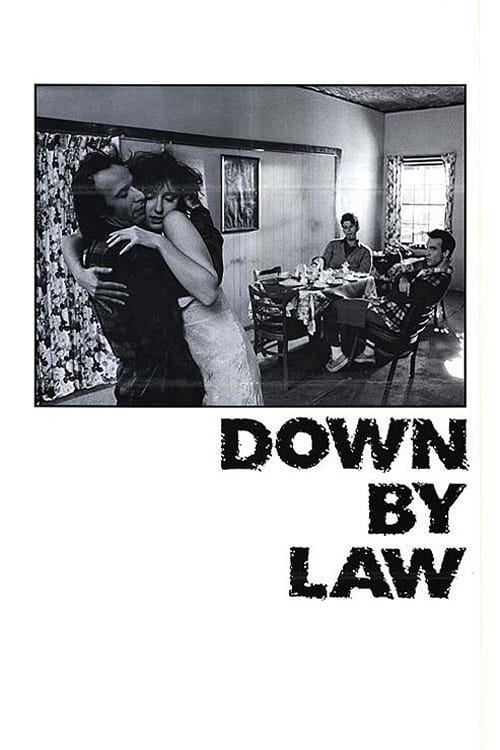
Down by Law
1986 · Jim Jarmusch
For a low-key night when you want to hang out inside a movie rather than be dragged through one — funny without being loud, stylish without trying hard. A comfort watch for people who like their comfort a little crooked.
What it's about
A laid-back New Orleans DJ, a small-time pimp, and a cheerfully bewildered Italian tourist end up sharing a cell in a Louisiana prison — three men with nothing in common except bad luck. Bickering turns into a strange fellowship, and eventually into an escape through the bayou, where the getting-away matters far less than the company.
The experience
Deadpan, unhurried, and quietly hilarious — the comedy comes from long silences, petty squabbles, and Roberto Benigni's mangled English suddenly lighting up the room. It's melancholy around the edges, cool as a slow blues record, and oddly soothing.
Performances
Roberto Benigni is a joy machine — his outsider's delight cracks the two sulking hipsters wide open — while musicians Tom Waits and John Lurie bring effortless, gravelly cool as men too proud to admit they like each other.
The craft
Robby Müller's black-and-white photography makes New Orleans and the bayou look like a dream of America — long, patient tracking shots past shotgun houses and swamp water — with Waits and Lurie on the soundtrack setting the late-night tone. It's gorgeous in a way that sneaks up on you.
Why it matters
It cemented Jim Jarmusch as the face of American independent film in the 1980s, proving that hangout rhythm, deadpan humor, and style could carry a movie without a conventional plot.
Snapshot
Jim Jarmusch's third feature is a laconic, black-and-white fable about three mismatched men—an unemployed New Orleans disc jockey, a small-time pimp, and a cheerfully bewildered Italian tourist—who share a cell in Louisiana State Penitentiary before escaping into the bayou. Shot by Dutch cinematographer Robby Müller with the austere patience of a Robert Bresson film and animated by the physical comedy of Roberto Benigni, Down by Law occupies a distinctive generic no-man's-land: too melancholy for straight comedy, too deadpan for drama, too episodic for conventional narrative. It is simultaneously a prison film, a road movie, a language comedy, and a meditation on chance and freedom, held together less by plot than by atmosphere, mood, and the collision of three radically incompatible temperaments. The film cemented Jarmusch's reputation as the defining sensibility of American independent cinema in the 1980s and introduced European art-house audiences to a strain of Americana filtered through an outsider's eye.
Industry & Production
Jarmusch had established himself with Stranger Than Paradise (1984), a microbudget black-and-white feature that won the Caméra d'Or at Cannes and became an unexpected international art-house success. That success gave him modest leverage but not Hollywood access; he remained deliberately outside the studio system, financing Down by Law through a combination of European co-production money and the small domestic independent infrastructure that was coalescing around companies like Island Pictures, which handled U.S. distribution. The film was produced with the involvement of German and European funding partners—a financing model Jarmusch would use repeatedly, allowing him to retain creative control in exchange for making films legible to international festival and art-house circuits. The exact budget has not been widely published, and the production kept a low profile consistent with Jarmusch's ethos of working cheaply enough that no financier could dictate terms. Shooting took place primarily in Louisiana—New Orleans proper and the swampy parishes to its south—in the summer, with a small crew accustomed to working quickly and quietly in real locations. Jarmusch cast from his own downtown New York milieu: John Lurie, the avant-garde musician and co-founder of the Lounge Lizards, had already appeared in Stranger Than Paradise; Tom Waits, the gravelly Los Angeles singer-songwriter, brought his own mythology to the role of Zack; Roberto Benigni was recruited from Italian cinema, where he had developed a reputation as a physical comedian and enfant terrible of popular comedy. Benigni's casting proved decisive: the Italian actress Nicoletta Braschi, who appears in the film's final act, became his partner during production and later his wife.
Technology
Down by Law was shot on 35mm film in black and white, a choice that was already conspicuously retrograde by 1986. Where color had become the default of American independent cinema as well as the mainstream, Jarmusch and Müller used monochrome as an aesthetic statement and a practical tool for compressing the saturated sensory landscape of New Orleans into something more abstracted and timeless. The black-and-white palette strips the French Quarter, the prison yard, and the Louisiana swamp of their tourist-brochure color, rendering them strange and slightly melancholy. Müller worked with the film's practical and natural light wherever possible, favoring available illumination in the New Orleans street sequences and using spare, controlled sources in the prison interiors. The aspect ratio is 1.33:1 (Academy ratio), a further act of deliberate archaism that aligns the film visually with classical Hollywood and with the European art films Jarmusch admired. The choice to shoot in Academy ratio on black-and-white stock is part of a coherent technological argument: this is cinema as it was before it became spectacle.
Technique
Cinematography
Robby Müller was already one of the most respected cinematographers in world cinema when Jarmusch recruited him, having shot Wim Wenders' road trilogy and Paris, Texas (1984). His collaboration with Jarmusch on Down by Law produced some of the most formally controlled images in American independent cinema of the decade. The opening sequence—a lateral tracking shot through New Orleans neighborhoods, following the street-level texture of the city before the characters are introduced—establishes the film's contemplative pace and its interest in place as autonomous subject. Müller's lighting in the prison sequences is particularly severe: the cell becomes an almost geometrically flat space, the men reduced to figures against a wall, their faces lit with the hard, unflattering clarity of institutional fluorescence. In the bayou escape, this austerity opens into something more lyrical; fog, water, and Spanish moss are rendered in tones of deep gray that make the landscape feel both beautiful and threatening. Müller's compositions consistently favor wide shots that place characters in relation to their environment rather than isolating them in close-up, reinforcing the film's sense that these men are subject to forces larger than themselves.
Editing
The editing rhythm of Down by Law is deliberately slow, organized around what might be called productive dead time: long takes in which nothing dramatic happens, scenes that begin before the action and end after it. The prison section in particular runs on an almost punitive patience—the three men sit, pace, argue, and fall silent across a series of shots that refuse to cut away from discomfort. This rhythm is not carelessness but strategy: it forces attention onto the texture of performance and forces the audience to inhabit the confinement alongside the characters. The transition between the film's three loose movements—New Orleans, prison, bayou—is handled with the same restraint, avoiding conventional scene-setting and allowing each new environment to announce itself gradually. The editing is credited to Melody London, who had worked with Jarmusch on Stranger Than Paradise and understood his preference for duration over momentum.
Mise-en-scène / Staging
Jarmusch stages Down by Law in a manner indebted to both the minimalism of Bresson and the frontal, deadpan compositions of Yasujiro Ozu, though the debt is absorbed rather than quoted. Characters frequently face the camera or move parallel to the picture plane; spatial depth is exploited less than lateral surface. The prison cell, a space of radical confinement, becomes a testing ground for this staging: three men in a small room, unable to escape one another or the frame, their physical proximity forced into comic and dramatic tension. The New Orleans sequences use real locations with a documentary lack of romanticization—the city is not presented as exotic backdrop but as a place where people actually live and work, often in poverty and boredom. The swamp sequence in the final third introduces a new spatial logic: horizontal movement through a landscape that seems to have no edges, a freedom that is also a kind of lostness.
Sound
Sound is given unusual prominence in Down by Law. Tom Waits contributed songs—most notably "Jockey Full of Bourbon," which plays over the film's opening—and his presence as both actor and musical collaborator blurs the boundary between diegetic and non-diegetic sound in ways the film exploits with casual sophistication. John Lurie, as both actor and musician (he composed additional score), similarly embodies the overlap between performance and soundtrack. The film's linguistic texture—English, Italian, and fragments of other languages—treats speech itself as a kind of music, particularly in scenes where Roberto Benigni's character deploys English phrases he has memorized from American books and songs. His rendering of "I scream, you scream, we all scream for ice cream"—repeated with the sincerity of a student reciting a lesson—is one of the film's most celebrated moments, a scene in which the comedy of language acquisition slides into something unexpectedly moving. Silence is used as deliberately as sound; the prison sequences are often nearly without music, the ambient noise of an institutional environment doing the work of score.
Performance
The three central performances are calibrated to a carefully managed asymmetry. Tom Waits and John Lurie play men of almost expressionless cool—their acting is reactive, guarded, built from restraint and a kind of studied hip disengagement that mirrors their characters' defensive postures. Against them, Benigni operates at a completely different register: physically extravagant, emotionally transparent, seemingly incapable of the ironic distance the others have adopted as survival strategy. The contrast is the engine of the film's comedy and its pathos. Benigni's Roberto is the only character who is genuinely present—who finds things funny, beautiful, and worth naming—and the film uses this contrast to suggest that his apparent naïveté is in fact a form of openness that the other two have abandoned. Jarmusch works with his actors through extended rehearsal and a collaborative looseness about dialogue; the film's rhythms feel improvised even when they are not.
Narrative & Dramatic Mode
Down by Law is structured in three roughly equal movements that function less as acts than as variations on a theme. The first establishes Zack and Jack separately in New Orleans, both men drifting through a life of mild disreputability, both about to be framed and arrested through bad luck rather than genuine criminality. The second confines all three in a prison cell, where the drama is purely relational—the slow erosion of mutual hostility into something approaching fellowship. The third traces their escape through the Louisiana bayou to a fragile provisional freedom. The film declines to render these movements as rising action toward a climax; the escape is less triumphant than ambiguous, and the ending disperses the characters without resolution or closure. This episodic, anti-dramatic structure is characteristic of Jarmusch's broader practice: he is interested in duration and texture rather than causality and consequence, in how characters inhabit time rather than how they change over it.
Genre & Cycle
The film borrows from and quietly subverts several genre traditions. The prison film—from the Warner Bros. social-problem pictures of the 1930s through Paul Newman's Cool Hand Luke (1967)—is invoked and then emptied of its usual ideological freight; there is no brutal warden, no prison politics, no violent climax. The escape narrative similarly foregoes the tension of the chase. The buddy film provides a structural template, but Down by Law is more interested in the failure of male bonding than in its consummation—Jack and Zack never really like each other, and their relationship remains unresolved. The road movie, the film's dominant genre in the final movement, connects it to an American tradition running from the Beat writers through Wenders' Alice in the Cities (1974) and beyond. Jarmusch's specific achievement is to use all these forms as pressure systems rather than blueprints, invoking their conventions in order to deflect them and locate meaning in the gaps they leave.
Authorship & Method
Jarmusch is one of the clearest auteur cases in American cinema of his generation: his films are immediately recognizable by their pace, palette, and preoccupations, and Down by Law is among his most characteristic works. He studied film at NYU and spent time in Paris, where he absorbed French New Wave aesthetics and encountered the Japanese cinema—particularly Ozu—that would become a persistent reference. His method is collaborative in a specific sense: he builds projects around performers whose personal qualities he wishes to explore, writing dialogue with and sometimes around their speech patterns and personas. The casting of Waits and Lurie as versions of their public musical identities, and of Benigni as an amplified version of his Italian comic persona, is a form of found-object art-making. Robby Müller's cinematographic contribution is not merely technical but conceptual; the two men share a commitment to slowness and to the autonomy of the image that shapes the film at every level. The score—divided between Waits's songs and Lurie's more conventional underscore—is of a piece with the film's interest in American vernacular music as an emotional register that prose dialogue cannot access.
Movement / National Cinema
Down by Law belongs to the wave of American independent cinema that emerged in the late 1970s and early 1980s in deliberate opposition to the high-concept blockbuster model that had come to dominate Hollywood since Jaws and Star Wars. Jarmusch is associated with the No Wave film scene of downtown New York—a movement connecting punk and post-punk music, avant-garde visual art, and low-budget filmmaking in figures like Amos Poe, Beth B, and Lizzie Borden. Unlike these filmmakers, however, Jarmusch pursued a more lyrical, less confrontational aesthetic, and his success at Cannes and in European distribution connected him more fully to an international art-cinema tradition than to purely domestic independent circuits. Down by Law is in this sense a film without a single national home: made by an American director, co-produced with European money, shot by a Dutch cinematographer, featuring an Italian star, and aesthetically indebted to French and Japanese cinema, it belongs to the cosmopolitan art-cinema network that Cannes sustained rather than to any single national tradition. This placelessness is itself part of its meaning: Jarmusch's New Orleans is a real place viewed through multiple layers of cinephilic displacement.
Era / Period
The mid-1980s were a period of unusual generativity for American independent cinema, partly because of the declining cost of 16mm and 35mm production and partly because of the growth of video distribution, which provided a secondary market for films that received limited theatrical release. Down by Law (1986) sits alongside films like John Sayles' Matewan (1987), Spike Lee's She's Gotta Have It (1986), and Alex Cox's work in a moment when independent cinema was asserting itself as a legitimate cultural category rather than merely a commercial failure. Internationally, 1986 was also the year of Akira Kurosawa's Ran (1985 Japan, 1986 international), Pedro Almodóvar's rising profile, and the continued relevance of European auteur cinema—a context in which Jarmusch's cosmopolitan sensibility was legible and marketable.
Themes
The film's central preoccupation is freedom and its ambiguity. All three men begin the film in a state of apparent freedom—loose in New Orleans, nominally self-determining—and end in prison; they escape from prison only to enter the more diffuse captivity of the swamp, from which they emerge into a freedom that is indistinguishable from aimlessness for Zack and Jack, and into a new form of belonging for Roberto. The film is skeptical of the American mythology of freedom as pure self-invention; its men are more constrained by their temperaments, their histories, and their social positions than by any explicit external force. Language is a second major theme: the comedy of Roberto's imperfect English—and his genuine delight in learning it—counterpoints the wordless sullenness of the other two, suggesting that the ability to remain open to language is connected to the ability to remain open to experience. The film is also persistently interested in chance and contingency: its characters end up in jail through accidents and set-ups rather than character, and the escape is achieved through Roberto's practical ingenuity rather than heroic will. Chance, the film implies, is a more honest account of life than any narrative of agency.
Reception, Canon & Influence
Backward influences: Jarmusch has cited Robert Bresson's use of non-professional or counterprogrammed actors and his systematic elimination of psychological interiority as key reference points. Ozu's frontal compositions and his interest in durational cinema are visible throughout. The French New Wave, particularly Godard's early features and their interest in genre parody and discontinuous narrative, is a persistent influence. Cassavetes' model of actor-driven, improvisatory American filmmaking provided an alternative to the studio system. In terms of direct precedent, the Louisiana prison film connects obliquely to films like Thieves Like Us (Robert Altman, 1974) and to the southern gothic literary tradition.
Reception: Down by Law premiered at the Cannes Film Festival in 1986 and was received with considerable enthusiasm by European critics, who recognized its affinities with art-cinema traditions and welcomed Benigni as a revelation. American critical response was warmer than for most independent films of the period, though some critics found the film's deliberate torpor trying. It was not a major commercial success in conventional terms but performed well in art-house release and on video. Over time it has been recognized as one of Jarmusch's essential films and a central document of 1980s American independent cinema.
Forward influence: The film's influence operates primarily at the level of tone and attitude rather than specific formal technique. Its model of a cinema comfortable with dead time—willing to let scenes breathe and refuse dramatic escalation—was absorbed by a generation of independent filmmakers in the late 1980s and 1990s. The deadpan comedy of language and cultural collision visible in Down by Law runs forward into the work of filmmakers like Aki Kaurismäki (who shares Jarmusch's affinities and with whom he has an acknowledged mutual admiration), and it anticipates the slacker aesthetic of early Richard Linklater. Roberto Benigni's international profile was substantially advanced by the film, preparing the ground for his Hollywood breakthrough and eventually for La vita è bella (1997). More broadly, Down by Law demonstrated that American independent cinema could succeed at Cannes and in European distribution without compromising its local specificity—a lesson that shaped the international ambitions of the Sundance generation that followed.
A Deleuzian reading
It starts with the city moving and nobody in it yet.
The full Deleuzian reading of Down by Law →
Reception
Premiering in competition at Cannes in 1986, it was warmly received but shrugged off by some critics as Jarmusch repeating the Stranger Than Paradise formula — today that 'retread' is widely ranked among his very best, a Criterion staple and for many the definitive Jarmusch.
How Down by Law was received, from release to now →
Influences: the films it descends from and the films it influenced
- A Man Escaped (1956) — Bresson's prison film supplies the formal model Jarmusch most directly follows: diegetic sound carrying dramatic weight that dialogue withholds—keys, footsteps, mechanical routine—and a duration-respecting editing rhythm that forces the viewer to inhabit confinement as lived time rather than compressed montage.
- Tokyo Story (1953) — Ozu's pillow shots—autonomous cuts to teapots, corridors, and doorways that punctuate scenes without narrative function—are the direct precedent for Müller and Jarmusch's use of static shots of New Orleans space as contemplative intervals rather than scene-setting transitional material.
- Alice in the Cities (1974) — Robby Müller's lateral tracking shots along urban storefronts and street-level pedestrian texture—here through West German and American cities—supply the precise compositional method he and Jarmusch deploy in Down by Law's opening New Orleans sequence before any character appears.
- Paris, Texas (1984) — Müller's wide-angle compositions placing lone figures against horizontal American landscape—allowing deep negative space to express psychological isolation—are the direct predecessor of how he frames Waits, Lurie, and Benigni in the Louisiana bayou escape sequences.
- Shadows (1958) — Cassavetes established the American underground production model that Jarmusch absorbed: jazz musicians performing in front of and behind the camera, improvisation-inflected naturalism, and black-and-white available-light location shooting as aesthetic position rather than budgetary concession.
- M. Hulot's Holiday (1953) — Tati's structural method—inserting a single figure operating in a physically exuberant, oblivious register against a surrounding world of restrained naturalism—is the direct ancestor of Benigni's role, where his cheerful bewilderment collides with the stoic, laconic performance registers of Lurie and Waits to generate comedy from incompatibility rather than situation.
- Breathless (1960) — Godard's elliptical approach to genre—using the crime film as a vehicle for existential deadpan and deliberate narrative incompletion—gave Jarmusch formal permission to subvert the prison film and road movie through anti-climax rather than genre satisfaction, including the deliberately deflating escape and the sudden, unexplained ending.
- Night of the Hunter (1955) — Stanley Cortez's black-and-white photography renders the Louisiana bayou as abstracted expressionist landscape—Spanish moss, fog, and dark water reduced to tonal fields of deep gray—anticipating the precise visual mode Müller uses when the three escapees move into the swamp, treating Southern Gothic geography as material for graphic composition.
- Two-Lane Blacktop (1971) — Hellman cast recording musicians (James Taylor, Dennis Wilson) as leads in a road film whose narrative deliberately refuses resolution, establishing the precedent for using an artist's extradiegetic persona—the known voice, the mythologized biography—as a layer of performance that the film's spare long-take style can neither explain nor exhaust; Jarmusch does exactly this with Tom Waits and John Lurie.
- Shoot the Piano Player (1960) — Jarmusch deploys Robby Müller's high-contrast black-and-white available-light cinematography to frame a passive musician-protagonist (Tom Waits) in a crime narrative defined by bad luck rather than agency — Piano Player's precise template of the musically-gifted man undone by passivity and circumstance, transposed from Parisian bars to Louisiana jails and swamps.
- Stroszek (1977) — Tom Waits performs his own original songs in character as a diegetic folk musician—the direct extension of Stroszek's folk-performance device—while the film's loop structure (escape that terminates not in freedom but in arbitrary dispersal into Louisiana swamp) echoes Stroszek's ski-lift finale as an image of systemic entrapment with no available exit.
- The American Friend (1977) — Müller transplants his American Friend palette and boxed, frames-within-frames compositions into American indie cinema, extending the cinematographer's method to a new generation.
- Mystery Train (1989) — Jarmusch and Müller's direct continuation of Down by Law's New Orleans setting converts the earlier film's single-strand prison-to-road structure into a triptych of simultaneous vignettes, each shot in the same black-and-white Academy ratio long-take idiom, with diegetic music—a single Elvis song heard from different source positions—as the structural connective tissue replacing plot.
- Night on Earth (1991) — The Rome segment most directly extends Down by Law's language-comedy method: Benigni, reprising the same asymmetric-register persona, plays an irrepressibly confessional taxi driver whose oblivious monologue overwhelms a silent, bewildered priest—formalized now as a two-person structure, the comic collision of incompatible registers isolated from the ensemble.
- Dead Man (1995) — Müller again shoots in black-and-white at Academy ratio with wide compositions; Neil Young's improvised electric guitar score, recorded against the finished cut without pre-composition and keyed to each scene's emotional duration rather than its action, extends Down by Law's diegetic/nondiegetic blur into a principle—sound that belongs simultaneously to the world and to some space outside it.
- Slacker (1990) — Linklater takes Down by Law's episodic, non-protagonist structure as a generative formal principle: the film passes narrative custody from character to character with no controlling thread, each encounter complete in itself, the long-take duration respecting the full texture of conversation and digression rather than editing toward compressed meaning.
- Wendy and Lucy (2008) — Reichardt's available Pacific Northwest light, minimal dialogue, and long observational takes of a woman drifting through an indifferent landscape directly inherit the Jarmusch negative-space method; the episodic structure and productive silence demonstrate that Down by Law's demonstration—that American independent film could be built from withholding rather than accumulation—had become a transmissible tradition.
- Inside Llewyn Davis (2013) — Jarmusch cast Tom Waits as a character essentially continuous with his own musician-drifter persona, and Robby Müller's cold black-and-white location photography established the visual grammar of a desaturated, spatially marginal America that Delbonnel extends directly to 1961 New York.
- Ghost Dog: The Way of the Samurai (1999) — First pairs Jarmusch with Robby Müller's humane naturalistic light and the comedy of marginal men, the cinematographic and tonal DNA carried directly into Ghost Dog's New Jersey rooftops.
- 24 Hour Party People (2002) — Showcases Robby Müller's available-light, painterly-naturalist cinematography, the celluloid sensibility Müller then transposed onto the new digital format for this film's visual texture.
- Noi the Albino (2003) — Frames-within-frames (bars, doors, windows) and slow tableau staging of entrapped men whose escape is comically anticlimactic.
- Chocolat (1988) — Denis's AD apprenticeship with Jarmusch taught the deadpan minimalist register — trusting pause, silence and the unexplained reaction shot to carry scenes instead of dialogue, which becomes Chocolat's underplayed economy.
- Güeros (2014) — Robby Müller's high-contrast, silvery black-and-white photography of aimless drifters — a photographic reference point for Güeros's crisp monochrome and its trio of listless escapees.
- 35 Shots of Rum (2009) — As Jarmusch's assistant, Denis learned his deadpan minimalism and trust in off-screen space and dead time — the elliptical patience that lets a scene breathe past its narrative function.
- Stranger Than Paradise (1984) — Müller and Jarmusch's immediate prior collaboration originated the complete formal vocabulary Down by Law inherits: static black-and-white Academy ratio compositions, black-leader cuts between discrete episodes, deadpan asymmetric performance registers, and the refusal of musical score in favor of diegetic source sound as the film's emotional texture.
- Killer of Sheep (1978) — Burnett's episodic, non-plot-driven black-and-white feature shot on available light in Watts operates in the same mode of productive dead time—scenes of observed behavior without dramatic payoff, ambient sound as score, wide shots in which figures are read against their physical environment—that Jarmusch adopts for Down by Law's prison middle section.
- Stranger Than Paradise (1983) — Reunites DiCillo's monochrome, one-shot-per-scene static tableaux and the deadpan trio dynamic, extending STP's exact formal vocabulary.
- Shadows in Paradise (1986) — Shares the year and the method: melancholic male losers filmed in stark held compositions with dryly comic underplaying and vintage-music cues functioning as authorial voice rather than emotional underscore.
- Ariel (1988) — Its picaresque of laconic misfits drifting toward escape, shot in composed static frames with black-out transitions and a musician's ear for source songs, runs in exact stylistic parallel to Ariel the same year.
- The Last One for the Road (2025) — An explicitly Beckettian trio of men waiting and wandering with nothing to do, its three-body comic geometry and futility-in-deadpan closely mirroring Sossai's trio-geometry and Godot structure.
Similar films
- Stranger Than Paradise (1984) — influence & lineage
- Mystery Train (1989) — influence & lineage
- Night on Earth (1991) — influence & lineage
- Dead Man (1995) — influence & lineage
- Paris, Texas (1984) — influence & lineage
- Stranger Than Paradise (1983) — shared sensibility
- Il Sorpasso (1962) — shared sensibility
- Only Lovers Left Alive (2013) — shared sensibility
All the films related to Down by Law →