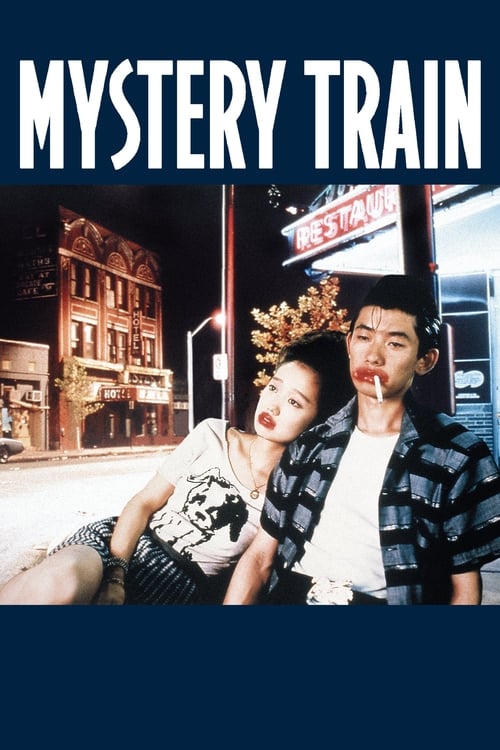
Mystery Train
1989 · Jim Jarmusch
For a mellow late night when you want atmosphere over plot — something cool, funny, and low-key that rewards patience. Comfort viewing for people who like their comfort a little offbeat.
What it's about
One night in a shabby Memphis hotel, three stories unfold side by side: a young Japanese couple on a pilgrimage to the birthplace of rock and roll, a widowed Italian woman stranded between flights, and three hapless small-timers hiding out after a night gone wrong. They never meet — but the same clock, the same radio playing 'Blue Moon,' and the ghost of Elvis bind their stories into one.
The experience
Droll, unhurried, and quietly magical — the humor is deadpan, the pacing is a stroll, and the pleasure is in noticing how the three stories rhyme and interlock. It feels like being up all night in a strange town: a little lonely, a little funny, oddly comforting.
Performances
Screamin' Jay Hawkins, the rock-and-roll wildman, is a deadpan delight as the hotel's night clerk, trading dry looks with Cinqué Lee's bellboy — the film's comic anchor.
The craft
Jim Jarmusch's first color film glows with jukebox reds and nighttime neon, and its structure is the star: three vignettes running concurrently, locked together by an offscreen gunshot, a radio broadcast, and a lobby clock. The soundtrack, steeped in Memphis music, does half the storytelling.
Why it matters
A landmark of American independent film's late-'80s flowering, it cemented Jarmusch's international reputation and became a touchstone for interlocking-story structures in indie cinema.
Snapshot
Mystery Train is Jim Jarmusch's fourth feature and his first in color — a triptych of interlocking vignettes set over a single night in a shabby Memphis residential hotel, all bound together by the presiding ghost of Elvis Presley. Three sets of strangers, none of whom meet, pass through the orbit of the same flophouse: a young Japanese couple on a pilgrimage to rock-and-roll's birthplace; a recently widowed Italian woman stranded between flights; and a clutch of small-time losers fleeing a botched liquor-store shooting. The film's organizing conceit is temporal rather than spatial — the three stories unfold concurrently, and a single off-screen gunshot, a recurring radio broadcast of "Blue Moon," and the hotel's lobby clock are the hinges that lock them into the same night. It is Jarmusch at his most formally playful and his most affectionate, treating Memphis as a faded shrine whose myth survives precisely because the city around it has gone to seed. Deadpan, melancholic, and quietly comic, Mystery Train extends the minimalist American-outsider sensibility of Stranger Than Paradise and Down by Law into a richer, more structurally ambitious register.
Industry & production
Mystery Train belongs to the moment when American independent cinema and overseas capital began to find each other. Jarmusch, having built an international reputation on shoestring productions, financed the film substantially through Japanese sources — JVC was a principal backer — an arrangement that gave him creative autonomy at a budget level still modest by Hollywood standards but generous by his own. The production was credited to Jarmusch's company alongside its Japanese partners, and the picture was released in the United States by Orion Classics, the specialty arm that handled much of the era's prestige independent and foreign product.
The film was shot on location in Memphis, and its use of real, weathered urban geography — vacant lots, empty downtown streets, the Arcade and the hotel interiors — was central to its meaning rather than incidental. Jarmusch's method by this point was well established: small crew, long takes, location-driven shooting, a tolerance for "dead time" that most commercial productions would cut. The casting drew on his by-now characteristic mixing of non-professional presences, musicians, and trained actors. The arrangement of foreign financing for a defiantly American subject — the mythology of Elvis and Sun Records seen partly through outsider, immigrant, and tourist eyes — is itself one of the film's quiet ironies, and a marker of how the independent sector was internationalizing at the end of the 1980s.
Technology
The film was photographed on 35mm color stock — a notable step for Jarmusch, whose previous two features had been celebrated for their stark black-and-white. The shift to color is not a neutral technical fact but a deliberate aesthetic decision: cinematographer Robby Müller renders Memphis in saturated reds, greens, and the sodium glow of night, giving the seedy hotel an unexpectedly lush, almost candied palette. The technology here is conventional for its period — no exotic apparatus — but the craft lies in the controlled use of practical and motivated light sources to make a low-budget interior feel both tawdry and dreamlike. The radio, the television, and the diegetic recordings function as an embedded sound technology within the fiction, threading Elvis and the era's music through the film's soundscape. The precise aspect ratio and lab details are the sort of granular technical record that is not always reliably documented for independent productions of this scale; what is certain and material is the move into color and the painterly use of nocturnal lighting.
Technique
Cinematography
Robby Müller — the Dutch cinematographer indelibly associated with Wim Wenders, and a recurring Jarmusch collaborator — is arguably the film's decisive authorial presence after the director himself. His compositions are frontal, patient, and architecturally precise: characters are framed within doorways, against the flat planes of hotel-room walls, beneath the lobby's portrait of Elvis. Müller favors the static long take, letting action play out within a fixed frame rather than chasing it with the camera, which lends the film its observational, almost diorama-like quality. The color work is the great revelation — after two black-and-white films, Jarmusch and Müller treat Memphis night as a chromatic event, with reds and greens pushed toward expressive saturation. The visual style honors the low and the worn: peeling paint, cheap furnishings, and empty streets are photographed with a tenderness that converts decay into a kind of beauty.
Editing
Editor Melody London, another Jarmusch regular, shapes the film's most distinctive formal gambit: the three stories are not told strictly in sequence but are temporally overlaid, so that a single gunshot is heard in all three, and the same radio cue recurs across them. The structure asks the editing to manage simultaneity — to make the audience retroactively understand that what felt sequential was concurrent. Within scenes, the cutting is unhurried, respecting the duration of Jarmusch's long takes and the rhythm of his pauses. The film's comedy and melancholy alike depend on timing held a beat longer than convention would allow, and the assembly trusts that withheld momentum.
Mise-en-scène / staging
The single recurring set — the hotel lobby and its rooms — is the film's anchoring space, and its staging is deliberately theatrical. The night clerk and bellboy occupy the lobby like a comic chorus; the rooms are nearly identical, each containing the same kitschy Elvis portrait, so that the three couples unknowingly inhabit a shared stage dressed with the same icons. Jarmusch composes for stillness and symmetry, blocking actors in flat, frontal arrangements that emphasize the rooms' boxiness. Memphis itself is staged as a depopulated mythic landscape — wide, empty frames of downtown that make the city feel like a ghost town presided over by an absent king.
Sound
Sound is the connective tissue of the entire design. A radio DJ — voiced by Tom Waits — and a broadcast of Elvis's "Blue Moon" recur across the three stories, anchoring them in the same night and the same airwaves. The off-screen gunshot is the structure's keystone, a single sonic event registered differently by each set of characters. Music is thematic rather than merely atmospheric: the film's very title comes from the Junior Parker song immortalized by Elvis at Sun, and rock-and-roll history is woven through the soundtrack as both subject and score. John Lurie's contributions provide a spare instrumental underlay that never competes with the diegetic music. Jarmusch's celebrated use of silence and ambient quiet — the hum of an empty lobby, the sound of footsteps in a deserted street — is as expressive as any cue.
Performance
The performances are pitched to Jarmusch's deadpan register, where underplaying is the house style. The musician Screamin' Jay Hawkins, as the imperious red-suited night clerk, is the film's comic and tonal lodestone, playing exasperated dignity with deadpan grandeur; Cinqué Lee (brother of Spike Lee) is his hapless bellboy foil. Masatoshi Nagase and Youki Kudoh, as the Japanese couple, calibrate cool detachment against wide-eyed enthusiasm. Nicoletta Braschi brings a grave, luminous stillness to the widowed Italian woman. The third story enlists Joe Strummer of The Clash, Steve Buscemi, and Rick Aviles as the trio of accidental fugitives, their loose, comic camaraderie offsetting the panic of their situation. Across the ensemble, the acting honors Jarmusch's preference for flatness, pause, and dryness over emotional emphasis.
Narrative & dramatic mode
The film's dramatic mode is the anthology or portmanteau structure, but with a crucial twist: rather than three discrete tales told one after another, Mystery Train tells stories that occupy the same time and place, revealing their simultaneity only gradually. The three segments — commonly titled "Far from Yokohama," "A Ghost," and "Lost in Space" — are each gentle, low-stakes, anecdotal. There is no overarching plot driving toward resolution; the pleasure is in pattern, recurrence, and the slow recognition of how the pieces interlock. This is anti-suspenseful storytelling in the best sense — Jarmusch withholds conventional dramatic payoff in favor of mood, coincidence, and the comedy of near-misses. The gunshot that would be a climax in another film is here a connective device, heard but not dramatized. The result is a narrative built on rhyme rather than causation, closer to a suite of songs than a three-act play.
Genre & cycle
Nominally a comedy, Mystery Train sits within the cycle of American independent "hangout" and outsider films that Jarmusch himself helped define. It belongs to a lineage of episodic, omnibus structures while subverting them through temporal overlay. It is also a road movie turned inside out — instead of motion across landscape, it is stillness within a single building, the travelers having arrived rather than departed. Its comedy is the deadpan, observational kind native to Jarmusch's sensibility, built on cultural dislocation, mismatched expectations, and the absurd dignity of marginal lives. The film's preoccupation with American pop mythology — Elvis, Sun Studio, rock-and-roll's origin sites — places it within a broader strain of late-1980s cinema reckoning with American iconography from an ironic, often outsider's distance.
Authorship & method
Mystery Train is a near-pure expression of Jarmusch's auteurist method as it had matured by the end of the 1980s. He wrote, directed, and shaped the film around his signature concerns: marginal characters, foreigners and drifters, the poetry of dead time, and an abiding love of music and musicians. His collaborators are integral and recurring. Robby Müller's cinematography supplies the painterly color vision; Melody London's editing executes the simultaneity structure; John Lurie — the Lounge Lizards saxophonist and a fixture of Jarmusch's earlier films, both as actor and composer — provides musical texture. The casting of working musicians (Hawkins, Strummer, Lurie's milieu) is itself a method: Jarmusch draws on the downtown New York and international music scenes as a casting pool, treating performers' real-world auras as part of their screen presence. The film exemplifies his belief that structure and atmosphere, not plot, carry meaning, and that a director's signature lies in tone, rhythm, and the company he keeps.
Movement / national cinema
Jarmusch is among the central figures of the American independent renaissance of the 1980s — a movement defined in opposition to Hollywood, drawing instead on European art-cinema models (Ozu, Wenders, the minimalism of Antonioni and Bresson) and downtown New York's punk and No Wave aesthetics. Mystery Train is a quintessential product of that formation, and its very financing — substantially Japanese — signals the transnational character the movement was acquiring. The film looks at America from an outsider's vantage, both through its immigrant and foreign characters and through Jarmusch's own European-inflected sensibility. It is American cinema made at an oblique, internationalist angle, equally legible at Cannes — where the film competed and was recognized — as in the U.S. art house.
Era / period
The film is firmly of the late 1980s, the period when specialty distribution arms (Orion Classics among them) and festival circuits had matured enough to sustain directors like Jarmusch outside the studio system. It captures a particular cultural moment's relationship to the recent American past: Elvis had died in 1977, and by 1989 his myth had calcified into kitsch, tourism, and iconography — precisely the condition the film anatomizes. The Memphis of Mystery Train is post-industrial, depopulated, its glory days legible only as ruins and shrines, which makes the film a Reagan-era meditation on American decline refracted through pop nostalgia.
Themes
At its heart, the film is about myth and its afterlife — the way a place becomes sacred through the stories told about it, even as the physical city decays. Elvis is the absent presiding deity, literally appearing as a ghost in one segment, his image papering every wall. Pilgrimage and tourism are recurring motifs: the Japanese couple come seeking authenticity at Sun Studio and Graceland, and the film gently interrogates what it means to consume another culture's mythology. Dislocation and foreignness run throughout — the outsider's perspective is the film's true subject, with America rendered strange and dreamlike by those passing through it. Loneliness, coincidence, and the invisible connections between strangers form the structural theme; the film insists that lives running in parallel, never touching, are nonetheless bound by shared time, shared place, and shared cultural ghosts.
Reception, canon & influence
Mystery Train was warmly received critically, widely read as a confident expansion of Jarmusch's minimalism into color and into a more intricate structure; it screened in competition at the 1989 Cannes Film Festival, where it was honored — the award is generally recorded as a prize for its artistic contribution, recognizing its craft (Müller's photography and the film's overall design are most often cited, though the precise framing of the citation should be checked against festival records). The film consolidated Jarmusch's standing as a leading independent auteur.
Its influences flow backward from a deep well of cinephilia and music. The portmanteau structure and the observational stillness owe to European modernism and to Ozu's contemplative framing; Robby Müller carries forward the road-movie lyricism of his work with Wenders; and the entire project is saturated in the iconography of Sun Records, Elvis, and the rock-and-roll origin myth. The interlocking-simultaneous-stories architecture, in particular, anticipates and parallels a structural device that would become prominent in 1990s independent cinema — most famously in the multi-strand, time-shuffled narratives associated with Quentin Tarantino and a wider hyperlink-film cycle — though direct lines of causation should be asserted cautiously rather than overstated. Within Jarmusch's own filmography, Mystery Train established a template he would revisit in the segmented structures of Night on Earth and Coffee and Cigarettes. Its enduring legacy lies in demonstrating that an episodic, plot-light, mood-driven film could achieve genuine architectural elegance — and in its tender insistence that the most American of myths might be best seen through a stranger's eyes.
A Deleuzian reading
The same picture hangs in every room.
The full Deleuzian reading of Mystery Train →
Reception
It landed well from the start — a Cannes '89 prize for artistic achievement and warm arthouse reviews — but its stature has only grown, with the Criterion treatment and a new generation falling for it as peak hangout-movie Jarmusch.
How Mystery Train was received, from release to now →
Influences: the films it descends from and the films it influenced
- Tokyo Story (1953) — Supplies the contemplative, low static framing and reverence for 'dead time' between events that Jarmusch transposes into the Arcade Hotel's waiting and the long held tableaux.
- Late Spring (1949) — Models the frontal, eye-level symmetrical compositions and pillow-shot cutaways to empty spaces (corridors, signage) that structure the film's transitional rhythm.
- Stranger Than Paradise (1984) — Establishes Jarmusch's grammar of fixed-camera long takes separated by blackouts and deadpan minimalism, which Mystery Train expands into color and interlocking blocks.
- Down by Law (1986) — Pairs Robby Müller's black-and-white static lyricism with musician-actor John Lurie, the direct precursor to Mystery Train's musician-casting method (Hawkins, Strummer).
- Paris, Texas (1984) — Robby Müller's saturated neon-and-roadside palette and the foreigner-adrift-in-mythic-America gaze carry directly into Mystery Train's Memphis as seen by strangers.
- The American Friend (1977) — Müller's earlier road-movie color expressionism and a casting practice of using non-actors/cult figures (filmmakers) for their real auras prefigures the working-musician casting pool.
- The Killing (1956) — Originates the overlapping-time portmanteau where separate strands replay the same off-screen event (here the gunshot) from different vantage points — Mystery Train's editing armature.
- Paisan (1946) — Neorealist anthology of discrete episodes bound by a single locale and the meeting of foreigners with a wounded postwar nation supplies the portmanteau-of-strangers template.
- Choose Me (1984) — Three unconnected strands are stitched by a single hub building, a shared gunshot, and Tom Waits's unseen radio DJ — the radio-voice-as-narration device from Dr. Love's show, doing the same work of binding people who never meet.
- Night on Earth (1991) — Carries the simultaneous-anthology structure forward, syncing five taxi rides to one global night just as Mystery Train syncs three stories to one Memphis evening and a single gunshot.
- Coffee and Cigarettes (2003) — Extends the segmented-vignette method and overhead/frontal-symmetry table staging, again casting musicians (Waits, Jack White, RZA) for their off-screen personas.
- Dead Man (1995) — Continues the Müller-style episodic stillness and use of music as connective tissue (Neil Young's score) while pushing the deadpan-myth-of-America gaze into the Western.
- Broken Flowers (2005) — Keeps the deadpan-observational performance register and frontal symmetrical framing, structuring the film as discrete encounter-episodes strung along a single deadpan quest.
- Only Lovers Left Alive (2013) — Sustains the music-saturated nocturnal mood, musician-adjacent casting, and theme of myth-and-afterlife (vampires haunting a decayed American city) seeded by Mystery Train's Memphis.
- Father Mother Sister Brother (2025) — His first interlocking triptych: three self-contained stories anchored to one location and clicked together by a shared off-screen event, prototyping the anthology architecture.
- Pulp Fiction (1994) — Shares the time-shuffled multi-strand architecture where chronology folds back so a death witnessed in one segment is recontextualized in another, the device Mystery Train deployed via the shared gunshot.
- Lost in Translation (2003) — Inherits the hotel-as-limbo for drifting foreigners, observational long takes, and pop-myth atmosphere over plot — the mood-driven 'two strangers in a borrowed city' mode.
- Goodbye, Dragon Inn (2003) — Pushes the static long take, anti-suspense dead time, and a haunted-venue-as-shrine to cinema/myth to an extreme that rhymes with the Arcade Hotel's afterlife stillness.
- Slacker (1991) — American-independent plotlessness organized as a daisy-chain of marginal characters passing through a single city, paralleling the mood-and-architecture-over-narrative ethos.
- Magnolia (1999) — Develops the hyperlink-cinema cycle Mystery Train anticipated — multiple strands in one city converging on a shared off-screen event and time signature.
Similar films
- Stranger Than Paradise (1984) — influence & lineage
- Night on Earth (1991) — influence & lineage
- Down by Law (1986) — influence & lineage
- Father Mother Sister Brother (2025) — influence & lineage
- Only Lovers Left Alive (2013) — influence & lineage
- Dead Man (1995) — influence & lineage
- Lost in Translation (2003) — influence & lineage
- Pulp Fiction (1994) — influence & lineage
All the films related to Mystery Train →