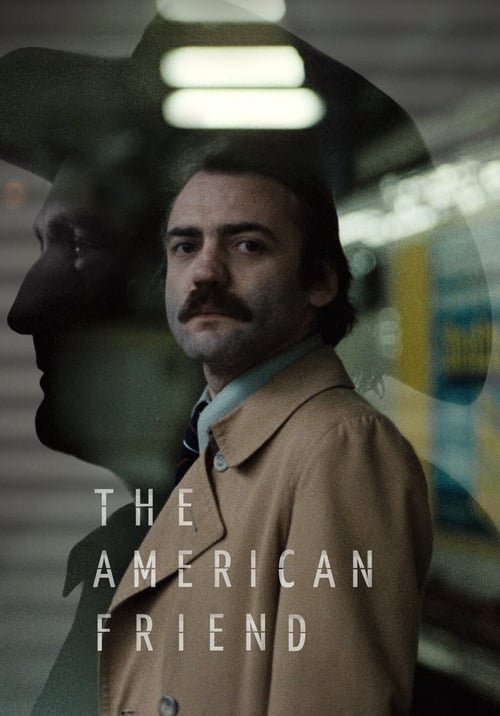
The American Friend
1977 · Wim Wenders
For a late night when you want atmosphere over plot — a slow-burn European noir to sink into when neon, trains, and moral drift sound like exactly the right company. More contemplative than comforting.
What it's about
A Hamburg picture framer with a terminal blood disease crosses paths with Tom Ripley, an American art forger drifting through Europe. Nursing a small slight and prodded by a French gangster, Ripley steers the dying man toward an unthinkable proposition: become a contract killer, and leave his family provided for. What starts as a cold transaction turns into a strange, wordless friendship between the two men.
The experience
Moody and melancholy more than pulse-pounding — a thriller that moves like a slow fever, punctuated by set pieces of genuinely sweaty tension. It's the rare crime film that leaves you sad rather than satisfied.
Performances
Bruno Ganz gives the film its soul as the ordinary man being quietly corrupted, all doubt and decency under pressure, while Dennis Hopper plays Ripley as a jittery, cowboy-hatted enigma — two acting styles from different worlds, which is precisely why their scenes together crackle.
The craft
Wenders and cinematographer Robby Müller drench Hamburg, Paris, and New York in sickly greens and neon reds, turning genre material into a travelogue of loneliness. The suspense sequences — built around trains and public spaces — are staged with patient, almost documentary realism, and the film is famously studded with veteran film directors cast in small roles.
Why it matters
It was Wenders's international breakthrough and a high-water mark of the New German Cinema's love affair with American genre movies — an art-house rethinking of the thriller that later crime films of mood and alienation still echo.
Snapshot
The American Friend (Der amerikanische Freund) is Wim Wenders's freest, most charged adaptation of Patricia Highsmith — a thriller assembled from the wreckage of the genre rather than its mechanics. Drawn from Highsmith's 1974 novel Ripley's Game, the film follows Jonathan Zimmermann (Bruno Ganz), a Hamburg picture framer and gilder dying of a blood disease, who is maneuvered into becoming a contract killer by Tom Ripley (Dennis Hopper), an expatriate American art forger nursing a small slight, and by the French gangster Raoul Minot (Gérard Blain), who supplies the money and the marks. What begins as a transaction curdles into something stranger: a fragile, wordless intimacy between the two men. The film is at once Wenders's international breakthrough and a culmination of his abiding obsession — the colonization of the German imagination by American images. Shot by Robby Müller in expressionistic, bruised color across Hamburg, Paris, Munich, and New York, it remains one of the defining works of the New German Cinema and arguably the most cinephile-saturated entry in the entire Ripley filmography.
Industry & production
The film arrived at a pivotal moment in Wenders's career, immediately following the road-movie trilogy that culminated in Kings of the Road (1976). Where those films were modestly scaled, black-and-white, German-language ventures, The American Friend was a deliberately international production — multilingual (German, English, French), multi-city, and built around an American star. It was produced through Wenders's own Road Movies Filmproduktion in Berlin in partnership with the French company Les Films du Losange, the outfit associated with Éric Rohmer and Barbet Schroeder; the co-production reflected the cross-border financing typical of European art cinema in the period and gave Wenders access to Paris locations and personnel.
Securing the rights to Highsmith and casting Hopper signaled ambition beyond the subsidized German television-and-film ecosystem (the Kuratorium/Filmförderung apparatus) that had nurtured the movement. The film premiered in competition at the Cannes Film Festival in 1977, where it consolidated Wenders's standing as a leading figure of the new German cinema and helped open the door to his subsequent American period. The production's most celebrated extracurricular fact is the difficulty of the Hopper shoot: by widely circulated accounts, Hopper arrived in a famously volatile state, and the friction between the unmoored American actor and his precise German director fed, productively, into the film's portrait of estrangement. I'd treat the more colorful anecdotes about on-set chaos as reported lore rather than settled fact.
Technology
Technologically the film is a conventional 35mm color production of its era, but two image-making technologies sit inside the story as motifs. The first is the Polaroid camera, which Ripley uses obsessively — instant images of himself, of his world, accumulating as evidence that he exists. The second, thematically, is photographic and painterly reproduction itself: the plot turns on forged paintings passed off as the work of a supposedly dead artist, Derwatt. The film thus folds the anxieties of mechanical and manual reproduction — authenticity, copy, fake — into its very texture, a concern Wenders shared with a generation thinking through Walter Benjamin. The deliberate, almost fetishistic attention to the craft of framing and gilding in Jonathan's workshop belongs to the same register: the film is fascinated by the material substrate of images.
Technique
Cinematography
Robby Müller's photography is the film's signal achievement and a turning point in his and Wenders's shared development. After the austere monochrome of the early films, The American Friend is awash in expressive, saturated color — sodium-vapor yellows, sickly greens, cold blues, arterial reds — used not for prettiness but for psychological weather. Müller works with available and motivated light wherever possible, lending even the most stylized images a documentary substrate; the urban exteriors of Hamburg and Paris feel inhabited rather than dressed. The palette has been read, plausibly, as a homage to the American genre cinema Wenders loved, filtered through a European sensibility, and the color was reportedly developed in close dialogue with the painter Highsmith's plot conjures. The compositions are restless and off-center, often shooting through glass, reflections, and frames-within-frames, so that the characters seem perpetually mediated — observed through the apparatus of pictures.
Editing
Peter Przygodda, Wenders's long-standing editor, cuts the film with a deliberate unhurriedness punctuated by sudden violence. The rhythm is closer to the contemplative tempo of the road movies than to the propulsive cutting of a conventional thriller; tension accumulates through duration and dead time rather than acceleration. The major set pieces — the killing in the Paris Métro and, above all, the extended, botched, blackly comic murder aboard a train — are constructed with a patient attention to spatial geography and Jonathan's mounting physical and moral panic, so that suspense arises from incompetence and proximity rather than slickness. The film's overall structure is elliptical, withholding connective tissue and trusting the viewer to live inside its disorientation.
Mise-en-scène / staging
Wenders stages the film as a study in alienated interiors and transitional non-places: Jonathan's warm, cluttered framing workshop and family flat set against Ripley's cavernous, half-furnished Hamburg mansion, with its jukebox, pool table, and air of arrested American adolescence. Stations, trains, airports, motorways, and harborsides recur — the in-between spaces that are Wenders's native habitat. The famous décor of Ripley's house, an American fantasia marooned in northern Germany, externalizes the film's theme of cultural transplantation. Throughout, the staging keeps the two men at a charged distance that slowly, never quite completely, closes.
Sound
Jürgen Knieper's score is spare and unsettled, eschewing the reassurance of conventional thriller scoring for dissonance and restraint, leaving long passages to ambient sound — traffic, machinery, the clatter of trains. The multilingual soundtrack is itself a dramatic device: characters talk past one another across German, English, and French, and the friendship between Ripley and Jonathan is built as much on what cannot be said as on what is. The film's sonic world reinforces its theme of communication breaking down across the gap between cultures.
Performance
Hopper's Ripley is a radical departure from Highsmith's smooth sociopath: lonely, twitchy, sentimental, a cowboy-hatted American adrift, murmuring into his tape recorder lines like "I know less and less about who I am or who anybody else is." It is a performance of estrangement, and Wenders uses Hopper's own dislocation as raw material. Bruno Ganz, by contrast, gives a performance of extraordinary inwardness and gathering desperation — the decent man whose terror of dying is turned against him. The chemistry between the two, reportedly forged through real on-set tension that thawed into genuine rapport, becomes the film's emotional core. The supporting cast is famous for its director cameos (see below); Lisa Kreuzer plays Jonathan's wife Marianne, the film's grounding moral conscience.
Narrative & dramatic mode
The dramatic mode is the existential thriller — the genre's machinery of contracts, killings, and double-crosses deployed in service of a meditation on mortality, complicity, and the longing for connection. Wenders strips Highsmith's plot to a spine and lets motive go deliberately murky: Ripley's reasons for ensnaring Jonathan are petty, almost arbitrary, and the film is more interested in the unlikely tenderness that grows between predator and prey than in the logic of crime. The narration is elliptical and mood-driven, privileging atmosphere, gesture, and the texture of waiting over exposition. It is a thriller in which the suspense is finally metaphysical: how does a dying man live, and with whom?
Genre & cycle
The film sits at the intersection of several lineages. It belongs to the European art-cinema appropriation of American noir and the crime thriller — Wenders, like Godard and Truffaut before him, reworking a beloved Hollywood genre through a self-conscious cinephile lens. It belongs as well to the Highsmith screen tradition, and specifically to the small cycle of Ripley adaptations that runs from René Clément's Plein soleil (1960) onward; The American Friend is the most idiosyncratic of these, and notably it shares its source novel with Liliana Cavani's later Ripley's Game (2002). And it carries forward Wenders's own cycle of films about American cultural penetration of the German psyche — a thread running through his work of the 1970s.
Authorship & method
The American Friend is a Wenders film through and through — he wrote the adaptation himself — but it is inseparable from a tight circle of collaborators. Cinematographer Robby Müller is the co-author of its look, the partnership here reaching a new maturity that would carry through Paris, Texas and beyond. Editor Peter Przygodda and composer Jürgen Knieper were likewise core members of Wenders's repertory company, shaping the film's contemplative rhythm and uneasy sound. Wenders's method is intensely allusive: the casting of veteran American directors Nicholas Ray (as the forger-painter Derwatt, presumed dead) and Samuel Fuller (as a gangster), alongside French filmmaker Gérard Blain as Minot and cameos by other directors associated with European cinema, turns the film into an act of cinephile homage and inheritance — a meditation on authorship, forgery, and the passing of an American film tradition to its European admirers. That Derwatt, the dead artist whose fakes drive the plot, is incarnated by Nicholas Ray is the film's central, self-reflexive joke about authenticity and the survival of the auteur.
Movement / national cinema
The film is a landmark of the New German Cinema (Neuer Deutscher Film), the movement that, alongside Fassbinder, Herzog, and Schlöndorff, restored West German cinema to international prominence in the 1970s. Within that movement Wenders represents the most Americanized sensibility — the filmmaker raised on rock music, comic books, and Hollywood genre, for whom the question of German identity is inextricable from the question of American influence. The American Friend is in many ways the movement's most explicit dramatization of that condition: a German story overrun by American money, American violence, and an American "friend," made by a director both seduced and disquieted by what he loved.
Era / period
Made in the mid-1970s, the film registers the textures of its moment — a divided Germany three decades after the war, still negotiating its relationship to the occupying culture that had remade it; the cosmopolitan, jet-and-rail-connected Europe of the period; and a cinema acutely conscious of its own history and possible exhaustion. It belongs to the great decade of the international art film, when European directors were reckoning openly with the legacy of classical Hollywood even as that classical order was passing. The casting of aging American masters as gangsters gives the film an elegiac, end-of-an-era quality entirely of its time.
Themes
The film's governing theme is authenticity versus forgery — literalized in the faked paintings, but radiating outward to identity, friendship, and feeling. Ripley is himself a kind of forgery, an American self performed into being; Jonathan is pressured to forge a new identity as a killer. Bound up with this is mortality: Jonathan's terminal illness, and the way the certainty of death is weaponized to make a man do the unthinkable. Male friendship and loneliness form the emotional center — the unspoken, doomed bond between two isolated men. And over everything hangs American cultural imperialism: the seductive, corrupting "friendship" of America for postwar Germany, an ambivalence Wenders never resolves into simple critique or simple love. The recurring motif of images, frames, and reproductions ties these threads together into a sustained reflection on how we know what — and who — is real.
Reception, canon & influence
The American Friend was a critical success that established Wenders internationally and is now widely regarded as one of his finest films and a high point of 1970s European cinema. Patricia Highsmith's own response is a matter of frequently repeated, somewhat soft, anecdote: she is generally reported to have been skeptical of the liberties Wenders took — and of casting Hopper as her Ripley — but to have come around to admiring the result. I'd flag the precise wording of her verdict as the kind of thing better cited from a primary interview than asserted flatly.
Looking backward, the film draws on the European New Wave tradition of cinephile genre reinvention, on American film noir and the crime thriller, on Hitchcock (the ordinary man drawn into murder, the contaminating moral compromise), and of course on Highsmith's novel. Its casting of Ray and Fuller makes those debts explicit, an act of homage to the American directors of Wenders's formation. Looking forward, its influence is broad. It cemented the Wenders–Müller partnership that would shape a major strain of art-cinema cinematography for decades. It stands as the most artistically ambitious node in the long chain of Ripley adaptations, an essential reference point for Anthony Minghella's The Talented Mr. Ripley (1999), Cavani's Ripley's Game (2002, the same novel), and Steven Zaillian's later Ripley — every subsequent filmmaker approaching Highsmith works in its shadow. More diffusely, its fusion of genre framework with contemplative European mood, its expressive yet naturalistic color, and its melancholy reading of masculine solitude fed into an international art-thriller sensibility that persists. Within Wenders's own career it is the hinge between the German road movies and the American films to come, the work in which his lifelong dialogue with America found its richest and most troubled expression.
A Deleuzian reading
Start with the Polaroids.
The full Deleuzian reading of The American Friend →
Reception
A hit at Cannes 1977 and a New German Cinema calling card even on release, it's only climbed since — the Criterion treatment and Robby Müller's sickly-neon Hamburg have made it the go-to answer for 'best Wenders' among people who find Paris, Texas too obvious.
How The American Friend was received, from release to now →
Influences: the films it descends from and the films it influenced
- Strangers on a Train (1951) — The earlier Highsmith adaptation supplies the template Wenders inherits — an ordinary man maneuvered into a murder pact via transferred, contaminating guilt — which Wenders rebuilds as Zimmermann's slow moral corruption.
- Shadow of a Doubt (1943) — Hitchcock's model of evil entering and poisoning the bourgeois domestic interior underwrites Wenders's framing of Jonathan's home and family as the moral stake being eroded.
- Purple Noon (Plein Soleil) (1960) — The first screen Ripley, against whose suntanned Mediterranean glamour Wenders deliberately defines his own — replacing cool sociopathic charm with Hopper's shambling, cowboy-hatted American melancholy.
- Pickup on South Street (1953) — Fuller's tabloid-pulp crime grammar of abrupt violence is honored directly by casting Fuller himself as a gangster, importing the American B-thriller idiom into a German art film.
- Bigger Than Life (1956) — Ray's expressive, anxiety-saturated widescreen color and his portrait of a family man unraveling feed Müller's palette; Wenders makes the debt literal by casting Ray as the forger Derwatt.
- In a Lonely Place (1950) — Ray's tender, doomed reading of a compromised, isolated man establishes the melancholy-masculine register Wenders adopts and pays back through Ray's on-screen presence as a 'dead' artist who survives.
- Shoot the Piano Player (1960) — The New Wave practice of reinventing the American crime thriller through cinephile homage and tonal digression is the method Wenders extends — adapting genre while pausing for contemplative, allusive interludes.
- Breathless (1960) — Godard's Cahiers-generation fusion of American genre iconography with elliptical European form and director-as-cameo cinephilia is the lineage of cinephile genre reinvention Wenders works within.
- The Third Man (1949) — Wenders reverses The Third Man's cultural axis — an American (Ripley) corrupts a European (Zimmermann) rather than the reverse — while replicating its formal method: Bobby Müller's deep-shadow location cinematography, a figure moving through a city whose geography maps its moral condition, an innocent drawn into a criminal network by a charismatic transatlantic villain.
- Shock Corridor (1963) — Wenders cast Fuller and absorbed his blunt use of genre as a vehicle for social fury into the New German / American-independent crossover.
- Purple Noon (1960) — A direct Ripley adaptation (Ripley's Game) that inherits Clément's conception of Ripley as an elegant, self-inventing forger of identity, transposed to a colder European palette.
- Paris, Texas (1984) — The Wenders–Müller partnership cemented here reaches full maturity, carrying forward the expressive-yet-naturalistic color and frames-within-frames into the American landscape.
- Down by Law (1986) — Müller transplants his American Friend palette and boxed, frames-within-frames compositions into American indie cinema, extending the cinematographer's method to a new generation.
- Dead Man (1995) — Müller's available-light, high-contrast monochrome and patient long takes continue the cinematographic method first matured in Wenders's film.
- The Talented Mr. Ripley (1999) — Every subsequent Ripley adaptation works in its shadow; Minghella's lush, guilt-haunted treatment of the murdering impostor is an explicit reference point against Wenders's reading.
- Ripley's Game (2002) — Adapts the very same Highsmith novel as Wenders, making it the most direct descendant — inevitably measured against his framing-picture forger plot and Ripley conception.
- Ripley (2024) — Zaillian's expressionistic monochrome and extended duration-as-suspense in the Highsmith material descend from Wenders's precedent of treating Ripley through art-cinema form rather than genre pace.
- The End of Violence (1997) — Originates the Samuel Fuller casting as authorial signature, the device by which Wenders literally inscribes his American-cinema cinephile lineage into the cast list, repeated here.
- The American (2010) — Highsmith-derived study of an alienated craftsman-killer adrift in foreign European cities, the watchful expatriate wandering unfamiliar streets that Corbijn relocates to the Abruzzo.
- Mystery Train (1989) — Müller's earlier road-movie color expressionism and a casting practice of using non-actors/cult figures (filmmakers) for their real auras prefigures the working-musician casting pool.
- Foreign Land (1996) — The transnational smuggling-and-betrayal architecture — an innocent drawn across borders by a contraband errand and doomed by it — that Foreign Land compresses into the violin-case smuggling MacGuffin.
- Until the End of the World (1991) — Introduces Wenders' method of emblematic casting — filling roles with fellow filmmakers and cultural icons (Nicholas Ray, Sam Fuller) so the faces carry cinephile freight, exactly the logic behind the seed film's international ensemble.
- Repo Man (1984) — Robby Müller's desaturated, available-light rendering of a grubby Americana is the exact naturalistic-flat-daylight grammar he carries into Repo Man.
- Alice in the Cities (1974) — The immediately prior Wenders–Müller collaboration that perfects the available-light shooting, frames-within-frames compositions, and road-movie ellipsis that The American Friend grafts onto a thriller plot.
- Kings of the Road (1976) — Made just before, it establishes Przygodda's duration-driven editing and Müller's naturalistic German landscapes — the contemplative rhythm Wenders then sets in tension with genre suspense.
- Le Samouraï (1967) — Melville's existential crime cinema — the solitary professional, minimal dialogue, and patient duration as suspense — shares the contemplative-genre temperament Wenders pursues.
- Mona Lisa (1986) — A contemporaneous European auteur neo-noir that refills the crime-thriller frame with an unlikely tender male bond and existential interiority rather than plot mechanics.
- Faraway, So Close! (1993) — Sibling within Wenders's oeuvre supplying the crime-thriller machinery — smuggling, a hesitant man pulled into violence — that the second half grafts onto the fable, the tonal bifurcation critics flagged.
- The Killers (1964) — Carries the existential professional killer into color-modernist European crime, extending the behaviorist, process-focused hitman lineage.
Similar films
- Ripley's Game (2002) — influence & lineage
- Paris, Texas (1984) — influence & lineage
- Alice in the Cities (1974) — influence & lineage
- The Talented Mr. Ripley (1999) — influence & lineage
- Strangers on a Train (1951) — influence & lineage
- Le Samouraï (1967) — influence & lineage
- The Passenger (1975) — shared sensibility
- The End of Violence (1997) — shared sensibility
All the films related to The American Friend →