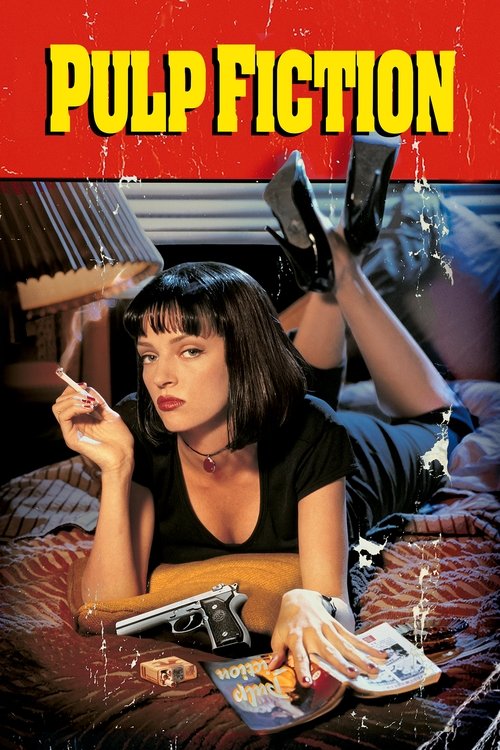
Pulp Fiction
1994 · Quentin Tarantino
Generates discourse without releasing anything: the abandoned Movie Critic "final film," podcast hot takes (dunking on Marvel actors as "not movie stars," snubbing Toy Story 3), and the eternal "what will the tenth film be" watch. The industry's loudest opinion-haver.
For when you want to have fun at the movies — quotable, cool, endlessly rewatchable, the film you put on with friends who claim they've seen everything. Comfort viewing with teeth.
What it's about
Three Los Angeles crime stories tangle around each other out of order: two hitmen running errands for their boss and talking about everything but the job, a boxer who's been paid to take a fall, and a night out with the boss's dangerously bored wife. A diner robbery brackets the whole thing. It's less a plot than a jukebox of underworld situations, each one turning on a bad decision.
The experience
Fast, funny, and profane, with sudden jolts of violence that land harder because you were laughing two seconds earlier. The conversations are the action — you lean in for the small talk and get whiplash from where it goes.
Performances
Samuel L. Jackson turns hitman patter into pulpit fire, John Travolta made this the comeback of the decade, and Uma Thurman owns the film's most iconic stretch on a fraction of its runtime. Even the bit parts are cast like leads.
The craft
Tarantino's screenplay is the star — dialogue so musical people recite it from memory — and the shuffled chronology turns three simple stories into a puzzle that snaps together with a click. The needle-drop soundtrack of surf rock and soul basically created the modern movie mixtape. It plays great anywhere, but the dialogue deserves good speakers.
Why it matters
It won the Palme d'Or, made independent film a commercial force, and spawned a decade of imitators trying to copy its talk, its timeline, and its cool. Few films have bent pop culture around themselves so completely.
Snapshot
Pulp Fiction arrived at the 1994 Cannes Film Festival and left with the Palme d'Or, signaling a rupture in American cinema. Quentin Tarantino's second feature is a non-linear triptych of Los Angeles crime stories — hitmen, a boxer, a gangster's wife, two diner robbers — whose interlocking chapters rewrote the grammar of mainstream narrative filmmaking for the decade that followed. Simultaneously a genre exercise, a postmodern collage, and a showcase of vernacular American speech, the film made an iconoclast out of a former video-store clerk and demonstrated that independent cinema could dominate popular culture without ceding its idiosyncratic vision.
Industry & production
Pulp Fiction was produced by Lawrence Bender and financed and distributed by Miramax Films, then operating under the Disney umbrella following a 1993 acquisition. The budget is widely reported at approximately eight million dollars — modest by studio standards but a significant step up from Reservoir Dogs (1992), Tarantino's debut. The script, developed from story ideas by Tarantino and co-writer Roger Avary, had circulated in various forms before Jersey Films came aboard as a producing partner. Avary's contribution was substantial enough that he shared the Best Original Screenplay Oscar with Tarantino at the 67th Academy Awards in 1995; the precise division of labor on specific story elements has been discussed publicly by both writers over the years, though the record on who drafted what remains contested.
Miramax's role in the 1990s independent film ecosystem is inseparable from the film's trajectory. Harvey Weinstein's aggressive award campaigning and wide-release strategy for specialty films had already reshaped independent distribution with My Left Foot (1989) and The Crying Game (1992); Pulp Fiction became the vehicle through which Miramax demonstrated that an R-rated, dialogue-driven, structurally unconventional film could compete commercially with studio tentpoles. The film was a landmark commercial success for the independent sector, earning well over $100 million domestically and substantially more worldwide on its limited budget, though precise grosses vary by source and should be verified against studio reporting.
The casting resurrected John Travolta, whose career had stalled after Saturday Night Fever (1977) and Grease (1978) and whose subsequent decade had been largely undistinguished. The role of Vincent Vega returned Travolta to A-list standing. Samuel L. Jackson, already a respected character actor with a small part in Reservoir Dogs, became a star through Jules Winnfield. Uma Thurman, Bruce Willis, Harvey Keitel, Tim Roth, Amanda Plummer, Ving Rhames, Eric Stoltz, and Christopher Walken round out an ensemble whose collective stature the film both exploited and amplified.
Technology
Pulp Fiction was shot on 35mm anamorphic stock, achieving a 2.35:1 aspect ratio that places the film squarely within the widescreen tradition Tarantino was consciously invoking — the scope ratios of spaghetti westerns, the CinemaScope Hollywood of the 1950s and 1960s. No digital intermediary was employed in original production; the image retains the grain and color latitude typical of mid-1990s photochemical work. The film predates the widespread adoption of digital non-linear editing systems as a post-production standard, though the editing workflow details have not been exhaustively documented in public accounts. Its production design relied on practical Los Angeles locations — actual diners, apartments, and storefronts — augmented by built sets, notably the Jack Rabbit Slim's interior, which was constructed for the production.
Technique
Cinematography
Andrzej Sekula, a Polish-born cinematographer who had also shot Reservoir Dogs, served as director of photography. The visual approach is deliberately restrained given the film's stylistic reputation: long takes, static or slowly drifting frames, and a preference for medium shots that permit extended dialogue without imposing editorial rhythm. Tarantino and Sekula frequently shoot characters from low angles, a choice that amplifies physical presence — Samuel L. Jackson's Jules, in particular, acquires a near-mythic scale through careful framing. The celebrated trunk-point-of-view shot, used twice, has become one of the film's signature images: a low-angle look up from within an open car trunk at whoever is about to close it. The source of the technique is often traced to earlier crime cinema without a definitive single antecedent, and its precise inspiration has not been documented by Tarantino or Sekula in a verifiable citation.
The lighting throughout favors naturalism leavened by golden interiors — the lamps and amber walls of Marsellus Wallace's bar, the neon glow of Jack Rabbit Slim's, the harsh overhead fluorescents of Brett's apartment. There is no ostentatious expressionism; the extremity of events is counterpointed by an almost matter-of-fact luminosity.
Editing
Sally Menke edited the film and continued to collaborate with Tarantino on every subsequent feature until her death in 2010. The edit is the film's structural spine: the non-linear arrangement of the three chapters — "Vincent Vega and Marsellus Wallace's Wife," "The Gold Watch," and "The Bonnie Situation" — with a prologue and epilogue involving Pumpkin and Honey Bunny, requires that the editing hold chrono-logical discontinuity together through tonal consistency rather than causal logic. The famous diner hold-up, which opens and closes the film, is the same scene experienced in different emotional registers depending on what the viewer has learned about Jules in the interim. Menke's work keeps these temporal dislocations legible without resorting to on-screen text cues. The editing pace within scenes is notably leisurely — conversations breathe, silences are permitted — which amplifies the sudden violent ruptures when they arrive.
Mise-en-scène / staging
Tarantino's staging is fundamentally theatrical: it prioritizes the actor and the spoken word over camera mobility. Scenes run long, occupying complete spatial units — a diner booth, a car interior, a hallway — without the fragmentation of contemporary action editing. The Jack Rabbit Slim's sequence, in which Vincent and Mia Wallace enter a 1950s nostalgia restaurant staffed by celebrity impersonators, is a sustained environment built to sustain mood; the twist contest that follows is a set piece structured around performance rather than cinematic effect. Props accrue symbolic weight through repetition — the mysterious briefcase whose luminous contents are never revealed is perhaps the most discussed MacGuffin in 1990s cinema — and costume anchors character identity: the hitmen's black suits and narrow ties, the boxer Butch's undershirt and watch, Mia's bob and white shirt.
Sound
The soundtrack is a distinct cultural artifact. Tarantino assembled a compilation of surf rock, soul, and pop rather than commissioning an original score. Dick Dale's "Misirlou," a 1962 surf instrumental, opens the film over the title card with an immediacy that functions as a genre declaration. Urge Overkill's cover of Neil Diamond's "Girl, You'll Be a Woman Soon" accompanies Mia's overdose. Al Green's "Let's Stay Together" and Ricky Nelson's "Lonesome Town" are among the further selections. The curation reflects Tarantino's aesthetic of unearthing subcultural familiarity — the songs are recognizable but not overly current, reaching back to a mid-century American soundtrack that sits in productive tension with the film's 1990s present. Dialogue is mixed with particular clarity; the film's sound design does not compete with its speech.
Performance
Tarantino's direction of actors produces a recognizable register: conversational naturalism within highly constructed speech patterns. The dialogue — elliptical, pop-culture-saturated, procedurally specific — requires actors to inhabit its cadences without performing heightened theatricality. Samuel L. Jackson delivers Jules Winnfield's Ezekiel monologue (a passage that departs substantially from the actual biblical text; the speech is largely Tarantino's invention invoking Ezekiel 25:17 as a loose frame) as a theatrical set piece that Jackson grounds in genuine menace. Travolta's achievement is subtler — Vincent Vega's low-grade existential drift, his heroin-addled philosophizing, required Travolta to underplay against type. Uma Thurman's Mia Wallace negotiates between archetype (the dangerous gangster's moll) and specificity (a failed actress with a particular way of drawing rectangles in the air). Bruce Willis brings physical weariness to Butch that grounds the film's most conventionally heroic arc in ambivalence.
Narrative & dramatic mode
The film's three-chapter structure with framing device refuses the linear causality of classical Hollywood narrative. Events that are chronologically earlier appear later in the film; a character's death in one chapter is impossible to know is imminent during an earlier-appearing scene. This temporal displacement does not obscure the film's story so much as multiply its emotional valences — the same event carries different weight depending on narrative position. The dramatic mode oscillates between farce and menace without tonal discord; Tarantino had demonstrated with Reservoir Dogs that extreme violence could coexist with humor, but Pulp Fiction extends this further, embedding a near-fatal overdose reversal and a sadomasochistic kidnapping within a film whose dominant mode is comedy of manners. The philosophical pretensions of the characters — hitmen debating the propriety of foot massages, the theological crisis of a man whose instinct toward professional murder suddenly breaks down — are played neither mockingly nor straight, producing an irony that is generative rather than distancing.
Genre & cycle
Pulp Fiction is formally a crime film, but it activates and subverts a range of genre conventions simultaneously. The heist-film prologue belongs to one tradition; the hired-killer narrative invokes another; the boxer-on-the-run chapter references noir and the sports film. The film's relationship to the blaxploitation cycle of the early 1970s — Shaft (1971), Coffy (1973), Jackie Brown would come later — is one of homage and appropriation; Tarantino has spoken openly about his affection for those films, though his transposition of their iconography into a predominantly white genre context generated significant critical debate about cultural borrowing that continued through his career. The film is also part of the early-1990s cycle of stylized American crime films — alongside True Romance (1993, written by Tarantino and directed by Tony Scott), Natural Born Killers (1994, from a Tarantino story), and The Usual Suspects (1995) — that collectively redefined the thriller for the decade.
Authorship & method
Tarantino's approach to filmmaking is self-consciously cinephilic: his stated influences, widely discussed in interviews and documented in critical literature, span Jean-Luc Godard (particularly Breathless and Band of Outsiders), Hong Kong action cinema, spaghetti westerns, 1970s American exploitation cinema, and hard-boiled literary fiction in the tradition of Jim Thompson and Elmore Leonard. His method involves extended, overly long first drafts that are cut down, with an emphasis on dialogue as the primary building material of scene and character. He does not use a traditional room of writers; scripts emerge from his solo drafting, in longhand, followed by collaboration and rewriting.
Roger Avary's contribution to Pulp Fiction was credited as story co-author, with the "Gold Watch" segment most often attributed to Avary's original material, though the public record on this is not exhaustively clear. Sally Menke's editorial contribution to the project's tonal consistency across non-linear structure was significant; her relationship with Tarantino constituted one of the more consequential director-editor collaborations of the period. Andrzej Sekula's restrained visual approach served the material; Tarantino would subsequently work with Robert Richardson on later features, indicating the DP relationship was not as central to his authorial signature as, say, the writer-editor axis.
Movement / national cinema
Pulp Fiction is American independent cinema in its commercial apex — the moment at which the Sundance-and-Miramax ecosystem produced something that achieved blockbuster cultural saturation without studio development. It sits at the convergence of the American independent movement that had expanded through the late 1980s (Jarmusch, the Coen brothers, Linklater, Hartley) and the art cinema impulses Tarantino absorbed from European and Asian sources. It is not, finally, a European art film, nor a studio picture; it is the product of a specific industrial and cultural moment in American cinema that was difficult to replicate and did not exactly recur.
Era / period
The mid-1990s were characterized by a collapse of genre certainty and a proliferation of ironic genre recombination. Grunge aesthetics, postmodern literary fiction, and the emergence of alternative distribution channels had produced an audience comfortable with pastiche and self-referentiality. Pulp Fiction is the central artifact of that formation. Its release in October 1994 in the United States followed its Cannes triumph and landed in a cultural moment primed to receive it.
Themes
The film's preoccupations include the intersection of mundane ritual and mortal violence — characters discuss fast food, foot massages, and television pilots in the intervals between acts of lethal force, and the film insists on holding these registers together. Professional codes of honor and their collapse run through all three chapters: the hitman who loses faith, the boxer who refuses to take a dive, the fixer who imposes order on catastrophe. Redemption is treated with skeptical ambivalence — Jules's apparent conversion is real within the film's logic but also staged as performance. The film is interested in the language through which its characters maintain identity and status, and in the way that language fails in extremity. Race, class, and the mythology of American cool are embedded throughout; the film participates in the cultural fantasy of white characters fluently inhabiting black American cultural forms, a dynamic that critics including bell hooks addressed in essays written in the film's immediate wake.
Reception, canon & influence
The Palme d'Or jury at Cannes 1994, presided over by Clint Eastwood, awarded the film the festival's top prize — notably over Krzysztof Kieślowski's Three Colors: Red, which many critics considered the stronger film and whose omission generated immediate controversy. The American critical reception was overwhelmingly positive, with dissenters largely focused on the film's violence, its cultural appropriation, and questions about whether its formal sophistication amounted to nihilism. The seven Academy Award nominations, including Best Picture and Best Director, confirmed its mainstream prestige; the sole win was Best Original Screenplay.
The film's backward influences are the most thoroughly documented aspect of its production mythology: Jean-Luc Godard's jump-cut grammar and narrative disjunction (Breathless), the long-take dialogue scenes of John Cassavetes, the pop-cultural self-awareness of Brian De Palma, the violent set pieces of Hong Kong crime cinema, the character-driven fatalism of Jim Thompson. The specific debt to Godard's Band of Outsiders is visible in the Jack Rabbit Slim's dance sequence. Whether these influences amount to pastiche or synthesis is a question that has organized much of the critical literature on Tarantino.
The forward influence is vast and, in some respects, corrupting: the mid-to-late 1990s produced an enormous number of films that adopted the surface features of Pulp Fiction — non-linear structure, criminal protagonists, sharp dialogue, compilation soundtracks — without its underlying structural intelligence. Guy Ritchie's Lock, Stock and Two Smoking Barrels (1998) and Snatch (2000), the Filipino crime cinema of Erik Matti, and countless direct-to-video American imitations represent different points on the spectrum of its influence. The term "Tarantino-esque" entered critical vocabulary as shorthand for a recognizable aesthetic cluster. More substantively, the film ratified the possibility of non-linear mainstream narrative and expanded the tonal range available to genre filmmakers. The Coen brothers' Fargo (1996), released two years later, operates in adjacent territory — dark crime comedy with literary aspirations — though the Coens' relationship to the film is one of contemporaneous parallel development rather than direct influence.
Pulp Fiction remains one of the most widely studied and debated American films of its decade. Its canonical status is secure; its meaning and value continue to be contested.
A Deleuzian reading
Vincent Vega walks out of a bathroom stall and into the diner, alive, ordering nothing, while you sit there knowing — because you watched it forty minutes ago — that this man is going to take a burst of fire from Butch's hand cannon and die on a kitchen floor.
The full Deleuzian reading of Pulp Fiction →
Reception
It arrived as a cultural earthquake — Palme d'Or at Cannes '94, then a mainstream smash — but famously lost Best Picture to Forrest Gump, a result film fans have been relitigating ever since. Thirty years on it's less reappraised than permanently installed: the film that defined 90s indie cinema.
How Pulp Fiction was received, from release to now →
Influences: the films it descends from and the films it influenced
- The Killing (1956) — Kubrick segments the same heist across multiple non-linear timeline passages — each tagged to a different participant — establishing the temporal-displacement chapter structure Tarantino scales to three interlocking Los Angeles storylines.
- Bande à part (1964) — Godard's chapter-title segmentation of a crime narrative into named episodes with intertitles is the direct organizational model for Pulp Fiction; Tarantino named his production company A Band Apart, and the Jack Rabbit Slim's twist contest formally quotes the Madison café-dance in both blocking and sustained duration.
- Le Samouraï (1967) — Melville's clinical patience with the hitman's pre-job preparation rituals — coat, hat, gun check — establishes the grammar of professional criminal mythopoeia that Tarantino extends to Jules and Vincent's suit-and-tie pre-hit discussions of foot massages and divine intervention.
- Shaft (1971) — Parks's template of the cool, authoritative Black urban protagonist set to a soul-funk compilation score directly furnishes the Jules Winnfield archetype and the film's blaxploitation musical palette, which Tarantino recombines with existential hitman mythology.
- Mean Streets (1973) — Scorsese's practice of counterpointing rock and pop compilation recordings against observed criminal violence — street-level men who speak of loyalty while committing casual brutality — establishes the compilation-soundtrack-as-ironic-doubling device Tarantino systematizes throughout.
- Stranger Than Paradise (1984) — Jarmusch demonstrated that sustained static-camera long takes of characters doing very little — eating, watching television, waiting — constituted dramatic cinema, directly licensing Tarantino's refusal to cut away from extended mundane dialogue and his leisurely intra-scene editing pace.
- Slacker (1990) — Linklater's film of unconnected conversations — philosophy, pop culture, and conspiracy theory treated as drama without imposed action — modeled the American independent idiom in which Tarantino's characters can discuss Big Macs and foot massages at feature length before any violence occurs.
- Reservoir Dogs (1992) — Tarantino and Sally Menke extend Reservoir Dogs' non-linear chapter chronology into a three-strand structure where temporal fragmentation creates thematic rhyme across independent storylines; the diegetic pop soundtrack strategy scales from a formal gesture into a full compositional system governing mood and irony across the entire film.
- GoodFellas (1990) — Tarantino's deployment of jump cuts within dialogue scenes, non-linear temporal fragmentation, and soul and surf music used as ironic counterpoint to criminal violence directly extends GoodFellas' formal vocabulary, with Tarantino explicitly citing GoodFellas as the model for deploying these devices in a demythologizing crime register.
- Pierrot le Fou (1965) — Builds narrative from interrupting chapter title-cards and promiscuous genre-mixing, treating pulp-novel structure as a launching pad to be ruptured exactly as Godard did with Lionel White's source.
- Blue Velvet (1986) — Tarantino, who cited Lynch as a direct influence, deploys surf rock and soul songs as tonal counterpoints against on-screen violence — extending the pop-as-emotional-dissonance device Lynch crystallized in Blue Velvet's use of 'In Dreams' during Frank's assault on Dorothy.
- Pickup on South Street (1953) — Tarantino, a self-declared Fuller devotee, builds on the unseen-contents MacGuffin (the glowing briefcase echoing Pickup's microfilm) and the slang-driven dignity granted to criminal lowlifes.
- Boogie Nights (1997) — Anderson applies Pulp Fiction's ensemble chapter architecture and wall-to-wall pop compilation soundtrack as primary structural scaffolding; the drug-deal climax replicates Tarantino's technique of escalating violence through sustained dialogue rather than cutting away from the scene.
- Lock, Stock and Two Smoking Barrels (1998) — Ritchie transplants the non-linear interlocking crime-chapter structure and MacGuffin-driven ensemble plotting to British working-class London, replicating Tarantino's deadpan-dialogue-to-sudden-violence tonal rhythm and the compilation soundtrack counterpoint.
- Go (1999) — Liman explicitly structures the film as three interlocking stories centered on the same New Year's Eve event, each narrated from a different character's temporal vantage — a direct formal citation of Pulp Fiction's temporal-displacement chapter model applied to a younger Los Angeles milieu.
- Amores Perros (2000) — Iñárritu's debut adapts the multi-strand interlocking chapter structure — three stories converging on a single violent incident — while relocating the genre recombination to Mexico City social realism; Iñárritu has cited Pulp Fiction directly as the structural template.
- Inglourious Basterds (2009) — The final Tarantino-Menke editing collaboration extends the Pulp Fiction formal system in full: chapter-title structure, theatrical long-take dialogue scenes building unbearable tension before explosive release, and compilation soundtrack counterpoint — the completest realization of the grammar they developed together.
- Snatch (2000) — The converging-contingency plot architecture — multiple criminal ensembles pursuing a single MacGuffin whose ownership shifts through coincidence — is directly transposed from Tarantino's structural template, including the non-chronological opening that destabilizes causal order before a voice-over spine reinstates it.
- Jackie Brown (1997) — Established the Tarantino-Menke editorial vocabulary — long dialogue scenes held past conventional comfort, rhythm built through selective cut timing rather than pace — which Jackie Brown inherits but transposes from fractured non-linear chronology into strict linear accumulation.
- American Psycho (2000) — Cinematographer Andrzej Sekula shot both films; his technique of static-controlled anamorphic compositions with extreme close-ups that fetishize mundane objects — the briefcase, the watch — carries directly into American Psycho's business card sequences and their object-worship aesthetic.
- In Bruges (2008) — Established the hitman-as-philosophical-conversationalist template: two professionals debating ethics and aesthetics in extended dialogue scenes structured around the assignment's aftermath rather than its action, with genre violence deliberately deferred so that conversation becomes the film's primary spectacle.
- Beasts Clawing at Straws (2020) — Non-linear chapter architecture that begins each storyline mid-action and withholds inter-thread connections, so that the formal reordering of scenes generates retroactive dramatic irony unavailable in sequential viewing.
- Memento (2000) — Normalized scrambled, achronological storytelling for a mainstream audience, building the viewer literacy in fractured chronology that Memento could presume.
- Strange Darling (2024) — Models the out-of-sequence chaptered structure with on-screen title cards that reorder cause and effect so each scene is ironically recontextualized by what we learn later — the exact device of Strange Darling's numbered chapters.
- Magnolia (1999) — Anderson's nine-character Los Angeles ensemble uses wall-to-wall Aimee Mann compilation songs as emotional counterpoint across interlocking storylines, extending Tarantino's compilation-soundtrack-as-architecture device into an operatic register while adopting the same non-linear multi-strand construction.
- The Royal Tenenbaums (2001) — Wes Anderson adopts the chapter-title narrative segmentation and wall-to-wall pop/rock compilation soundtrack as structural skeleton — a direct inheritance of Tarantino's device of using named episodes and anachronistic music to organize a morally complex ensemble.
- True Romance (1993) — Deploys the same ensemble casting density, pop-mythology identity construction, and self-contained episodic scene structure, but restores the non-linear chronology that Scott's direction linearized — making the two films a paired experiment in how narrative order determines moral weight.
- Trainspotting (1996) — Tarantino constructs curated pop songs as structural tonal architecture—each licensed track a statement about character and irony, not ambient underscoring—alongside drug sequences handled through deadpan black comedy rather than horror, constituting a direct sibling development of the same formal strategies Boyle deploys with Iggy Pop and Lou Reed.
- Short Cuts (1993) — Tarantino exploited Avid non-linear digital editing to reassemble a multi-strand narrative out of chronological sequence, using the same post-production flexibility Short Cuts employed to construct associative thematic rhymes across otherwise unconnected storylines.
- Chungking Express (1994) — Both films deploy a two-part episodic structure and diegetic pop music as ironic emotional counterpoint to on-screen action; Tarantino's recognition of this formal kinship led him to distribute Chungking Express through Rolling Thunder Pictures.
- Natural Born Killers (1994) — The same 1994 Tarantino crime cycle: pop-cultural pulp dialogue and needle-drop musical juxtaposition NBK shares at its source even as Stone overwrites it.
- Three Kings (1999) — Defined the post-90s mode of ironic pop needle-drops over violence and gleeful genre subversion that Three Kings inherits and politicizes.
- Kill Bill: Vol. 1 (2003) — Establishes Tarantino's signatures repurposed here — non-linear chaptered structure with titled segments, the curated needle-drop mixtape functioning as score, and editor Sally Menke's tonal-shift rhythm.
- 21 Grams (2003) — Popularized scrambling chronology as authorship — withholding and reordering scenes so the audience reassembles cause and effect, the core 'is the structure essential' device 21 Grams pushes to fragmentation.
- Tampopo (1985) — Shares the anthology-of-digressions structure in which characters deliver extended riffs on food and eating as cultural decoding, echoing Tampopo's roving, appetite-driven vignette form.
- Sin City (2005) — Modeled the interwoven portmanteau crime anthology whose chapters loop back on each other in nonlinear time — and Tarantino's guest-directed Sin City scene makes the kinship a literal collaboration.
Similar films
- Inglourious Basterds (2009) — influence & lineage
- GoodFellas (1990) — same viewing thread
- The Sting (1973) — same viewing thread
- Jackie Brown (1997) — shared sensibility
- Reservoir Dogs (1992) — shared sensibility
- L.A. Confidential (1997) — shared sensibility
- Django Unchained (2012) — shared sensibility
- The Big Lebowski (1998) — shared sensibility
All the films related to Pulp Fiction →
Watch it with: curated runs of related films
- The Great American Crime Film — A run through the seductions and wreckage of American crime — mob epics that span a whole life beside capers that unravel over a weekend, all told with the same eye for how ordinary greed curdles into violence.
Film essays and courses that include it
- Fade In to Fracture: The Screenplay from Architecture to Anarchy
- Blood, Myth, and Grammar: The Gangster Film's Century
- Cold Business: Hired Killers from Noir to the Nation-State
- Out of Order: A Century of Fractured Time
- Everybody Talks at Once: The Art of the Ensemble Film
- The Body Under the Influence: A Century of Addiction Cinema
- Drop the Needle: Pop Music as Cinema's Beating Heart
- The Decade the Outsiders Got In
- The Magpie