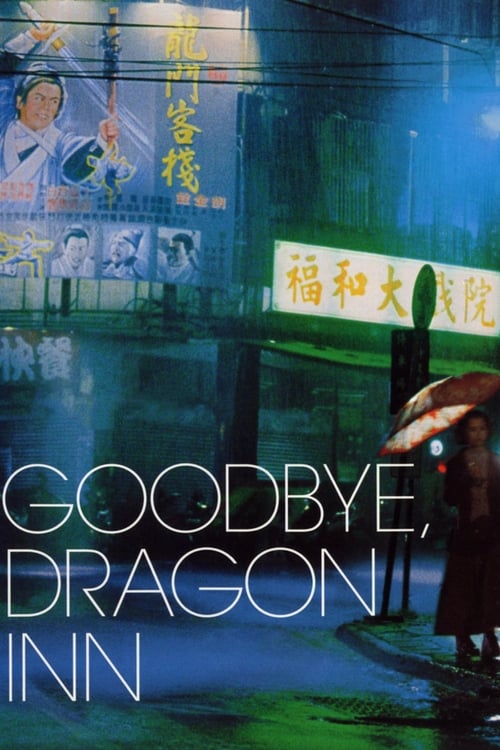
Goodbye, Dragon Inn
2003 · Tsai Ming-liang
For when you want to slow all the way down and feel something bittersweet about movies themselves — a meditative late-night watch for the patient, and a challenge worth taking.
What it's about
On a rainy Taipei night, a cavernous old movie palace opens its doors for the last time, screening King Hu's 1967 wuxia classic Dragon Inn to a handful of stragglers. A ticket clerk crosses the building's vast spaces toward a projectionist she never quite reaches, a tourist drifts the corridors, men cruise the aisles — and in the audience sit two stars of the original film, watching their younger selves fight across the screen.
The experience
Hushed, hypnotic, and quietly funny before it turns achingly sad — with barely ten lines of dialogue, it's built from footsteps, rain, and the sounds of an old film echoing through empty halls. It's a film you sink into rather than follow.
The craft
Tsai Ming-liang shoots the dying theater in long, fixed takes that turn its hallways and screening hall into a haunted body, letting the soundtrack of the old wuxia film bleed through the walls. It rewards the biggest, darkest room you can watch it in — the film is literally about that experience.
Why it matters
A touchstone of slow cinema and one of the most beloved elegies for moviegoing ever made, regularly cited among the finest films of its century so far.
On its final rainy night, a cavernous Taipei picture palace screens King Hu's 1967 wuxia landmark Dragon Inn to a scattering of patrons: a Japanese tourist drifting through the corridors, men cruising the aisles and washrooms, a ticket clerk with a limp crossing the building's vast spaces, a projectionist she never quite reaches. Tsai Ming-liang's elegy for moviegoing contains perhaps ten lines of dialogue and some of the most eloquent silences in modern cinema — every long, fixed take turning the dying theater into a haunted body, its hallways and screening hall thick with memory. In the audience sit Miao Tien and Shih Chun, stars of the original Dragon Inn, watching their younger selves fight across the screen: cinema mourning itself with its own witnesses present. The cruising subplot makes the film equally a landmark of queer cinema, the movie palace doubling as a sanctuary for desire that has nowhere else to go. Its penultimate gesture — a static shot of the emptied auditorium, held for minutes, rows of seats staring back at us — is one of the century's indelible images.
A Deleuzian reading
A woman with a limp walks the length of a corridor.
The full Deleuzian reading of Goodbye, Dragon Inn →
Reception
A Venice FIPRESCI-winner in 2003 that mostly played to festival devotees and slow-cinema faithful, it climbed steadily for two decades — a 2020 4K restoration landed mid-pandemic, when its elegy for empty movie theaters suddenly felt prophetic, and by 2022 it had entered the Sight & Sound greatest-films poll (ranked 108th).
How Goodbye, Dragon Inn was received, from release to now →
Influences: the films it descends from and the films it influenced
- Dragon Inn (1967) — The literal film-within-the-film: Tsai holds his static camera on Hu's rapid spatial cutting and vertical wuxia choreography so that Hu's kinetic découpage becomes the ghost his stillness mourns — and he casts Hu's actual stars (Shih Chun, Miao Tien) to watch their younger selves onscreen.
- Jeanne Dielman, 23 quai du Commerce, 1080 Bruxelles (1975) — Locked-off frontal fixed frames that observe mundane action in near-real time and keep running on emptied rooms past narrative need — the durational-observation grammar Tsai applies to the theater's corridors and toilets.
- L'Eclisse (1962) — The 'temps mort' device of letting shots persist on architecture after the characters exit the frame, so built space and absence carry the drama.
- Tokyo Story (1953) — Low static frontal setups and 'pillow shots' of vacated interiors that convert stillness into contemplation — Tsai's empty-auditorium inserts are Ozu's transitional voids stretched to feature length.
- Au hasard Balthazar (1966) — Non-expressive 'model' performance and elliptical minimalism, with isolated ambient sounds (footsteps, dripping, rain) foregrounded in place of dialogue — the near-silent sound design Tsai builds his theater from.
- Empire (1965) — Duration as pure endurance: a near-motionless long take that dares the viewer to sit with banal time — the conceptual license behind Tsai's minutes-long held shots.
- Vive L'Amour (1994) — Tsai's own template of wordless bodies (Lee Kang-sheng) drifting through vacant apartments in unbroken takes, ending on an extended silent-weeping long shot — the method Goodbye, Dragon Inn transplants into the movie palace.
- Gertrud (1964) — Trusts stillness, silence, and the held empty or near-static frame as primary expressive material in the contemplative, anti-spectacular mode Gertrud founded.
- India Song (1975) — A near-wordless film built from long static takes of a decaying movie-palace as architecture of absence, where sound and the ghosts of the past haunt near-empty, motionless frames.
- Death in Venice (1971) — Tsai's static held frames organized around furtive looking at an unattainable object, with dialogue stripped and performance reduced to presence, descend directly from the film's geometry-of-looking and suppression.
- What Time Is It There? (2001) — Extends WTIIT's cinephilia motif into a dying movie palace, holding long static takes of a near-empty auditorium watching an old film — the projected-image-as-mourning device pushed to feature length.
- Close Your Eyes (2023) — Shares the elegy for cinema-and-loss set in a dying movie house, where the film screened within mourns its own medium and unhurried duration becomes an act of farewell to spectatorship.
- Colossal Youth (2006) — Rigorously composed static frames of marginal figures held in decaying architecture, sustained by near-silence and available light — Tsai's stillness extended to Lisbon's slums.
- Syndromes and a Century (2006) — Slow-cinema long takes that treat interior space as haunted and porous, with the camera drifting or holding on empty corridors — the theater-as-liminal-zone idea carried forward.
- Norte, the End of History (2013) — Durational static long takes in which whole scenes unfold in a single distant frame with no coverage — Tsai's held-shot ethic scaled to epic length.
- 'Til Madness Do Us Part (2013) — Observational duration inside a confining institution, the fixed/patient camera trailing bodies through corridors in near-real time — documentary heir to Tsai's architectural stillness.
- Stray Dogs (2013) — Tsai pushes his own device to the limit: the near-14-minute static two-shot before a mural, where the long take stops being a scene and becomes an object of contemplation.
- Kaili Blues (2016) — Tsai's model of extreme long takes in a decaying public space where ambient sound (projector hum, rain, footsteps) largely displaces dialogue, and where the location itself functions as a memory-space for a vanishing cultural form, is the closest Chinese-language slow cinema precedent for Bi Gan's approach to location, duration, and ambient sound design.
- Magellan (2025) — Codifies the static-wide, no-score, location-ambience method—holding empty or near-still frames so long that diegetic sound and architecture become the drama, a discipline Diaz shares with Tsai's wing of slow cinema.
- A City of Sadness (1989) — Taiwanese New Wave long-take deep-focus staging in static wide frames, letting action play out at a distance without cutting in — the shared regional grammar of unhurried framing.
- Yi Yi (2000) — Architectural framing through glass, reflections and doorways that dwarfs figures in urban interiors — the same use of built space and layered surfaces to stage alienation.
- Platform (2000) — Long-take static realism trained on decaying, about-to-vanish public spaces (troupes, theaters, walls) — a contemporaneous Chinese-language elegy for institutions dying in the frame.
- Sátántangó (1994) — Extreme long-take duration tracking bodies walking through desolate, rain-soaked space, where the shot's length itself becomes the subject.
- Irma Vep (1996) — A sibling elegy on cinema exhaustion that mourns the medium from inside a dying movie palace, sharing Irma Vep's centenary-era anxiety about film's survival.
- The Assassin (2015) — Tsai's durational stillness and near-silent long takes, built explicitly around King Hu's Dragon Inn playing in an empty cinema, is the parallel Taiwan slow-cinema elegy for the same wuxia inheritance.
- Uncle Boonmee Who Can Recall His Past Lives (2010) — Shares the cinema-as-mortality device — a dying movie palace haunted by the ghosts of old films — rendered in extreme-duration static long takes, the vanishing-cinema homage Boonmee builds into its six-reel design.
- Landscape in the Mist (1988) — Extends the single-take tableau and sparse diegetic soundscape, with the dispersing theatrical/cinema troupe as elegiac subject — the static long take as a meditation on vanishing performance.
- Cemetery of Splendor (2015) — Holds static long takes on a near-empty decaying public interior, mining deadpan emptiness and ambient room-tone—Cemetery's school-turned-hospital shares this haunted-architecture stillness.
- Mystery Train (1989) — Pushes the static long take, anti-suspense dead time, and a haunted-venue-as-shrine to cinema/myth to an extreme that rhymes with the Arcade Hotel's afterlife stillness.
- Resurrection (2025) — A cinema-about-cinema elegy for the dying movie palace that foregrounds spectatorship, kin to Bi's 'audience watching itself' opening conceit.
- Dry Leaf (2026) — Tsai builds entire scenes from emptied, prolonged static takes about watching and vanishing, making 'looking and disappearance' a formal subject — the durational gaze Koberidze's theme of seeing echoes.
Similar films
- Yi Yi (2000) — influence & lineage · same viewing thread
- A City of Sadness (1989) — influence & lineage · same viewing thread
- Tokyo Story (1953) — influence & lineage · often watched together
- Dragon Inn (1967) — influence & lineage
- Satantango (1994) — influence & lineage
- Syndromes and a Century (2006) — influence & lineage
- What Time Is It There? (2001) — same viewing thread · often watched together
- Long Day's Journey Into Night (2018) — same viewing thread
All the films related to Goodbye, Dragon Inn →
Watch it with: curated runs of related films
- Sinophone Slow Cinema — A run of Chinese-language films — Taiwan's New Wave and its mainland and Bi Gan heirs — where time pools and city, family, and memory recur; watch them near each other, from A Brighter Summer Day to An Elephant Sitting Still, for how they rhyme on drift and the weight of the past.