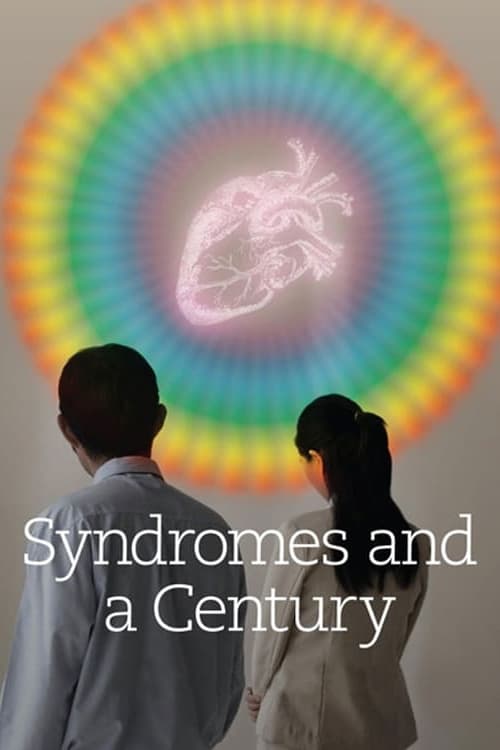
Syndromes and a Century
2006 · Apichatpong Weerasethakul
Memoria's "one screen at a time, never streaming" release turned distribution itself into an artwork and a permanent debate about access versus aura. The name that signals deepest-end cinephilia.
For when you want to slow your pulse rather than race it — a meditative evening, phone in another room, letting a film wash over you. It's a challenge if you need story momentum, and pure balm if you don't.
What it's about
A film in two rhyming halves, drawn from the director's memories of his parents — both doctors — and a childhood spent around hospitals. In a rural Thai clinic ringed by trees, a female doctor interviews a new colleague, a dentist befriends a young monk, and tentative courtships flicker; then the film begins again in a cool, modern Bangkok hospital, replaying similar encounters in a changed world and watching what shifts.
The experience
Serene, funny in sidelong ways, and quietly hypnotic — it asks you to sink into its rhythm rather than follow a plot, and rewards you with a strange afterglow. Scenes drift like remembered afternoons; the second half casts a subtle spell of déjà vu that's oddly moving.
The craft
Weerasethakul builds the whole film on structural rhyme: two settings, two light temperatures — green and sun-drenched, then fluorescent and blue — with long, patient takes and drifting camera moves that turn corridors and courtyards into music. The ambient sound design is remarkable; on good speakers the hum of rooms becomes half the experience.
Why it matters
One of the defining works of 2000s contemplative cinema and a fixture of best-of-the-decade polls — and, after Thai censors demanded cuts, the flashpoint that galvanized a movement for filmmakers' freedom in Thailand.
Snapshot
Syndromes and a Century (Thai: Sang sattawat, roughly "Light of the Century") is Apichatpong Weerasethakul's fourth feature, a two-part reverie loosely modeled on the courtship of his physician parents and on his own childhood inside provincial Thai hospitals. Commissioned for Peter Sellars's New Crowned Hope festival marking the 250th anniversary of Mozart's birth, the film premiered in competition at the Venice Film Festival in 2006 — reportedly the first Thai feature to compete there. Its two halves rhyme rather than continue: the first unfolds in a rural clinic surrounded by trees and open light; the second replays many of the same encounters, scrambled and displaced, inside a cooler, more institutional Bangkok hospital. The result is one of the signal works of 2000s contemplative cinema, and, through a censorship battle in Thailand, an unexpected catalyst for a filmmakers' free-expression movement.
Industry & production
The film's financing followed the transnational arthouse model that had by then become Apichatpong's home ground. It was produced through his own Bangkok-based company, Kick the Machine, in partnership with European producers — including Charles de Meaux's Anna Sanders Films (France) and the UK's Illuminations Films (Simon Field and Keith Griffiths) — under the umbrella of the New Crowned Hope commission overseen by Sellars, which drew Austrian cultural funding tied to the Mozart anniversary. The New Crowned Hope program notably also underwrote features by Paz Encina, Bahman Ghobadi and Garin Nugroho, positioning Apichatpong within a curated international slate rather than a conventional producer's development pipeline.
The defining industrial event of the film's life came at home. Thailand's censorship board demanded the removal of several scenes — commonly reported as four — depicting behavior it deemed improper: monks in ordinary, playful activity (a monk with a guitar; monks handling a flying toy), doctors drinking liquor within the hospital, and a doctor embracing his girlfriend in a way read as sexual. Apichatpong refused to make the cuts, and the film went effectively unreleased in Thailand. His stance — and his gesture of screening the film with silent, blacked-out gaps standing in for the censored passages — helped galvanize the Free Thai Cinema Movement, which agitated for reform of the country's film-rating and censorship regime. This episode is among the best-documented facts of the film's history and is central to how it is remembered in Thai film culture.
Technology
Syndromes was shot on 35mm film, consistent with Apichatpong's practice in this period and with the film's emphasis on the physical qualities of natural light. The technology on display is, deliberately, unspectacular: there are no visible optical effects, and the film's most "technological" images are diegetic — hospital machinery, an eerie basement smoke-extraction vent, the fluorescent light of institutional corridors. The reliance on available and naturalistic lighting, long lenses and sustained takes places the burden less on apparatus than on duration and observation. I have not been able to confirm specific camera or lab details from the public record, and will not invent them.
Technique
Cinematography
The cinematography is credited to Sayombhu Mukdeeprom, who would become one of Apichatpong's essential collaborators (and later shot for Luca Guadagnino, among others). The two halves are visually distinguished with great precision. The rural first part favors soft, dappled natural light, greenery pressing at the windows, and a camera that drifts and pans with a curiosity that feels almost autonomous — most famously a slow, unmotivated pan away from a conversation toward the landscape. The urban second part is cooler and more enclosed, its light harder and more institutional, its framings more frontal and boxed-in. The film is built from long takes and a largely static or slowly mobile camera; the compositions are patient enough that the viewer begins to attend to background events and offscreen sound as much as to the ostensible subject.
Editing
Editing is by Lee Chatametikool, Apichatpong's regular editor across this era. The crucial editorial idea is structural rather than local: the film is cut into two long movements that echo one another, so that the "edit" the viewer performs is a mental cross-referencing of scenes — the same interview, the same characters, the same lines recurring in altered surroundings. Within scenes, cuts are sparse; the rhythm is governed by the length of takes and by the film's willingness to let an action or a silence run past conventional narrative usefulness. The celebrated late passage — a prolonged fixation on a smoking basement duct that pulls toward abstraction before the film opens out into sunlight and a park full of people exercising — is an editorial and tonal gambit as much as a photographic one.
Mise-en-scène / staging
Staging is organized around repetition-with-difference. Characters are frequently arranged in frontal, interview-like configurations — a recurring job-interview or medical-questioning scene anchors both halves — and the hospital itself functions as the film's principal set and its principal metaphor: a place of thresholds, waiting, examination and quiet desire. Apichatpong stages small, oblique comedy (a dentist who moonlights as a country singer; a doctor concealing liquor) alongside images of stillness and reverie. Bodies are often placed at the edges of frames or partly obscured, and the space beyond the actors — corridors, gardens, ventilation systems — is given as much staging weight as the human foreground.
Sound
Sound is arguably the film's most controlling technical element. Apichatpong's cinema is built on dense, layered ambient sound — insects, wind, machinery, the hum of interiors — and Syndromes uses this atmospheric field to bind and differentiate its two worlds, the organic soundscape of the country clinic against the mechanical drone of the city hospital. The film largely eschews conventional non-diegetic scoring in favor of source music and environmental sound; a character's country song and incidental pop are folded in diegetically. I am not confident of a credited composer for an original score and will not assert one; the sound design and music supervision are better understood as an ambient, largely diegetic construction than as a scored soundtrack.
Performance
Performance is naturalistic and understated, mixing Apichatpong regulars with non-professional and local performers. Nantarat Sawaddikul plays the central woman doctor whose interview and quiet romantic history frame both halves; Jenjira Pongpas (a recurring presence across Apichatpong's work) and Jaruchai Iamaram feature among the ensemble, with additional roles for performers including Sophon Pukanok and Arkanae Cherkam. The acting register is deliberately flattened — gentle, affectless, sometimes drolly comic — so that emotion registers through gesture, pause and placement rather than through dramatic emphasis.
Narrative & dramatic mode
The dramatic mode is elliptical, associative and structurally rhymed rather than plot-driven. There is a nominal romantic thread — memories and half-memories of a courtship between two doctors, refracted through the director's sense of his parents — but the film withholds conventional cause and effect. Its governing form is the diptych: a set of scenes presented once in a rural key and again, transformed, in an urban one, so that meaning arises from variation and displacement. Time is treated as porous and recursive; the film behaves less like a story than like memory itself, or like a Buddhist meditation on repetition and impermanence. Dialogue is often mundane on its surface — medical questionnaires, small talk, confessions of feeling — while the emotional current runs underneath.
Genre & cycle
Nominally a drama with romantic elements, Syndromes belongs more usefully to the international cycle of slow cinema / contemplative cinema that crystallized in the 2000s, alongside filmmakers such as Tsai Ming-liang, Lisandro Alonso and Pedro Costa. It is also a memory film and an autobiographical reverie, and it carries a thread of Apichatpong's characteristic deadpan comedy. Within his own filmography it extends a bipartite, "two films in one" structure he had already explored in Blissfully Yours (2002) and Tropical Malady (2004), making Syndromes the most formally symmetrical entry in that personal cycle.
Authorship & method
Apichatpong Weerasethakul — a Thai artist trained in architecture in Khon Kaen and in filmmaking at the School of the Art Institute of Chicago — writes, directs and produces from a method rooted as much in gallery and experimental-film practice as in narrative cinema. His approach favors improvisation within loose structures, collaboration with non-professionals and returning performers, and an openness to chance and the environment. Syndromes is his most explicitly autobiographical feature to that date, grounded in his parents' careers as doctors and his own memories of hospital life in northeastern Thailand, yet filtered through abstraction rather than confession.
The authorship is genuinely collaborative in its craft. Cinematographer Sayombhu Mukdeeprom and editor Lee Chatametikool are the key technical partners, and both are integral to the film's signature of long takes, ambient density and structural rhyme; performer Jenjira Pongpas is part of the continuing "company" that recurs across Apichatpong's cinema. Producer relationships with figures such as Charles de Meaux, Simon Field and Keith Griffiths connect the film to the transnational arthouse infrastructure that sustained Apichatpong's work in this period.
Movement / national cinema
The film sits at the confluence of two currents. Nationally, it belongs to the internationally visible wave of Thai auteur cinema that emerged around the turn of the millennium — Apichatpong alongside Pen-ek Ratanaruang and Wisit Sasanatieng — which brought Thai film to festival prominence even as it strained against domestic censorship. Apichatpong is the most avant-garde of that group, closer in sensibility to structural and experimental film than to genre reinvention. Internationally, Syndromes is a landmark of festival-circuit slow cinema. The censorship dispute makes the film's national dimension inseparable from its aesthetics: its fate at home dramatized the gap between Thailand's globally celebrated art cinema and a domestic regulatory culture uneasy with images of monks and doctors behaving as ordinary people.
Era / period
Produced in 2006, the film is a product of the mid-2000s moment when digital-age festival culture, transnational co-production and a global appetite for durational aesthetics converged. It arrived at the height of critical attention to "slow" and observational cinema, and in the same span as its Thai-political backdrop — the country's turbulent mid-2000s, culminating in the September 2006 coup — though the film addresses that context obliquely at most. Its embrace of memory, hospitals and quiet ritual reads, in period terms, as a counter-current to fast, plot-heavy commercial cinema, and as an assertion of regional and personal specificity within an accelerating global film economy.
Themes
Its central themes are memory and its unreliability; repetition, doubling and impermanence (an unmistakably Buddhist frame); the porous line between the rural and the urban, the organic and the institutional; love recalled rather than lived; and healing as both medical fact and spiritual metaphor. The hospital serves as the master image — a threshold-space of waiting, examination and desire where bodies and feelings are quietly attended to. The Thai title's invocation of "light" points to a further preoccupation with sunlight, illumination and their withdrawal, culminating in the film's movement from a dark, smoke-filled basement toward open air and communal exercise in the light.
Reception, canon & influence
Critically, Syndromes was received abroad as a major achievement and consolidated Apichatpong's standing among the essential filmmakers of his generation; its Venice competition slot and warm festival reception were widely noted, and it recurred in critics' and institutions' surveys of the best films of the 2000s in subsequent years. (I'd flag that precise poll placements and any box-office figures are not something I can cite reliably; its commercial life was that of a specialized arthouse release, and it went effectively unreleased theatrically in Thailand because of the censorship standoff.) The film has been a touchstone in scholarship on Apichatpong, including the influential critical attention gathered around his work by writers and programmers such as James Quandt and Tony Rayns, and, in the Thai context, critics such as Kong Rithdee who framed the censorship affair for both domestic and international readers.
Looking backward, the film draws on several lineages: Apichatpong's training in American experimental and structural film; the durational, observational strain of Asian art cinema (Tsai Ming-liang is a frequent comparison); Buddhist conceptions of time and rebirth; and the textures of provincial Thai life, radio and popular song. Its diptych architecture is a self-influence, refining the two-part form of Blissfully Yours and Tropical Malady.
Looking forward, Syndromes directly prepared the ground for Uncle Boonmee Who Can Recall His Past Lives (2010), which won the Palme d'Or and made Apichatpong one of world cinema's most garlanded contemporary directors; the memory-and-reincarnation concerns and the patient, ambient style of Syndromes are extended there. Its cinematographer and editor carried this visual and rhythmic grammar into later high-profile work. And in Thailand, the film's most concrete legacy is political-cultural: the censorship battle it precipitated fed the Free Thai Cinema Movement and the broader argument over film regulation that shaped Thai cinema policy debates in the years that followed. Its wider influence on international slow cinema is real but diffuse — visible in a generation of filmmakers who took durational observation and structural rhyme as serious narrative tools rather than as mere style.
A Deleuzian reading
A doctor is answering the usual intake questions — where did you work, why did you leave — and the camera, mid-sentence, loses interest.
The full Deleuzian reading of Syndromes and a Century →
Reception
Rapturously received on the festival circuit after its 2006 Venice premiere, but effectively suppressed at home when Thai censors demanded cuts — then, in 2009, a TIFF Cinematheque poll of 60+ international curators and historians voted it the best film of the decade, cementing a leap from cause célèbre to canon.
How Syndromes and a Century was received, from release to now →
How to watch Syndromes and a Century: what to notice on a first viewing
- Watch the camera drift away from a conversation toward the trees. In an interview scene, the camera slides off the speaker's face toward the greenery outside, following nothing that anyone in the room is looking at. For a moment nobody is directing your attention; the film simply looks at the world on its own.
- Listen for the insects and machinery under every conversation. Apichatpong layers dense ambient sound instead of a score, so the hum of the rural clinic becomes as present as anything a character says. The place itself gets a voice; you end up listening to the room as much as to the people in it.
- Notice how often characters face the camera in interview poses. A recurring medical questionnaire scene poses the doctor almost frontally, seated and facing forward, as if she were speaking straight to you rather than to the other person. The staging turns small talk into something closer to testimony, worth paying attention to even when it sounds ordinary.
- Watch how flat and gentle every actor's delivery stays. The cast, mixing regulars and non-professionals, underplays confessions and jokes alike, so feeling comes through pause and small gesture rather than emphasis. The calm delivery asks you to supply the emotional weight yourself instead of having the actors supply it for you.
- Notice how long a shot runs after the talking has stopped. Editor Lee Chatametikool lets silences and pauses extend well past the point most films would cut away, so the room itself gets time to register. The extra time is not empty; it is where you start noticing what the scene is actually made of.
The whole guide to watching Syndromes and a Century, with the keys for a rewatch →
Influences: the films it descends from and the films it influenced
- Wavelength (1967) — Apichatpong's structural-film training surfaces in the closing sustained, unmotivated push into the hospital's ventilation duct — a durational camera gesture divorced from character, exactly Snow's zoom-as-form logic.
- Blissfully Yours (2002) — Self-influence: the mid-film rupture and delayed opening credit establish the two-panel diptych architecture that Syndromes inherits and formalizes.
- Tropical Malady (2004) — Refines the same bifurcated structure — one emotional situation replayed in a shifted register (rural/urban here, folk-tale/reality there), the structural rhyme that is Syndromes' backbone.
- Vive L'Amour (1994) — The durational static long take holding characters within emptied architectural space, carried by ambient room-tone rather than score — the observational grammar Syndromes adopts wholesale.
- Flowers of Shanghai (1998) — Long takes with a slow, unmotivated lateral drift and available-light interiors — the 'floating' camera and natural illumination Sayombhu Mukdeeprom translates to the clinic.
- An Autumn Afternoon (1962) — Frontal, near-axial framing of seated figures conversing toward the lens plus interstitial 'pillow shots' of empty space — the frontal-interview staging Apichatpong repeats verbatim across his two halves.
- Au Hasard Balthazar (1966) — The 'model' method — nonprofessional performers delivering flat, de-dramatized affect and gesture — underlies the naturalistic performances of Jenjira Pongpas and company.
- Playtime (1967) — Modernist architecture as co-protagonist, staged in deep focus with layered diegetic ambient sound — echoed in the glass-and-concrete geometry and humming basement of the modern hospital wing.
- Goodbye, Dragon Inn (2003) — Slow-cinema long takes that treat interior space as haunted and porous, with the camera drifting or holding on empty corridors — the theater-as-liminal-zone idea carried forward.
- Uncle Boonmee Who Can Recall His Past Lives (2010) — Directly extends Syndromes' patient ambient style and memory/reincarnation logic, with Mukdeeprom and editor Lee Chatametikool carrying the same long-take, structural-rhyme grammar forward.
- Cemetery of Splendor (2015) — Returns to the hospital-as-metaphor and Jenjira Pongpas, reprising the frontal-interview staging and sleeping/illumination motifs of Syndromes' clinical spaces.
- Memoria (2021) — Pushes the ambient sound-design principle to its limit — a single unplaceable diegetic sonic event structures the film, radicalizing Syndromes' reliance on room-tone and buried noise.
- By the Time It Gets Dark (2016) — Thai New Wave descendant that inherits the doubled two-part structure and memory-through-repetition, replaying scenes and performers as structural rhyme in the Apichatpong mode.
- Long Day's Journey Into Night (2018) — Treats memory as a durational long-take phenomenon and deploys unmotivated drifting camera movement, extending the slow-cinema-as-memory-architecture Syndromes modeled.
- So Long, My Son (2019) — Edited by Lee Chatametikool, whose patient elliptical slow-cinema rhythm and structural bifurcation of time inform the seed's contemplative duration and withholding cuts.
- All We Imagine as Light (2024) — The formal split into two mirrored halves — one clinical and interior, one open and expansive — models the bifurcated city/coast structure that reorganizes the film's final third.
- Silent Light (2007) — Shares the durational natural-light aesthetic and structural bookending (dawn-to-dusk rhyme), treating patient observation and formal symmetry as narrative tools rather than decoration.
- Colossal Youth (2006) — Contemporaneous slow-cinema work built on static frontal compositions and nonprofessional performers playing near-versions of themselves in a documented real milieu.
- Norte, the End of History (2013) — Radical durational observation with fixed long takes and ambient natural sound, part of the same 2000s–2010s slow-cinema current that took structural duration as serious form.
- Kaili Blues (2016) — Weerasethakul's bipartite structure in which the same narrative events unfold twice — first in a rural hospital, then in an urban hospital — with no diagetic explanation for the doubling provided a second formal model for Kaili Blues' use of structural repetition and transformation as a way of rendering time as non-linear experience.
- The Wayward Cloud (2005) — Builds from two unmarked, tonally mismatched blocks joined without transitional signposting and scored only by ambient room and exterior sound — the same juxtaposition-without-explanation editing grammar Tsai uses between drama and musical number.
Similar films
- Uncle Boonmee Who Can Recall His Past Lives (2010) — influence & lineage · same viewing thread · often watched together
- Tropical Malady (2004) — influence & lineage · often watched together
- Cemetery of Splendor (2015) — influence & lineage
- Memoria (2021) — influence & lineage
- Au Hasard Balthazar (1966) — influence & lineage · same viewing thread · often watched together
- Spring, Summer, Fall, Winter... and Spring (2003) — same viewing thread
- Wavelength (1967) — influence & lineage · often watched together
- Last Life in the Universe (2003) — often watched together
All the films related to Syndromes and a Century →
Watch it with: curated runs of related films
- Transcendental Style — A run for when you want cinema as prayer — faith, ritual, and the turning of seasons rendered in long takes and painterly stillness, where time itself becomes the subject rather than the story.