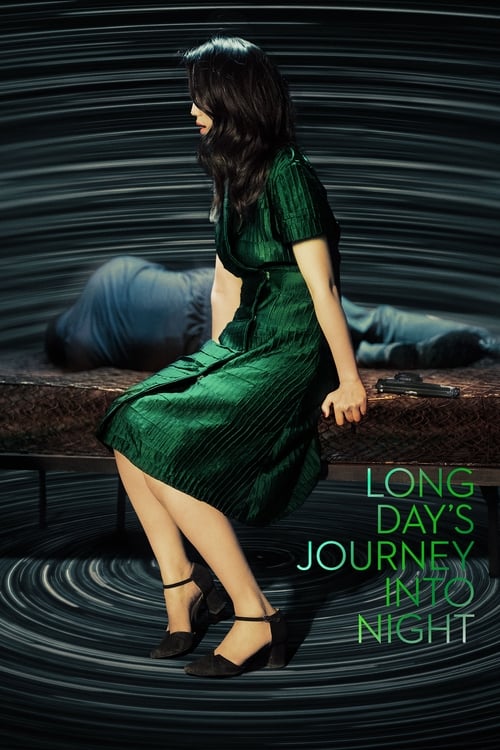
Long Day's Journey Into Night
2018 · Bi Gan
Resurrection's Cannes special prize confirmed him as art cinema's great showman — the one whose hour-long 3D takes make cinephiles book flights. "Event cinema for the Letterboxd 4.5 crowd."
For a late night alone when you want to surrender to atmosphere instead of following a plot — when an old love is on your mind and you want a film that feels the way missing someone feels. This is a challenge-and-reward watch, not comfort viewing.
What it's about
After years away, Luo Hongwu comes back to Kaili, the rain-soaked hometown he once fled, following his father's death. He starts hunting for a woman he loved long ago and never got over, working from scraps of memory that may not be reliable. The search pulls him through pool halls, tunnels, and ruined buildings where the past and present blur into each other.
The experience
Slow, humid, and hypnotic — less a mystery you solve than a dream you sink into. The first half drifts through fractured memories; the second half becomes one long, floating passage through a night town that feels like walking inside someone else's longing. You come out of it dazed, the way you do after sleeping in the afternoon.
Performances
Tang Wei is magnetic as the woman at the center of Luo's memory — enigmatic and melancholy, playing someone who exists half in reality and half in his imagination, and Huang Jue carries the film's weariness as Luo.
The craft
The second half is one of the great technical feats of recent cinema: an unbroken, hour-long single take that drifts down hillsides, through tunnels, even into the air, originally presented so audiences put on 3D glasses at the midpoint. Every frame drips — neon, rain, wet concrete, a droning romantic score. Demands the biggest, darkest screen you can find; on a laptop half its spell evaporates.
Why it matters
It became a landmark of contemporary Chinese art cinema and a genuine cultural event at home, where a bold marketing push sold an avant-garde film to a mass New Year's Eve audience. It confirmed Bi Gan, still in his twenties, as one of the most audacious formal talents anywhere.
Snapshot
Bi Gan's second feature is among the most formally audacious Chinese films of the twenty-first century. Released domestically under its literal title 地球最后的夜晚 (The Last Night on Earth), it was retitled for international distribution as an allusion to Eugene O'Neill's autobiographical play — an apt if imprecise borrowing, since the film shares little of O'Neill's theatrical realism and everything of his subject: time consumed by grief and longing, the self corroded by memory it cannot discharge. Structurally, the film splits into two halves of roughly equal length. The first, shot in conventional 2D, traces Luo Hongwu's fragmented recollections as he returns to the Guizhou city of Kaili following his father's death and resumes his search for a woman named Wan Qiwen. The second half abandons this mode entirely: a single, continuous, fifty-nine-minute take shot in stereoscopic 3D, staging Luo's dream as one unbroken spatial and temporal event. The film premiered at the 2018 Cannes Film Festival in Un Certain Regard and became, on its Chinese theatrical release, the unlikely subject of one of the decade's more instructive marketing controversies.
Industry & production
The film was produced by Huanxi Media (欢喜传媒), a Chinese entertainment company with interests across mainstream and arthouse production. The production budget was modest by the standards of Chinese commercial cinema, though the technical requirements of the long-take second half — crane rigs, a steadicam operator navigating a cave, coordination across multiple locations in a single night shoot — made it a logistically complex undertaking. Bi Gan wrote the screenplay himself, continuing the practice he established on Kaili Blues (2015) of working from autobiographical and locally rooted material; the film is again set in and around Kaili, the Guizhou town where he was born and raised.
The Chinese theatrical release on New Year's Eve 2018/2019 was accompanied by an aggressive social media campaign positioning the film as a romantic countdown experience: audiences were encouraged to enter the cinema at 11 p.m. and emerge, having lived through the film's dream, into the new year. The campaign went viral and drove an extraordinary opening day — estimates placed first-day gross in the hundreds of millions of yuan, making it briefly one of the highest single-day earners in Chinese box office history. The subsequent collapse was equally swift. Audiences expecting a conventional romance encountered an experimental art film in the tradition of Tarkovsky and Resnais; online reviews turned hostile almost immediately, and the grosses fell precipitously over the following days. The episode opened a serious public conversation in China about arthouse marketing ethics and audience preparedness.
Technology
The film's defining technological fact is its second half: a single uninterrupted shot lasting approximately fifty-nine minutes, executed in stereoscopic 3D and projected in that format in cinemas. To accomplish this, the production required a camera rig capable of sustained operation across multiple locations — interiors, a cave system, a rain-slicked outdoor pavilion, a snooker hall, a rooftop — with continuous movement linking them. The transition into 3D is theatrically literalized: audiences are instructed, at the changeover point, to put on their 3D glasses, converting the act of viewing from passive reception to conscious physical participation in the passage into dream.
The 3D format in the second half is not used for the pop-out spectacle of blockbuster filmmaking. Instead it constructs depth as an analog of psychological interiority — space that the dreamer inhabits rather than watches. The choice aligns the film's technology with its themes in an unusually precise way. The first half, shot in flat 2D, is the realm of incomplete and unreliable memory; the second, in stereoscopic depth, is the realm of the dream that completes what memory cannot.
Technique
Cinematography
The film's two-part structure corresponds to a division of cinematographic labor, though specific crew credits across the two halves are not always clearly documented in English-language sources and should be treated with care. What is certain is that the long-take second half demanded a different set of technical competencies than the first — sustained Steadicam operation, pre-choreographed blocking across large physical spaces, and the management of stereoscopic depth across a range of lighting conditions, from the natural bioluminescence-like glow of the cave sequences to the artificial light of interiors. The visual language of the first half draws on the shallow-focus, memory-softened aesthetic of Wong Kar-wai's Hong Kong films, with pools of warm artificial light against rain and neon; the second transitions into something more akin to the long, patient deep-focus of Hou Hsiao-hsien or the luminous spatial poetry of Apichatpong Weerasethakul.
Editing
The first half is edited in a fragmented, non-linear mode that presents Luo's memories as overlapping and interpenetrating rather than chronologically anchored. The editing refuses to stabilize a continuous past — scenes fold into one another through match cuts and associative juxtapositions that identify mood and image rather than narrative sequence. The editor's task here is to construct a dreamlike coherence from apparently discontinuous material, so that the viewer arrives at the second half already habituated to a logic of displacement rather than causality. The second half, by definition, contains no editing at all; the cut disappears as an instrument and is replaced by continuous movement through space.
Mise-en-scène / staging
Bi Gan stages the film's first half with a preference for static or slowly drifting frames that allow actors to move through pools of light rather than being tracked by the camera. The milieu — Kaili's rain-slicked streets, derelict interiors, low-lit bars — is built into the staging as a participant rather than a backdrop. In the long-take second half, the mise-en-scène becomes the primary formal element. The camera moves through a cave where a woman dances beside an underground pool, follows a journey by zipline above a sleeping town, enters a snooker hall where a game of billiards proceeds in one continuous arc. These images do not illustrate narrative events so much as accumulate into a spatial poem, each location succeeding the last with the associative logic of dream.
Sound
The sound design is among the film's most carefully considered elements. The first half uses a voiceover in Bi Gan's own words — lyric, first-person, imagistic — that functions less as narration than as a written score superimposed over image. The relationship between voice and image is rarely illustrative; more often, the voiceover comments obliquely, as poetry comments on experience, generating resonance rather than explanation. In the second half, spatial audio becomes central: the continuous take requires the sound to track seamlessly across environments, and the audio design creates a sense of immersive acoustic depth that reinforces the stereoscopic image. Music in the score is used sparingly and atmospherically throughout.
Performance
Tang Wei, one of contemporary Chinese cinema's most internationally recognized performers, plays Wan Qiwen — and also, in the second half, a character named Kaizhen who may or may not be the same woman transposed into the dream. The doubling is typical of Bi Gan's narrative strategy: identity is neither stable nor fully resolved. Huang Jue carries the film as Luo Hongwu with a quality of suspended grief, a man present in body but absent in attention, always partially elsewhere. Sylvia Chang, the veteran Hong Kong actress and director, appears in a supporting role. The ensemble is asked to perform for a camera that often holds them at a remove, allowing behavior to accumulate rather than be punctuated by close-ups.
Narrative & dramatic mode
The film operates in what might be called an oneiric noir mode: it borrows the surface grammar of the classic noir thriller — the return to the scene of an old crime, the fatally beautiful woman, the dead friend, the unreliable narrator — and dissolves it into the logic of dream. Luo Hongwu is an archetypal noir protagonist, but the film is not interested in the genre's usual drive toward revelation and resolution. The "mystery" of Wan Qiwen is not solved; it is inhabited, circled, and finally submerged into the unconscious work of the dream. The dramatic mode is therefore lyric rather than dramatic in the Aristotelian sense: it proceeds by accumulation of feeling and image rather than by complication and reversal of plot.
Genre & cycle
Long Day's Journey Into Night belongs to a loose international cycle of what might be called "slow cinema" or contemplative cinema, associated with filmmakers including Apichatpong Weerasethakul, Lav Diaz, Pedro Costa, and Wang Bing, who prioritize durational experience and spatial immersion over narrative efficiency. Within Chinese cinema specifically, it participates in a renewed tradition of personal, auteurist filmmaking that emerged in the 1990s with the Sixth Generation (Jia Zhangke, Wang Xiaoshuai) and has continued to evolve in the work of younger directors like Bi Gan and Gu Xiaogang. The film is unusual within this cycle for its theatrical self-consciousness — the instruction to put on 3D glasses makes the act of genre-shifting literal and public in a way rarely attempted in art cinema.
Authorship & method
Bi Gan was born in 1989 in Kaili, Guizhou, and studied film at the Shandong College of Arts. His debut Kaili Blues (2015) announced him as a formally precocious director; that film also contained a celebrated long take of around forty minutes, also set in Kaili, and was compared immediately to Tarkovsky and Hou Hsiao-hsien. Bi Gan is the sole credited screenwriter on both features and draws explicitly on autobiographical material — Kaili is his hometown, and the films share actors, locations, and even characters across their diegetic worlds. He has spoken in interviews about his background in poetry, and the voiceover texts in both films read as literary prose poems as much as conventional screenplay narration. His method is one of intensive pre-production, including storyboarding and technical rehearsal for the long takes, combined with a lyric openness to the associative possibilities of image that resists systematic interpretation.
The cinematographer Yao Hung-I, primarily known for his work with Hou Hsiao-hsien (including The Assassin, 2015), is associated with the film's production in the long-take second half, though precise breakdown of cinematographic credits across the two halves has not been definitively established in scholarly literature. The collaboration, if confirmed, would place Long Day's Journey Into Night in direct dialogue with the Taiwanese New Cinema tradition through working relationship as well as influence.
Movement / national cinema
The film positions itself at the intersection of Chinese arthouse cinema and international art-film practice. It is Chinese in its settings, language, and cast, and it was financed and distributed through Chinese industry channels. At the same time, it belongs to a transnational current of contemplative filmmaking that has few specifically national characteristics. Bi Gan's sensibility — lyric, spatial, unconcerned with social or political realism — distinguishes him from the dominant Sixth Generation approach of Jia Zhangke, whose work is centrally occupied with the social textures of post-reform China. Bi Gan's Kaili is a felt place rather than a documented one.
Era / period
The film was released in 2018, a moment when the Chinese film market had become one of the largest in the world and was absorbing an expanding range of content, including arthouse work through dedicated screening circuits. The New Year's Eve marketing event that propelled its opening day represented an attempt to insert arthouse cinema into mainstream commercial event-filmmaking — an experiment that, in its spectacular failure, clarified both the appetite for and the limits of mass arthouse crossover in that market.
Themes
Memory, as Bi Gan handles it, is not a record but a gravitational force — it warps the present without illuminating the past. Luo Hongwu cannot reconstruct Wan Qiwen with any clarity; what he carries is the weight of her, not her image. Time is the film's other obsessive subject: the first half is structured around the impossibility of recovering the past; the second half enacts a different temporal mode, one in which time is slowed to the pace of a dreaming body moving through space. Love and guilt are largely indissociable in the film's emotional register; the dead friend Wildcat (野猫) functions as a figure of the consequence Luo cannot escape, just as Wan Qiwen functions as the desire he cannot complete. Place — Kaili specifically — is not merely setting but an emotional field, a landscape of the unconscious that the film maps with topographic care.
Reception, canon & influence
Critically, the film received sustained positive attention at Cannes and in the international art-film press, with reviewers consistently foregrounding its formal ambition — particularly the long take — and situating it within the tradition of Tarkovsky's Mirror (1975) and Stalker (1979), Resnais's Last Year at Marienbad (1961), and Apichatpong's Tropical Malady (2004) and Cemetery of Splendor (2015). The Tarkovsky comparison is the most frequently cited, and Bi Gan has acknowledged Tarkovsky's influence directly; the spatial and temporal qualities of the long take, its movement through environments that seem both physical and psychological, and the film's refusal of conventional dramatic resolution all bear comparison. Wong Kar-wai's influence is also legible — in the film's color palette, its mood of thwarted romantic longing, its use of pop music as emotional punctuation in the first half.
The domestic critical and popular reception was more divided. The New Year's Eve marketing episode generated widespread resentment, and the film's reputation in China has remained contested in a way it has not internationally. Its long-term canonical position within Chinese cinema has not yet been settled, though it is regularly taught and discussed in Chinese film school contexts.
In terms of forward influence, it is still early to trace the full extent of Bi Gan's impact on subsequent filmmaking. The film's success at Cannes and on the international festival circuit helped consolidate international awareness of a new generation of Chinese arthouse directors. The formal concept of the divided film — a conventional first half giving way to an uninterrupted long take in a different photographic register — has not, to this reviewer's knowledge, been directly imitated in a widely seen subsequent film, though the film's general project of embedding long-take cinema within a commercially viable genre framework (noir, romance) has clear resonance with ongoing debates in global arthouse production. Bi Gan's own next projects, as of this writing, remain the clearest immediate site of his continuing influence.
A Deleuzian reading
There is a moment, roughly an hour into Bi Gan's film, when nothing happens except an instruction.
The full Deleuzian reading of Long Day's Journey Into Night →
Reception
In China it was infamously marketed as a romantic date movie for New Year's Eve 2018 — a record arthouse opening collapsed overnight amid furious audience backlash and cratering user scores. Abroad it premiered to acclaim at Cannes Un Certain Regard, and the 'scam that was actually a masterpiece' story is now part of its legend.
How Long Day's Journey Into Night was received, from release to now →
Influences: the films it descends from and the films it influenced
- Mirror (1975) — Bi Gan directly borrows Tarkovsky's structural model of the lyric voiceover as prose-poem, organizing non-linear memory fragments through associative logic rather than causal sequence, with the narrator's voice hovering over images that refuse to anchor to a single timeline.
- Stalker (1979) — The Zone's logic — a physical environment where forward movement in space is simultaneous inward movement in psyche, and where rules of causality are suspended — directly informs the 3D long take's journey through Kaili as a mind-space that cannot be mapped by ordinary geography.
- Last Year at Marienbad (1961) — Resnais's treatment of hotel architecture as frozen contested memory — rooms and corridors existing in an eternal present that may be fabrication or compulsion — supplies Bi Gan's oneiric casino and the unreliable narrator whose account of past encounters cannot be verified.
- 8½ (1963) — Fellini's device of an autobiographical director-figure whose memories, fantasies, and present-tense experience share identical visual grammar — indistinguishable until retrospectively decoded — informs Bi Gan's refusal to mark memory images as flashback, treating them as fully present-tense occurrences.
- Werckmeister Harmonies (2000) — Tarr's system of extended tracking shots — 39 shots across 145 minutes — through rain-soaked environments that carry the weight of entire social and metaphysical collapse supplies the slow-cinema architectural grammar within which Bi Gan's unbroken long take claims its right to duration.
- In the Mood for Love (2000) — Bi Gan borrows Wong's specific color palette (deep greens, warm ambers, saturated reds in wet streets) and his technique of building romantic longing entirely through withheld rather than shown encounters, with pop ballads deployed as sudden emotional punctuation in an otherwise withholding film.
- Russian Ark (2002) — The first feature-length single-continuous-take film, which used newly available HD digital technology to conduct an architecturally charged spatial memory journey; Bi Gan's appropriation of 3D as an enabling commercial technology for an extended unbroken art-cinema take directly inherits this precedent of recruiting new formats for contemplative ends.
- Tropical Malady (2004) — Bi Gan directly inherits Apichatpong's structural device of the divided film — two halves in different photographic and generic registers, the second abandoning the social-realist logic of the first — as the governing formal principle of his own split between conventional noir first half and oneiric 3D long take.
- Horse Money (2014) — Costa's long takes through labyrinthine spaces simultaneously physical present and haunted past — with a protagonist who moves between waking state and trance without the film marking the transition — directly parallels the spatial logic by which Bi Gan's long take refuses to separate memory from the walk the character is currently taking.
- Goodbye to Language (2014) — Godard's use of stereoscopic 3D not for entertainment spectacle but to generate impossible spatial contradictions — the two eyes receiving irreconcilable images — enabled and legitimized Bi Gan's decision to deploy the same commercial technology as a contemplative art-cinema device for spatial immersion and disorientation.
- Kaili Blues (2015) — The direct technical prototype: a ~40-minute unbroken tracking shot through the same Guizhou locations using the same prose-poem voiceover method and overlapping characters, making this debut the autobiographical and formal rehearsal for every craft solution Bi Gan scales and stereoscopically deepens in the feature's 59-minute take.
- The Assassin (2015) — The likely collaboration of cinematographer Yao Hung-I — Hou's longtime DP — on the long-take second half places the film in direct working-relationship dialogue with Taiwanese New Cinema's contemplative long-take tradition, importing Hou's method of observing gesture and landscape without explanatory cutting.
- Memoria (2021) — Extends the spatial audio problem Bi Gan poses — sound as involuntary, sourceless memory intrusion — into a film where a single mysterious recurring sound is the central formal and narrative event, while contemplative long takes in a specific non-Western landscape serve, as in the 3D take, as the vehicle for a character's involuntary movement through accumulated time.
- Resurrection (2025) — Its celebrated hour-long immersive final take — shot with the same DP, Dong Jingsong — is the single-take experiment Resurrection expands into a whole anthology.
- Cemetery of Splendor (2015) — Both films treat a specific national landscape as a haunted psychic space where sleeping and waking states interpenetrate without clearly marked boundaries, using slow cinema's temporal dilation and a local geography of provincial towns as the means by which national and personal history leak into the present.
- By the Time It Gets Dark (2016) — Adopts a divided and shifting film structure in which identity and temporal logic dissolve across characters in a Southeast Asian slow-cinema context, sharing Bi Gan's debt to Apichatpong and his interest in using film-within-film self-reflexivity to destabilize the boundary between a character's present and their unresolved past.
- Zama (2017) — Both films construct a protagonist suspended in temporal limbo — waiting, geographically displaced from the home they cannot return to — within environments whose sound design renders all surrounding space as psychic rather than merely physical, making the landscape an extension of the character's arrested interiority.
Similar films
- Resurrection (2025) — influence & lineage
- In the Mood for Love (2000) — influence & lineage
- Memoria (2021) — influence & lineage
- Last Year at Marienbad (1961) — influence & lineage
- Taipei Story (1985) — same viewing thread · often watched together
- Kaili Blues (2016) — same viewing thread
- Goodbye, Dragon Inn (2003) — same viewing thread
- An Elephant Sitting Still (2018) — same viewing thread
All the films related to Long Day's Journey Into Night →
Watch it with: curated runs of related films
- Sinophone Slow Cinema — A run of Chinese-language films — Taiwan's New Wave and its mainland and Bi Gan heirs — where time pools and city, family, and memory recur; watch them near each other, from A Brighter Summer Day to An Elephant Sitting Still, for how they rhyme on drift and the weight of the past.