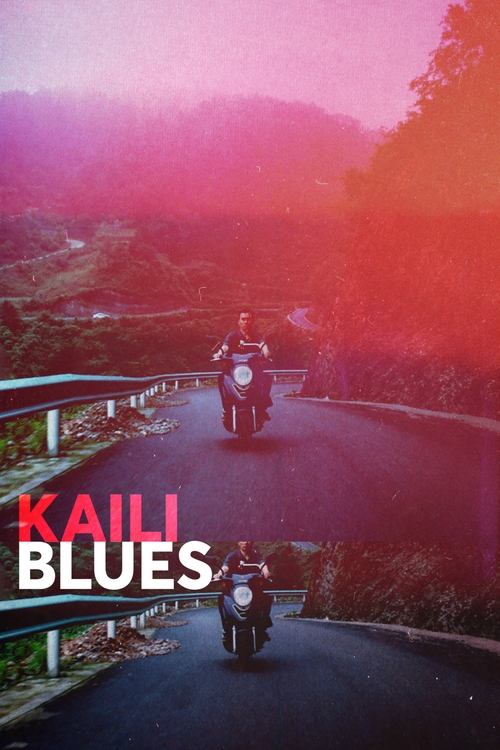
Kaili Blues
2016 · Bi Gan
Resurrection's Cannes special prize confirmed him as art cinema's great showman — the one whose hour-long 3D takes make cinephiles book flights. "Event cinema for the Letterboxd 4.5 crowd."
For when you want a film to chew on for days — something hypnotic to surrender to rather than follow. A challenge, not comfort viewing: best late at night, phone off, when you're willing to drift.
What it's about
A middle-aged doctor in the mist-soaked mountain city of Kaili sets out for a nearby village to deliver medicine and find his young nephew, abandoned by the boy's father. The journey drifts off the map: in the riverside village he passes through, the people he meets seem to belong to his past and his future at once.
The experience
Slow, humid, and dreamlike — less a plot than a current that carries you, until a single unbroken forty-minute shot moves through a village by foot, motorbike, and boat and time quietly comes unglued. It asks patience and repays it with a trance state few films achieve.
The craft
The centerpiece is that forty-minute single take, threading through real village streets and across a river, a logistical high-wire act that turns continuous time into the film's whole subject. Shot in the fog and green of Guizhou province with poetry read over the images, it's tactile, low-budget filmmaking of startling ambition — headphones or a quiet room help it cast its spell.
Why it matters
This debut announced Bi Gan as one of the most distinctive new voices in world cinema and became a touchstone for a younger generation of Chinese art-film directors.
Snapshot
Bi Gan's debut feature is a slow-cinema poem set in the mist-hung mountains of Guizhou province, following a middle-aged doctor named Chen Sheng (Chen Yongzhong) as he travels from the provincial city of Kaili into the nearby village of Dangmai to deliver medicine and search for his estranged nephew Weiwei. The film's structure divides roughly in two: a conventionally edited first act, and a second act consisting of one unbroken take lasting approximately forty minutes, in which the camera moves through Dangmai by foot, motorbike, boat, and aerial cable car, dissolving the boundaries between past, present, and future within a single continuous duration. The film's original Chinese title, 路边野餐 (Lùbiān yěcān), translates literally as "Roadside Picnic" — the same title as the Arkady and Boris Strugatsky science-fiction novel that served as the source for Andrei Tarkovsky's Stalker (1979), an intertextual signal Bi Gan has acknowledged as deliberate. Kaili Blues arrived as one of the most consequential debut features from mainland China in decades, securing its director an immediate international profile and establishing Guizhou — a province rarely seen in prestige cinema — as a vivid new geography of world art film.
Industry & production
Kaili Blues was produced on a remarkably constrained budget for a film of its formal ambition; figures cited in press coverage place it in the range of a few hundred thousand renminbi, making it a genuinely micro-budget independent production by any international standard. Bi Gan shot the film in and around his hometown of Kaili, casting largely from his own extended circle — Chen Yongzhong, who plays Dr. Chen Sheng, is Bi Gan's uncle, a fact that inflects the film's atmosphere of intimate, documentary-adjacent authenticity. The production operated without the backing of a major Chinese studio. Distribution in mainland China followed a limited art-house circuit in 2016, and the film's Chinese theatrical exposure remained modest relative to the critical attention it attracted abroad. Its international profile was consolidated at the Taipei Golden Horse Film Festival, where it competed and where Bi Gan received recognition as a major emerging voice; the film collected awards on the international festival circuit and generated serious critical discussion in Western outlets covering world cinema. The production model — self-financing, hometown crew, family cast, deeply personal geography — aligns Kaili Blues with a strand of Chinese independent filmmaking that sidesteps both the commercial mainstream and the established Fifth and Sixth Generation art-film institutions.
Technology
The forty-minute long take that constitutes the film's second half was shot on a digital camera; the production did not use 35mm film. The choice of digital acquisition was partly pragmatic — the budget precluded the cost of film stock — but it also suits the film's tonal quality. The image has a certain softness and grain-like texture that Bi Gan and cinematographer Wang Tianxing cultivated in post, giving the film a sensory register closer to analog memory than to the clinical sharpness of high-resolution digital capture. The long take posed significant logistical challenges: the camera had to move continuously through exterior and interior spaces, transition between modes of conveyance, accommodate live performance of a song, and remain stable on water. The use of a Steadicam rig and, during the boat passage, a handheld or gimbal-assisted configuration required meticulous choreography of actors, extras, and camera operators across real topography. Unlike the digital long takes of contemporaries working with higher budgets, the Kaili Blues sequence was achieved without elaborate crane or drone infrastructure. The film's sound design, discussed below, was substantially crafted in post-production.
Technique
Cinematography
Wang Tianxing served as cinematographer, and the visual language of the film belongs to the tradition of slow cinema: extended takes, minimal camera movement in the conventionally edited first section, and a preference for wide and medium-long framings that place characters within landscape rather than isolating them against it. Light is often diffuse — Guizhou's characteristically overcast, humid atmosphere provides a natural diffusion that gives the film its pallid, dreamlike quality. The forty-minute take is the film's supreme technical achievement. Within it, the camera performs a sustained journey through Dangmai's streets, interiors, waterways, and hillsides without a single cut. The shot is choreographed to accommodate temporal shifts: characters encountered in one moment reappear in different configurations, and the viewer gradually understands that the camera is not simply traversing space but navigating time. The sequence recalls the procedural logic of Tarkovsky's famous long takes — particularly the seven-minute steadicam shot in The Sacrifice (1986) and the traverse of the Zone in Stalker — but is embedded in a specifically Chinese material and cultural context. The camera's movement through the shot is neither ostentatious nor strictly functional; it has the rhythm of a person walking, remembering, half-dreaming.
Editing
The editing of the first half of the film is deliberate and elliptical, with scene transitions that do not follow classical continuity logic. Bi Gan cuts in ways that suggest memory's associative jumps rather than the linear advance of narrative causality. The film's most radical editing statement is, paradoxically, the refusal to edit at all in the second half. The single continuous take makes the join between the film's two halves feel like a structural rupture, a shift in ontological register. The edited first section functions almost as preparation or prologue; the unbroken take is the film's true proposition about time, consciousness, and cinema's capacity to model both simultaneously.
Mise-en-scène / staging
Bi Gan stages his actors with a naturalism that verges on non-performance, particularly in scenes between Dr. Chen and the incidental figures he encounters. The settings are entirely real locations in Kaili and Dangmai — barbershops, clinics, river banks, hillside paths — and the film makes no effort to dress them into cinematic idealization. Objects carry symbolic weight without being schematically arranged: a caged bird, a photograph, a clock stopped at a particular hour. The staging during the long take requires characters to perform across long durations without the safety net of additional takes covering the same moment from multiple angles. A singer performs a song in the sequence; her performance had to be timed precisely to the camera's arrival at and departure from her position. The live coordination of this kind of staging — actors, extras, vehicles, water — across real landscape is one of the production's most significant achievements.
Sound
Sound in Kaili Blues is one of its most complex and least-discussed dimensions. The film was not recorded with sync sound throughout; like many low-budget productions working in noisy real environments, portions of the dialogue and ambient texture were rebuilt or replaced in post-production. Bi Gan uses music sparingly and pointedly: folk songs associated with the Miao culture of Guizhou appear at particular moments, and the song performed within the long take serves as both a realistic element (a woman simply singing) and a lyric punctuation of the sequence's temporal drift. The ambient soundscape — rain, water, distant voices, the hum of a motorbike — is mixed to reinforce the film's atmosphere of submersion in place and memory rather than to advance narrative information. Sound, like image, is used as a medium of duration rather than causality.
Performance
Chen Yongzhong's performance as Dr. Chen Sheng is minimalist without being affectless. He carries the weight of the film's backstory — a sister's death, a failed marriage, an estrangement from his brother — without melodramatic explication. The character is largely reactive, moving through a world that keeps producing figures from his past and anticipations of his future. The non-professional or semi-professional quality of much of the supporting cast contributes to the film's documentary texture. Bi Gan's decision to cast his own uncle in the lead is consistent with the deeply autobiographical grain of the project; Kaili is Bi Gan's own city, and the film's emotional landscape is inseparable from a personal relationship to the place.
Narrative & dramatic mode
Kaili Blues operates in a mode best described as lyric cinema or cinematic poetry rather than narrative film in any conventional sense. The first half establishes a rudimentary plot situation — Chen Sheng will travel to Dangmai — but the film's interest is never in the resolution of that situation. The long take abandons the plot's forward pressure entirely, entering instead a durational present tense that is simultaneously past and future. Bi Gan has spoken about writing poetry as his primary creative practice before filmmaking, and the film is structured according to lyric rather than dramatic principles: image, sound, and duration accumulate resonance rather than building toward revelation or catharsis. The narrative's apparent subject — a search for a missing nephew — becomes a pretext for something closer to meditation on time, loss, and the persistence of place in memory. The film does not resolve its nominal drama so much as dissolve it into landscape.
Genre & cycle
Kaili Blues belongs to the international slow cinema movement that emerged as a critical and curatorial category in the 2000s and 2010s, associated with filmmakers such as Béla Tarr, Carlos Reygadas, Lav Diaz, Albert Serra, and Pedro Costa. Within mainland Chinese cinema, the film occupies a specific position: it is neither a commercial genre film nor a product of the established independent documentary tradition of the early 2000s (associated with directors like Wang Bing or Zhao Liang), but a work of avant-garde art cinema with explicit international film-historical ambitions. It can also be placed within a regional Chinese cinema cycle — films set in the peripheral, non-metropolitan provinces of southwest China, where landscapes of post-industrial melancholy and minority cultural survival have attracted a small number of serious filmmakers. The film's interest in Miao cultural presence and the specific geography of Guizhou gives it an ethnographic dimension, though Bi Gan is not approaching his material as an outsider documentarist.
Authorship & method
Bi Gan was born in 1989 in Kaili and is self-taught as a filmmaker, having attended Sichuan Normal University with a film-related major but formed primarily through the study of films and through his practice as a poet. He wrote, directed, and composed some of the film's music, functioning as an auteur in the full sense. His method is deeply personal: working with family members, in his hometown, on stories drawn from his own experience and interior life. Wang Tianxing as cinematographer was a close collaborator rather than a hired technician; the visual language of the film reflects a shared sensibility developed over the course of a close working relationship. The film was edited by Bi Gan in close collaboration, though the record on the editing credit is less detailed in available sources. The film's literary dimension — its use of intertitles, its relationship to Bi Gan's own poetry, the structural parallel between the verse and prose sections that some critics have noted — reflects an authorial practice that moves between media.
Movement / national cinema
Kaili Blues arrives from mainland China but sits outside the dominant institutional and commercial structures of Chinese cinema. It is not a Fifth Generation film (associated with directors like Zhang Yimou and Chen Kaige, trained at the Beijing Film Academy in the post-Cultural Revolution period) and not strictly a Sixth Generation film (associated with directors like Jia Zhangke and Wang Xiaoshuai, working in a realist mode often focused on urban modernity and social change). Bi Gan represents something sometimes called a "New Wave" within Chinese independent film — younger directors working with digital tools, micro-budgets, and a more explicitly internationalized film-historical consciousness, less focused on the social-realist documentary impulse of the Sixth Generation. The film's Guizhou setting connects it to a strand of provincial and regional Chinese filmmaking that deliberately refuses the Beijing-Shanghai axis of mainstream Chinese cultural production. It should also be understood in relation to Taiwanese slow cinema — Hou Hsiao-hsien's long-take tradition is a clear ancestor — and to the broader international slow cinema field.
Era / period
The film was shot and completed in approximately 2014–2015 and released in Chinese theaters in 2016, placing it within a specific moment of Chinese cultural politics: a period of tightening censorship and increasing pressure on independent filmmakers to work within state-approved channels, but also a moment of genuine international curiosity about Chinese art cinema. The film's success on the festival circuit, and the critical attention it attracted, opened space for Bi Gan's subsequent work. It was made during the ascendancy of streaming platforms in China, which had begun to reshape distribution patterns for films that could not compete in mainstream theatrical release.
Themes
The film's central preoccupations are time, memory, and the relationship between the living and the dead. Dr. Chen moves through a landscape saturated with the traces of his dead sister and his estranged relationships; the long take enacts a model of time in which past and future coexist with the present as simultaneous experiential realities rather than sequential positions. Place — Kaili, Dangmai, the rivers and hills of Guizhou — is not merely setting but a storage medium for human feeling and memory. The film meditates on stasis and drift: characters who have failed to move on, communities that persist at the margins of modernization, a doctor whose vocation is care but whose personal relationships are broken. Bi Gan's use of the Roadside Picnic title invokes the Strugatsky brothers' concept of the Zone — a space in which normal rules of physics and causality are suspended — as a figure for the film's own temporal logic. There is also an ecological and cultural dimension: the Miao cultural landscape of Guizhou appears in the film not as spectacle but as a living context, though Bi Gan does not develop this into explicit thematic argument.
Reception, canon & influence
Influences on the film (backward): Tarkovsky is the most frequently cited influence, and the most legible — the Zone logic, the long take as spiritual duration, the preoccupation with memory and elemental landscape. Béla Tarr's model of extended duration as moral and aesthetic stance (particularly Sátántangó and The Turin Horse) is a clear structural precedent. Hou Hsiao-hsien's approach to long takes within specifically Chinese cultural landscapes is relevant, as is Edward Yang's non-linear memory structure. Wong Kar-wai's treatment of time as subjective and sensory rather than objective has been noted by critics. Alain Resnais's films about memory and temporal non-linearity — particularly Last Year at Marienbad — are an important European precursor. Bi Gan's own practice as a poet inflects the film's lyric structure; he has cited poetry, including classical Chinese verse, as a more significant influence than most of his film-historical predecessors.
Critical reception: The film was received with significant enthusiasm in international art cinema circles, generating serious critical attention in journals and publications covering world cinema. It won prizes on the festival circuit and was singled out by multiple critics as one of the most significant debut features of its year. The forty-minute long take became the focal point of critical discussion — sometimes productively, sometimes at the expense of attention to the film's other dimensions. A minority of critics found the film's difficulty willful or its influences worn too visibly; the majority position treated it as a genuinely achieved work rather than a promising exercise.
Legacy and forward influence: Kaili Blues established Bi Gan as a director of international standing and enabled his second feature, Long Day's Journey Into Night (2018), which was produced on a substantially larger budget and included a fifty-nine-minute 3D long take designed for theatrical exhibition. The second film built directly on the formal and thematic propositions of Kaili Blues while expanding their scale. More broadly, Kaili Blues contributed to the international visibility of a new generation of Chinese art filmmakers working outside studio infrastructure, and it helped consolidate critical and curatorial interest in the slow cinema mode as a site of genuine formal innovation rather than mere homage to established masters. Its demonstration that a forty-minute continuous take was achievable on a micro-budget, and that such a take could carry genuine emotional and philosophical weight, has been noted by younger filmmakers as an enabling precedent. Whether it has had direct stylistic influence on specific subsequent films is difficult to document with precision at this stage; its significance is more properly understood as part of the broader legitimation of slow cinema as a vital contemporary practice within world film culture.
A Deleuzian reading
Somewhere in the village of Dangmai, the camera climbs onto the back of a motorbike and never gets off — not for forty minutes.
The full Deleuzian reading of Kaili Blues →
Reception
It premiered quietly at Locarno in 2015 and won Best Emerging Director, then snowballed by word of mouth as critics and cinephiles discovered its 41-minute long take — within a few years Bi Gan had gone from unknown debut filmmaker to the poster child of a new Chinese arthouse generation.
How Kaili Blues was received, from release to now →
Influences: the films it descends from and the films it influenced
- Stalker (1979) — Tarkovsky's extended steadicam traverse through the Zone — where unbroken takes render duration as spiritual experience and post-synchronized sound creates a dissociative gap between image and heard world — is the most direct formal precedent for Bi Gan's forty-minute take as a mode of inhabiting time rather than representing it.
- Mirror (1975) — Tarkovsky's lyric film structured by a poet's associative logic — in which present, childhood memory, and dream are rendered indistinguishable within the same visual texture without conventional transitions — is the formal model for Kaili Blues' temporal dissolution and Bi Gan's poet-as-filmmaker mode.
- Sátántangó (1994) — Tarr's deployment of multi-minute steadicam takes following characters through landscape as a philosophical declaration that shot-length is a moral stance — not a stylistic choice — is the structural precedent for Bi Gan's conception of the continuous take as a way of inhabiting duration rather than depicting it.
- The Turin Horse (2011) — Tarr and Hranitzky's achievement of extreme sustained duration on near-micro-budget conditions, using natural diffuse window light as the sole cinematographic tool and refusing artificial illumination, directly models Bi Gan's use of available light and minimal equipment to sustain a long take without studio infrastructure.
- Flowers of Shanghai (1998) — Hou's extended single-setting takes in which the camera moves autonomously and slowly, reframing independently of dramatic action within a specifically Chinese cultural and linguistic space, and his elliptical editing that implies temporal passage without marking it, are the nearest Chinese-language formal precedents for Kaili Blues' visual language.
- Last Year at Marienbad (1961) — Resnais and Robbe-Grillet's formal proposition that past, present, and possible futures are indistinguishable in the photographic image, realized through post-synchronized narration that floats free of the image track, is the European modernist precedent for Kaili Blues' temporal dissolution and its voice-over's ambiguous relationship to what we see.
- In the Mood for Love (2000) — Wong's use of diegetic music as a sensory trigger that collapses temporal distance — the repeated Shigeru Umebayashi theme as involuntary memory device — is operative in Kaili Blues' Miao folk song sequences, where regional music anchors the film in a specific cultural memory while also dissolving temporal boundaries.
- Goodbye, Dragon Inn (2003) — Tsai's model of extreme long takes in a decaying public space where ambient sound (projector hum, rain, footsteps) largely displaces dialogue, and where the location itself functions as a memory-space for a vanishing cultural form, is the closest Chinese-language slow cinema precedent for Bi Gan's approach to location, duration, and ambient sound design.
- Tropical Malady (2004) — Weerasethakul's invention of the bipartite split — a realist first half followed by a mythological second half in which the same characters are reconstituted in a different ontological register without transition or explanation — is the most precise structural precedent for Kaili Blues' two-part form, where the prose section gives way to the poem-section long take.
- Yi Yi (2000) — Edward Yang's elliptical associative editing, which rhymes images and situations across temporal registers without conventional scene-setting transitions, and his treatment of the city as an archive of personal memory accessible only through structural juxtaposition, are the Chinese-language narrative precedents for Kaili Blues' non-linear memory structure.
- Vive L'Amour (1995) — Chinese-language slow cinema of melancholic urban drift built on extended takes and ambient sound, descending from Tsai's durational treatment of longing in dead architectural space.
- Platform (2001) — Carries the provincial-memory-in-duration inheritance — small-town Guizhou time-and-passage rendered in extended long takes — into a younger generation's reworking of Jia's observational drift.
- Long Day's Journey Into Night (2018) — Bi Gan directly extended Kaili Blues' formal proposition into a fifty-nine-minute 3D continuous take designed for theatrical exhibition, adopting stereoscopic format specifically as a technological strategy for intensifying the immersive durational experience his first film had established at micro-budget scale.
- An Elephant Sitting Still (2018) — Hu Bo's four-hour debut adopted the same Chinese independent production model as Kaili Blues — minimal equipment, natural light, restrained non-professional performance, extreme running time as formal stance — substituting telephoto compression for Bi Gan's steadicam immersion as the primary cinematographic device for trapping characters within landscape.
- Resurrection (2025) — Bi's own debut long-take dream-poem fusing memory, folklore and present time is the method-seed that Resurrection scales up.
- Uncle Boonmee Who Can Recall His Past Lives (2010) — Weerasethakul's integration of Isan folk spiritual traditions — the forest as a non-linear space where the dead return and time is reversible — into the structural logic of the film rather than its thematic content is the closest contemporary model for Bi Gan's integration of Miao folk cosmology into Kaili Blues' temporal architecture.
- Syndromes and a Century (2006) — Weerasethakul's bipartite structure in which the same narrative events unfold twice — first in a rural hospital, then in an urban hospital — with no diagetic explanation for the doubling provided a second formal model for Kaili Blues' use of structural repetition and transformation as a way of rendering time as non-linear experience.
- Cemetery of Splendor (2015) — Made the year before Kaili Blues, Weerasethakul's film works the identical lyric-cinema mode: natural diffuse light in a specific regional Thai landscape carries the weight of suppressed historical memory, and the associative structure refuses narrative causality in favor of sensory accumulation anchored by a folk-cultural spatial logic.
- Stray Dogs (2013) — Tsai's penultimate film pushed the long-take method to its extreme, including a sequence of approximately fourteen minutes in which two characters simply stare at a painted mural, demonstrating contemporaneously with Kaili Blues' preparation that extreme duration was still a site of genuine formal discovery in Chinese-language art cinema.
- Dear You (2026) — The same authorial position rather than the same style: a director working in his home dialect with non-professional local performers and negotiated hometown locations, making a place legible to itself on screen instead of importing a national-cinema crew.
Similar films
- Long Day's Journey Into Night (2018) — influence & lineage · same viewing thread
- An Elephant Sitting Still (2018) — influence & lineage · same viewing thread
- Goodbye, Dragon Inn (2003) — influence & lineage · same viewing thread
- Yi Yi (2000) — influence & lineage · same viewing thread
- Syndromes and a Century (2006) — influence & lineage · often watched together
- Uncle Boonmee Who Can Recall His Past Lives (2010) — influence & lineage · often watched together
- Resurrection (2025) — influence & lineage
- Satantango (1994) — influence & lineage
All the films related to Kaili Blues →
Watch it with: curated runs of related films
- Sinophone Slow Cinema — A run of Chinese-language films — Taiwan's New Wave and its mainland and Bi Gan heirs — where time pools and city, family, and memory recur; watch them near each other, from A Brighter Summer Day to An Elephant Sitting Still, for how they rhyme on drift and the weight of the past.