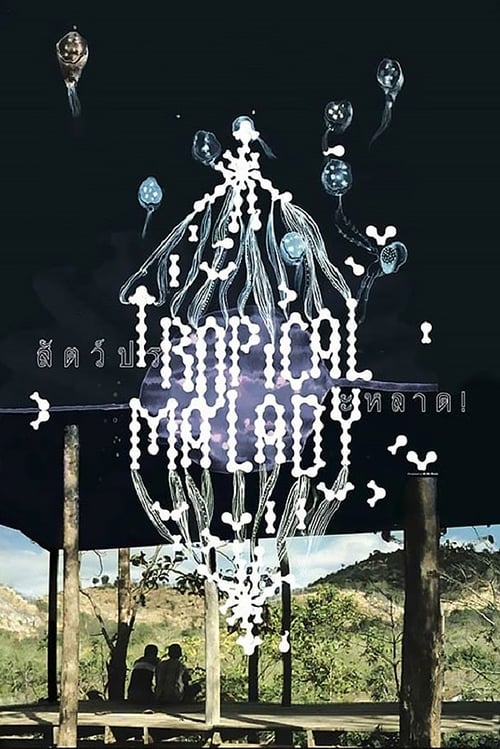
Tropical Malady
2004 · Apichatpong Weerasethakul
Memoria's "one screen at a time, never streaming" release turned distribution itself into an artwork and a permanent debate about access versus aura. The name that signals deepest-end cinephilia.
For when you want a film to chew on for days and don't mind letting go of the wheel — this is a challenge, not comfort food, and it rewards patience and an open mind. Best watched at night, undistracted.
What it's about
A soldier stationed in the Thai countryside falls into a shy, sweet courtship with a young local man — motorbike rides, temple visits, an easy flirtation under the sun. Then, halfway through, the film starts over as something else entirely: a folk tale in which a soldier tracks a shape-shifting shaman, said to become a tiger, alone through the jungle at night.
The experience
The first half is warm and unhurried, all sunlight and stolen glances; the second is nearly wordless and genuinely eerie, the jungle darkness pressing in until desire and dread become the same feeling. It leaves you dazed, in the best way.
The craft
Apichatpong Weerasethakul builds the film as a diptych, two halves that echo and transform each other, and the jungle passages are a feat of sound and darkness — insect drone, breath, and shapes at the edge of visibility. It demands a dark room and good speakers; on a phone it simply won't work.
Why it matters
The Jury Prize at Cannes in 2004 made Weerasethakul a major figure in world cinema and turned this into a touchstone for filmmakers blending myth, landscape, and queer desire.
Snapshot
Tropical Malady (Thai: Sud Pralad, สัตว์ประหลาด, literally "monster" or "strange beast") is the third feature by the Thai filmmaker and artist Apichatpong Weerasethakul, and the film that consolidated his international reputation when it won the Jury Prize at the 2004 Cannes Film Festival. It is structured as a diptych: a first half traces a tender, halting courtship between a provincial soldier, Keng (Banlop Lomnoi), and a younger country man, Tong (Sakda Kaewbuadee), in the small towns and roadsides of rural Thailand; a second, almost wordless half rewrites the same material as folk legend, sending a soldier alone into the jungle at night to track a shaman who can take the form of a tiger. The film fuses gay romance, ethnographic naturalism, and Thai animist myth into a single structure whose two panels rhyme without explaining one another. It remains one of the defining works of "slow cinema" and of art cinema's early-2000s turn toward Southeast Asia.
Industry & production
The film was made through Apichatpong's own Bangkok-based company, Kick the Machine, the production banner he had used since Mysterious Object at Noon (2000), in partnership with European art-cinema financiers. Like much of his work of the period, it was an international co-production drawing on Thai, French, German, and Italian sources — the kind of pan-European/Asian arthouse financing assembled through festival markets and co-production funds rather than through commercial Thai studios. The French producer Charles de Meaux and his company Anna Sanders Films were among Apichatpong's principal collaborators in this period; the exact roster of co-producers and funds is a matter for the credits, and I will not reconstruct figures I cannot verify.
Crucially, the film was made entirely outside the mainstream Thai film industry, which in the early 2000s was oriented toward genre product (horror, romantic comedy, period epics such as those around Suriyothai). Apichatpong's cinema was, and remained, marginal at home: his films were screened little in Thailand and would later run into direct conflict with state censorship, most famously when Syndromes and a Century (2006) was cut by Thai censors, prompting the filmmaker's public "Free Thai Cinema" campaign. Tropical Malady belongs to a body of work whose economic and cultural base was the European festival circuit rather than the domestic box office; precise theatrical grosses are not the relevant metric and are not reliably documented.
Technology
Tropical Malady was shot photochemically on film, consistent with Apichatpong's practice in this era and with the grainy, available-light texture of the image. (I will not assert a specific gauge — accounts vary, and the credit is the safer authority than my memory.) The film's technological signature is not a matter of novel equipment but of method: long takes, natural and practical light, location sound, and a willingness to let the camera sit at the edge of legibility. The decisive technical gamble is the second half, much of which unfolds in genuine forest darkness, the image reduced to faint moonlit shapes, glowing animal eyes, and the grain of underexposed night photography. Apichatpong pushes the medium toward the threshold of visibility, asking the photochemical image to hold barely-there information — a choice that is as much aesthetic as technical, and one that the digital projection of later years has sometimes struggled to preserve.
Technique
Cinematography
The two halves are shot in markedly different registers. The first is bright, green, and humid — daylight exteriors of roads, fields, a hospital, a temple, a cinema, photographed in loose, observational framings that let actors move within the shot rather than cutting around them. The camera favors medium-long takes and a patient, slightly detached middle distance. The second half inverts this entirely: it is a nocturnal film of silhouettes, torchlight, and near-total blackness, where the frame must be scanned for movement. The film carries multiple cinematographer credits, a collaborative shooting practice typical of Apichatpong's productions; I won't attach individual names to individual sequences without the credit in front of me. What is unmistakable is the deliberate tonal split — the courtship is lit like memory, sunlit and soft; the hunt is lit like a dream or a fever, where vision itself becomes the drama.
Editing
The editing — by Lee Chatametikool, Apichatpong's long-standing editor and one of the most important figures in contemporary Thai and Southeast Asian art cinema — is built on duration and the long take rather than on rhythmic cutting. Within scenes, shots are held well past conventional dramatic need, so that gesture, weather, and ambient life accrue meaning. The film's most radical editorial decision is structural: the abrupt caesura roughly midway, where the first story simply stops, the screen goes dark, and an intertitle introduces the second tale. The two halves are joined not by causal continuity but by montage at the largest scale — the cut between panels is the film's central formal idea, forcing the viewer to read the second half against the first.
Mise-en-scène / staging
Apichatpong stages life at the threshold between the everyday and the uncanny. The first half is full of mundane, documentary-feeling settings — a truck, a dog, a roadside meal, a country cinema, a cave shrine visited as a tourist outing — within which the romance is conveyed through small physical courtesies: a hand, a shared earphone, a walk. The staging is anti-theatrical; nothing is underlined. The second half strips the mise-en-scène to essentials — a man, a forest, a trail, animals — and lets the natural world become the set. Recurring motifs (animals, the jungle, light in darkness, the doubling of characters across the two parts) do the work that plot ordinarily would. The film's "monsters" are staged not as effects but as presences felt at the edge of the frame.
Sound
Sound is arguably the film's most important sensory channel, especially once the image recedes into darkness. The second half relies on a dense, naturalistic field of jungle sound — insects, wind, animal calls, footsteps — so that the viewer, like the hunting soldier, navigates by ear. Dialogue all but disappears; the drama is carried by ambient texture and by the few stylized interventions (a talking animal, a voice in the dark) that the folk-tale frame licenses. The first half, by contrast, admits popular music and the sounds of social life. Apichatpong characteristically uses pre-existing songs and location sound rather than a continuous orchestral score, and I won't credit a composer I cannot confirm; the film's "music" is better described as its engineered soundscape.
Performance
The two leads, Banlop Lomnoi as Keng and Sakda Kaewbuadee as Tong, give performances of studied naturalism — shy, understated, built on glance and hesitation rather than declaration. Their nonprofessional or near-nonprofessional ease is central to the first half's documentary warmth; the attraction reads as real partly because neither actor "plays" desire in a conventional dramatic key. Sakda Kaewbuadee in particular became a recurring presence in Apichatpong's cinema, and Banlop Lomnoi would return to the director's work years later. In the second half the same bodies are recast as archetypes — hunter and spirit — and the performance mode shifts from social realism to something closer to ritual: physical, silent, mythic.
Narrative & dramatic mode
The film's defining feature is its bifurcated narrative. The first half is a realist romance in the slow-cinema mode: episodic, undramatic, accumulating intimacy through duration. The second half abandons psychological realism for the form of a folk legend, complete with explanatory intertitles, in which a soldier pursues a tiger-shaman through the jungle and is gradually drawn into a confrontation that is also a seduction and a dissolution of self. The relationship between the panels is left productively unresolved: the second tale can be read as the first's myth, dream, memory, afterlife, or unconscious — the jungle as the psyche of the love story. This refusal of a single explanatory frame is the film's dramatic engine. It treats narrative not as a chain of causes but as two transparencies laid over each other, meaning emerging from their overlap.
Genre & cycle
Tropical Malady sits athwart several genres without belonging to any. It is a queer romance, a jungle adventure, a folk-horror/fantasy, and an art-film essay on desire, and it activates each only to suspend it. It belongs most coherently to the international cycle of early-2000s "slow cinema" / contemplative art cinema — the festival lineage associated with Tsai Ming-liang, Hou Hsiao-hsien, Lisandro Alonso, and others — and to a Southeast Asian new wave that gained festival visibility in the same years. Within Apichatpong's own filmography it is part of a personal cycle of doubled, bipartite structures: Blissfully Yours (2002) with its delayed credit sequence and Syndromes and a Century (2006) with its mirrored halves both rhyme with Tropical Malady's diptych form.
Authorship & method
Tropical Malady is a strong instance of art-cinema auteurism, bearing Apichatpong Weerasethakul's signature in nearly every dimension. Born in Bangkok in 1970 and raised in Khon Kaen in the northeastern Isan region — the rural, working-class milieu that recurs throughout his films — he trained first as an architect at Khon Kaen University before taking an MFA in filmmaking at the School of the Art Institute of Chicago. That dual background, in spatial design and in American experimental/structural film, informs his cinema's combination of patient observation, gallery-art sensibility, and folk-cultural rootedness; he is equally a maker of feature films and of installation and short-form work in the art world.
His method is collaborative and accretive: he works repeatedly with the same performers (Sakda Kaewbuadee here, later Jenjira Pongpas and others) and the same key crew, most importantly editor Lee Chatametikool, whose handling of duration is integral to the films' rhythm. Apichatpong typically writes and directs, builds films around landscape, memory, dream, and animist belief, and favors nonprofessional actors and real locations in Isan and the Thai countryside. Tropical Malady's second-half legend draws on Thai folk and animist traditions of spirit-animals and shamanic transformation; the director has framed his cinema as deeply tied to such belief systems and to the textures of provincial Thai life. Specific collaborator credits beyond editor Lee Chatametikool — the multiple cinematographers and the sound team — are best taken from the film's own credits, which I won't paraphrase into false precision.
Movement / national cinema
The film is a landmark of the Thai art-cinema new wave of the late 1990s and 2000s, a movement that emerged alongside but apart from Thailand's commercial revival of the same period. While directors like the Pang brothers and Nonzee Nimibutr brought Thai genre cinema to international markets, Apichatpong — together with peers such as Pen-ek Ratanaruang in his more experimental mode — represented an avant-garde, festival-facing tendency rooted in personal memory and regional (especially Isan) identity rather than national-commercial spectacle. Internationally, Tropical Malady was received as part of a broader Southeast Asian and East Asian "contemplative cinema" wave that European festivals were actively championing in the early 2000s. Its position vis-à-vis the Thai state was oppositional: Apichatpong's later censorship battles make clear that his cinema's relationship to official national culture was fraught, and Tropical Malady's frank gay romance and animist cosmology stood well outside sanctioned representations of Thai identity.
Era / period
The film is a product of the early-2000s moment when digital tools, co-production financing, and an expanding global festival network briefly opened space for radically slow, non-narrative features to reach international audiences. It arrives at the high-water mark of festival "slow cinema," a few years before the form became codified (and contested) as a critical category. It also belongs to a period of relative openness before the political turbulence and tightened cultural control that would shape Thailand later in the decade — the 2006 coup and the censorship of Syndromes and a Century lay just ahead. Tropical Malady thus marks a hinge: the work that turned a regional experimentalist into a central figure of world cinema, on the eve of the conflicts that would define his public profile.
Themes
The film's governing theme is desire as transformation — love that does not resolve into possession but into a merging and undoing of the self, literalized when the hunter is invited, in the legend, to be devoured and so absorbed by the tiger-spirit. Around this it threads several of Apichatpong's enduring preoccupations: the porousness of the boundary between human and animal, civilization and jungle, waking and dream; reincarnation and the recurrence of souls across forms (the same two men reborn as hunter and beast); memory and doubling as structuring principles; and the spiritual charge of the Thai rural landscape, where animist belief is treated not as superstition but as an operative reality. Queerness is central yet unmarked — the gay romance is presented without crisis or apology — and the film locates the erotic within a larger cosmology in which to love is to risk dissolution into another, and into nature itself.
Reception, canon & influence
At its 2004 Cannes premiere the film was famously divisive — its slowness, its bisected structure, and its near-invisible second half reportedly drew walkouts and incomprehension from some quarters — yet it took the Jury Prize, and its reputation grew rapidly in the years after. Critics, particularly in France (where Cahiers du Cinéma and the broader cinephile press became key champions of Apichatpong), embraced it as a major work, and it recurred on critics' best-of-the-decade lists by the end of the 2000s. It is now widely treated as a canonical work of 21st-century art cinema and as the film that established Apichatpong, ahead of the Palme d'Or he would win for Uncle Boonmee Who Can Recall His Past Lives in 2010.
Looking backward, the film draws on Thai folk and animist storytelling and on the comic-book and popular-culture textures of the director's youth, while its formal lineage runs through structural/experimental film (the influence of his Chicago training) and the durational art cinema of forebears in the long-take tradition. Looking forward, Tropical Malady helped legitimize a whole register of contemplative, ambiguous, structurally bifurcated filmmaking and brought sustained Western critical attention to Southeast Asian art cinema. Its diptych logic and its blurring of realism and myth anticipate Apichatpong's own later features and resonate across a generation of slow-cinema and "festival film" directors who followed. Within his oeuvre it functions as the keystone between the early experiments and the mature, fully realized cosmology of Uncle Boonmee and Memoria (2021). Where the historical record on specific production details remains thin, the critical record is not: Tropical Malady is now firmly established as one of the essential films of its decade.
A Deleuzian reading
Start with the earphone.
The full Deleuzian reading of Tropical Malady →
Reception
At Cannes 2004 it split the room — reports of walkouts and baffled boos at the press screening — yet the jury gave it the Jury Prize; two decades on it's a fixture of best-of-the-21st-century polls and arguably Apichatpong's most beloved film.
How Tropical Malady was received, from release to now →
Influences: the films it descends from and the films it influenced
- Mysterious Object at Noon (2000) — His own exquisite-corpse debut establishes the method of building a film from chained folk storytelling and nonprofessional villagers, blurring documentary record and invented myth that the second half of Tropical Malady then weaponizes.
- Blissfully Yours (2002) — Prototypes the structural caesura by withholding the opening credits until ~45 minutes in, splitting the film at the jungle's edge — the exact bisecting device and available-light forest-picnic naturalism Tropical Malady formalizes into a diptych.
- Cat People (1942) — The Lewton-Tourneur grammar of conveying human-to-predator transformation through underexposed darkness, off-screen sound, and unseen stalking — never the beast itself — directly models the night-jungle tiger hunt of the second half.
- Au Hasard Balthazar (1966) — Bresson's flat, affectless 'models' (nonprofessionals drained of theatrical performance) and his treatment of the animal as a porous spiritual presence underwrite the film's naturalism and human-animal continuity.
- Persona (1966) — The mid-film rupture and the unresolved doubling of two figures who bleed into one another is the structural ancestor of the soldier/spirit pairing split across the two halves.
- Stalker (1979) — The durational walk of two men into a charged wilderness, where long takes let landscape become a metaphysical threshold rather than a backdrop, is the template for the second-half pursuit through the forest.
- Taste of Cherry (1997) — Nonprofessional actors placed in real terrain, durational stretches of movement, and a deliberately open, unresolved ending that refuses narrative closure prefigure Tropical Malady's refusal to reconcile its two panels.
- Goodbye, South, Goodbye (1996) — The Taiwan New Wave long-take aesthetic of available-light naturalism, ambient diegetic soundscape, and drifting non-dramatic duration is a key formal forebear of the film's first-half rhythm.
- Fallen Angels (1995) — Extends Fallen Angels' diptych formal innovation — two parallel strands sharing characters but operating in wholly separate registers that never converge — into a spiritual-realist framework, with the non-verbal performance register and the refusal to resolve narrative asymmetry carried forward as structural principles.
- Days of Being Wild (1990) — The film's formal bisection — a protagonist and narrative dissolve and reconstitute in an entirely new register mid-film — extends WKW's dispersed/vanishing protagonist technique into Southeast Asian mythological cinema, where structural rupture carries ritual rather than psychological weight.
- Werckmeister Harmonies (2001) — A two-part structure where durational long takes replace plot with accumulation of sensory texture, and sound design prioritizes ambient atmosphere over dialogue intelligibility — slow cinema's Southeast Asian branch absorbing the formal inheritance of Tarr's temporal architecture and applying it to Thai folk-spiritual material.
- Satantango (1994) — Apichatpong inherits from Tarr the non-synchronous score and the long take as a vessel for offscreen sound that refuses to anchor its source, deploying extended duration to structurally rupture genre expectation in a way Sátántangó authorized — the film proceeds as though duration itself is the argument.
- Syndromes and a Century (2006) — Takes the Tropical Malady diptych further into an explicit two-panel mirror structure, repeating a story across rural and urban hospital settings — the bisection device now made fully architectural.
- Uncle Boonmee Who Can Recall His Past Lives (2010) — Extends the animist human-animal porousness and the glowing-eyed jungle spirit-creature of the second half into a full cosmology of reincarnation and transformation.
- Tabu (2012) — Builds an explicit two-part structure — a contemporary prologue followed by a mythic, near-silent second movement set in a colonial jungle — adopting Tropical Malady's split between mundane present and legendary register.
- Jauja (2014) — Stages a durational journey into wilderness where the protagonist's identity and the film's reality progressively dissolve, inheriting the desire-as-dissolution arc of the forest half.
- Silent Light (2007) — Carries forward the slow-cinema use of nonprofessional actors and available-light landscape pushed toward transcendence, where a naturalist surface opens onto the miraculous.
- Norte, the End of History (2013) — Embodies the contemplative, extreme-duration register Tropical Malady helped legitimize, fusing patient long-take realism with folk and moral-mythic undercurrents in Southeast Asian art cinema.
- Cactus Pears (2025) — Defines the Global-South queer slow-cinema mode — diegetic ambient soundscapes, attention to non-metropolitan terrain, and tenderness staged in unhurried real time outside the city.
- Kaili Blues (2016) — Weerasethakul's invention of the bipartite split — a realist first half followed by a mythological second half in which the same characters are reconstituted in a different ontological register without transition or explanation — is the most precise structural precedent for Kaili Blues' two-part form, where the prose section gives way to the poem-section long take.
- Long Day's Journey Into Night (2018) — Bi Gan directly inherits Apichatpong's structural device of the divided film — two halves in different photographic and generic registers, the second abandoning the social-realist logic of the first — as the governing formal principle of his own split between conventional noir first half and oneiric 3D long take.
- Zama (2017) — Apichatpong's jungle sensorium, where dense insect/animal sound and ellipsis dissolve linear narrative into a bodily, half-dreamed state, is a key precedent for Zama's soundscape-driven immersion.
- Yuni (2021) — Chatametikool's editing and the film's dissolve of mundane realism into folk-myth prefigure Yuni's superstition-driven ticking-clock structure grafted onto naturalism.
- All We Imagine as Light (2024) — Its nocturnal, dream-porous slide from the observed everyday into a hushed, spectral register licenses Kapadia's coastal night sequence where a comatose man seems to speak and reality loosens.
- The River (1997) — Shares the fixed durational long take in service of near-silent queer longing, where desire is registered through bodies in static space rather than dialogue or plot.
- Mulholland Drive (2001) — A contemporaneously released bisected narrative whose second half re-encodes the first through unresolved doubling, demonstrating the same diptych logic that asks the viewer to read one panel against the other.
- Chungking Express (1994) — Apichatpong's two-part structure—where the second half reconfigures the first's meaning without explaining it, each episode self-contained yet incomplete alone—develops the lyric-episodic bifurcated form in a parallel tradition of Southeast Asian art cinema without deriving from Wong directly.
- Happy Together (1997) — Color and black-and-white deployed at the film's structural midpoint as an ontological register shift; queer male desire organized around a deferred encounter the narrative refuses to resolve — formal parallels to HT's color-alternation device and recursive-repetition structure.
- Only God Forgives (2013) — The bifurcation into two formally distinct halves — the second submitting genre materials to a mythological Thai narrative framework in which a spirit-world logic replaces psychological causality — and the treatment of desire and violence through contemplative duration directly parallels Only God Forgives's structural method of using myth as formal armature rather than theme.
- Cemetery of Splendor (2015) — Fuses documentary capture of rural Isan daily life with deadpan animist supernature inside the same static long-take grammar, the template Cemetery deploys for its goddesses and dreaming soldiers.
- Last Life in the Universe (2003) — Thai New Wave contemporary deploying durational slow cinema and a mid-film structural rupture that destabilizes reality much as Last Life's match-cut warps do.
- Call Me by Your Name (2017) — Cinematographer Sayombhu Mukdeeprom's signature here — languid natural light and humid, sensuous landscape texture — is the same eye he brought to CMBYN's single-lens 35mm look.
- La Ciénaga (2001) — International slow-cinema sibling building enveloping ambient (jungle) sound and refusing the dramatic climax, so environment and off-screen texture replace narrative payoff.
- The Metamorphosis of Birds (2021) — Parallels her layered voice-and-nature sound design, dissolving whispered speech into a dense forest ambience as a single field, and organizes its two-part form around a literal metamorphosis.
- From What Is Before (2014) — Makes the forest an offscreen antagonist through sound alone — a dense insect-and-canopy ambience that does the work a score would, with the threat always just outside frame — the same acoustic strategy Diaz uses for the woods that swallow the barrio's people.
Similar films
- Syndromes and a Century (2006) — influence & lineage · often watched together
- Uncle Boonmee Who Can Recall His Past Lives (2010) — influence & lineage · often watched together
- Cactus Pears (2025) — influence & lineage
- Au Hasard Balthazar (1966) — influence & lineage · often watched together
- Cemetery of Splendor (2015) — shared sensibility
- Memoria (2021) — shared sensibility
- Kishkindha Kaandam (2024) — shared sensibility
- The Mysterious Gaze of the Flamingo (2025) — shared sensibility
All the films related to Tropical Malady →
Watch it with: curated runs of related films
- Desire on Uneven Ground — A run of tender, lopsided intimacies — an outsider fixed on someone just out of reach — that keep slipping from realism into dream, myth, or memory.