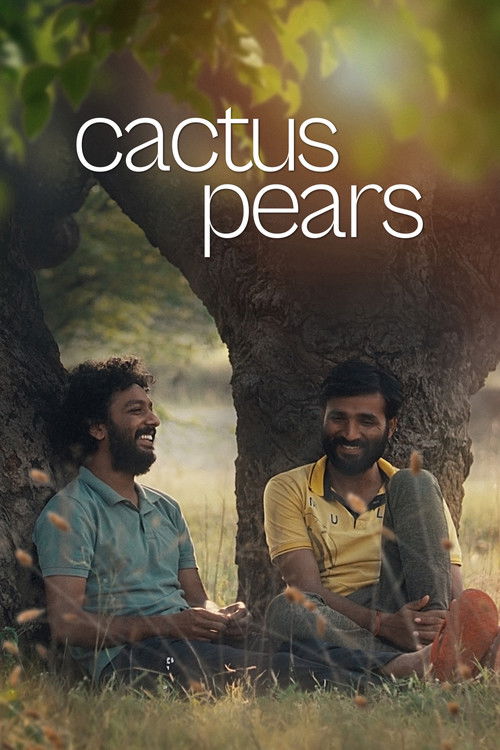
Cactus Pears
2025 · Rohan Kanawade
For a slow, tender evening when you want a grown-up love story told softly — good for when you need to feel something without being put through melodrama. A quiet cry is likely.
What it's about
Anand, a thirty-something call-center worker from Mumbai, returns to his family's village in rural Maharashtra for the ten-day Hindu mourning period after his father's death. There he reconnects with Balya, a farmer and childhood friend quietly fending off his own family's pressure to marry. Out of grief and proximity a tenderness grows — with the end of the ritual, and Anand's return to the city, hanging over every day of it.
The experience
Unhurried, gentle, and quietly devastating — it moves at the pace of the mourning ritual itself, letting intimacy accumulate in shared chores and long walks. It leaves you with equal parts warmth and ache.
The craft
Rohan Kanawade's debut, in Marathi, sets the romance against the drought-hardened landscape of western India and structures the whole film around ritual time — ten days, then a decision. The restraint is the point: no big speeches, just two men finding a language for something their world has no room for.
Why it matters
A landmark for Marathi-language and Indian queer cinema on the international festival circuit, proving a regional-language love story this quiet could travel worldwide.
Snapshot
Cactus Pears — its Marathi title Sabar Bonda, the name of the prickly desert fruit that gives the film its English handle — is a quiet, deliberately unhurried queer love story set against a ten-day Hindu mourning period in rural western India. Anand, a thirty-something call-center worker living in Mumbai, is obliged to return to his ancestral village in the drought-prone interior of Maharashtra to grieve his father; there he reconnects with Balya, a farmer and childhood acquaintance who is quietly resisting his own family's pressure to marry. Out of obligation, proximity and grief, a tender intimacy grows, and the film's central tension is the ticking clock of the ritual itself: when the mourning ends, Anand must go back to the city, and the two men must decide what their relationship can survive. The film is significant beyond its modest scale because of its festival trajectory — it premiered in competition at the Sundance Film Festival in January 2025 and took the Grand Jury Prize in the World Cinema Dramatic Competition, a landmark for a Marathi-language film and for Indian queer cinema more broadly. It marks the narrative-feature debut of writer-director Rohan Kanawade and belongs to a current of regional, small-scale, festival-facing Indian filmmaking that works in the realist register rather than the idioms of mainstream Hindi or Marathi commercial cinema.
Industry & production
Cactus Pears is a product of the international art-cinema co-production circuit rather than of any domestic studio system. It was financed and assembled as a multi-territory independent production drawing on Indian, Canadian and United Kingdom support — the kind of patchwork of soft money, festival labs and producer partnerships that has become the standard route to existence for non-commercial South Asian cinema. The film's path ran through development support and festival-lab attention before its Sundance premiere; the public record on its precise budget, financing breakdown and recoupment is thin, and any specific figures should be treated as unverified. What is clear is the production logic: a first-time narrative feature director working in a regional language, with a small cast and rural locations, made viable by international co-production and festival selection rather than by theatrical pre-sales in India.
The Sundance win materially changed the film's industrial position. A Grand Jury Prize in the World Cinema Dramatic Competition is one of the most valuable launch assets available to a small film, converting an unknown title into a festival-circuit fixture and a candidate for arthouse distribution in multiple territories. For a Marathi-language film, this represented an unusual route to international visibility — historically, Indian films that travel to the top-tier Western festivals have more often been Hindi, Bengali, Tamil or Malayalam works, and Marathi cinema's international profile has rested on a relatively small number of titles. The detailed distribution roll-out, sales-agent arrangements and any domestic Indian release plan are matters where the precise record is still incomplete at the level of confirmable fact.
Technology
Cactus Pears is, on the available evidence, a digitally originated film made with the lightweight, high-sensitivity tools that define contemporary low-budget realist production: small-sensor-to-full-frame digital capture, naturalistic available-light or minimally augmented lighting, and post-production finishing in a standard digital pipeline. The aesthetic is one of restraint rather than technological display — there is no reliance on visual effects, elaborate camera rigs or formats chosen for spectacle. The specific camera bodies, lenses and capture format used on the production are not reliably documented in the public record, and it would be inventing to name them. What can be said with confidence is that the film's technological choices are subordinated entirely to a naturalist program: the technology is deployed to disappear, to let rural light, weather and faces register without stylistic intervention.
Technique
Cinematography
The film's visual language is patient and observational. Its cinematography — credited to Vikas Urs, whose involvement is part of the film's identity as a regional-realist work — favours composed, often static or slow-moving frames that hold on the textures of the rural landscape: the parched fields, the rocky scrub, the cactus from which the title's fruit grows. The grammar is one of distance and duration rather than coverage and cutting; the camera tends to observe the two men within their environment rather than isolating them in tight close-up, so that the geography of the village, with its open spaces and few hiding places, becomes a structuring presence in the love story. Natural light and a muted, earthbound palette reinforce the documentary-adjacent texture. This is a cinematography of withholding — intimacy is conveyed through the gap between bodies in a wide shot as much as through proximity — and it aligns the film with the contemplative wing of contemporary world cinema rather than with the heightened visual style of mainstream Indian production.
Editing
The editing serves duration and patience. Scenes are allowed to run, conversations to breathe, and the rhythm is calibrated to the ten-day ritual structure that organizes the narrative — a countdown that the cutting honors by refusing to rush. Rather than compressing time, the film lets the mourning period accumulate, so that the growing closeness between Anand and Balya feels earned by lived hours rather than by montage. The precise editorial credit and any account of the cutting process are not something I can attribute reliably, and I won't manufacture a name. The effect, however, is legible: an editing strategy of accretion and restraint, where the emotional turns land because the film has taken the time to make them inevitable.
Mise-en-scène / staging
Staging is the film's quiet strength. The rural setting is not backdrop but dramatic apparatus: the village's openness, the constant presence of relatives during a mourning, the lack of privacy, all press on the lovers and shape where and how they can be together. Domestic interiors — the family home, the spaces of ritual — are crowded with the obligations of grief and kinship, while the fields and the margins of the village become the only zones where intimacy can be staged. The mise-en-scène thus dramatizes the central problem of the film spatially: queerness has to find its room within a landscape and a social order that leave little of it. Props and gestures are kept ordinary — food, water, work, the rituals of mourning — so that the eroticism and tenderness emerge from the everyday rather than being signposted.
Sound
The soundscape is naturalistic, built from the ambient texture of the countryside — wind, insects, livestock, the sounds of agricultural work and domestic ritual — rather than from an assertive score. In keeping with the realist mode, music is used sparingly if at all, and the film leans on quiet and on the human voice. I cannot reliably attribute a composer or sound-design team for this title, and will not invent one; what is evident from the film's overall method is a preference for diegetic, environmental sound that keeps the viewer inside the lived reality of the village and refuses the emotional underlining that a conventional score would supply.
Performance
Performance is where the film's restraint pays its highest dividend. The two leads — Anand and Balya — are played in a low-key, interior register that depends on glance, withholding and small physical adjustments rather than on declamation. The roles are reportedly carried by actors working in a naturalist idiom (Bhushaan Manoj as Anand and Suraaj Suman as Balya are the names associated with the leads, though readers should treat exact casting attributions as subject to confirmation). The performances must do delicate work: convey desire that the social world forbids being spoken, register grief and attraction in the same scenes, and make the audience feel the asymmetry between a city man who can imagine leaving and a farmer bound to the land. The supporting performances — particularly the mothers and relatives who embody the marital pressure and the rituals of mourning — anchor the film's social realism.
Narrative & dramatic mode
The dramatic mode is realist chamber drama operating under a ritual deadline. The ten-day mourning is the film's clock and its frame: it gathers the characters in one place, imposes a finite duration, and guarantees a forced separation at its end. This structure converts a slow-burn romance into something with quiet suspense — not the suspense of plot mechanics but of whether and how the relationship can outlast the ritual that incubated it. The narration is observational and elliptical, trusting the viewer to read subtext, and it resists melodrama: there is no villain, no public catastrophe of exposure, only the steady pressure of social expectation and the asymmetry of two lives. The film belongs to the tradition of the "minor key" love story, where the drama lies in what is unsaid and in the impossibility of a clean resolution. Its closing dilemma — Anand's decision about the relationship's future — is posed as a genuinely open question rather than resolved with reassurance, which is consistent with the film's refusal of consolation.
Genre & cycle
Formally the film sits at the intersection of romance and social-realist drama, and within a recognizable cycle of contemporary queer cinema from the Global South that treats same-sex desire not as a coming-out spectacle but as a fact negotiated within family, land and tradition. It belongs to a strand of slow, place-rooted gay love stories — works that locate queer intimacy in agrarian or provincial settings and let landscape carry meaning. Within Indian cinema specifically, it is part of a post-2018 wave (following the decriminalization of same-sex relations) of films that move queer narratives out of the urban, English-speaking milieu and into regional languages and rural worlds, insisting that such lives exist outside the metropolis. The film resists the conventions of both Bollywood romance and the issue-driven "social message" film; its cycle is the international festival queer realist drama, with kinship to rural-set love stories worldwide.
Authorship & method
The film is decisively an authorial work. Rohan Kanawade writes and directs, and the project carries the marks of a personal, long-gestated vision rather than an assignment: the specificity of the Marathi rural setting, the intertwining of grief ritual and queer desire, and the autobiographical resonance often associated with the material suggest a director working from lived knowledge of the world depicted. Kanawade's background lies in shorter and documentary-adjacent work before this narrative feature, and Cactus Pears reads as the culmination of that apprenticeship — a first feature with an unusually settled sense of tone and patience.
Among the key collaborators, the cinematographer Vikas Urs is the most clearly identifiable creative partner, responsible for the observational, landscape-attentive image that is inseparable from the film's meaning. The editorial, music and sound credits are not ones I can attribute with confidence from the reliable record, and I decline to invent names for them; the honest position is that the film's authorship is most securely located in Kanawade's writing-directing and in the cinematographic collaboration, with the remaining craft credits a matter for verification. The method throughout is one of restraint, location shooting, naturalist performance and a refusal of stylistic assertion — an auteurism of withholding.
Movement / national cinema
Cactus Pears is a Marathi-language film, and its arrival at the apex of the Western festival circuit is most meaningfully read against the history of Marathi cinema and of Indian regional film. Marathi cinema has a deep and venerable history — it is, by some accounts, the cradle of Indian film — but its contemporary international visibility has been intermittent, carried by a handful of festival breakouts rather than by a continuous presence. The film also belongs to the broader category of Indian "parallel" or independent cinema: the realist, socially engaged counter-tradition to the commercial mainstream, which has long used regional languages and non-star casts to depict ordinary life. By winning at Sundance, the film extends that tradition into the contemporary queer-cinema conversation and demonstrates that Marathi-language work can compete on the same terms as the better-known regional cinemas of India. It is, in that sense, both a national-cinema milestone and a node in a transnational art-film network.
Era / period
The film is firmly of its moment — the mid-2020s, in a period when Indian queer cinema has been able to develop in the years since the 2018 reading-down of Section 377 created legal and cultural room for such stories, and when international co-production and festival labs have become the dominant survival mechanism for non-commercial South Asian filmmaking. It reflects the contemporary global appetite for slow, place-rooted, identity-attentive realist cinema, and the particular salience of queer narratives at the major festivals. At the same time, its rural setting and its grounding in mourning ritual root it in a timeless agrarian India largely untouched by the digital-urban modernity its protagonist inhabits, so that the film stages an encounter between the contemporary city subject and a more enduring village order.
Themes
The film's governing theme is the collision between desire and obligation — between who one loves and what family, kinship and tradition demand. Marriage pressure functions as the social antagonist: Balya's resistance to being married off is the mirror of Anand's, and the institution stands in for the entire apparatus of heteronormative expectation. Grief is the second great theme, and the film's most original move is to braid mourning and eros together, so that the rituals of death become the occasion for new life and intimacy — loss and desire share the same ten days. Place and rootedness form a third axis: the asymmetry between the mobile city man and the land-bound farmer encodes a question about whether love can survive the difference between leaving and staying. Underneath runs a meditation on visibility and concealment — on how queer life finds its narrow room within a world that has no language for it — and on the passage of time, dramatized by the deadline that the film never lets the viewer forget.
Reception, canon & influence
Critically, the film's defining event is its Sundance Grand Jury Prize in the World Cinema Dramatic Competition, which established it immediately as a notable international title and generated the festival momentum that small films depend on. The reception framed it as a landmark for Marathi cinema and for Indian queer film, praised for its tenderness, patience and refusal of melodrama, and welcomed as evidence that regional Indian realist cinema can reach the highest festival tier. A fuller, settled critical canonization is still forming, and detailed accounts of its wider reviews and audience reception should be regarded as developing rather than fixed.
In terms of influences on the film (backward), it draws on the lineage of Indian parallel cinema's realist tradition and on the international current of slow, landscape-attentive queer love stories set outside the metropolis — films that treat same-sex desire as something negotiated within family and rural community rather than declared in the city. Its braiding of mourning ritual with romance connects it to a broader art-cinema interest in time-bound, ritual-structured drama.
Its legacy and forward influence (what it shaped) are necessarily provisional, given how recent the film is, and it would be inventing to claim a measurable lineage so soon. What can responsibly be said is that, as the first Marathi-language film to win its Sundance category, it expands the sense of what regional Indian cinema can attempt internationally and offers a template — rural setting, naturalist method, queer intimacy under social pressure, co-production financing — that other filmmakers working in India's regional languages may follow. Whether that potential hardens into demonstrable influence is a matter for the coming years, and the honest scholarly position is to mark it as a milestone whose downstream effects are not yet written.
A Deleuzian reading
Two men stand in a parched field, and the film keeps them apart in the frame.
The full Deleuzian reading of Cactus Pears →
Reception
A self-financed Marathi debut that nearly collapsed mid-shoot became the first Marathi film ever to play Sundance — and then won the 2025 World Cinema Grand Jury Prize, the first Indian fiction feature to do so. Within a year it went from unknown indie to the Indian arthouse story of 2025.
How Cactus Pears was received, from release to now →
How to watch Cactus Pears: what to notice on a first viewing
- Watch how far apart the camera keeps the two men. Vikas Urs favors wide shots that hold Anand and Balya at a distance within the landscape, rather than cutting to close-ups when they're together. The gap between their bodies in the frame is carrying as much of the romance as any touch would.
- Notice the ten-day mourning period counted out onscreen. The Hindu mourning ritual gives the film a fixed clock from the start, gathering everyone in one place for a duration that has to end. You know from the opening how long this has to last, which is where the film gets its quiet suspense.
- Watch the ordinary chores they do together: food, water, fieldwork. Sharing a meal or drawing water becomes as expressive as any dialogue, small physical acts standing in for feelings the film never states directly. An ordinary chore is doing the work a line of dialogue would do in most other films.
- Listen for wind, insects, and livestock instead of music. The soundscape stays naturalistic and ambient throughout, with almost no score cueing you toward a particular feeling in any given scene. You're left inside the village's real sound instead of being told how to feel by the music.
The whole guide to watching Cactus Pears, with the keys for a rewatch →
Influences: the films it descends from and the films it influenced
- Pather Panchali (1955) — Founds the Indian parallel-cinema grammar Cactus Pears inherits — location shooting, available light, and patient observation of rural domestic routine that lets emotion accrete from gesture rather than dialogue.
- Uski Roti (1969) — Models the elliptical, durational construction — long held frames and withheld narrative information — that Cactus Pears uses to render desire as subtext rather than statement.
- Ankur (1974) — Establishes the feudal-rural social-realist register, dramatizing forbidden intimacy negotiated within caste-and-family obligation through interior, anti-melodramatic performance.
- Brokeback Mountain (2005) — Pioneers landscape-as-apparatus for queer feeling — wide vistas carrying the inexpressible, with desire perpetually pressured by social duty and emotion conveyed through what goes unsaid.
- Tropical Malady (2004) — Defines the Global-South queer slow-cinema mode — diegetic ambient soundscapes, attention to non-metropolitan terrain, and tenderness staged in unhurried real time outside the city.
- Weekend (2011) — Builds a ticking-clock two-hander romance on naturalist long-take conversation and minutely interior performance, the time-bound deadline structure Cactus Pears adapts to a mourning ritual.
- God's Own Country (2017) — Shares the rural queer-romance template of taciturn naturalist performers, hands-on manual labor, and natural-light landscape, with affection earned through restraint and physical proximity.
- The Wound (2017) — Braids same-sex desire with a tradition-bound communal ritual in a Global-South rural setting, using landscape and ceremony as the pressure cooker for clandestine intimacy.
- Aligarh (2015) — An Indian queer drama of withholding — quiet interior naturalism and a refusal of activist declamation that depicts gay life as privately negotiated against social exposure.
- Court (2014) — Marathi social realism built on wide static observational long takes that let scenes play out in real time, framing characters within institutional and environmental space.
- The Disciple (2020) — Extends the Marathi slow-accretion method — sparse cutting, durational scenes, ambient diegetic sound — so meaning gathers across patient, undramatic passages.
- Fandry (2013) — Marathi rural realism using non-professional casting, sun-struck location landscape, and caste-bound social constraint to ground forbidden longing in a specific village world.
- Sairat (2016) — Stages rural Marathi romance as a collision between desire and family/caste obligation, anchoring transgressive love in fields, water and labor rather than urban abstraction.
- Thithi (2016) — Structures a rural drama around a death-and-funeral ritual deadline, using non-professional villagers and observational long takes to let life unfold around the rite of mourning.
- Rafiki (2018) — A Global-South queer love story negotiated within tight community surveillance and family expectation, post-criminalization, foregrounding intimacy under social pressure.
- Moonlight (2016) — Uses elliptical chaptered construction and intensely interior performance to render queer desire constrained by masculine social codes, emotion surfacing in held looks and silence.
Similar films
- Pather Panchali (1955) — influence & lineage
- Brokeback Mountain (2005) — influence & lineage
- God's Own Country (2017) — influence & lineage
- Romería (2025) — same viewing thread
- Kadaisi Vivasayi (2022) — shared sensibility
- Homebound (2025) — shared sensibility
- C/o Kancharapalem (2018) — shared sensibility
- The Mysterious Gaze of the Flamingo (2025) — shared sensibility
All the films related to Cactus Pears →
Watch it with: curated runs of related films
- Home for the Funeral — A run of return-to-the-village films where a death draws someone back to the family they left, and the days of mourning unearth what was buried — old secrets, forbidden desire, the true shape of who's gone.